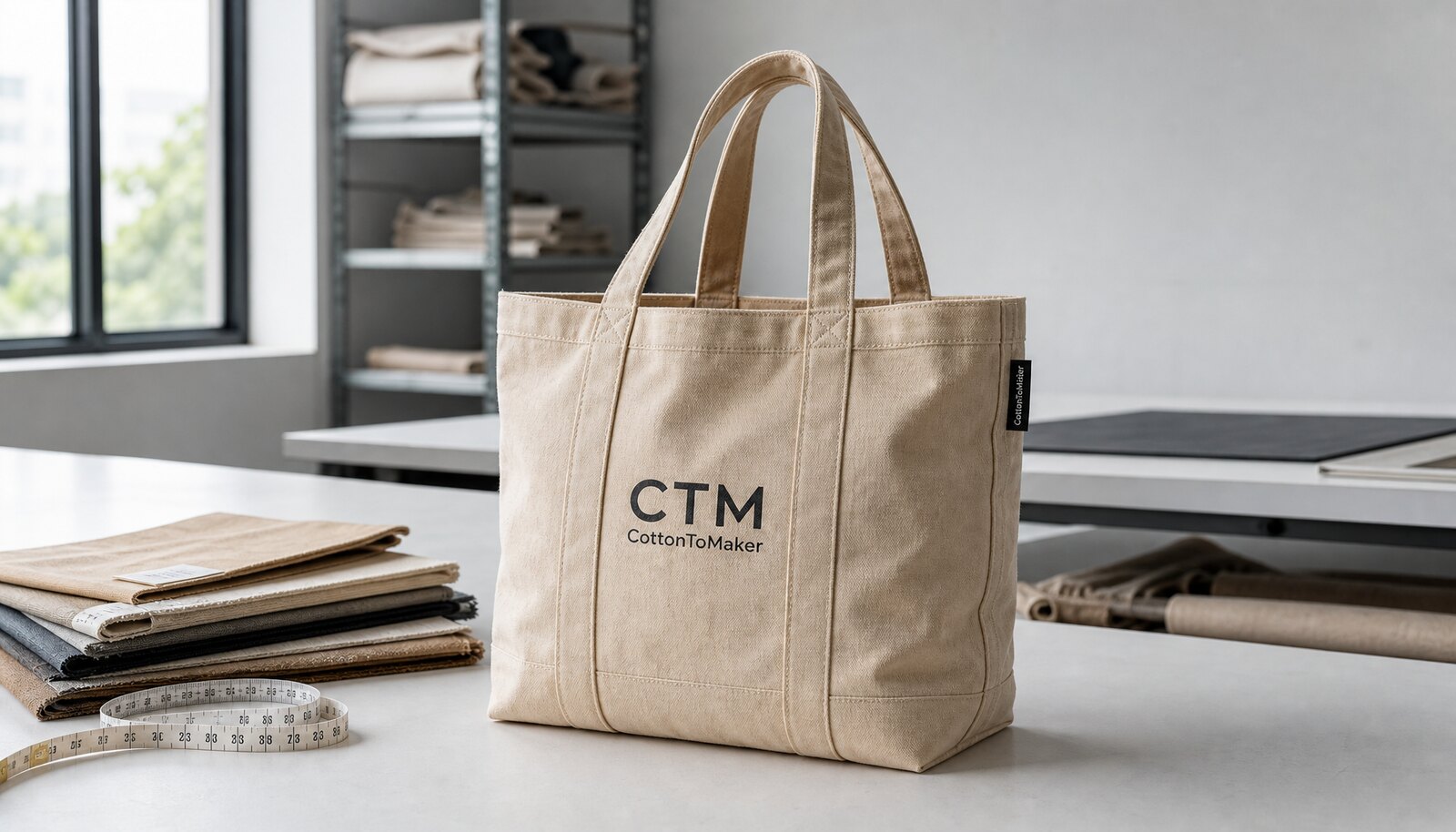
Why bookstore tote quotes go wrong
Bookstore buyers usually start with a simple brief: heavy canvas tote bags that can hold books, look premium on shelf, and hit a workable unit cost. The problem is that suppliers may quote very different constructions under the same name. One factory may be using 10 oz canvas with light webbing, while another is quoting 14 oz fabric, reinforced handles, and better print control. If you compare those quotes line by line without normalizing the spec, the lowest number is often the weakest bag.
A usable factory quote for bookstores must do more than confirm size and logo. It has to define the carrying load, the canvas weight, the print method, the handle build, the packing method, and the commercial term. For a retail buyer, the real risk is not only price; it is getting a tote that creases badly, prints off-center, or fails at the handle after a few book-heavy uses.
- Treat the tote as a load-bearing retail item, not a generic giveaway bag.
- Compare quotes only after matching fabric weight, print method, and packing basis.
- Use the buyer brief to protect shelf quality and reduce complaints from stores.
Set the core spec before you request quotes
For bookstore programs, the most practical starting range is 12 oz to 14 oz cotton canvas. That gives enough body for hardcovers, journals, and boxed gift items without making the bag so stiff that it feels industrial. If the tote is meant for heavy book sets or premium retail positioning, 16 oz can make sense, but it increases fabric cost, sewing difficulty, and carton weight. Always ask the factory to quote in both oz and GSM so you can compare vendors who source from different mills.
The bag dimensions should follow the shelf and use case, not a generic tote formula. A bookstore bag often needs enough height for large-format books and enough gusset to stand better during checkout. Common buyer details include finished width, height, gusset depth, handle drop, and whether the top is open or zippered. If your stores want the bag to sit upright with a hardcover inside, mention that directly; otherwise the factory may optimize for a flatter promo tote instead of a durable retail bag.
- Useful spec range: 12 oz-14 oz canvas, with 16 oz reserved for premium or high-load programs.
- Define finished size, gusset, handle drop, and top finish in the RFQ.
- State whether the tote must carry hardcovers, boxed sets, or mixed retail gifts.
Choose the print method around logo detail and order size
For bookstore logos, screen printing remains the most efficient option when the artwork is simple and the order volume is stable. It works well for one to three solid colors and gives strong opacity on natural canvas. If the artwork includes fine linework, gradients, or a short seasonal message, digital print or heat transfer can be more practical, especially for lower volumes or test orders. Embroidery can look premium, but it usually belongs on small logos rather than large artwork because it adds cost and can distort softer canvas panels.
The wrong print method is a classic quote trap. A supplier may offer a low unit price on a print style that cannot keep linework crisp or color blocks aligned on a wide tote face. Ask for the print area, ink count, setup fee, and whether the artwork is printed on one or both sides. If the logo needs Pantone matching, say so up front; otherwise the supplier may quote a close visual match that fails brand review later.
- Screen print: best for solid bookstore logos and repeat orders.
- Digital or heat transfer: better for short runs, multi-color art, or seasonal campaigns.
- Embroidery: useful for small premium marks, not large artwork panels.
Compare supplier routes before you compare price
Not every quote comes from the same type of supplier, and that changes both cost and control. A direct factory with sewing and printing under one roof can usually hold better spec discipline and react faster to corrections. A trading company may be useful if you need mixed sourcing support, but the quote should clearly show who is making the bag, who is printing it, and who owns the final QC. Without that transparency, you can end up comparing a true factory price against a broker price with hidden markups and looser accountability.
For bookstore buyers, the best route depends on volume and repeatability. If you plan reorders across several stores or seasons, a direct factory quote is usually the safer base because the construction can be locked. If you are testing a new line and want a small pilot, a trading route may work if they can still provide sample control and production photos. The key is to force each supplier to quote the same construction and the same commercial term.
- Direct factory: better for stable specs and repeat orders.
- Trading company: acceptable for small pilots only if sourcing and QC are transparent.
- Always compare the same trade term, such as EXW or FOB, not a mix of terms.
Use the comparison table to normalize quotes
The quote comparison is where most buying decisions either become clear or get distorted. You need to normalize fabric weight, handle build, print method, packing, and trade term before you choose a supplier. A cheap quote with unreinforced handles and loose packing can become more expensive once you factor in damage, store complaints, or rework at receipt. For bookstore totes, the real cost difference often comes from details that are invisible in the first line item.
This is also where MOQ logic matters. A supplier may offer a very low price at 1,000 pieces but quietly charge extra for custom dye, multiple print colors, or polybagging. Another may quote a slightly higher unit price but include a cleaner production process and more predictable lead time. Use the table below as your comparison lens, then ask suppliers to re-quote if any row does not match the others.
What to look for in sample approval
A pre-production sample should not be treated as a casual approval sample. It should be the reference point for dimensions, color, print placement, handle construction, seam quality, and finishing. For bookstore totes, the sample should also be judged in a real load test: fill it with books, carry it by the handles, and watch how the top hem and handle junction behave. A tote can look fine empty and fail once it is loaded with hardcovers.
Set your sample acceptance around measurable items. A good buyer review includes finished size, gusset depth, print position from seam edge, handle length, handle width, and whether the bag stands reasonably upright. If the sample has a natural canvas lot variation, decide whether that variation is acceptable before mass production starts. Once the sample is signed off, put the exact sample reference into the purchase order.
- Approve size, print placement, handle build, and top seam against the sample.
- Do a practical book-load test before final signoff.
- Attach sample photos or a physical reference to the PO.
Packing and carton rules that affect retail handling
Packing is not a minor detail when the buyer is a bookstore chain or distributor. If the totes are bulk packed, the carton count should match how the warehouse will allocate inventory to stores. If the bags are polybagged, confirm whether the polybag is plain, printed, or barcoded, and whether the fold direction supports fast shelf opening or online fulfillment. A packed tote that arrives too compressed can hold a deep crease that affects retail presentation.
Carton marks should be readable and standardized. Ask for carton size, gross weight, net weight, pack count, and the exact labeling format before the factory starts packing. If the order goes to multiple stores, barcode stickers and consistent carton counts reduce receiving errors. Individual polybags add material and labor cost, so only specify them when there is a real downstream need.
- Bulk pack lowers cost and carton volume.
- Individual polybagging helps retail presentation but adds cost.
- Carton marks, pack count, and barcode format should be written into the PO.
Lead time, bottlenecks, and where schedules slip
For standard heavy canvas totes, a realistic production lead time is often 35 to 50 days after pre-production sample approval, but that only covers the factory schedule. It does not include sample iteration, raw fabric reservation, printing setup, or ocean booking time. If your bookstore launch date is fixed, build a buffer for artwork approval and packing confirmation. Special dye colors or washed finishes can add time because the supplier may need extra lab dips or finishing tests before cutting starts.
Schedule risk usually appears in three places: fabric availability, print approval, and packing change requests. A late logo correction can push the whole order back because canvas panels are already cut by the time the print issue is spotted. Similarly, changing from bulk pack to individual polybag after production starts creates labor disruption. The simplest way to protect the schedule is to freeze the spec early and require a pre-production sample signoff before any mass cutting begins.
- Plan 35-50 days after sample approval for standard builds.
- Allow more time for dyeing, washing, or complex print work.
- Freeze packing and artwork before bulk production starts.
Landed cost is bigger than the unit price
A bookstore tote quote should be judged on landed cost, not just ex-factory price. Compare EXW, FOB, CIF, and DDP separately so you know which costs are already included. Freight, export docs, inland trucking, cartonization, and local import handling can change the final unit cost materially. A supplier with a slightly higher EXW price may still be cheaper once cartons are packed efficiently and shipped from a better port.
For procurement teams, the cleanest approach is to build a quote worksheet that separates bag price, printing, packaging, sampling, tooling, and logistics. Then add your own duty and destination charges. That prevents a supplier from appearing cheap because they excluded key costs. It also makes repeat orders easier to benchmark, since you can see whether price changes come from fabric, labor, print setup, or freight.
- Never compare quotes without matching trade terms.
- Separate bag cost, print cost, packaging, and freight in the worksheet.
- Use landed cost per usable retail bag, not headline unit price.
Practical RFQ wording for bookstore buyers
A good RFQ for heavy canvas tote bags for bookstores factory quote checklist purposes should read like a production instruction, not a marketing brief. State the exact canvas weight, desired handle construction, print method, and packing format. Then add the carrying use case, such as general bookstore merchandise and hardcover books. The supplier should know whether the tote is expected to live at point of sale, in a membership program, or in a retail gift wall, because each setting changes the acceptable finish and the risk level.
If you want better quotes, include the data the factory needs to cost correctly. That means finished size, artwork size, logo color count, quantity per size or color, target ship date, and destination port or delivery term. The more concrete the RFQ, the less room there is for optimistic quoting that later turns into variation orders.
- Write the carrying use case into the RFQ.
- Include artwork count, size, quantity split, and delivery term.
- Specify exactly which optional items are allowed and which are not.
Specification comparison for buyers
| Spec decision | Recommended option | When it fits | Buyer risk to check |
|---|---|---|---|
| Fabric weight | 12 oz to 14 oz cotton canvas; use 16 oz only if the bag must hold heavy books or hardbound sets | Independent bookstores, museum shops, and premium retail programs that want a structured bag with fewer complaint returns | Some mills quote finished weight differently; confirm GSM, weave density, and whether the weight is before or after dyeing/washing |
| Supplier route | Direct factory quote with bag-specific sewing line and in-house printing | Reorders, private label programs, and buyers who need stable specs across multiple seasons | Trading companies may hide actual fabric and print subcontracting, which can weaken control over color, sewing, and lead time |
| Print method | Screen print for 1-3 solid colors; heat transfer or digital for short runs with fine detail; embroidery only for small logos on premium versions | Bookstore logos, author event bags, seasonal campaigns, and membership merch | Do not compare prices across different print methods without matching ink count, setup cost, and wash/abrasion expectations |
| MOQ logic | 500-1,000 pcs per color/spec for standard canvas tote programs; lower only if the factory already stocks the fabric and handle webbing | Launch orders, test store rollouts, and regional bookstore chains | Low MOQ quotes often exclude custom dye, special handle length, or individual polybagging, then add costs later |
| Handle construction | Cross-stitched, reinforced handles with 25-30 mm webbing or folded self-fabric handles for a softer retail look | Totes expected to carry books, catalogs, or boxed gifts | Weak handle bar-tacks are a common failure point; ask for stitch count and reinforcement location rather than only handle length |
| Packing method | Bulk packed with size/carton marks for low-cost distribution; individual polybag only if retail display or e-commerce fulfillment needs it | Wholesale bookstore supply, warehouse replenishment, or mixed-store allocation | Individual polybags add cost and carton volume; confirm whether barcode stickers, insert cards, and silica gel are included or extra |
| Lead time structure | 35-50 days after PP sample approval for standard cotton canvas; add time for dyeing, special printing, or rush sea freight booking | Seasonal programs with fixed launch dates and replenishment orders | Factories may quote production days only; buyers must separate sample time, material sourcing time, and shipment booking time |
| Quality standard | Tolerance-based approval on size, GSM, stitch density, print registration, and seam strength, with pre-production sample signoff | Buyers who need repeatable shelf quality and lower return rates | If the quote does not reference measurable tolerances, the factory may ship bags that vary too much in size or print placement |
| Landed-cost route | Compare EXW, FOB, and DDP separately and build your own duty, freight, and local handling estimate | Importers and distributors comparing suppliers across countries or ports | A low unit price can lose to a higher quote once cartons, inland trucking, export docs, and freight are added |
Buyer checklist before sampling
- Confirm the exact finished size, gusset depth, and handle drop you want on the RFQ, not just a vague tote size.
- Specify canvas weight in oz and GSM together, and state whether you want natural, bleached, dyed, or washed fabric.
- Define print area, print method, number of colors, and whether the logo must match a Pantone reference.
- State target carrying load, for example books, hardcovers, notebooks, or boxed retail items, so the factory can size seam reinforcement correctly.
- Request a pre-production sample and keep approval based on measurable points: size, color, print position, handle strength, and stitch quality.
- Ask for packing details: bulk pack, polybag, carton count, carton dimensions, barcode label, and master carton mark format.
- Separate unit price from tooling, sampling, print setup, and freight so you can compare suppliers on the same basis.
- Request photos or videos of fabric rolls, sewing line, and printing process if the supplier has not produced this exact style before.
Factory quote questions to send
- What is the exact fabric spec: ounce weight, GSM, weave count, and whether the quoted weight is before or after finishing?
- Is the quote based on direct factory production or outsourcing any part of sewing, dyeing, or printing?
- What handle construction do you recommend for carrying books, and what reinforcement is included at the stress points?
- What is the print method, setup charge, color limit, and expected print durability after repeated use?
- What is the MOQ per color, per print design, and per size, and what changes will trigger a new MOQ or surcharge?
- What sample will you provide before mass production, and which dimensions and details will be approved against the sample?
- What is included in packing: polybag, barcode sticker, insert card, carton marks, carton pack count, and carton test standard if any?
- What is the full production schedule from sample approval to ex-factory, and what risks could extend it?
- What quotation terms are you using: EXW, FOB, CIF, or DDP, and which costs are excluded?
- Can you provide photos of a previous similar tote run or a factory inspection reference for this construction?
Quality-control points to confirm
- Measure finished size and gusset against agreed tolerance, typically within +/- 0.5 cm to +/- 1 cm depending on bag size.
- Check fabric weight and hand feel on incoming roll inspection; thin or loose-weave canvas can pass appearance checks but fail load use.
- Inspect handle stitch reinforcement at the top edge and stress points; bar-tacks should be even and not cut into the canvas.
- Confirm print registration, color density, and edge sharpness; misaligned logos are common on large flat tote surfaces.
- Pull-test handle attachment on at least a sample set from the production lot if the bag is meant to carry books or catalogs.
- Review seam quality at side gusset, bottom seam, and top hem; skipped stitches or puckering show poor machine setup.
- Check carton packing count, label accuracy, and fold consistency so retail teams can receive and count stock quickly.
- For washed or dyed bags, compare shade variation across cartons and approve an acceptable range before shipment.
- Record sample-approved dimensions and print placement in the PO so the inspection team has a clear acceptance reference.