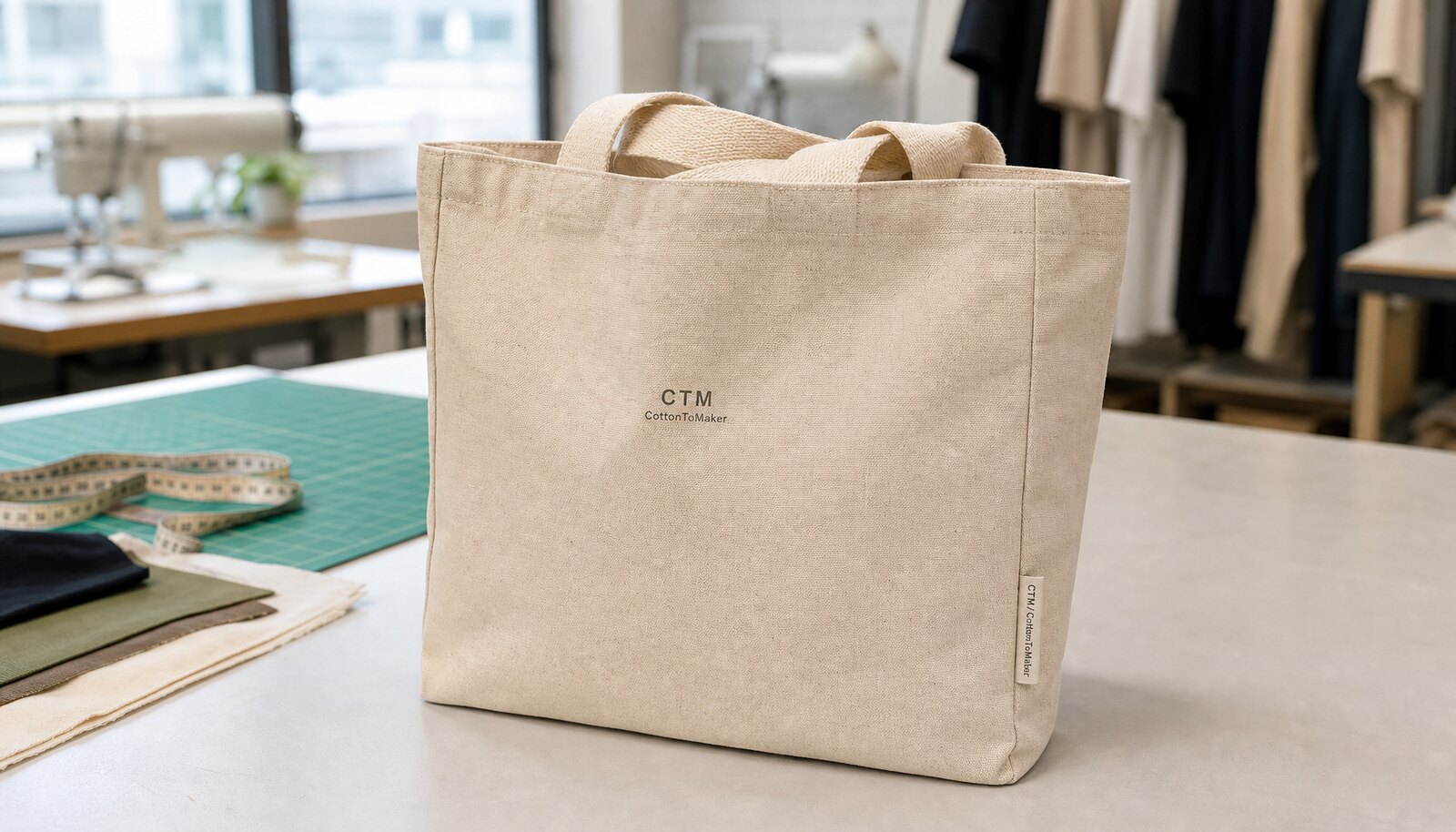
What heavy canvas tote bags need to do at retail launch
Heavy canvas tote bags are not judged like a free promo bag. In an apparel launch, they sit next to the main collection, carry the brand in public, and often need to support a sales price instead of just a marketing budget. That changes the buying brief. The bag has to look intentional on shelf, survive handling in store, and arrive in packaging that does not make it look like a commodity.
For procurement, the important question is not 'How cheap can we buy a tote?' It is 'What specification lets us hit our retail price and margin without creating quality or logistics problems?' A well-made heavy canvas bag can justify a better perceived value, but only if the fabric, print, handle construction, and packing all support that positioning. If one of those pieces is weak, the product feels off even when the logo is correct.
- Treat the tote as a retail SKU, not just a branded accessory.
- Set the commercial target first, then spec the bag around it.
- Decide early whether the tote is meant to be durable, structured, soft, or lightweight to carry.
Build the economics before you build the spec
The fastest way to lose margin is to source from the outside in. Start with the price architecture you need, then work backward to the tote spec that can support it. If the bag will retail on its own, your margin target and channel margin matter. If it is sold as a bundle item or gift-with-purchase, then the cost has to fit within the broader campaign economics. In both cases, the ex-factory price is only part of the picture.
A buyer should build a landed-cost view before asking factories to quote. That means factory price, sample and setup charges, freight, duties, customs handling, inland transport, and receiving costs. A tote that looks acceptable at ex-factory can become expensive when cartons are small, the shipment is split, or the order is too light to absorb freight efficiently. Small spec changes also matter: heavier canvas, extra print colors, lining, interior pockets, woven labels, or retail inserts all move unit cost. The right choice is the one that protects margin while still meeting the retail expectation.
- Ask finance or merchandising what margin the tote needs at wholesale or MSRP before locking the spec.
- Compare suppliers on landed cost, not ex-factory price alone.
- Use a simple cost waterfall so everyone can see where each spec decision adds or removes cost.
Choose the fabric weight for the job, not the trend
There is no universal best canvas weight. In retail launches, buyers often look at finished canvas in a mid-to-heavy range because it helps the tote stand up, print cleanly, and feel more substantial in hand. Many programs land somewhere in the 10 oz to 16 oz range, with heavier builds used when the bag needs more structure or a premium feel. The right answer depends on whether the tote is expected to carry merchandise, function as an everyday carry bag, or simply act as a branded accessory.
The key word is finished. Ask for the finished fabric weight after any washing, dyeing, or finishing steps, not a vague yarn description or greige fabric spec. A washed canvas can feel softer but may lose structure. A tighter weave can improve print sharpness and body, but may raise cost. Also confirm whether the fabric is natural, bleached, dyed, or garment-washed, because those choices affect both appearance and price. If the supplier only speaks in broad terms like 'thick' or 'premium,' the spec is not ready for quote comparison.
- Request weight in both oz and GSM so different suppliers can be compared consistently.
- Approve a swatch before bulk if color, handfeel, or structure matters to the launch.
- Match the fabric weight to the use case: retail accessory, paid merch item, or functional carry bag.
Use the right supplier route for the launch risk you actually have
Supplier route is a commercial decision, not just a sourcing preference. A direct factory usually gives the cleanest control over sewing, print, and packing, which matters when the tote has to match a signed sample and arrive on a fixed launch date. The factory is also easier to hold accountable if handle placement drifts or stitching quality slips in bulk.
A trading company or agent can be useful when your team wants one point of contact or needs cross-category coordination, but the buyer should still know where the bag is being produced and who owns the final approval. Domestic converters and decorators can be strong options when speed outweighs cost or when the launch needs a quick replenishment run. Marketplace suppliers can reduce friction on simple orders, but they usually give you less control over packing, quality, and true cost transparency. The right route depends on the launch risk profile, not just the quote total.
- Ask who physically cuts, sews, prints, inspects, and packs the tote.
- Confirm who approves the pre-production sample and who can authorize a rework.
- If a supplier cannot name the factory or explain the production flow, treat the quote as incomplete.
What a useful factory quote should include
A quote for heavy canvas tote bags should explain the price structure, not just list a number. For procurement, the goal is to understand the cost drivers so suppliers can be compared on a like-for-like basis. That means the quote should state bag size, finished fabric weight, handle material, reinforcement method, print process, packaging method, carton count, and any setup charges. If those pieces are not visible, you cannot tell whether a lower price reflects a better process or just a weaker spec.
It is also worth asking how the quote changes with volume. Some suppliers will discount only when the order crosses a fabric or print threshold, while others price setup more aggressively at small runs. The buyer should look at the spread between 500, 1,000, and 3,000 pieces if the launch may replenish. A quote that looks cheap at the first run but becomes expensive on repeat orders can distort the whole program economics.
- Compare only quotes built on the same spec sheet and artwork version.
- Separate one-time setup charges from recurring unit cost.
- Ask for a versioned quote that is easy to tie back to the sample approval.
Supplier comparison table: which route fits which launch
Use the comparison below to match supplier route to launch needs. The point is not to chase the lowest unit price. The better question is which route gives you the best blend of control, speed, transparency, and repeatability for the specific tote you are launching.
If the tote will be sold in-store next to apparel, the cost of a bad sample match or an unclear pack spec can be higher than a slightly stronger ex-factory price. For that reason, many launch buyers prefer the route that gives them the clearest chain of accountability, especially on the first order.
- Use route choice to manage risk, not just cost.
- Ask for recent examples of similar construction before you commit.
- Keep the same tech pack language across every supplier so comparisons stay meaningful.
MOQ is a pricing signal, not just a production minimum
MOQ on heavy canvas tote bags is often treated like a hard barrier, but for launch buyers it is usually a pricing signal. A supplier may quote 300, 500, or 1,000 pieces, yet the real question is whether that quantity can be made efficiently with the chosen fabric width, print setup, reinforcement, and packing format. The smaller the run, the more the order absorbs setup and handling cost, which is why a very low MOQ often pushes the unit price up.
For a retail launch, a moderate first run is often more economical than a tiny test order if the product is already approved and the launch window is fixed. That said, the right quantity depends on sell-through confidence, channel mix, and replenishment timing. If the tote is a seasonal accessory, you may want the first buy to protect cash and leave room for a reorder. If it is tied to a store opening or campaign drop, you may need enough volume to avoid stockouts in the first weeks. Ask the supplier whether MOQ changes by color, print color, label type, or packaging version, because those variations can create hidden cost steps.
- Treat MOQ as a combination of price, setup, and risk.
- Ask whether multiple colors can be run under the same base construction.
- Make sure the MOQ is tied to the actual production configuration, not a generic brochure number.
Branding choices that affect unit price and sell-through
On heavy canvas, the branding method affects more than appearance. It changes setup cost, repeatability, and how the tote ages in use. Screen print is usually the cleanest choice for simple artwork with one to three solid colors. It tends to be the most predictable option for a stable logo and can look strong on heavier canvas when the ink coverage and curing are correct. If the design is straightforward, it is often the most procurement-friendly option because the process is repeatable.
Heat transfer or similar applied graphics can make sense for short runs or designs that change by season, but the buyer should inspect the result on actual canvas. On thick fabric, weak transfer adhesion or poor curing can lead to edge lift or early wear. Embroidery can read premium, but it works best for small marks. Once the embroidery gets large, it can distort the bag body and add cost quickly. The practical test is simple: does the branding still look deliberate after handling, folding, and retail display? If not, the method is wrong for the product.
- Use screen print for stable retail logos and repeat orders.
- Use transfer methods only when artwork flexibility is worth the risk of a less permanent finish.
- Reserve embroidery for small marks or accents, not full-panel decoration.
Sampling and approval need to test the real production path
A good sample is not just a pretty sample. It is a production standard. The buyer should approve a sewn pre-production sample built from the same fabric weight, handle construction, seam allowance, and print method planned for bulk. If the artwork is new, ask for a print strike-off on the actual canvas, not only a digital proof. A paper proof can hide opacity, edge quality, and curing problems that become visible only on fabric.
Use the sample review to check dimensions, print placement, handle drop, seam symmetry, and overall build quality. If the bag must sit upright on shelf or look crisp in-store, inspect the body shape after folding and refolding it. Keep one signed reference sample and make sure the purchase order, tech pack, and QC checklist all point to the same version. The common failure point on launch orders is not the first sample itself; it is the drift between the sample and the bulk run after a small spec change or a rushed approval.
- Approve a sewn sample, not only an art proof.
- Measure the sample against the tech pack line by line.
- If the supplier offers revisions, make sure each revision is versioned and tracked.
Packing, labeling, and carton specs can protect the retail look
Packing is often treated as a logistics detail, but for heavy canvas tote bags it is part of the product experience. The bag can arrive wrinkled, distorted, or stained if the pack method is careless. A flat fold can help control shipping efficiency, while inner wrapping may protect the surface and make retail presentation cleaner. Some brands prefer polybags for protection, others prefer paper wrap for presentation or sustainability reasons. The right answer depends on channel expectations and receiving requirements.
Carton efficiency also affects landed cost. More compact cartons can reduce freight per unit, but over-compression can leave hard fold lines or flatten the tote in a way that looks cheap on shelf. Ask the factory for carton dimensions, gross weight, pack count, and the exact folding method. If your DC scans cartons by barcode, get the carton mark format, barcode position, and any inner label rules locked before production. Rework at this stage is expensive because it changes both packing labor and shipment timing.
- Define whether the tote ships flat, folded, wrapped, or bagged.
- Lock carton counts and carton marks before bulk packing begins.
- Check whether the packing format helps or hurts shelf presentation after arrival.
Specification comparison for buyers
| Supplier route | What it usually gives you | Best fit | Procurement watchout |
|---|---|---|---|
| Direct factory | Lower handoff risk, clearer control over fabric, stitching, printing, and packing, and easier accountability on sample-to-bulk match | Retail launches that need consistent quality, custom size control, and repeat orders | Confirm the factory really owns sewing and packing, not just sourcing; otherwise the quote can hide another layer of margin or delay |
| Trading company or sourcing agent | Broader coordination across materials, artwork, and packaging, plus easier communication if your team needs project support | Smaller buying teams or multi-item launches that need one point of contact | Ask where production happens and who signs off on the final sample; trading layers can blur responsibility when defects appear |
| Domestic decorator or converter | Fast turnaround, easier in-person approvals, and simpler freight for urgent programs | Short-run launches, regional events, or replenishment when speed matters more than unit cost | Unit cost is often higher, and product options may be limited by local fabric, print, or sewing capability |
| Marketplace or catalog distributor | Low-friction ordering and fast quote collection | Very simple promotional orders with fixed specs | You may get limited spec control, weaker transparency on fabric origin, and less leverage on packaging or QC details |
| Material | 8-12 oz cotton canvas, 120-220 gsm cotton, recycled cotton, or blended fabric selected by use case and target price | Before price comparison | Different cloth weights, backing, or certification claims make quotes hard to compare |
| Construction | bag size, gusset, handle drop, seam allowance, stitch density, reinforcement patch, and loading expectation | Before sampling | Weak stress points create returns and failed inspections |
| Decoration | screen print, heat transfer, embroidery, woven label, or hangtag matched to fabric texture and brand durability needs | Before artwork approval | The wrong method can crack, bleed, pucker, or fail on the chosen fabric |
| MOQ | Base MOQ plus change drivers | During quote review | Custom colors, trims, and packing can change minimums |
Buyer checklist before sampling
- Set a target landed cost before asking for quotes, including freight, duties, inland delivery, and receiving fees.
- Decide whether the tote is a paid retail item, a bundle item, or a promotional add-on, because that changes your margin target.
- Confirm the finished fabric weight, not just raw cloth weight or generic 'heavy canvas' wording.
- Lock tote dimensions, handle drop, seam allowance, and gusset depth before sampling.
- Request a sewn pre-production sample and, if the artwork is new, a print strike-off on the real fabric.
- Approve logo placement, Pantone tolerance, and artwork size in writing, not only by screenshot.
- Define packing format, carton count, carton marks, and barcode placement before bulk production starts.
- Ask whether the quote includes setup charges, print screens, labeling, inserts, and any carton-level overage.
- Build a shipping buffer into the launch calendar so bulk completion does not become a stockout at arrival.
- Keep the signed sample, approved tech pack, and final quote version linked to the same order reference.
Factory quote questions to send
- What is the finished fabric weight after washing or finishing, and can you quote it in both oz and GSM?
- Is the quoted price factory-direct, or does it include a trading layer, sourcing fee, or agency commission?
- What exactly is included in the unit price: fabric, sewing, handle reinforcement, print, label, packing, and carton work?
- How many setup charges apply for the artwork, print screens, embroidery file, or packaging changes?
- What is the exact MOQ by style, by color, by artwork version, and by packing configuration?
- Can you show a sewn sample photo with close-ups of seams, handle reinforcement, and print placement before bulk approval?
- What carton pack count, carton size, gross weight, and carton marking format are you quoting?
- Which parts of the lead time are fixed, and which parts can shift if we change artwork, color, or packing after approval?
- What inspection standard do you use before shipment, and can you share what is checked on size, stitch quality, print quality, and packing?
- If we need a second production run, what changes in price or lead time should we expect?
Quality-control points to confirm
- Finished fabric weight should match the approved spec within an agreed tolerance band, and the buyer should verify the sample and the bulk lot with the same measuring method.
- Seam construction should show even stitch density, secure backtacks, and no skipped stitches at side seams, gusset turns, or handle anchoring points.
- Handle reinforcement should be consistent on all pieces, with the same attachment position, stitch pattern, and visual symmetry from bag to bag.
- Print quality should be checked for opacity, alignment, edge definition, curing consistency, and any cracking, smudging, ghosting, or color shift against the approved strike-off.
- Bag dimensions should stay within the approved measurement tolerance for width, height, gusset depth, and handle drop across the lot.
- Bulk color should stay within the agreed sample-match tolerance under normal viewing conditions; if color is critical, review under consistent lighting.
- Packing should preserve shape without over-compressing the body or scuffing the print, and each carton should match the agreed count and label format.
- Pre-shipment inspection should confirm that loose threads, oil marks, chalk residue, stains, broken stitches, and damaged edges are below the agreed reject threshold.
- If you use third-party inspection, tie the report to the signed sample and tech pack version so the standard is unambiguous.