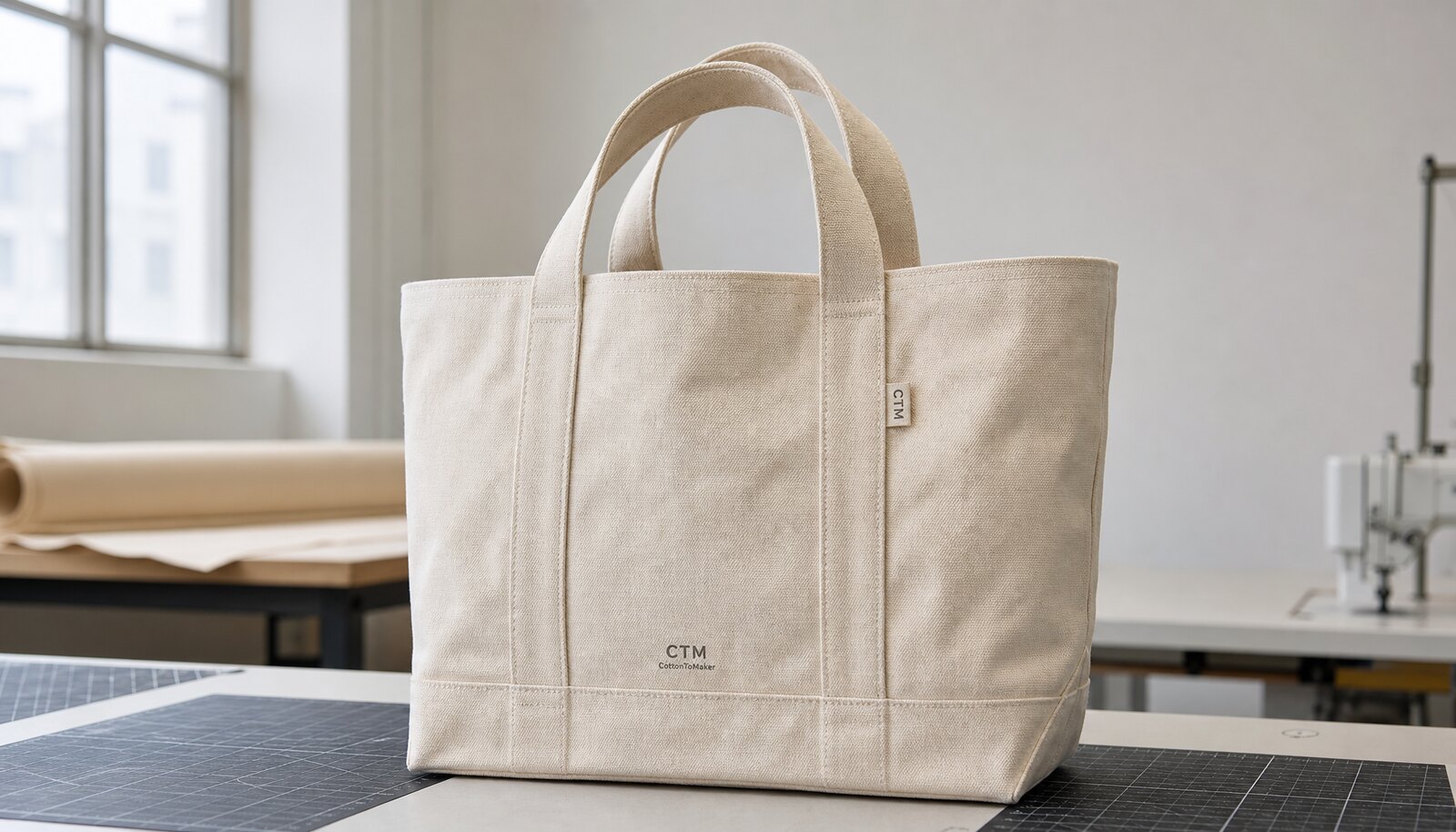
1. Start with the job the tote has to do
For apparel brands, a heavy canvas tote is rarely just a blank accessory. It may be sold as merchandise, included as a gift-with-purchase, used as a shopping bag in-store, or packed inside an e-commerce shipment. Those four use cases create different sourcing priorities. A retail product needs presentation quality and cleaner logo placement. A shipping insert needs efficient folding and low carton cost. A customer carry bag needs handle strength and comfort. A campaign gift may need visual impact first, with function second.
The first procurement mistake is ordering from a vague brief such as “nice quality heavy canvas tote with logo.” That wording gives the factory too much room to choose its own default fabric, handle length, print method, and packing format. If the tote is used the wrong way, even a technically acceptable sample can feel wrong in the market: too soft on shelf, too bulky in transit, too short on the shoulder, or too expensive for the campaign budget.
A stronger RFQ names the use case and the commercial priority. For example: “retail-selling tote with premium presentation,” “launch-event gift with low crease risk,” or “shipping insert with flat-pack efficiency.” This tells the supplier how to balance fabric weight, construction, and packing. It also makes later quote comparisons more meaningful because every vendor is pricing the same job, not their own interpretation of it.
One practical rule helps procurement teams avoid wasted cycles: decide what cannot change before you ask for price. If the bag must stand upright, write that down. If the logo must stay small and subtle, write that down. If the customer experience depends on a flat-folded tote that fits a certain carton, write that down. The more clearly the job is defined, the less rework you will face after sampling.
- Retail sell-through: prioritize appearance, seam finish, and logo accuracy.
- Packaging insert: prioritize flat folding, carton density, and crease control.
- Store carry bag: prioritize handle strength and shoulder comfort.
- Launch gift: prioritize brand impact and a clean retail-ready look.
2. Choose canvas weight based on load, structure, and brand position
Heavy canvas tote bags usually sit somewhere between 10 oz and 16 oz, but the right choice is not always the thickest one. For many apparel-brand programs, 12 oz or 14 oz finished canvas is the best starting point because it gives enough body for a premium feel without making the tote difficult to sew, fold, or ship. If the tote is too light, it may collapse visually and feel promotional rather than retail-ready. If it is too heavy, it raises cost, freight weight, and handling difficulty without necessarily improving the customer experience.
Procurement buyers should be careful about how the fabric weight is described. A factory may quote raw fabric weight, finished weight, or a post-wash figure. Those numbers are not interchangeable. Ask the supplier to say exactly how the weight is measured and whether the bag uses raw canvas, washed canvas, or dyed canvas after finishing. If the answer is vague, the comparison is not reliable.
A tighter weave can sometimes matter more than a thicker number. Two bags both called “12 oz” can feel very different if one has a denser weave and cleaner finish. That is why a sample should be judged by hand feel, body shape, and stitch behavior, not only by the ounce figure on the quote. If the tote must stand in a store display, the supplier may be able to improve the structure with a gusset change, a bottom insert, or a firmer finish instead of simply moving to a heavier cloth.
There is also a commercial tradeoff. More weight can support a premium brand image, but it can also increase freight and reduce packing efficiency. For large volume orders, that can be a meaningful cost difference. The best decision is usually the lightest fabric that still gives the bag the required structure and customer feel.
- 10-11 oz: suitable for lighter campaign use and cost-sensitive programs.
- 12 oz: a common balance point for retail-facing apparel orders.
- 14 oz: better structure and a more substantial hand feel, but higher cost.
- 16 oz+: usually reserved for premium carry bags or heavier load requirements.
3. Lock down construction details that influence real-world failure rates
Most tote problems are caused by construction details, not by the logo. Handle attachment, seam balance, gusset twist, and edge finishing determine whether the bag looks and performs like a branded product or a low-end promo item. If customers are expected to carry garments, books, or boxed accessories, the handles need reinforcement that is designed for load, not just appearance. If the tote is a fashion accessory, seam finish matters because the bag will be viewed from the outside, not only from a distance.
The RFQ should spell out the geometry. Include finished width, finished height, gusset depth, handle width, handle length, and handle drop. Do not leave these as “standard.” Standard means different things at different factories. If the tote must stand upright, tell the supplier whether that comes from a wide gusset, a firmer finish, or a bottom insert. If it is meant to feel more fashion-led, a self-fabric handle may look better than webbing, but the tradeoff is usually lower comfort under load unless the handle is widened or reinforced.
Ask how the factory reinforces stress points. Bar-tacks, cross-stitching, and layered stitch reinforcement at the top of the handle are not nice-to-have details; they are the load-bearing features that prevent early tearing. Buyers should also confirm whether thread ends are trimmed, seams are pressed, and the gusset stays symmetrical. A tote that is slightly twisted can look acceptable in a carton but poor on a rack or in product photography.
If your order will be reordered later, ask for the same construction method to be documented in the spec sheet. That makes repeat buying easier and reduces the risk that a future production run quietly changes reinforcement or seam allowance.
- Handle width and handle drop should be specified, not assumed.
- Stress points need bar-tacks or equivalent reinforcement.
- Decide whether the bag must stand, collapse flat, or sit between the two.
- Document seam finish and edge trimming for future reorders.
4. Match the logo method to the canvas surface and artwork complexity
Printing on canvas is a different problem than printing on smooth fabric. The weave texture affects edge sharpness, ink deposition, and the readability of fine detail. A logo that looks excellent in a digital proof may lose clarity when applied to heavy canvas, especially if it uses thin lines or small text. This is why the print method should be chosen after the artwork is reviewed, not before.
Screen print is usually the most efficient choice for one- or two-color logos and repeatable volume. It can look very strong on canvas if the art is simple and the line thickness is suitable for the weave. DTF or heat transfer is often better when the artwork has more color, detail, or small type, but procurement teams should ask about rub resistance and edge durability because transfer films can be more sensitive to folding and wear. Embroidery can add a premium feel, yet it also makes the panel stiffer and may distort the fabric if the logo area is large. Woven labels or patches can work well when the brand wants a smaller, more understated mark.
The right question is not “which print method is best?” It is “what is the logo supposed to do on this bag?” A launch tote may need a larger front graphic because the bag itself is part of the campaign. A retail tote may need subtler branding because the bag should fit the broader apparel aesthetic. The supplier should be able to advise on how the artwork will behave on canvas, including minimum line thickness and whether any type should be simplified before production.
A good supplier will not promise that every logo can be printed perfectly at every size. They will tell you where the risk is: very small lettering, dense negative space, heavy ink coverage on coarse weave, or a large embroidery area that may pucker. That kind of answer is more useful than a generic “yes, we can do it.”
- Screen print: best for simple spot-color logos and stable pricing.
- DTF or heat transfer: useful for multi-color or detailed art, but validate durability.
- Embroidery: premium look, but it can stiffen the panel and distort the fabric.
- Woven label or patch: good for subtle branding or fashion-led programs.
5. Compare supplier types by control, documentation, and rework burden
The supplier route affects more than unit price. It affects how much control you have over sample quality, print consistency, packing accuracy, and post-order changes. A direct factory that regularly makes canvas totes usually has the best control over repeatability because the same operation owns fabric cutting, sewing, printing, inspection, and packing. A trading company can be helpful when the buyer wants one contact for several SKUs, but the brand should still confirm who actually controls production and how defects are handled. A general sewn-goods factory can also work, but only if canvas totes are a routine product rather than a one-off side project.
Procurement buyers should verify capability, not assume it from a website. Ask for close-up photos of comparable totes, not just finished lifestyle images. Request evidence of handle reinforcement, seam finish, and print quality on canvas. Ask how the supplier controls fabric lots and whether the same material can be reserved for reorders. If the seller cannot explain these points clearly, then the risk is not only quality—it is also the possibility that the next production run will not match the approved sample.
Factory audits are worth doing when the order is important, recurrent, or brand-visible. An audit does not need to be a complex consulting exercise. At minimum, verify that the factory has a cut-and-sew line suitable for canvas weight, stable sample-making capability, an inspection process, and a packing area that can support your carton and label requirements. If the supplier claims embroidery, dyeing, or wash finishing capability, ask to see that process in-house or ask for the exact subcontracting path.
For larger programs, documentation matters as much as the sample. Ask for a spec sheet, approved sample reference, inspection standard, and packing instruction. The more of the tote’s definition that lives in writing, the easier it is to compare quotes and hold the supplier to the approved version later.
- Direct factory: strongest control over repeatability and process ownership.
- Trading company: useful for coordination, but verify the real factory and QC flow.
- General sewn-goods factory: viable only if tote production is a regular category.
- If the order will repeat, ask how the same fabric and print setup will be maintained.
6. Read the quotation as a sourcing document, not just a number
A useful tote quote should let you compare like for like. If one supplier quotes a single number and another quotes a more detailed breakdown, the cheaper option may only look cheaper because it excludes setup or packing. Ask the factory to state exactly what is included: fabric, sewing, printing, sample, packaging, barcode sticker, carton, and outer carton mark. Without that clarity, the buyer cannot tell whether the quotes are truly comparable.
The main cost drivers for heavy canvas tote bags are fabric weight, color, print method, logo coverage, handle construction, and packing format. Larger print areas require more setup and can carry more reject risk. Dyed fabric may need additional lead time. Individual polybagging adds labor and freight volume. Embroidery usually adds both stitch time and quality-control burden. These are not minor details; they are the reasons one quote can be materially higher than another even when the bags look similar at first glance.
It is often helpful to ask for two quote versions: a base spec and a preferred spec. The base spec should be the lowest acceptable version of the tote. The preferred spec can include stronger reinforcement, more refined packing, or a heavier fabric if the brand wants to see the cost of upgrading. That approach gives procurement a real negotiation tool and makes it easier to decide where value is worth paying for and where it is not.
If the supplier refuses to break out cost elements, be careful. A single lump-sum number makes it difficult to identify hidden substitutions later. For example, a supplier could quietly shift from finished weight to raw weight, reduce handle reinforcement, or simplify packaging and still claim the order matches the quote. Line-item clarity is not paperwork for its own sake; it is risk control.
- Confirm whether sample, setup, packing, and carton costs are included.
- Ask for separate pricing on fabric color changes, print color changes, and packing upgrades.
- Check whether the quote is by piece, by colorway, or by total order.
- Use line-item pricing to reduce hidden substitutions later.
7. Use a comparison framework that ties supplier type to risk and volume
A practical sourcing table should help the buyer decide which supplier route is right for the order. Price matters, but the more important questions are: who can repeat the approved spec, who can support the required QC standard, and who can absorb changes without turning the order into a delay. The table below is designed for that decision, not just for browsing numbers.
When apparel brands compare suppliers, the cheapest quote is often the one with the most assumptions hidden in it. A factory that specializes in totes may charge more, but it can often reduce rework and protect launch timing. A trading company may offer convenience, but only if its production oversight is real. A general sewn-goods factory may be flexible, but not necessarily tuned for canvas-specific issues such as seam strength, print rub, and consistent folding. The right supplier is the one whose operating style matches the order’s business risk.
8. Approve samples with measurable acceptance criteria, not general approval language
Sample approval is where many tote projects become too subjective. A buyer may say the sample “looks good,” but that phrase leaves too much room for interpretation during bulk production. A better approval process uses written measurements and a physical sample that matches production as closely as possible. If the sample does not use final fabric, final logo method, and final packing, it should be treated as a reference only, not as the production benchmark.
Measure the tote against the specification sheet. Confirm body width, height, gusset depth, handle length, handle drop, and logo placement. If the logo contains text or small details, inspect it at normal viewing distance and also close up to check whether the canvas weave is swallowing detail. If the bag is expected to stand on a shelf, test it on a flat surface and see whether it sits evenly or tips because the seam balance is off. These checks are especially important for apparel brands because the tote often appears in customer-facing environments, not just in back-of-house use.
The sample process should also cover print durability and folding behavior. Ask whether the bag can be folded without obvious print cracking, whether the handle lies flat, and whether the edges show any rub marks after packing. For larger orders, keep one sealed reference sample and label it with the approved date, supplier name, and version number. That gives both sides a clear benchmark if production disputes arise later.
If the sample has any deviation, request a revision note rather than relying on verbal agreement. The revision note should say what changed, why it changed, and whether the change is approved for bulk. That small step prevents a lot of avoidable confusion once production begins.
- Measure the physical sample, not just the photo.
- Compare logo size and placement against the artwork proof.
- Check print rub, edge clarity, and any visible bleed on the woven surface.
- Keep one sealed reference sample for final production comparison.
9. Build QC around measurable defects, not generic “good quality” language
QC for canvas totes should be specific enough that the factory knows what gets rejected. Natural canvas has some texture variation, so not every small visual difference is a defect. But the buyer should still define which issues are minor and which are not acceptable. A vague “good quality” requirement is too open-ended for procurement use. The PO should say what must pass, what can be tolerated, and what must be rejected.
The easiest way to tighten QC is to tie it to function and appearance. Handle reinforcement should be symmetrical and secure. Seams should be straight and free from skipped stitches or loose thread bundles. Logo placement should match the approved proof within the allowed tolerance. Print should not show obvious bleed, weak curing, or incomplete coverage. The tote should fold as expected and, if required, stand upright without visible distortion. If the order includes dyed fabric, shade consistency should be checked against the sealed sample or approved reference.
For large orders, it is smart to define a defect threshold before production starts. For example, a small natural weave mark may be acceptable on raw canvas, but a stain, torn seam, misaligned logo, or handle issue should be a reject condition. You do not need to publish every internal standard to the factory, but you do need enough clarity that an inspector could use the same logic at the mill, at final inspection, and at receiving.
If your brand has strict retail standards, ask the supplier whether they work to an AQL or a factory-specific inspection standard and request the actual criteria in writing. Even when the standard itself differs by supplier, the buyer should still require defect categories, measurement method, and inspection sampling plan. This is where a procurement team can reduce surprises later.
One helpful practice is to add a short QC annex to the PO. It should list critical dimensions, acceptable variance, print standard, seam standard, and packing standard. That annex is often more useful than a long generic quality statement because it tells the supplier exactly what to preserve.
- Define acceptable, minor, major, and critical defects in the PO.
- Set dimensional tolerances for body size, gusset, and handle length.
- Require symmetry and secure reinforcement at all load points.
- Use a sealed reference sample to judge bulk production.
10. Treat packing, carton design, and lead time as part of the commercial spec
Packing is not a logistics afterthought; it is part of the product definition. Heavy canvas bags can crease, mark, or rub against each other if they are packed loosely or folded inconsistently. If the order is going to retail, e-commerce, or a warehouse with strict receiving rules, the packing format should be documented in the RFQ. A supplier should know whether the tote needs individual polybags, barcode stickers, fold direction control, or master carton marks before production starts.
The carton spec matters because canvas weight affects carton weight quickly. Ask for carton dimensions, units per carton, gross weight, and carton marks. If the cartons will be handled manually, a lower gross weight may be necessary even if it increases carton count. If the warehouse expects fixed SKU labels or barcode placements, those should also be in the brief. The correct packing choice depends on channel: retail, wholesale, event distribution, or internal use.
Lead time should be discussed as a schedule, not a promise. Separate the time needed for material booking, sample approval, print setup, bulk sewing, in-process inspection, final QC, and ready-to-ship status. This is especially important if you are changing artwork, using dyed canvas, or adding embroidery, because those steps can extend the timeline more than the sewing itself. A quote that only gives a sewing-day number is incomplete.
For seasonal apparel programs, leaving a buffer is usually smarter than chasing the shortest theoretical lead time. Even a good factory can be delayed by fabric availability, artwork revisions, or packing changes. Procurement teams should build in time for the sample loop and for one round of corrections if the first pre-production sample does not match the approved direction exactly.
- Define fold direction, polybag needs, barcode labels, and carton marks.
- Ask for carton dimensions, unit count, and gross weight before approval.
- Separate material, sample, production, inspection, and transit time.
- Build a schedule buffer for artwork changes and first sample revision.
Specification comparison for buyers
| Spec decision | Practical recommendation | What to verify with supplier | Volume tier where it fits best | Cost and risk impact |
|---|---|---|---|---|
| Fabric weight | 12 oz or 14 oz finished canvas is the most common starting point for apparel-brand totes | Ask whether the quoted oz is finished weight, raw fabric weight, or post-wash weight; request weave density if available | 500-5,000 pcs | Heavier fabric raises material cost, sewing difficulty, carton weight, and freight, but may improve structure and shelf presence |
| Supplier type | Direct sewn-goods factory is best when tote repeatability matters; trading company is useful for coordination but needs proof of factory control | Verify who owns sampling, production, inspection, and rework decisions; ask for factory name, tote photos, and production references | 1,000-20,000+ pcs | Lower upfront price can hide weaker QC or slower change control if the seller is not the actual maker |
| Print method | Screen print for simple spot-color logos; DTF or heat transfer for more detailed art; embroidery or patch for premium branding | Confirm print on canvas, wash/rub resistance expectations, minimum line thickness, and whether the art has filled-in risk on textured weave | 300-8,000 pcs | Setup cost, reprint risk, and artwork complexity all affect unit price; some methods carry higher reject risk on coarse canvas |
| Construction route | Self-fabric body with reinforced handles and bar-tacks or cross-stitch reinforcement | Request close-up photos of handle anchors, seam finish, edge trimming, and any lining or base-board options | 500-10,000+ pcs | Weak reinforcement is a common functional failure and can create returns or brand damage even when the tote looks fine at first glance |
| Sampling path | Approve a true pre-production sample made with production fabric, final print method, and final packing | Ask if the sample is made from the same fabric roll, same ink or transfer process, and same folding method as bulk goods | Any first order or artwork change | Skipping a production-real sample can lead to size drift, print mismatch, or packing surprises in the bulk run |
| MOQ logic | Quote by colorway and print setup, with tiered pricing at 500 / 1,000 / 3,000 pcs if possible | Ask what drives MOQ: fabric roll minimum, print screen count, labor, packaging, or dye batch size | 200-10,000+ pcs | Very low MOQ may still be expensive because setup costs are spread across fewer units; the buyer should compare landed cost, not only unit price |
| Packing spec | Retail or e-commerce orders should define polybag, barcode, and carton marks; internal-use orders may use bulk packing | Confirm unit count per carton, inner packing style, carton dimensions, gross weight, and whether the tote is flat-folded or gusset-aligned | Any volume, especially 1,000+ pcs | Poor packing increases crease marks, print rub, and receiving errors; oversized cartons also raise freight cost |
| Lead time profile | Treat lead time as a staged schedule rather than a single promise | Request separate dates for material booking, sample approval, bulk sewing, print, inspection, and ship-ready date | Any volume | A quote that only states sewing days is incomplete; material sourcing, artwork changes, and packing can extend the true timeline |
Buyer checklist before sampling
- State the tote’s use case first: retail product, launch gift, shopping bag, packaging insert, or store carry bag.
- Specify finished size, gusset depth, handle length, handle width, and whether the bag must stand upright when empty or loaded.
- Write the canvas spec in procurement language: finished oz/GSM, finish type, and any washed, dyed, or raw-finish requirement.
- Provide vector artwork, Pantone references, print position, print size, and minimum line thickness for any fine detail.
- Ask for a true pre-production sample that uses production fabric, final logo method, and final packing format.
- Request close-up photos of handle reinforcement, seam finish, and logo on canvas before bulk approval.
- Define packing rules: polybag or bulk pack, barcode labels, carton count, and carton mark format.
- Confirm who pays for samples, strike-off, re-sample, and courier if artwork or spec changes after approval.
- Ask for the supplier’s inspection standard for size, stitching, print quality, stains, and carton count.
- Record in the PO what cannot change: fabric shade, logo placement, handle feel, fold method, and retail-ready presentation.
Factory quote questions to send
- Is the quoted fabric weight finished weight, raw fabric weight, or post-wash weight? Please state tolerance and measurement method.
- What is the canvas weave density or fabric construction, and is the material raw, washed, or dyed after finishing?
- Which print method are you quoting, and what are the limits for line thickness, color count, print area, and edge clarity on canvas?
- What handle reinforcement do you use at the anchor points, and can you show a close-up photo of a similar tote?
- What exactly is included in the unit price: fabric, print, sewing, sample, polybag, barcode sticker, carton, and outer carton marks?
- Can you separate the schedule into material lead time, sample lead time, production lead time, and transit time?
- What carton size, units per carton, and gross weight per carton are you using, and can you confirm whether the tote is flat-folded?
- What defect standard do you apply for skipped stitches, loose threads, print bleed, size drift, stains, and shade variation?
- If we change handle length, logo size, print color count, packing method, or fabric finish, what changes in price and lead time?
- Can you share photos of comparable finished orders so we can assess seam consistency, print clarity, and handle reinforcement?
Quality-control points to confirm
- Size tolerance: ask the supplier to state an acceptable tolerance for body width, body height, gusset depth, and handle length before production starts. For procurement purposes, many brands will want tighter control on logo placement than on natural canvas size variance.
- Handle reinforcement: require bar-tacks, cross-stitching, or an equivalent reinforced anchor at both handle ends. Reject visible gaps, loose stitching, or asymmetry at the stress points.
- Seam quality: seams should be straight, even, and free from skipped stitches, broken thread, seam twisting, or obvious puckering at the gusset and top edge.
- Logo placement: compare the bulk sample to a measured proof for height, width, centering, and distance from edge. If the logo is off-center or scaled without approval, treat it as a production defect, not a minor cosmetic issue.
- Print quality: check for ink bleed, weak curing, patchy coverage, cracking, or fill-in on fine lines. On coarse canvas, text that is too small often becomes unreadable even if the print technically applied.
- Fabric consistency: verify the approved fabric lot against the bulk run for hand feel, color, and weave consistency. If the order includes dyed or washed canvas, ask for shade control against a sealed reference.
- Function test: load the bag to the intended use weight and check handle pull, seam stress, and whether the tote sits or collapses as intended. A retail tote and an insert tote should not be judged by the same carry test only.
- Packing control: confirm count accuracy, SKU label accuracy, and carton marks before shipment. Look for oil stains, needle holes, thread scraps, and print transfer caused by tight folding or poor interleaving.
- Acceptance criteria: define which defects are minor, major, and critical in the PO. For example, a small natural weave variation may be acceptable, but a misprinted logo, wrong size, or torn handle should be rejectable.
- Retention sample: keep one approved physical sample sealed and labeled. Use it for final production comparison when cartons arrive, especially if the order is large or the brand is planning reorders.