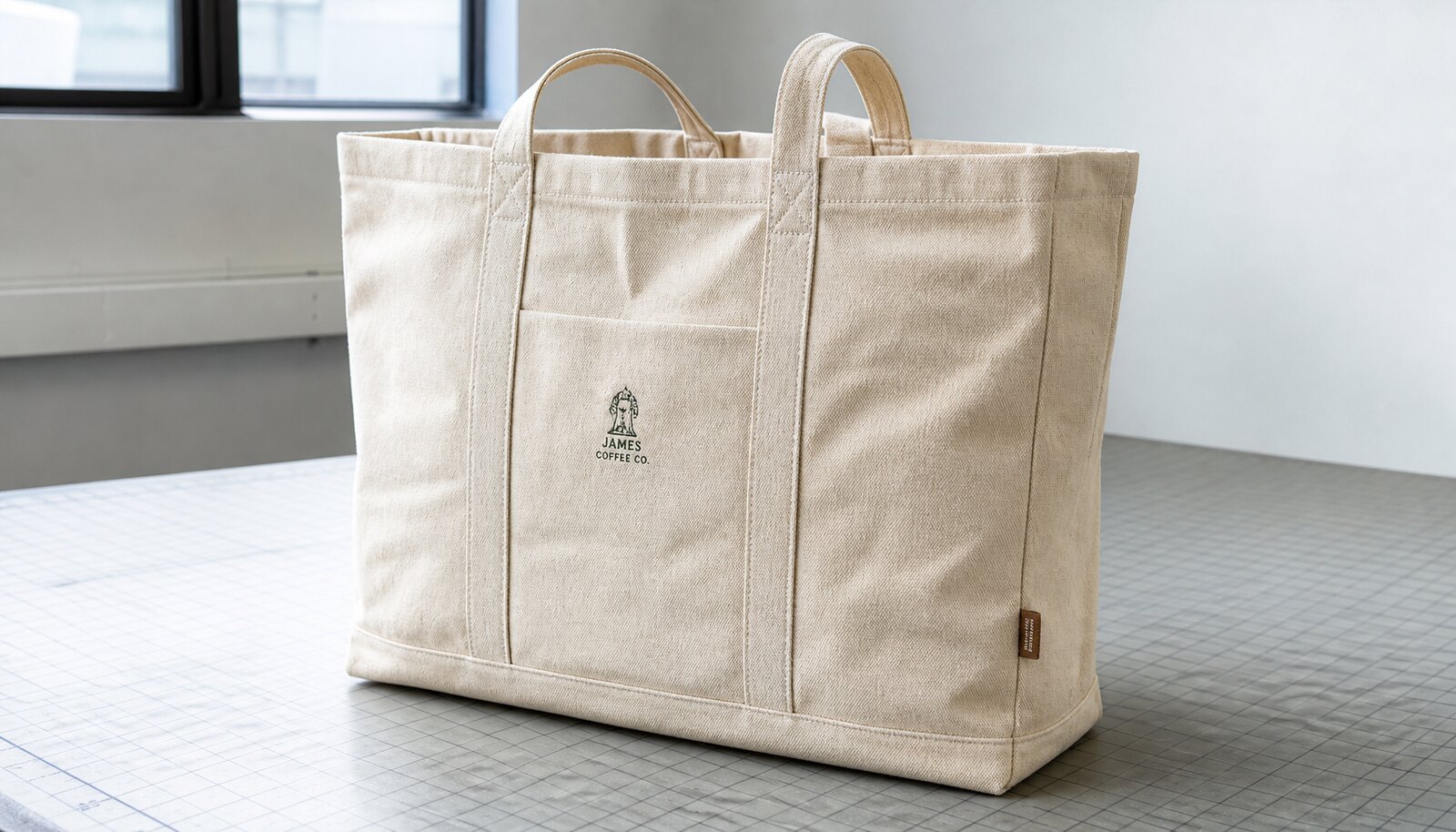
Why the print method matters more than the artwork
For heavy canvas tote bags used at farmers markets, the print method decides how the bag looks after folding, loading, and repeated handling. A simple logo can fail if the ink sits too thick on rough canvas, if small lettering fills in, or if the print area shifts against the seam line. Buyers often focus on the artwork file first, but in this category the real decision is how that artwork will survive on thick, textured fabric at a commercial print speed.
Farmers market buyers usually need a tote that feels sturdy, reads well from a distance, and does not look cheap after a few uses. That means the method should match the logo complexity, the target price point, and the order size. The wrong choice can push up rejection rates, create reprint requests, or force a supplier to simplify the graphic after the sample stage.
- Simple logo, one or two colors: screen print is usually the first method to quote.
- Fine lines, small type, or multicolor art: expect more risk and more setup cost.
- Premium retail positioning: add a woven label or side label so the brand survives wear better than ink alone.
Start with the fabric: 12 oz versus 14 oz versus heavier canvas
The most useful starting point is fabric weight. For a market tote, 12 oz canvas is the lower end of what many buyers would consider heavy enough for repeat use, while 14 oz usually gives a firmer hand feel, better body, and a more premium shelf appearance. In GSM terms, buyers often see roughly 406 GSM for 12 oz and around 475 GSM for 14 oz, though mills and suppliers may vary slightly by construction and finishing.
Heavier is not automatically better. If the bag will be folded into retail packaging, shipped in large volumes, or used by customers who value a lighter carry weight, an extra-heavy canvas can feel overbuilt. But if the tote will carry bottles, root vegetables, jars, or bundled produce, the buyer should protect the handles and bottom panel first, then choose the print method around that fabric instead of the other way around.
- 12 oz canvas: common balance of structure and cost for market totes.
- 14 oz canvas: better for premium brands, larger loads, and stronger shelf presence.
- If the tote has a gusset and bottom board, ask whether the fabric weight can be reduced without weakening the final carry performance.
Screen print, heat transfer, embroidery, or label: what buyers should actually compare
Screen print remains the default choice for most heavy canvas tote programs because it gives a clean logo, stable repeat cost, and workable MOQ levels. On thick canvas, it usually produces the best price-to-durability ratio when the art is simple and the brand only needs one or two colors. The key is to keep the ink choice and mesh count aligned with the fabric texture so the logo does not look broken or muddy.
Heat transfer can work for detailed graphics or short-run campaigns, but the buyer must treat it as a more sensitive option. It can sit on top of the fabric and look crisp at first, yet it may show fold lines earlier than screen print. Embroidery gives strong brand value on premium bags, but it increases cost and can distort lighter canvas unless the panel is reinforced. A woven label or side label does not replace print, but it improves branding when the tote is sold in retail or expected to be reused many times.
- Screen print: best for repeat orders, simple artwork, and lower unit cost.
- Heat transfer: suitable for detailed artwork, but requires more careful fold and wash testing.
- Embroidery: premium look, but usually better on smaller logo zones or reinforced panels.
- Woven or sewn label: useful as a secondary branding element, especially on folded retail display.
Use supplier quotes to compare more than unit price
A useful quote comparison starts with the sourcing route, not just the factory name. Direct factories usually give better control over sewing, printing, and packing, while traders or sourcing offices may be more flexible with communication but less transparent on where defects occur. For canvas totes, that matters because print registration, handle stitching, and carton packing are all easy to separate into different steps if the supplier is not vertically integrated.
The landed-cost view is what procurement teams should use. A low FOB quote can look attractive until setup charges, carton volume, freight density, and waste from sample corrections are included. For example, a slightly higher unit price can still be cheaper overall if the supplier packs more efficiently, keeps the print setup stable, and avoids overcutting fabric. Buyers should compare the quote structure, not just the final unit number.
- Ask whether the printer is in-house or subcontracted.
- Compare unit price together with setup cost, sample cost, and carton packing cost.
- Request carton dimensions and gross weight before approving the order value.
Comparison table for sourcing routes and print decisions
The table below is useful when a farmers market tote program needs both brand visibility and repeatability. It compares the most common sourcing routes buyers evaluate when moving from sample to bulk. Use it to decide whether you want the lowest unit cost, the safest quality control path, or the fastest delivery with the least artwork risk.
The sample record for heavy canvas tote bags for farmers markets print method comparison should include front, back, side, seam, logo, label, inside, and packed-carton photos. For important programs, keep one signed physical sample and record the sample version in the approval file.
- Write decisions in measurable language, not only descriptive wording.
- Ask for sample photos plus one physical approval sample for important orders.
- Keep quotation, sample approval, and inspection notes tied to the same spec version.
What usually drives cost on heavy canvas tote orders
Most buyers underestimate how much the construction details change the quote. Fabric weight is one driver, but print color count, handle length, seam reinforcement, and carton packing often move the price more than expected. If a supplier is quoting one style with a wide handle, a bottom gusset, reinforced corners, and a one-color print, the unit price can rise noticeably once those options are built into the sewing line.
MOQ logic also matters. Many factories price their first level around one fabric color, one artwork placement, and one print setup. Each extra variable can add a setup charge or push production into a larger minimum. If you need multiple farmer market themes, region-specific names, or seasonal artwork, it is usually cheaper to hold the bag spec constant and change only the print screen or woven label than to change the bag structure.
- Fabric weight and width affect raw material usage and cutting yield.
- More print colors usually increase setup time and registration risk.
- Custom handle length, lining, or pocket details can shift MOQ upward.
Sample approval should test the real bag, not just the artwork
A good sample for a heavy canvas tote is not only a visual approval piece. It should include the actual fabric, the intended print method, the final handle length, and the same folding or packing method used for bulk shipping. Buyers should load the sample with real market items, not just hold it by hand. A tote can look acceptable when empty and still fail when a bottle shifts the seam or the handle pull stretches the stitch line.
The pre-production sample is the right place to lock tolerances. If the logo is meant to sit 50 mm from the top edge, record that as an acceptable range rather than a vague approval. If the supplier proposes a different ink or a slightly thinner canvas at sample stage, do not accept it as a silent substitute. That change often becomes the reason the bulk order looks different from the approved sample.
- Approve the exact fabric weight, not a similar fabric family.
- Measure print placement from fixed points such as top edge and side seam.
- Test handle strain with a real payload before confirming bulk production.
Packing and carton planning for wholesale and retail programs
Packing is where many canvas tote orders become harder to sell than they should be. A heavy canvas tote holds its shape, so bad folding can create deep creases in the print area or crush the handle lines. For wholesale distribution, flat bulk packing is usually efficient, but the tote should still be folded in a consistent direction so the logo faces cleanly when cartons are opened. If the bags are going to retail shelves, an individual polybag or paper wrap can protect the face print and improve presentation, but it adds labor and carton volume.
Carton planning should start with the bag dimensions and the desired units per carton. Buyers should know how many bags fit without crushing the handles or distorting the gusset. The quote should show carton size, carton quantity, and estimated CBM so the freight team can calculate ocean or air costs early. If the supplier cannot explain why the chosen pack count was used, there is a higher chance the packing will be improvised on the line.
- Keep the print face protected from carton friction.
- Avoid random folding that lands on the logo area.
- Get units per carton and CBM before approving the final order.
Lead time risk: where orders slip and how buyers can avoid it
For standard heavy canvas totes, a practical planning window is often 25 to 45 days after sample approval, but that range changes with fabric availability, print complexity, and packing requirements. The long pole is usually not sewing itself; it is the sequence of confirming artwork, buying fabric, making print screens or transfer plates, and resolving sample corrections. If the order involves dyed fabric or a special wash, the calendar risk increases quickly.
Procurement teams should separate sample lead time from bulk lead time. Some suppliers can send a proto sample fast, but that does not mean the production line is ready. A reliable schedule is built on approved art, approved fabric, and a locked packing spec. If any of those move after approval, the shipment date should be treated as provisional until the supplier reissues the production plan.
- Fastest delay trigger: artwork changes after screen or plate setup.
- Second common delay: fabric shade variation between sample and bulk.
- Third common delay: carton count changes after packing confirmation.
Buyer checklist and quote discipline for the next RFQ
If the goal is a cleaner comparison between suppliers, the RFQ should read like a production brief, not a marketing request. A supplier can only quote accurately when the bag size, fabric weight, print method, and packing method are fixed. When those are vague, the quote will usually look cheaper than it really is because the supplier is assuming lighter fabric, looser tolerances, or simpler packing than you actually need.
The checklist below helps buyers keep the bid apples-to-apples. It also reduces the risk that one supplier quotes a premium spec while another quotes a basic version and both appear similar on paper. For farmers market tote programs, the differences hide in small details such as handle reinforcement, print alignment, and carton protection.
- Give one artwork file and one approved print placement drawing.
- Request separate pricing for sample, bulk, and optional packing upgrades.
- Ask for a full landed-cost view before comparing suppliers.
Specification comparison for buyers
| Spec decision | Recommended option | When it fits | Buyer risk to check |
|---|---|---|---|
| Fabric weight | 12 oz to 14 oz canvas, roughly 406 to 475 GSM | Reusable retail tote for produce, bread, flowers, jars, and heavier market purchases | Below 10 oz often feels light for premium farmers market programs and can show print strike-through or weak structure |
| Print method | 1 to 3 color screen print for most programs | High-volume market bags where the logo stays simple and repeat orders matter | Fine detail, gradient artwork, and very small type can fill in or look soft on textured canvas |
| Branding style | One side print plus woven side label | When the tote must read well at shelf and still carry brand identity after use | A large print only approach can wear faster and gives you no secondary brand cue when the bag is folded or partially covered |
| Supplier route | Direct factory with in-house printing and stitching | Programs needing better control over fabric, print registration, and carton packing | Trading routes can hide where defects happen and make rework slower if print and sewing are handled by different vendors |
| MOQ logic | Base MOQ around one fabric color and one print setup | Buyer wants the lowest unit cost without multiplying SKUs | Multiple artwork versions, handle colors, or lining options can raise MOQ and setup charges quickly |
| Sample path | Pre-production sample with actual fabric, ink, handle length, and packing method | Any first order, retail launch, or seasonal refresh | Artwork on paper approval alone misses ink density, stitch balance, and bag shape after filling |
| Packing method | Bulk packed in inner poly or paper wrap with master carton marks | Wholesale, distributor, and retail replenishment orders | Loose folding can crease print areas; overpacking can distort handles and increase carton damage |
| Lead time | Usually 25 to 45 days after sample approval for standard constructions | Simple canvas tote orders with available greige or dyed fabric | Custom dyeing, special wash effects, or imported trims can extend schedules and push you into missed promotion dates |
| Landed-cost route | Compare FOB factory price plus freight, duty, and local handling | Importers and distributors comparing China, India, or regional sourcing routes | A low FOB quote can lose once carton count, print setup, and freight volume are included |
Buyer checklist before sampling
- Confirm the finished bag size, gusset depth, handle length, and whether the tote must stand upright when loaded with produce
- Lock the fabric spec in GSM or ounce weight and state whether the canvas must be bleached, natural, or dyed
- State the print method you want quoted separately: screen print, heat transfer, embroidery, woven label, or mixed branding
- Provide vector artwork and note the minimum line thickness, smallest text size, and number of print colors
- Define acceptance criteria for sample approval: print registration, color tolerance, stitch count, handle strength, and seam alignment
- Specify packing format, carton mark requirements, and whether inner polybags or paper wraps are required
- Ask the supplier to quote with lead time split into sample, production, and shipping-ready dates
- Request carton dimensions, carton quantity, gross weight, and estimated CBM for freight planning
Factory quote questions to send
- Which fabric is being quoted: 12 oz, 14 oz, or another GSM, and is it greige, bleached, or dyed before sewing?
- Is the print setup cost separate from unit price, and does it change if we move from one color to two colors?
- What is the MOQ for each print method, and does MOQ increase if we change bag size or handle length?
- Are you printing in-house or outsourcing printing, and how do you control registration between sewing and print lines?
- What sample do you provide before production: blank proto, printed pre-production sample, or shipment sample?
- What carton size, units per carton, and packing method are included in the quote?
- What is the standard production lead time after sample approval, and which steps add calendar risk?
- Can you quote FOB and also estimate packed carton weight and CBM for our freight planner?
Quality-control points to confirm
- Fabric weight tolerance should be agreed before production; for heavy canvas, a practical buyer band is usually plus or minus 5 to 8 percent unless the material is specially finished
- Handle stitching should be checked for stitch density, bartack placement, and symmetry so the handles do not twist under load
- Print registration should be measured against seam placement and panel centerline; a tote that is off-center by a visible margin will look flawed on shelf
- Ink coverage must be even across the textured canvas surface with no pinholes, cracking at fold lines, or visible strike-through to the reverse side unless the design permits it
- Finished dimensions should be measured after pressing and folding, not only after sewing, because heavy canvas can relax or shrink slightly after handling
- Carton packing should protect print faces from scuffing and prevent handle compression marks during transit
- Random carton sampling should include both visual inspection and a functional load check with typical market items such as produce, bottles, or canned goods