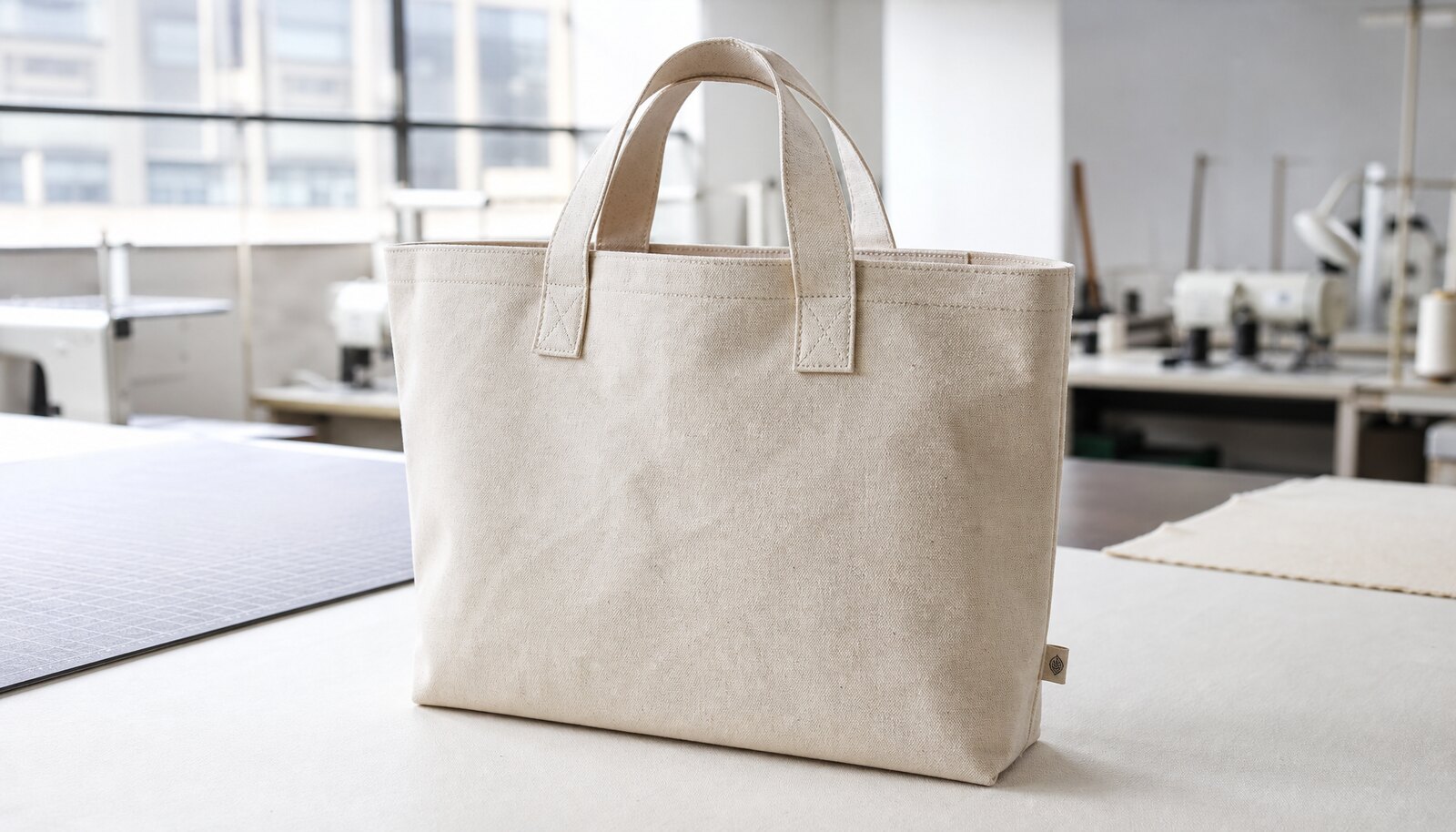
Why cosmetic brands need a stricter tote inspection than generic promo bags
Heavy canvas tote bags for cosmetic brands are judged differently from ordinary promotional totes. A beauty shopper notices fabric body, print sharpness, and handle finish immediately because the bag sits next to products with premium packaging. If the tote looks soft, crooked, or cheap, it weakens the brand story even when the cosmetics inside are strong.
That is why procurement teams should treat the tote as a retail item, not an expendable giveaway. The buying problem is usually not just cost; it is whether the factory can hold a consistent look across the whole order. For this product, the inspection checklist must control fabric weight, print method, handle reinforcement, and packing presentation before the order leaves the factory.
- Beauty buyers usually need a more structured hand-feel than standard promo totes.
- Small defects are visible because the bag is often photographed, gifted, or resold.
- The tote has to survive products with hard corners, glass, or metal closures.
- A weak quote often hides assumptions on fabric weight, print colors, and packing.
Set the base spec before you compare suppliers
The fastest way to get misleading quotes is to ask for a "heavy canvas tote" without defining what heavy means. In practice, most cosmetic-brand orders work well in the 12–16 oz range. A 14 oz cotton canvas is often the best middle ground because it holds shape, accepts printing well, and keeps sewing manageable. If the bag is meant to carry boxed skincare or multiple items, a 16 oz canvas can improve body, but the supplier may need stronger machine setup and more careful seam control.
Fabric weight alone does not tell the full story. You also need to define fabric finish, shrinkage control, and whether the bag should be natural, bleached, dyed, or washed for a softer retail look. If the artwork depends on a clean background, natural canvas can show specks and shade variation that are normal for the fiber but not acceptable if the brand expects a pure white appearance.
- Use ounces or GSM in the RFQ and avoid wording like "thick canvas".
- State the bag’s intended load: sample kit, gift bundle, retail purchase, or event carry.
- Give exact finished dimensions, gusset depth, and handle length.
- Decide whether the tote must stand upright or only lay flat in pack.
How fabric weight changes cost, hand-feel, and production risk
Higher fabric weight raises material cost, but it also changes cutting yield, sewing speed, and print appearance. On a thick canvas, the edges are more rigid and the machine needs stronger needle and thread settings. That can improve the final feel, but it can also increase skipped stitches or puckering if the factory is not experienced with the gauge. Buyers should read the quote with this in mind: if one supplier offers a much lower price on 16 oz than everyone else, the likely tradeoff is either thinner actual fabric, weaker finishing, or reduced QC effort.
The best practice is to ask for the basis weight, not just the marketing description. A supplier may say 14 oz, but the real finished fabric could vary based on weave density, coating, or post-treatment. For a cosmetic brand, the buyer should approve a physical sample and compare it against a known reference for stiffness, panel drape, and seam bulk. If the bag is too soft, it can look limp at shelf. If it is too hard, it can feel industrial instead of premium.
- 14 oz usually balances retail appearance and sewing stability.
- 16 oz is better for structured feel but can slow stitching and raise wastage.
- Finished fabric weight should be referenced in the sample approval note.
- If the tote needs inner lamination or coating, confirm how that changes print adhesion.
Choose the print method based on artwork complexity and order size
For most cosmetic-brand totes, screen printing is the default because it gives sharp logos, good opacity, and predictable cost at volume. It works well for one-color or two-color branding and is usually the safest option for thick canvas. If the artwork includes gradients, tiny text, or multiple photo-like details, the factory may propose digital print or transfer. Those methods can work, but they need closer approval because they often look different on canvas than on paper or screen.
The buyer should not accept the print method as a supplier preference alone. Ask how the ink sits on the canvas, whether the print will crack after folding, and how the factory will control alignment across repeated runs. For cosmetic packs, logo placement matters a lot. A print that is 1 cm too high or too low can break the premium look when the bag is stacked on a shelf or shown in product photography.
- Screen print for simple logos, clear brand marks, and repeat orders.
- Heat transfer for complex artwork or limited runs, but verify durability.
- Digital print only when design detail matters more than ultra-low cost.
- Require a strike-off or decorated sample before bulk approval.
Comparison of sourcing routes for heavy canvas cosmetic totes
The right sourcing route depends on how stable your spec is. If the bag is a repeat item with simple artwork, a direct factory usually gives better control and a cleaner price structure. If the order is small, highly customized, or combined with mixed packaging needs, a trading company can sometimes simplify coordination. The issue is not who is "better" in general; it is which route can own the spec, sample control, and QC responsibility without adding hidden cost.
Procurement teams should compare the route, not just the quote. A cheaper unit price from a middleman can turn into a higher landed cost if samples take longer, carton labeling is inconsistent, or the supplier cannot answer basic construction questions. Use the comparison below to pressure-test where the real risk sits.
Inspection table: what to compare before you place the order
Define the measurable checks around fabric weight, size tolerance, handle pull, seam strength, logo rub, stains, loose threads, and carton count verification. Add tolerance ranges only where the buyer truly cares, and ask for photos that show the measurement point, not just a finished product overview.
For measurement and defect checks, the inspection note should say who checks, when they check, and what evidence is required. Photos without measurements are often not enough for remote approval.
- Write decisions in measurable language, not only descriptive wording.
- Ask for sample photos plus one physical approval sample for important orders.
- Keep quotation, sample approval, and inspection notes tied to the same spec version.
Run the sample stage like a production rehearsal
A useful sample is not a showroom piece; it is a production rehearsal. The pre-production sample should use the exact canvas weight, thread, print method, handle material, and packing style that will be used in the bulk order. If the supplier sends a cleaner or lighter sample than the final spec, the approval is meaningless and the problem will show up later in the production lot.
The sample should be checked in the same way the received shipment will be checked. Look at seam symmetry, handle attachment, print position, thread trimming, and bag shape after a light fill test. For cosmetic bags, one of the most overlooked checks is surface scuffing. A tote that rubs cleanly in the sample stage can still pick up marks if the factory changes packing or stacks cartons too tightly.
- Approve one physical sample as the standard reference, not just a PDF image.
- Test print sharpness after folding and light rub handling.
- Check handle reinforcement with a light load, not just visual inspection.
- Record any approved variance in writing before mass production starts.
QC thresholds that catch the defects buyers actually complain about
Most tote failures are simple and predictable: print misplacement, crooked handles, loose threads, seam breakout, and visible shade variance. Buyers should define what counts as a major defect before the factory starts cutting. For example, if the tote is meant to be symmetrical, a handle that is visibly offset is not a minor issue. Likewise, a logo that sits too close to a seam may look acceptable on one sample but become unacceptable across a retail batch because the human eye catches the imbalance immediately.
A practical QC standard should focus on presentation and function. The bag has to carry weight without stressing the seams, keep its shape in packing, and arrive clean enough for shelf or gift use. That means the inspection team should examine not only random pieces, but also carton pack consistency. If the factory mixes sizes or folds differently from carton to carton, the receiving team may reject otherwise usable product because the unpacked presentation is messy.
- Major defect examples: broken stitch, wrong size, severe print shift, torn canvas, dirty bag.
- Minor defect examples: small loose thread, slight wrinkle, minor thread trimming issue.
- Use an AQL framework or a written defect limit for consistency.
- Inspect at least one carton opening pattern from each production lot or color.
Packing, carton marking, and logistics details that affect landed cost
Packing is often treated as an afterthought, but for heavy canvas totes it changes freight cost and retail readiness. A flat-packed tote with a controlled fold uses less carton space and reduces dimensional weight. If the bag includes tissue, insert cards, or individual polybags, the quote should show how much that packaging adds to carton count and gross weight. Buyers comparing two suppliers on unit price only can easily miss that one factory is shipping denser cartons with fewer bags per carton.
Carton marking matters for inbound receiving as well. The carton should show style number, color, size, quantity, and gross/net weight clearly. If multiple artwork versions are included in one shipment, the outer carton labels need to separate them cleanly. Otherwise the warehouse may open the wrong carton first and delay the launch. For cosmetic brands, that can cause a release problem even when the bags themselves are acceptable.
- Confirm whether each bag is folded, tissue-wrapped, polybagged, or bulk-packed.
- Ask for carton size and quantity per carton before confirming freight mode.
- Make sure carton markings match your SKU system exactly.
- If retail presentation matters, review one packed sample carton before bulk starts.
Lead time planning and quote structure for cleaner RFQs
A serious quote for heavy canvas tote bags should break the schedule into stages: fabric booking, sample approval, print plate or screen setup, bulk sewing, packing, and ex-factory readiness. If the supplier gives only one total lead time, it is hard to see where the delay risk sits. For cosmetic launches, print approval is often the critical path because artwork revision can pause everything else. That is why the buyer should lock artwork early and ask the factory to separate the approval window from the manufacturing window.
The quote should also distinguish one-time charges from recurring unit cost. Setup fees, screen charges, print plates, sampling fees, and special packaging can make a low unit quote look attractive at first glance. Procurement teams should compare landed cost using the same assumptions for fabric weight, print color count, pack style, and carton quantity. If the supplier cannot show those assumptions clearly, the quote is not ready for decision-making.
- Request a line-item quote for sample, setup, unit cost, packing, and extra print colors.
- Ask for production lead time by stage, not one undifferentiated date.
- Confirm whether rush orders change MOQ or pricing.
- Build a buffer for print approval and first-article correction.
Specification comparison for buyers
| Spec decision | Recommended option | When it fits | Buyer risk to check |
|---|---|---|---|
| Fabric weight | 12–16 oz cotton canvas, with 14 oz as the common retail-safe middle | Cosmetic brands that need a structured tote with enough body for gifts, samples, or bundled purchases | Too light feels cheap and collapses; too heavy can distort print and raise unit cost and sewing difficulty |
| Fabric finish | Pre-shrunk or tightly controlled greige-to-finished fabric with low shade variation | When color consistency matters across multiple retail drops or promotional runs | Shrinkage after washing or wet exposure can warp seams, handles, and print alignment |
| Print method | Screen print for simple logos; heat transfer or digital print only for short runs or complex art | Brands with clear one- to two-color logos and a need for stable pricing at volume | Overly detailed art on thick canvas can bleed, crack, or look muddy if the supplier pushes the wrong method |
| Handle construction | Reinforced self-fabric or cotton webbing handles with box-x or bar-tack stitching | For heavier cosmetic kits, event giveaways, or retail bags that will carry glass and boxed items | Weak handle attachment is the first field failure; single-row stitching is not enough on heavy canvas |
| Supplier route | Direct factory for repeat volume; trading company only if it adds QC, consolidation, or small-run flexibility | Brands that have stable artwork and a clear forecast | Hidden markups, vague specs, and unclear responsibility for defects can make quotes look cheaper than they are |
| MOQ strategy | Start with 500–1,000 pcs per color/style for custom production; lower only if stock fabric and simple print are used | New cosmetic launches or pilot retail tests | Very low MOQs often mean limited color control, no dedicated QC, or higher per-unit packaging costs |
| Packing method | Flat-packed with tissue insert and carton master labeling; polybag only if retail presentation or moisture protection is needed | When bags must arrive clean, crease-managed, and shelf-ready | Overpacking can increase freight; underpacking creates wrinkles, dirt, and shape loss in transit |
| Inspection level | AQL-based final inspection plus pre-production sample and top-of-production approval | Any order where brand presentation matters and the bag will be visible at retail or unboxing | Skipping midline checks can hide print drift, seam puckering, or shade mismatch until the whole lot is finished |
Buyer checklist before sampling
- Confirm the target fabric weight in oz or GSM, plus whether the canvas is bleached, natural, dyed, or enzyme-washed.
- Lock the tote dimensions, gusset depth, handle length, and usable opening width in a spec sheet, not just a sketch.
- State the logo size, print placement, Pantone reference if applicable, and whether the print must pass rub or wash testing.
- Require a sewn sample or pre-production sample with the exact fabric, thread, print method, and packing style.
- Define stitching minimums at handle stress points, seam allowance, and whether bar-tacks or box-x reinforcement is mandatory.
- Review carton pack-out, inner packing, master carton markings, and drop-test expectations before production starts.
- Ask the factory to separate fabric, printing, sewing, and packing lead times instead of giving one vague delivery date.
- Request a clear defect policy for loose threads, misprints, crooked handles, off-size bags, and shade variation.
Factory quote questions to send
- What exact canvas weight are you quoting, and is that finished fabric weight or greige basis weight?
- Which print method are you pricing, and how many colors are included in the quoted price?
- Are handle reinforcements box-x, bar-tack, or simple cross stitching, and how many stitches per reinforcement area are standard?
- Does your MOQ change by fabric color, print color count, or packaging requirement?
- What sample stage do you supply before bulk production, and what changes are allowed after approval?
- How do you pack each tote for shipment, and what is the carton quantity, carton size, and gross weight target?
- What is your expected lead time by stage: fabric booking, print approval, sewing, packing, and ex-factory shipment?
- Which defects are counted as major versus minor in your inspection standard?
- Can you provide photos or records of previous tote production with similar canvas weight and print complexity?
Quality-control points to confirm
- Fabric weight should be within the agreed tolerance; the buyer should define the acceptable range before sampling, not during inspection.
- Canvas should be even in weave, without slubs, holes, oil stains, or obvious shade bands between panels.
- Print should sit in the agreed placement zone, with clean edges, no pinholes, no obvious ghosting, and no color shift versus the approved sample.
- Handle length tolerance should allow consistent shoulder carry or hand carry as specified; uneven handles are a common retail complaint.
- Stress-point stitching at handles and side seams should be dense, straight, and free of skipped stitches or thread breakage.
- Bag dimensions should be checked flat and filled lightly; heavy canvas can shrink visually if the pattern is not controlled.
- Interior seams should not unravel, and seam allowances should be consistent enough to survive transit and store handling.
- Packaging must keep the tote clean, flat, and traceable by carton; missing size marks or carton labels create receiving errors.
- Final shipment should match the approved sample for fabric tone, print finish, and overall construction feel.