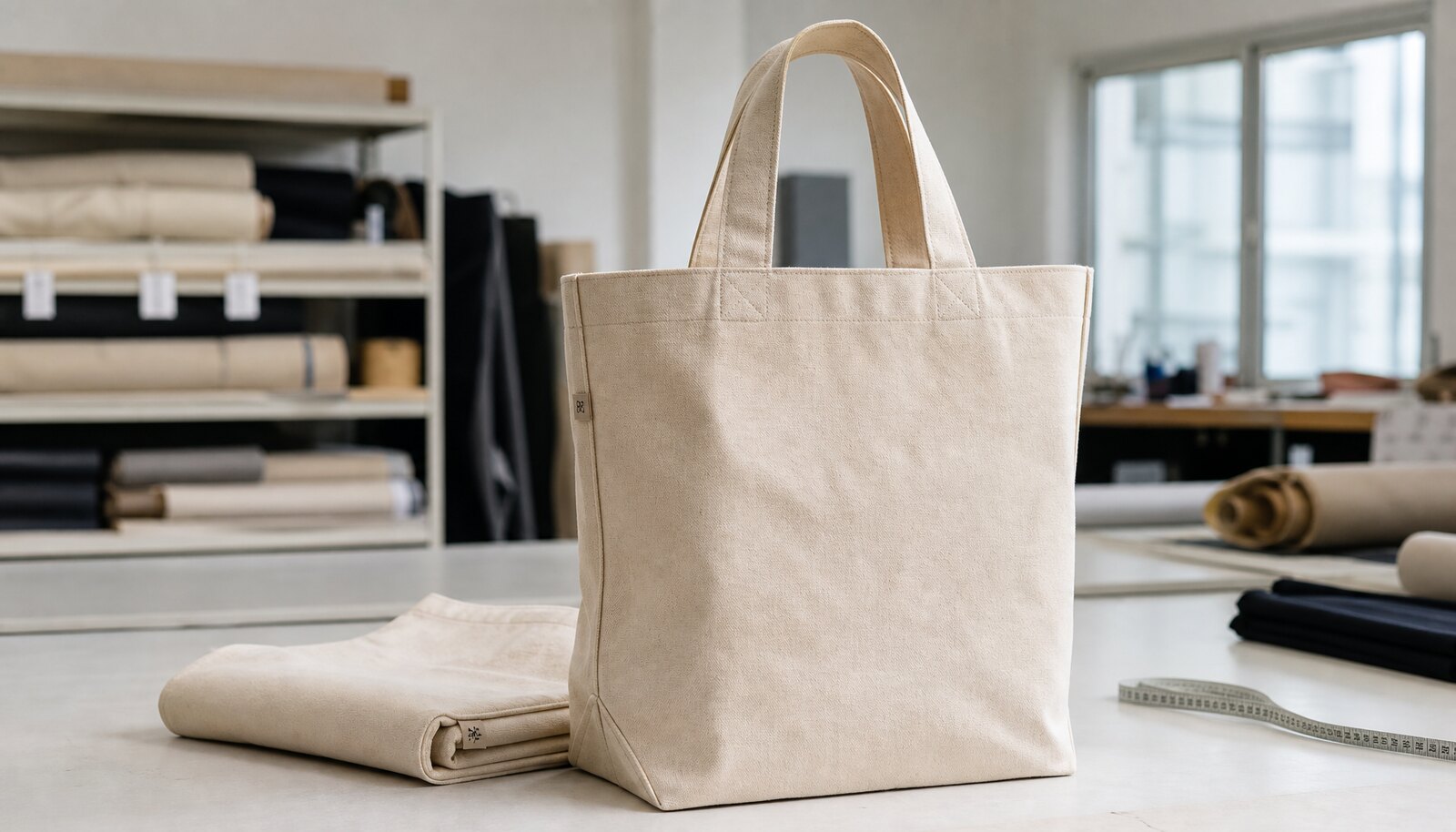
Why heavy canvas tote pricing is easy to misread
For apparel brands, heavy canvas tote bags sit between packaging, promotional item, and retail accessory. That makes first-round pricing easy to misread. One supplier may quote a low unit price on a vague spec, then add cost later for heavier fabric, tighter stitching, better print, custom labels, or export-ready packing. Another supplier may quote a higher number because the offer already includes the details your merchandising team will expect on shelf.
The right pricing plan starts with use case, not with the cheapest number in the inbox. A tote sold beside apparel needs cleaner print registration and a more finished hand feel than a simple event giveaway. A tote used as a purchase-with-purchase item needs enough structure to hold its shape in store and enough seam strength to survive repeated carry. A tote shipped with a capsule collection may also need carton rules that fit your DC and store receiving process. Once the job is clear, you can compare bulk pricing much more accurately.
It also helps to think like a brand buyer rather than only a procurement buyer. The tote may affect perceived value for the apparel it sits next to. If the canvas looks flimsy or the print looks cheap, that perception can drag on the collection it supports. So the buying plan should protect margin, but it should also protect merchandising quality.
- A low quote often means a thinner spec, simpler packing, or less inspection scope.
- Retail-facing totes usually need stronger fabric and cleaner finishing than giveaway bags.
- Price comparison only works when the spec, packing, and QC scope are locked first.
Start with the spec that actually drives cost
Heavy canvas is not one fixed material. In buyer language, you are usually choosing between 12 oz, 14 oz, and 16 oz canvas, which roughly maps to about 400–540 GSM depending on weave and finish. For apparel brands, 12 oz often works for a structured but cost-conscious tote, while 14 oz to 16 oz is better when the bag is part of the premium mix or needs to carry heavier folded garments, catalogs, or boxed items.
Size changes the cost structure more than many RFQs show. A smaller but dense tote can cost more to sew per square inch than a larger, simpler body because of cut waste, shorter seam runs, and the same labor spread over fewer units of fabric. Gusset depth, handle width, top hem reinforcement, lining, and bottom structure all change labor time. If the buyer wants a clean retail look, the factory may also need tighter cut control and better seam consistency, which adds cost before printing starts.
For procurement work, ask the factory to separate the quote into fabric, cutting, sewing, print, packing, and optional trims. That makes it easier to see whether a higher price is coming from a genuinely better construction or from a wider margin built into the offer. It also helps merchandising teams understand what they are paying for when they choose one version over another.
- Use GSM or oz in the RFQ, but define whether the weight is pre-wash or finished fabric.
- State finished dimensions, not only approximate size, and include tolerance expectations.
- If the tote needs structure, specify whether you want a bottom board, lining, or reinforced top hem.
Choose the print method before you compare unit prices
Print method is one of the biggest price drivers in bulk pricing. For heavy canvas tote bags for apparel brands, one-color or two-color screen print is usually the most balanced route when artwork is bold and repeatable. It gives good opacity on natural canvas and usually holds up better in retail handling than many low-cost transfer options. If the artwork is complex, the supplier may propose heat transfer, digital transfer, or embroidery, but each option has a tradeoff in durability, texture, and cost.
Screen print is not automatically the cheapest choice if the art changes often or if you need very small runs. For short collections, region-specific logos, or campaign-specific graphics, transfer printing can reduce setup work. The tradeoff is that buyers should verify rub resistance, fold performance, and edge quality after the bag is packed and unpacked several times. Embroidery can look premium, but on thick canvas it adds labor, needle damage risk, and a higher chance of puckering if the placement sits too close to a seam.
A strong RFQ should include artwork format, Pantone targets if you use them, print area in centimeters, color count, and whether the design crosses seams or wraps around the gusset. It should also say whether a lighter, distressed, or fully opaque look is acceptable. Those details help the factory quote the correct method instead of defaulting to the cheapest one. They also reduce the chance that the sample looks acceptable while the bulk lot misses brand standards.
For apparel buyers, print choice also affects merchandising. A strong, simple graphic can read better on a shelf display or in an e-commerce image than a busy print with weak edges. If the tote is going to be photographed next to a garment line, insist on a print method that supports visual clarity at both product and campaign level.
- Screen print usually suits larger repeat orders and simple brand graphics.
- Transfers can work for low MOQ, but test cracking, peeling, and edge lift after folding.
- Embroidery looks premium but increases labor, needle risk, and cost quickly on thick canvas.
A practical supplier comparison for bulk pricing
The cheapest route is not always the best route for apparel brands. A direct factory quote often gives the cleanest cost structure because sewing, printing, and packing sit under one control point. Trading companies can be useful if you need multi-item consolidation or if your internal team wants one point of contact, but they may add margin without improving process control. Regional converters may help with short lead times, though their fabric options and printing capacity can be narrower.
When a brand buyer compares sourcing routes, the question is not only price. It is who owns each production step, who signs off on samples, and who absorbs the risk if the print shade, bag size, or carton count drifts. That is the real basis for choosing a bulk pricing plan. The best comparison is not quote versus quote; it is production route versus production route using the same spec version.
A fair comparison also needs the same commercial terms. Ask each supplier to quote the same Incoterm or the same ex-factory basis, the same sample scope, the same packing style, and the same inspection standard. Otherwise, the cheapest line item may be hiding extra charges in packing, export handling, or quality control. If one supplier includes carton marks and another does not, the price gap is not a true price gap.
One useful way to evaluate a mill or factory is to ask for evidence that matches the tote program you actually need. For the fabric source, request the exact canvas construction, the mill spec or fabric reference, shade tolerance range, and shrinkage behavior if relevant. For the sewing factory, ask how they control handle symmetry, top hem folding, and seam strength. For the printing partner, ask how they manage screen registration, ink opacity, and cure consistency on thick canvas. A supplier does not need to be perfect in every category, but they should be able to explain their controls clearly and without hesitation.
- Ask whether printing is in-house or outsourced.
- Confirm who approves the strike-off and who approves the sewing sample.
- Request the same quote structure from each route so comparisons stay fair.
- Ask the supplier to identify the actual mill or fabric spec if the canvas is not standard stock.
- Use the same packing and inspection assumptions for every quote, or the comparison is distorted.
MOQ: where pricing improves and where it only creates waste
MOQ logic is simple in theory and messy in practice. Fabric order minimums, printing setup, sewing line efficiency, and carton packing all influence the break point. A factory may offer 250 pieces for a simple natural tote with one-color print, but the same factory may require 1,000 pieces if the bag needs dyed canvas, multiple print hits, custom woven labels, or special packing. That is not always a sales tactic; it is often how production economics work.
For apparel brands, the right MOQ is the one that fits the assortment plan. If you are testing a new tote as a seasonal add-on, a smaller run with a slightly higher unit cost may be safer than overbuying. If the tote will sit in a core range and reorder regularly, a larger run can lower the cost of fabric, print setup, and packing. The key is to know what the quoted MOQ is tied to: dye lot, print screen setup, sewing batch, carton allocation, or label sourcing.
Tiered pricing is only useful if the break points are real. Ask the supplier to show pricing at practical volumes, not just a single best-case number. For example, a supplier may offer one price at 500 pieces, another at 1,000, and a third at 3,000. If your plan is 1,200 pieces, you should know whether the price behaves like the 1,000 tier or whether the extra 200 pieces still carries the higher setup cost. That detail matters for margin planning because a bad assumption at the tier boundary can erase the savings you expected from a stronger sell-through.
- Small MOQ can be acceptable if the spec is simple and the art is stable.
- Tiered pricing should show clear breaks at realistic volume steps.
- If the supplier cannot explain the MOQ basis, compare that quote cautiously.
Build the landed-cost plan, not just the factory price
A bulk pricing plan should show landed cost in a way your procurement team can actually use. Start with ex-factory price, then add packing, inland transfer, export carton cost, freight allocation, duty or tax assumptions, and any local receiving or repacking expense. Heavy canvas can move freight cost more than expected because the material is dense, and carton weight rises quickly when bags are packed flat in large counts.
A buyer may find that a slightly more expensive factory quote delivers a lower landed cost if the supplier packs more efficiently or reduces defect risk. For example, a neatly flat-packed tote with controlled carton quantity may cut volumetric waste. Likewise, a direct factory that includes carton marks and export-ready packing can save labor at the destination warehouse. The cheapest unit price is not the same thing as the lowest total cost in your DC.
The landed-cost worksheet does not need to be fancy. List unit price, multiply by quantity, add sample fees if they are non-refundable, then add packing or label charges, freight, and customs assumptions under the same baseline used by finance. If two quotes look close, landed cost often exposes the real winner. This is also where brand teams should weigh margin impact. A tote that looks slightly more expensive at factory level may support a better retail price, a cleaner display, or lower in-store handling cost, which can matter more than a few cents at purchase order stage.
If you are buying for multiple markets, build the landed cost by destination rather than using a single blended number. Freight, duty, and warehouse handling can vary enough to change the decision between one tote spec and another. That is especially true for heavy canvas, where modest changes in packed weight can affect the final rate more than buyers expect.
- Ask for gross weight per carton and carton dimensions before comparing freight.
- Request unit price by tier plus packing cost if packing is optional.
- Do not ignore repacking labor if the factory packing format differs from your DC standard.
- Compare landed cost by destination if the bags will ship to more than one market.
Sample approval should cover material, print, and structure separately
Heavy canvas tote bags are easy to misread in photos and easy to underestimate in samples. That is why sample approval should be split into three checkpoints: fabric swatch approval, print strike-off approval, and pre-production sample approval. A swatch confirms hand feel, thickness, and color. A strike-off confirms color density, registration, and line sharpness. A pre-production sample confirms sewing, handle length, gusset shape, and finished packing method.
If the supplier only sends one sample and calls it final, you lose visibility into where the product is likely to fail in bulk. In practice, many tote issues are not print issues at all. They are cut-size drift, handle asymmetry, poor top hem folding, or stitch tension that shows up only when the bag is loaded. For apparel brands, that means sample approval should include a load test and a visual check after the bag is filled.
If your program includes branded labels, woven tabs, care labels, or hangtags, approve those details before bulk release too. A tote can look correct in a flat sample and still miss the retail presentation standard once folded and labeled. That is especially important when the tote will be merchandised with apparel, where visual consistency matters across the whole product set. In many apparel programs, the tote is part of the story rather than a side item, so sample approval should protect brand cohesion as well as construction quality.
A good approval record should be easy to follow later. Keep one signed version of the tech pack, one signed sample, one strike-off image, and one note on any approved deviation. That keeps production aligned if personnel changes mid-order or if the factory asks for clarification after the order is already in motion.
- Compare sample measurements to the tech pack, not to memory.
- Put print color reference and fabric shade reference in the approval record.
- If the bag uses labels, approve placement, fold direction, and label finish separately.
- Keep one signed sample record so bulk production has a clear reference.
Packing choices that affect damage, receiving time, and shelf readiness
Packing is a real cost and a real risk. Heavy canvas tote bags are often packed flat, but the fold direction and internal wrap method can affect crease marks and shelf presentation. Some apparel buyers want each tote in a polybag; others prefer a paper band or no individual wrap to reduce plastic use and save cost. The right answer depends on whether the tote is sold as a finished item, inserted into apparel cartons, or shipped to a DC for relabeling.
Carton discipline matters more once you scale. A quote should state the quantity per inner pack and master carton, carton dimensions, gross weight, and outer marking format. If you receive mixed SKUs or inconsistent counts, warehouse labor goes up fast. Better packing rules at the factory usually save more than they cost. They also reduce the chance that stores receive a carton that needs immediate repacking before it can be placed on shelves.
For apparel brands, merchandising can be affected by pack format before the bag ever reaches the customer. If the tote is displayed folded beside folded apparel, the fold lines, handle lay-flat position, and label visibility matter. If the tote sits in a shipping carton until store replenishment, then carton strength and easy identification matter more. In other words, packing should be designed around the selling channel, not just around factory convenience.
If you already know your warehouse standards, share them in the RFQ. That lets the factory quote the right labor and material mix from the start. It also keeps the supplier from using a cheap retail pack style that creates downstream work in your distribution center. In many bulk tote programs, the hidden savings come from reducing touch points rather than from shaving a small amount off the unit price.
- Request one packing style for samples and another for bulk only if you truly need the difference.
- Set max carton weight to match your warehouse handling rules.
- Use SKU-level carton marks if there are multiple colors, sizes, or art versions.
- Choose packing around the channel: retail shelf, DC intake, or direct-to-store replenishment.
QC details that are specific enough to stop avoidable claims
Quality control for canvas bags should be more than a visual pass/fail. Start with measurement checks: overall body size, gusset depth, handle length, and handle drop. Then check construction: seam allowance consistency, top hem fold, handle attachment, bar-tack placement, and cut edge cleanliness. For print, verify registration, ink coverage, color match, and curing quality. For presentation, check fold consistency, label position, and carton count.
If you want a practical inspection approach, ask the supplier what standard they use for in-line checks and final inspection. Many buyers use an AQL-style final inspection with a defined acceptance level, then add product-specific checks for tote features that matter most. The point is not the label on the method; the point is that the inspection plan is written down, shared, and tied to the risks of the bag. For heavy canvas, the most common failure points are handle reinforcement, print quality, and inconsistent dimensions.
Test methods should match the bag’s use. A simple load test can reveal whether the handles or shoulder seams are strong enough for real carrying conditions. A rub check on the print can show whether ink is curing correctly. A fold-and-unfold check can reveal cracking or edge lift on transfer prints. If the tote is expected to withstand retail handling or repeat customer use, ask for a small number of samples to be tested before bulk release instead of waiting for complaints after arrival.
If your brand uses wash or care exposure tests, define the standard in plain language. State the number of cycles or the type of exposure, and decide in advance what failure looks like: color bleed, print damage, shrinkage beyond tolerance, seam distortion, or handle failure. That avoids arguments later about whether a result is acceptable. It also keeps the supplier from assuming a lighter standard than your brand actually needs.
The most useful QC programs are the ones that connect product and commercial risk. A tote with slightly uneven stitching may still be usable for a free gift, but the same issue can be unacceptable for a retail accessory displayed next to premium apparel. Your inspection threshold should match how the tote will be sold, not just how it looks in a production photo.
- Check size, seam, print, and packing separately rather than as one general visual inspection.
- Use AQL-style final inspection if your team already works that way, but add tote-specific checks.
- Run load, rub, and fold checks on approved samples before bulk release.
- Write down what counts as a failure for wash or care exposure if those tests apply.
A simple pricing scenario by order volume
The easiest way to pressure-test a pricing plan is to model one practical buyer scenario. Imagine an apparel brand ordering a natural heavy canvas tote with one-color screen print, self-fabric handles, flat packing, and standard export cartons. At 500 pieces, the quote may look higher because print setup and cutting labor are spread over fewer units. At 1,500 pieces, the unit price usually drops because setup cost is diluted. At 5,000 pieces, the biggest savings often come from fabric purchase efficiency, sewing rhythm, and more predictable packing.
Now change one variable. If the same tote moves from natural to dyed canvas, or from one-color print to two-color print, the unit price may rise even at the same volume because of additional setup, color control, or slower production. If you add a woven label, each piece may rise again even if the bag shape stays the same. This is why the right question is not simply, 'What is your best price?' It is, 'What is the price at my target spec, at my target quantity, with my required packing and QC scope?'
For planning purposes, buyers often compare three volume bands: test order, launch order, and repeat order. The test order should favor learning and approval speed. The launch order should favor acceptable margin and reliable delivery. The repeat order should favor cost efficiency and stable replenishment. That structure helps merchandising, finance, and procurement align on one tote strategy instead of treating every purchase as a fresh negotiation.
The commercial nuance for apparel brands is that the tote may support a higher-value assortment. A better tote can lift perceived value around a collection and justify a premium bundle or gift-with-purchase. That means the lowest tote price is not always the smartest choice. If a slightly heavier canvas or cleaner print creates a better retail display and reduces markdown pressure on the associated apparel, the margin impact can be positive even if the tote itself costs more. Procurement should make room for that discussion rather than focusing only on per-piece savings.
- Use three planning bands: test, launch, and repeat.
- Ask the factory to price your exact spec at each tier, not an adjusted spec.
- Track whether price drops come from volume or from reduced quality scope.
- Evaluate the tote’s effect on bundle value and shelf presentation, not just on standalone cost.
Specification comparison for buyers
| Buying route / spec choice | Best fit | Typical strengths | Buyer risk to check |
|---|---|---|---|
| Direct factory, in-house sewing and printing | Apparel brands that want tighter cost control and fewer handoffs | Cleaner accountability, easier sample traceability, fewer middle layers | Confirm whether any trimming, washing, or printing is quietly outsourced |
| Trading company / sourcing agent | Brands that need one contact across multiple SKUs or categories | Convenient coordination, broader category consolidation | Margin may be hidden; verify spec lock, factory identity, and QC responsibility |
| Regional converter near market | Short runs, urgent replenishment, or programs needing fast reorders | Shorter transit, easier communication across time zones | Fabric options may be narrower and true bulk economics can be weaker |
| 12 oz natural canvas | Retail totes with a lighter premium feel and moderate carry load | Lower cost, good print visibility, easier sewing than very heavy canvas | Can feel soft or underbuilt if the bag is meant to carry dense products |
| 14 oz canvas | Most balanced option for apparel brand retail programs | Better structure, better perceived value, good print support | Need to verify seam strength and handle reinforcement at actual load |
| 16 oz canvas or heavier | Premium accessories, gift-with-purchase programs, and heavy carry use | Strong hand feel, better shape retention, more substantial shelf presence | Higher unit cost, more sewing difficulty, and higher freight weight |
| Screen print, 1–2 colors | Simple branding with repeatable artwork | Cost-efficient at scale, good opacity on natural canvas | Coarse weave can affect fine detail; registration must be checked carefully |
| Transfer or digital transfer | Short runs or variable art | Useful for low MOQ or complex graphics | Risk of cracking, edge lift, and poor rub performance if not tested |
| Self-fabric handles | Retail totes that need a clean, integrated look | Simple appearance, fewer material inputs | Need reinforcement and bar-tacks to avoid handle failure |
Buyer checklist before sampling
- State finished tote dimensions, gusset depth, handle drop, and acceptable tolerances before requesting quotes.
- Specify canvas weight in GSM or oz and note whether the fabric should be natural, bleached, dyed, washed, or pre-shrunk.
- Define the tote’s job: retail resale, purchase-with-purchase, gift-with-purchase, carrier bag, or premium accessory.
- List print method, color count, print area, and whether the artwork crosses seams or wraps around the gusset.
- Ask for separate approvals for fabric swatch, print strike-off, pre-production sample, and any label or hangtag sample.
- Confirm folding method, individual wrap type, carton quantity, master carton marks, and carton weight limits.
- Set defect acceptance criteria for stitching skips, stains, shade variation, misregistration, size drift, and loose threads.
- Ask when lead time starts: after deposit, after sample approval, or after all packaging components are approved.
- Request proof of whether the supplier is quoting direct factory, trading company, or mixed sourcing.
- Ask for landed-cost items separately so freight, duty assumptions, and destination handling do not get buried in the unit price.
Factory quote questions to send
- What canvas weight do you propose, and is that based on finished fabric after shrinkage or mill spec before washing?
- Is the quotation based on in-house sewing and printing, or are any steps subcontracted?
- What is the MOQ per color, per artwork, and per size, and how does price change by tier?
- What exactly is included in the unit price: fabric, cutting, sewing, print, labels, packing, cartons, and inspection?
- Can you share separate timelines for strike-off, pre-production sample, bulk production, and shipping?
- What are your tolerances for bag size, handle length, print placement, and seam alignment?
- What inspection standard do you use for stitching, stains, print defects, and measurement variance?
- What gross weight and carton dimensions should we use for freight and warehouse planning?
- Which mill or fabric specification is used if you have more than one source option?
- What cost changes if we switch from natural canvas to dyed or pre-shrunk canvas, or from self-fabric handles to webbing handles?
Quality-control points to confirm
- Confirm finished size against the approved tech pack, commonly within +/- 1 cm for small totes and +/- 1.5 cm for larger bodies unless the construction is intentionally soft.
- Check canvas weight against the approved swatch or lab spec; the bulk lot should not appear visibly thinner or looser under normal inspection light.
- Inspect handle attachment for bar-tacks or equivalent reinforcement, with no loose ends, skipped stitches, or needle damage at stress points.
- Verify print placement against the signed strike-off; check color density, registration, edge sharpness, and overlap where art crosses seams.
- Check seams for straight sewing, no broken stitches, no seam slippage, and no puckering that distorts the bag shape.
- Review top hem, gusset, and bottom corners for symmetry because those points often reveal cut or sewing drift.
- Look for stains, lint contamination, oil marks, broken threads, and panel shading mismatch beyond the approved tolerance.
- Confirm carton counts, carton markings, and compression resistance so bags arrive without crush damage or repacking surprises.
- For retail-ready programs, verify fold direction, handle lay-flat position, label placement, and outer presentation before release.
- Run a filled-bag stress check at the expected carry load to catch handle or seam weakness before the full lot ships.