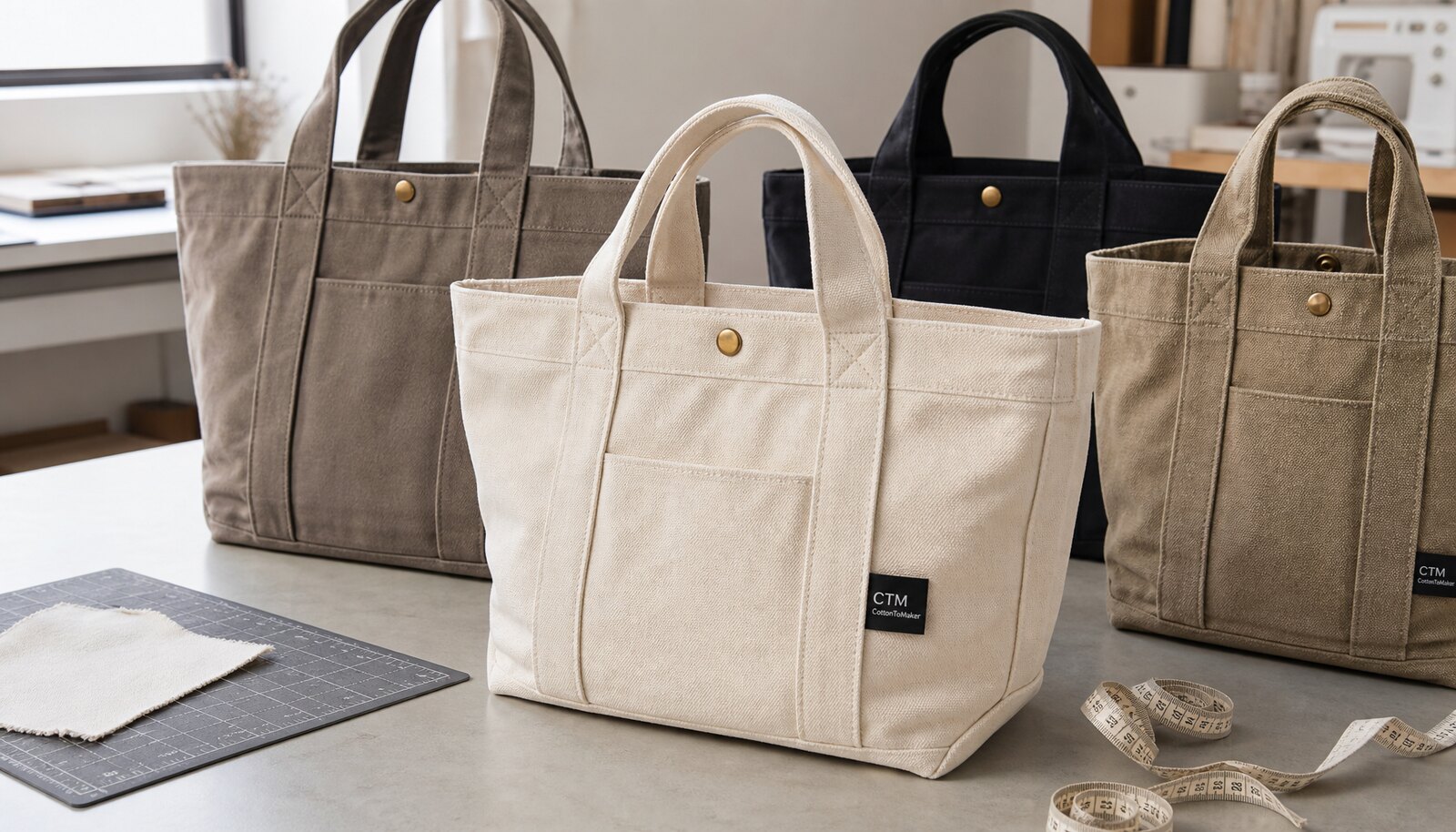
Why apparel brands need a stricter tote bag quote
Heavy canvas tote bags look simple, but apparel brands usually need them to perform like a retail accessory, not a cheap giveaway. That changes the quote. A bag that sits well beside folded garments needs the right fabric weight, a controlled finish, a clean print surface, and enough seam strength to survive customer use after purchase.
The most common sourcing mistake is treating the tote as a generic cotton bag. For a brand drop, the bag is part of the product line and often shares the same quality expectations as the apparel. That means the factory quote has to capture details that many sales sheets leave out: GSM, shrinkage, print method, handle reinforcement, and the packing standard that affects landed cost.
- A retail-ready tote must look consistent on shelf and in e-commerce photography.
- The quote should reflect the real build, not just a headline unit price.
- If the tote will carry apparel, the bag shape and handle strength matter more than decorative extras.
Start with the build spec, not the artwork
For heavy canvas tote bags, the fabric spec is the first cost and quality driver. Most apparel brands end up between 12oz and 16oz canvas. At the lower end, the bag is easier to fold, lighter to ship, and usually cheaper to sew. At the higher end, the tote holds shape better, feels more premium, and protects the print area from looking flimsy. If the bag is meant to sit next to apparel in a premium channel, 14oz or 16oz is often the safer starting point.
Use GSM or ounce weight in the RFQ, and do not stop there. Ask whether the canvas is raw, washed, or pre-shrunk. Raw canvas can be more economical, but shrinkage and skew are real risks after steam pressing or customer washing. A pre-shrunk or sanforized finish adds cost, yet it reduces unpleasant surprises when the bag is used with apparel packaging or resold in retail.
- 12oz canvas: lighter, lower freight, good for basic merch and short carry loads.
- 14oz canvas: balanced option for premium brand drops and repeat retail handling.
- 16oz canvas: best when shape retention and perceived value matter most.
- Specify seam allowance, gusset depth, and handle drop in millimeters, not just by sample photo.
What actually drives factory pricing
The unit price on a tote bag quote usually hides four separate cost buckets: fabric, sewing labor, print setup, and packing. Fabric is obvious, but print setup can be a big spread if the artwork has many colors or tight registration. A one-color logo on the front panel is a different job from a dense all-over graphic or a large tonal print that needs careful ink control.
MOQ logic also affects price more than buyers expect. A supplier may quote a good price at 3,000 units, then jump sharply at 500 because they cannot spread fabric loss, cutting time, and setup over enough pieces. When comparing factories, ask for the next price break, the setup fee, and any color-change surcharge. That makes the quote comparable instead of misleading.
- Fabric cost changes with GSM, weave density, dyeing, and whether the canvas is pre-shrunk.
- Print cost changes with color count, placement size, and whether a screen, plate, or transfer is required.
- Sewing cost changes with gussets, inner pockets, zippers, binding, and reinforcement details.
- Packing cost changes with polybag use, hangtag insertion, barcode labeling, and carton pack count.
Compare sourcing routes before you compare supplier names
A buyer often looks at several suppliers, but the real comparison should be between sourcing routes. One route is a direct factory that makes fabric-backed tote bags in-house. Another is a trade company that coordinates fabric, print, and sewing. A third is a mixed route where the factory handles sewing and a subcontractor handles printing or washing. Each route has a different risk profile, especially for apparel brands that need repeatability.
If your brand is launching a signature tote, the cleanest route is usually a factory that can control sewing and final packing under one roof, or at least under one quality system. If your order is small and you are validating demand, a trading route may be faster to sample, but you need stronger paperwork because responsibility can blur across multiple subcontractors.
- Direct factory: better control over stitch quality, packing, and production timing.
- Trading route: useful for lower MOQs or quick sourcing, but requires tighter documentation.
- Mixed route: flexible on materials, but the buyer must watch shade variation and hand-feel inconsistency.
Source comparison table for heavy canvas tote bags
Use this comparison to decide how much control you need versus how much flexibility you can tolerate. The cheapest route is not always the cheapest landed cost once sampling, defect handling, and inbound delays are added.
For apparel brands, a tote bag usually has to look consistent across the whole drop. That is why route selection should be based on repeatability, not only on initial unit price.
- Write decisions in measurable language, not only descriptive wording.
- Ask for sample photos plus one physical approval sample for important orders.
- Keep quotation, sample approval, and inspection notes tied to the same spec version.
Sample approval should include the same risk points as bulk
A common mistake is approving a sample that looks good but was made with different fabric, different print curing, or a more careful hand-sewn process than the bulk run. The pre-production sample should use the final canvas weight, final print method, and final label or side tag. If the factory says the sample is only a reference, it should not be used for final approval.
The best approval path is simple: confirm the strike-off or print proof, then approve the pre-production sample, then seal one TOP sample for the factory and one for your file. Measure the actual bag size, handle drop, and gusset depth, and check where the print lands after the bag is filled and folded.
- Compare sample and spec against a fixed measurement sheet.
- Test the handle load with a realistic weight, not just by hand lift.
- Inspect print edge clarity after light folding and rubbing.
- Review the label position so it does not create bulging in retail presentation.
Pack format, carton data, and freight volume matter more than many quotes show
Two quotes with the same unit price can land very differently if the packing format is not the same. A flat-fold tote with standard polybag and an efficient carton layout may be dramatically cheaper to ship than a loosely folded bag with oversized cartons. For importers, volume is part of the price. That is why carton dimensions, carton count, and gross weight per carton belong in the quote, not in a separate email thread.
If the tote is part of apparel kitting, the packing plan must also reflect retail receiving. Some buyers want individual polybags, size stickers, and barcode labels. Others want bulk packed units for distribution center repacking. The right answer depends on your warehouse process, but the factory needs a clear instruction set before production starts.
- State whether each bag goes in an individual polybag or only bulk carton packing.
- Require carton count per shipment unit and carton dimensions on the quotation.
- If labels are added, specify placement and whether they are sewn, woven, printed, or adhesive.
Lead time risk is usually a materials problem, not a sewing problem
When a supplier gives a short lead time, it is usually based on the sewing line being free, not on all inputs being ready. For heavy canvas tote bags, the common delay points are fabric dyeing, print queue time, label delivery, and bulk packing. A real schedule should separate sample approval time, material booking time, production time, and packing time.
For seasonal apparel launches, ask the supplier to state the longest likely delay, not just the best-case lead time. If the order requires a new print screen, a custom woven label, or a washed finish, those steps can extend the timeline even when sewing itself is straightforward. A clear schedule protects the launch date and reduces pressure to approve a weak sample under time stress.
- Short lead time without material booking detail is a risk flag.
- New artwork normally adds setup time, even if the bag shape is simple.
- Washed or pre-shrunk canvas usually takes more planning than raw canvas.
The landed-cost view: what to compare beyond unit price
A useful quote for apparel brands should show enough data to estimate landed cost. That means unit price, setup fees, sample fees, packing details, carton sizes, and any special labeling or kitting charge. If the supplier only gives one all-in number, you may not know whether the quote is truly competitive or simply stripped of necessary detail.
When comparing suppliers, normalize the data first. Match fabric weight, print method, packing format, and carton count before making price decisions. A bag quoted on 12oz canvas with a one-color screen print and loose bulk packing should not be compared directly with a 16oz pre-shrunk tote with woven side label and retail polybag.
- Normalize all quotes to the same fabric weight and print method.
- Use the same packing format when comparing freight impact.
- Include setup fees and sample charges in your decision, not only unit cost.
Final buyer checklist before you release the PO
Before placing the order, lock the spec in one document and make sure the factory quote references it line by line. The goal is to avoid open interpretation. A tote bag seems simple, but a few loose words can create the wrong fabric, the wrong print, or the wrong carton pack. Once production starts, those errors are expensive to fix.
The safest practice is to tie the PO to the approved sample, measurement sheet, print proof, packing instruction, and QC acceptance standard. That gives procurement a real basis to compare, reject, or renegotiate if the bulk run drifts away from the agreed build.
- Spec sheet matches approved sample exactly.
- Quote lists GSM, print method, MOQ, lead time, and packing.
- Carton and polybag details are written into the PO.
- QC defects and tolerance limits are defined before bulk production.
- Freight volume estimate is based on actual carton dimensions.
Specification comparison for buyers
| Spec decision | Recommended option | When it fits | Buyer risk to check |
|---|---|---|---|
| Fabric weight | 12oz to 16oz washed or raw canvas | Apparel-brand merch bags that need a premium hand feel and better shape retention | Too-light fabric collapses when packed with garments; too-heavy fabric can distort print detail and raise freight cost |
| Weave and finish | Tight plain weave with sanforized or pre-shrunk finish | When the bag will carry folded apparel, catalogs, or gift sets | Unfinished canvas can shrink, skew, or twist after washing and heat exposure |
| Handle build | Self-fabric handles with reinforced cross-stitch or box-X | For retail carry use and repeated customer handling | Short handle drop or weak stitch count causes early failure at the shoulder point |
| Print method | Screen print for simple logos; heat transfer or digital for multi-color art; embroidery or woven label for premium placement | When the brand graphic, color count, and quantity vary by style | Artwork that looks fine on screen may bleed, crack, or lose edge detail on heavy canvas |
| MOQ route | Single-factory full package if you need stable color and repeat orders; trading route only for very small test quantities | Brands with 300 to 5,000+ units per color and clear spec control | Mixing suppliers for fabric, print, and sewing creates shade variation and harder QC liability |
| Sample stage | Pre-production sample with all final materials, then sealed TOP sample | When launch timing matters and defects will create retail complaints | A sales sample without final fabric or print method can hide shrinkage, ink density, or stitch issues |
| Packing method | Flat pack with bulk polybag and carton pack count listed on quote | Apparel shipments that need low freight cost and clean warehouse receiving | Loose fold standard changes carton size and landed cost; unmarked packs slow inbound counting |
| Lead time structure | Quote should separate material booking, sample approval, production, and packing time | When delivery window is tied to a product launch or seasonal drop | Supplier promises without production milestones often hide fabric delay or print queue risk |
| Quote format | Unit price plus setup, sample fee, carton spec, and inland packing details | When comparing multiple factories or routes on landed cost | A low unit price can be offset by print screens, labeling charges, carton upgrades, or incomplete packing data |
Buyer checklist before sampling
- Confirm exact canvas weight in GSM or oz, plus whether it is raw, dyed, washed, or pre-shrunk.
- State bag size, handle length, handle drop, gusset depth, and target carry load in kilograms.
- Specify print method, artwork colors, print location, and whether Pantone matching is required.
- Request a stitched sample with final fabric, final label, and final packing format before bulk approval.
- Ask for carton count, inner polybag requirement, and master carton dimensions in the quote.
- Compare MOQ by color and by print setup, not just by total order quantity.
- Ask for production lead time split into sampling, material booking, sewing, printing, and packing.
- Request QC criteria for stitch density, seam allowance, color tolerance, and acceptable print registration.
- Get landed-cost assumptions for freight volume, carton count, and any special labeling or kitting.
- Confirm whether the supplier owns the fabric and sewing or is outsourcing part of the build.
Factory quote questions to send
- What is the exact fabric spec in GSM or oz, and is it raw canvas, pre-shrunk canvas, or washed canvas?
- What is the handle construction, stitch pattern, and reinforcement method at the stress points?
- What print method do you recommend for this artwork, and what are the limits on color count, line thickness, and edge detail?
- What is the MOQ per color, per artwork, and per size, and what cost changes at the next quantity tier?
- Can you quote separately for sample fee, setup fee, printing screen or plate fee, packing, and cartonization?
- What is the standard production lead time after sample approval, and what events can extend it?
- What are your acceptance standards for seam slippage, print misalignment, size tolerance, and color variation?
- What is the packing format, carton size, carton quantity, and gross weight per carton?
- Can you share photos or measurements of a previous similar build, plus your QC process for bulk production?
- Do you own the fabric and sewing line, or will any step be subcontracted?
Quality-control points to confirm
- Fabric weight should stay within the supplier's declared tolerance; for a premium heavy-canvas tote, a small underweight shift can change the hand feel and bag structure.
- Seam allowance should be consistent at all major seams, especially side seams, gusset joins, and handle anchors.
- Handle reinforcement must show full box-X or equivalent locking stitches, with no skipped stitches or loose thread ends.
- Printed artwork should meet the approved strike-off for placement, line clarity, and color density; minor shade drift may be acceptable, but bleeding or blur is not.
- Finished dimensions should be measured after pressing or final finishing, not only from cut size.
- Needle damage, oil stains, dirt marks, and broken yarns should be listed as rejectable defects in the QC standard.
- Carton pack count must match the order count exactly, with no mixed colors unless pre-approved on the PO.
- Barcode, care label, or side label placement should not interfere with retail presentation or fold line.
- If pre-shrunk or washed canvas is specified, the supplier should state the post-wash dimension tolerance and color variation risk.