Why sample approval matters before heavy canvas tote production
A heavy canvas tote bag looks simple, but most production disputes start from a sample that was approved too loosely. Buyers often approve the general look of the bag and forget to lock the measurable details: fabric GSM, handle drop, print curing, seam allowance, packing style, and carton marks. When bulk production starts, the factory follows the written specification more than the buyer's memory of the sample. If the specification is not clear, the factory may choose a cheaper stock canvas, a faster stitch method, or a different packing method to keep the order moving.
For procurement teams, the sample approval stage is the last low-cost moment to correct the product. After fabric is cut, even a small change in handle length, logo position, or gusset width becomes expensive and slow. A practical approval checklist helps both sides agree on what is acceptable before mass cutting. It also makes supplier quotes easier to compare, because each factory must price the same construction instead of interpreting the tote bag in its own way.
- Treat sample approval as a production control document, not a visual confirmation.
- Use one approved sample number and revision date in the purchase order.
- Keep one approved physical sample with the buyer and one sealed reference sample with the factory.
- Do not release bulk cutting until fabric, print, label, and packing details are confirmed in writing.
Define the exact sample type before you approve it
Not every sample has the same value. A showroom sample may show sewing capability, but it may use fabric from an old roll, a different logo process, or a size that is easy for the factory to make. A blank size sample is useful for checking dimensions and carrying comfort, but it does not prove logo print quality. A print strike-off confirms logo color and ink behavior, but it does not confirm full bag construction. For a heavy canvas tote bag order, the most important approval sample is the pre-production sample made with the intended fabric, sewing method, label, logo, and packing.
If the supplier says the final bulk will be similar, ask what exactly will be different. Sometimes the sample is made with available 16 oz canvas while bulk will use 14 oz fabric. Sometimes the sample is sewn by a sample master, while bulk will be sewn on a production line with different speed and stitch control. These differences are normal in manufacturing, but they must be declared and accepted. Your approval should state which differences are allowed and which are not.
- Showroom sample: use only to check factory capability and general workmanship.
- Blank sample: use to approve size, gusset, handle drop, and construction.
- Print strike-off: use to approve logo color, opacity, registration, and curing on actual canvas.
- Pre-production sample: use as the final reference for bulk production and QC inspection.
Check fabric weight, weave, color, and shrinkage
Heavy canvas is often quoted in ounces, but buyers should also ask for GSM because fabric suppliers and markets use different conventions. A 12 oz canvas is commonly used for sturdy promotional and retail totes, while 14 oz to 16 oz canvas gives a stronger hand feel and more structure. However, higher weight is not automatically better. A very thick fabric can be harder to sew cleanly, may create bulky seams, and can increase freight volume. The right choice depends on the bag size, handle design, expected load, and retail presentation.
The sample should include a fabric swatch cut from the same roll or same bulk fabric plan. Check the weave density, surface hairiness, slub level, and color under different light. Natural cotton canvas can vary from cream to beige, and dyed canvas can show batch shade differences. If the tote will be washed or exposed to steam pressing, ask for shrinkage tolerance. For tight finished dimensions, the factory should explain whether the fabric is pre-shrunk or whether finished size tolerance already allows for shrinkage.
- Record both oz and GSM in the approval sheet, for example 14 oz / approximately 475 GSM if that is the confirmed fabric.
- Cut and keep a signed fabric swatch from the approved sample for future comparison.
- Confirm whether the canvas is natural, bleached, dyed, organic cotton, recycled cotton blend, or conventional cotton.
- Ask for fabric weight tolerance, shade tolerance, and shrinkage tolerance before placing a repeat order.
Measure dimensions like a production inspector
A tote bag can pass a quick visual check but still be wrong for retail use. The buyer should measure the finished width, height, gusset, handle drop, handle width, and any inner pocket or zipper opening. Heavy canvas has thickness, so the measurement method matters. Measure the bag flat, without stretching the fabric. For gusseted bags, define whether width includes the side gusset laid flat or only the front panel. If the bag must fit a product box, laptop, wine bottle, catalog, or grocery format, test with the actual item before approval.
Tolerances must be realistic. A small handmade-sewn textile product cannot be controlled like a molded plastic part, but wide tolerance creates problems in packing, display, and user experience. For many canvas tote orders, buyers use a practical tolerance such as plus or minus 1 cm for main dimensions and smaller tolerance for logo position. The exact tolerance should match the order quality level and the price point. The key is to put it in writing before bulk sewing.
- Measure bag width, height, bottom gusset, side gusset, handle drop, handle width, and seam allowance.
- Check whether the bag shape remains balanced when filled, especially with wide gussets.
- Confirm logo placement from the top edge, side seam, or center line using one fixed method.
- Add a dimension tolerance table to the purchase order if the tote must match retail packaging.
Inspect handle strength and seam construction
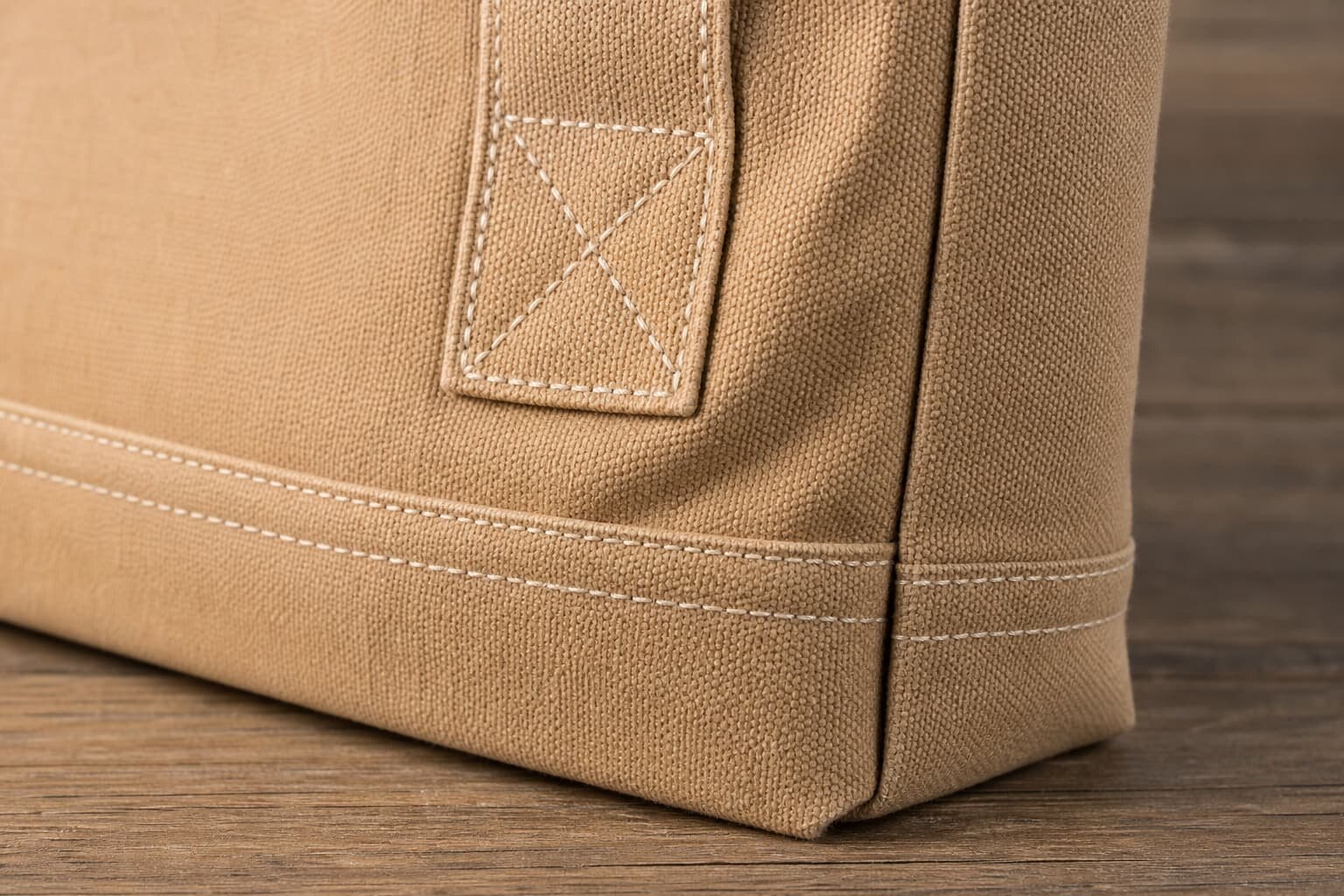
The handle is the highest-risk part of a heavy canvas tote bag. Buyers usually notice fabric thickness first, but end users complain when handles tear, twist, or feel uncomfortable. On the approved sample, check whether the handles use the same canvas, cotton webbing, dyed webbing, or contrast material. Measure the handle drop based on actual use: short hand-carry, shoulder carry, or long shoulder carry over outerwear. For heavier retail totes, a comfortable handle width and proper reinforcement are more important than simply using thicker fabric.
Look at the stitching method where the handle joins the bag body. A simple single line stitch may be enough for a lightweight giveaway tote, but heavier canvas normally needs box stitch, cross stitch, bartack reinforcement, or multiple rows depending on the load requirement. Also inspect side seams and bottom corners. If the bag has a gusset, the corner construction must be clean and strong. Ask the supplier to define stitch density, thread type, and whether seam edges are overlocked, bound, or folded.
- Check handle drop on a real shoulder, not only by measuring flat on the table.
- Use a practical load test such as books, groceries, or buyer-specified weight for a fixed time.
- Reject skipped stitches, broken thread, loose bartacks, twisted handles, and uneven handle placement.
- For premium retail totes, consider inside seam binding to improve appearance and reduce fraying.
Approve logo print on actual canvas, not only artwork
Logo approval is one of the most common causes of delay. A digital artwork proof can confirm size and position, but it cannot show ink absorption, edge sharpness, or color on thick cotton canvas. Heavy canvas has texture, so small letters, thin lines, and large solid blocks behave differently than they do on paper or polyester. Screen print is usually the most stable choice for solid brand logos, while heat transfer may be used for detailed multi-color graphics. Embroidery can work for small premium marks, but it adds weight, needle holes, and backing considerations.
The sample approval should include print method, color reference, print size, print position, and curing expectation. For screen printing, check opacity and hand feel. Too little ink can look faded; too much ink can feel rubbery or crack. For dark canvas, ask whether an underbase is required. For natural canvas, expect some color warmth from the fabric background. If the order is a repeat program, keep the printed sample and color target because print ink and fabric shade both affect the final appearance.
- Approve print on the same fabric weight and color as bulk production.
- Check small text, registration, edge sharpness, pinholes, ink coverage, and print surface cracking.
- Confirm whether Pantone matching is a target or an exact tolerance, because cotton fabric affects color.
- Do not approve bulk production from a paper print proof alone.
Review labels, trim, and compliance details before bulk
Small components can block shipment if they are reviewed late. A heavy canvas tote bag may need a woven side label, printed care label, country of origin label, hangtag, barcode sticker, retail price sticker, or carton label. These items should be included in the sample approval package. If the buyer supplies labels, confirm delivery date and wastage allowance. If the factory produces labels, confirm artwork, material, fold type, stitching position, and color before mass production.
Compliance requirements depend on destination market and buyer channel. Do not ask the factory to guess. Procurement should state any restricted substance, fiber content, labeling, packaging, or retailer routing requirements in the RFQ. For natural cotton canvas, buyers may also care about odor, mold prevention, and moisture control during packing. If an importer needs testing, the approved sample should represent the bulk material and print process as closely as possible.
- Confirm fiber content wording and country of origin label before production.
- Approve side label position and stitch method so it does not interfere with seams or logo placement.
- Check barcode readability if the bag will go directly to retail or distributor warehouse.
- Include hangtags, stickers, and carton marks in the quoted unit price or list them separately.
Connect sample approval to MOQ and lead time
MOQ is not only a sales policy. For heavy canvas tote bags, MOQ is affected by fabric roll quantity, dyeing minimums, cutting efficiency, print setup, label production, and packing style. A natural canvas tote with one-color screen print can often be planned more flexibly than a custom dyed canvas tote with multiple logo positions and special labels. If the buyer asks for a low MOQ, the supplier may use stock fabric, existing trim, or simplified packing. That may be acceptable, but it must match the approved sample.
Lead time should be counted from the right starting point. Many quotes say production takes a certain number of days, but that usually starts after deposit, artwork approval, sample approval, and material confirmation. If the sample is revised several times, the shipment date moves. Procurement teams should separate sample lead time, material preparation time, bulk sewing time, printing time, packing time, and inspection window. This gives a more realistic schedule and prevents pressure to skip sample checks.
- Ask for MOQ by fabric color, logo design, print method, and packing method.
- Confirm whether the approved sample uses stock canvas or fabric that must be woven or dyed.
- Add sample revision time to the sourcing calendar, especially before seasonal launches.
- Do not approve mass cutting until the final sample revision is closed in writing.
Check packing before it becomes a freight problem
Packing is part of the product. Heavy canvas can crease, attract dust, absorb odor, and show pressure marks if packed incorrectly. A sample approval should include folding method, individual packing, carton quantity, carton size, carton gross weight, and carton marks. For retail programs, the fold must show the logo cleanly and fit shelf or warehouse requirements. For distributor orders, the packing must protect the bag during long transport and repeated handling.
Over-packing also creates cost. Individual polybags can protect the bag but may conflict with sustainability goals or retailer rules. Paper bands, tissue, master polybags, or no individual bag may be better depending on the market. Heavy canvas totes can make cartons dense, so check carton weight against warehouse handling limits. If the printed panel is folded against another printed panel, ask whether interleaving paper is needed to avoid ink transfer.
- Approve one folded sample exactly as it will ship.
- Confirm pieces per inner pack and pieces per export carton.
- Check whether carton dimensions work for pallet loading and courier limits.
- Specify moisture protection if shipping during humid seasons or long ocean transit.
Turn the approved sample into quote data
A good supplier quote should be traceable to the approved sample. The quote should not only show a unit price. It should list fabric weight, bag size, handle size, logo method, number of print colors, label details, packing method, MOQ, sample cost if any, lead time, payment terms, and trade terms. Without this detail, a cheaper quote may simply exclude items that another supplier included. Procurement teams comparing multiple factories should force the same specification format.
When a supplier revises price after sample approval, ask what changed. Common reasons include higher fabric GSM, added print underbase, extra stitch reinforcement, special packing, lower quantity, or custom label MOQ. These changes may be legitimate. The problem is not the price change itself; the problem is approving a sample without understanding which cost drivers are included. A written approval checklist makes cost changes visible and easier to negotiate.
- Attach approved sample photos and measurement sheet to the RFQ.
- Ask suppliers to quote against the same fabric GSM, print method, and packing method.
- Separate tooling, screen, label, and sample charges from unit price if needed.
- Require the final proforma invoice to reference the approved sample version.
Specification comparison for buyers
| Spec decision | Recommended option | When it fits | Buyer risk to check |
|---|---|---|---|
| Fabric weight | 12 oz to 16 oz cotton canvas, roughly 380-540 GSM depending on weave | Retail totes, gift bags, event merchandise, and reusable shopping bags needing structure | Supplier may quote oz but sample in lower GSM; ask for actual fabric test report or cut swatch weight |
| Handle construction | Same-fabric canvas handles with cross-stitch or reinforced box stitch | Heavier contents, retail use, bookstores, grocery, and promotional resale bags | Handle length, width, and stitch density often change between sample and production if not locked |
| Main seam | Inside overlock plus top stitch, or bound seam for premium finish | Bulk orders where durability and clean inside appearance matter | Loose threads and weak seam allowance can pass visual review but fail load testing |
| Print method | Screen print for solid logos; heat transfer only for complex multi-color art; embroidery for premium small marks | Most brand logos on 12 oz to 16 oz canvas | Ink coverage, color shift, cracking, and registration must be approved on actual canvas, not paper proof only |
| Shrinkage control | Pre-shrunk fabric or confirmed shrinkage tolerance before cutting | Bags requiring tight finished dimensions or repeat orders | Unwashed canvas can shrink after steam pressing, washing tests, or end-user care |
| Packing method | Flat pack with inner polybag or paper band, carton sized to avoid crushing | Retail and distributor shipments needing clean presentation | Over-compression can crease heavy canvas and mark printed panels |
| MOQ logic | MOQ based on fabric availability, print setup, dyeing, and cutting efficiency | Custom size, custom color, logo print, or special label projects | Low MOQ quotes may use stock fabric only; bulk fabric shade and hand feel can differ |
| Approval sample type | Pre-production sample made with bulk-intended fabric, trim, print ink, label, and packing | Before deposit balance, mass cutting, or final production release | A showroom sample is not enough; it may use different fabric, sewing line, or print process |
Buyer checklist before sampling
- Confirm the sample is a pre-production sample, not only a showroom or reference sample.
- Measure finished width, height, gusset, handle drop, handle width, seam allowance, and pocket size if included.
- Record fabric weight in oz and GSM, and keep a signed fabric swatch from the approved sample.
- Check canvas color under daylight and indoor light, especially natural, black, navy, and dyed custom shades.
- Compare logo size, position, print color, edge sharpness, ink hand feel, and print coverage against the artwork file.
- Inspect stitch density, seam straightness, bartacks or box stitches, handle alignment, and loose thread trimming.
- Load test the handles and seams using a realistic buyer-specified weight, not only a quick pull by hand.
- Check whether the bag stands, folds, or packs as required for retail display or distributor handling.
- Approve care label, country of origin label, hangtag, barcode sticker, carton mark, and packing method before bulk.
- Ask the factory to quote with the exact approved sample reference number, date, and revision version.
Factory quote questions to send
- Is your quote based on the approved sample fabric weight, or on an alternative stock canvas?
- What is the actual GSM range tolerance for the bulk canvas, and can you attach a fabric specification sheet?
- Will bulk fabric be greige, bleached, dyed, or pre-shrunk, and what shrinkage tolerance should we approve?
- Which print method is included in the quote, and how many colors, screens, or setup charges are included?
- What is the MOQ by fabric color, logo design, size, and packing style, not only the general factory MOQ?
- Does the quoted unit price include labels, hangtags, barcode stickers, inner packing, export cartons, and carton marks?
- What sample stages are included before production: artwork proof, blank sample, print strike-off, or pre-production sample?
- What is the estimated sample lead time and bulk lead time after written sample approval and deposit confirmation?
- Which dimensions and construction points will you control during inline inspection before final packing?
- If bulk production differs from the approved sample, what approval process will be used before continuing production?
Quality-control points to confirm
- Fabric weight must match the approved sample within the agreed tolerance, with no unexpected thin panels or mixed rolls.
- Finished bag dimensions must stay within buyer-approved tolerance after sewing, trimming, pressing, and packing.
- Handle placement and handle drop must be consistent across the order, because small variation changes carrying comfort.
- Logo print must match approved color, size, position, opacity, and curing standard on actual canvas fabric.
- Seams, bartacks, boxed corners, and gussets must be inspected for skipped stitches, open seams, puckering, and weak reinforcement.
- Natural canvas should be checked for stains, oil marks, weaving defects, strong odor, and excessive slubs if a cleaner retail look is required.
- Packing must protect the print face and canvas surface from creases, abrasion, moisture, and carton compression.
- Carton quantity, carton weight, and carton dimensions must match the shipping plan and importer warehouse requirements.