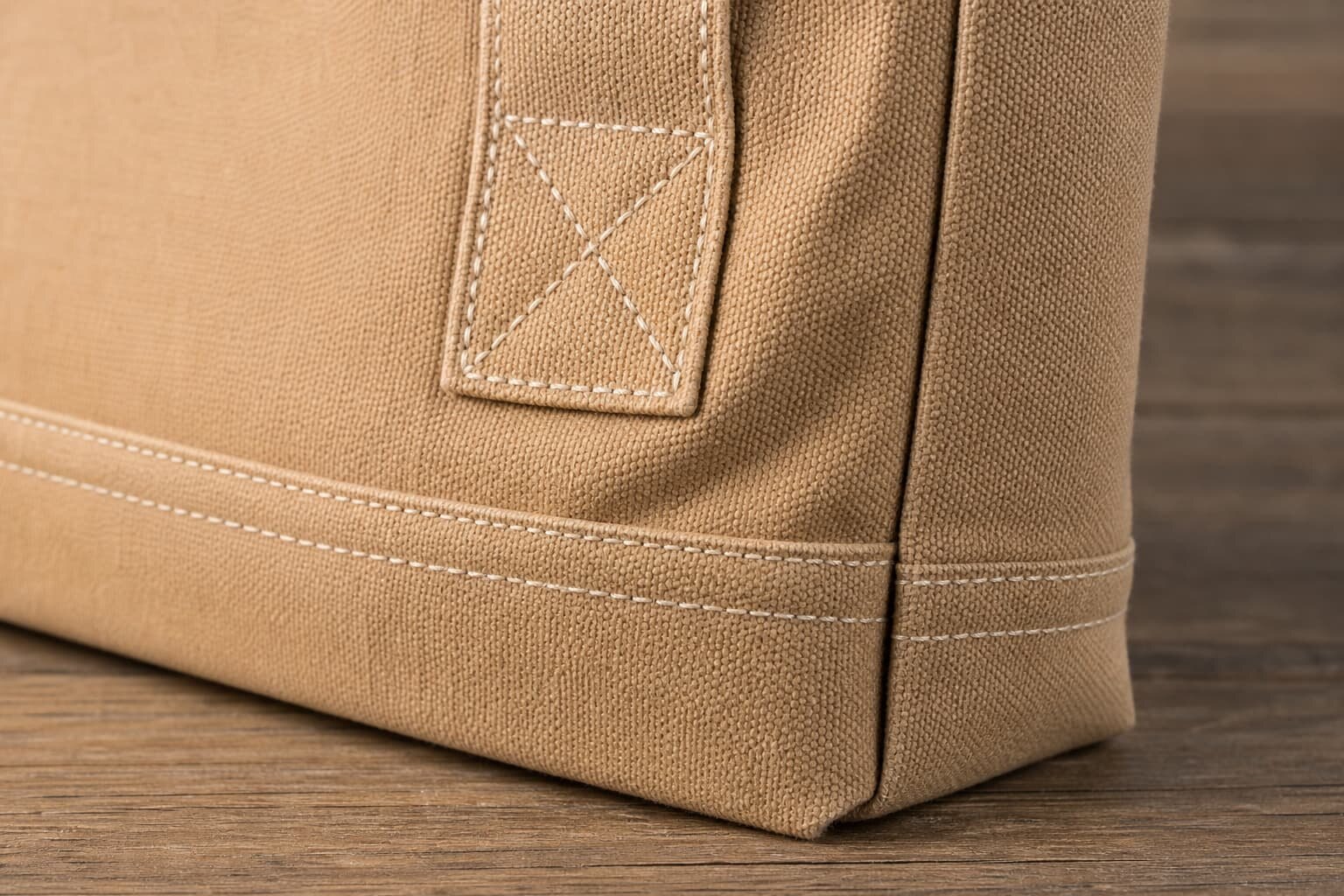
Why Pre-Shipment Inspection Matters for Heavy Canvas Totes
Heavy canvas tote bags look simple, but they are not low-risk items once you add brand printing, reinforced handles, retail packing, and shipment deadlines. A 12 oz or 16 oz canvas tote has more fabric bulk, more sewing tension, and more chance of print texture problems than a light cotton giveaway bag. If the inspection happens only after cartons are sealed, the buyer may discover size drift, weak handles, or logo defects too late to repair without delaying shipment.
A useful pre-shipment inspection is not just a visual check. It should connect the approved sample, purchase order, artwork file, packing instruction, and factory quote. The goal is to decide whether the goods are ready to ship, whether rework is needed, and whether the supplier understood the commercial requirements. Procurement teams should treat the checklist as a risk-control tool before balance payment and before vessel booking.
- Use the approved pre-production sample as the control sample, not a sales sample made months earlier.
- Inspect when at least 80 percent of the order is packed and the remaining quantity is finished or close to finished.
- Separate functional defects from appearance defects so handle failures are not treated like minor loose threads.
- Record shipment release decisions in writing, especially if the buyer accepts a limited concession.
Start With the Approved Specification, Not the Carton Count
Many failed inspections start with a weak RFQ. If the purchase order says only heavy canvas tote bag with logo, the inspector has little basis for rejecting borderline goods. Before inspection, the buyer should provide a clear spec sheet showing finished dimensions, fabric weight, fabric color, handle size, seam type, print method, print size, label position, packing method, carton quantity, and any compliance requirements.
The factory should also confirm which version of the sample is approved. A buyer may approve one sample for shape, another for print color, and a third for packing. That creates confusion at inspection unless the final approval record is consolidated. A practical inspection file includes the final artwork, approved sample photos, Pantone or fabric color reference, carton mark layout, and the latest purchase order.
- Finished size: width, height, gusset, handle drop, handle width, and tolerance.
- Fabric: canvas oz or GSM, yarn count if agreed, dyeing or washing finish, and color reference.
- Construction: top hem, side seam, bottom seam, inner seam finishing, and handle reinforcement.
- Branding: print method, logo size, logo position, color standard, and acceptable print variation.
- Packing: unit fold method, polybag or plastic-free packing, carton quantity, carton marks, and pallet needs.
Check Fabric Weight, Handfeel, and Color Before Sewing Defects
For heavy canvas tote bags, fabric is usually one of the largest cost drivers. A 10 oz canvas bag and a 16 oz canvas bag may look similar in online photos, but the material cost, handfeel, structure, and freight weight are very different. During inspection, the buyer should not rely only on the supplier saying the fabric is 12 oz. Check the finished fabric against the approved sample and review whether the GSM was measured before or after dyeing, washing, or finishing.
Color control is another common issue. Natural canvas can vary from cream to beige depending on cotton source and bleaching level. Dyed canvas can show shade difference between panels if fabric lots are mixed. A pre-shipment inspection should check side panels, gussets, handles, and body fabric under consistent light. For retail programs, shade bands should be agreed in advance because a small difference may look worse when bags are displayed together.
- Common heavy canvas range: 10 oz to 16 oz, roughly 339 to 542 GSM depending on fabric construction.
- Natural canvas: check black seed flecks, slubs, stains, and whether the buyer accepts natural cotton variation.
- Dyed canvas: check shade matching between body, handles, gusset, and any contrast trim.
- Washed canvas: check shrinkage, softness, wrinkle level, and whether the print method still performs well.
- Coated canvas: check odor, surface tackiness, cracking, and whether coating affects ink adhesion.
Measure Finished Dimensions and Shape Consistency
Dimension checks must be done on finished bags, not cut panels. Heavy canvas can shrink during washing, pull during sewing, or distort around the gusset. A tote that is 2 cm short in height may still be usable, but it can create retail planogram problems or make the bag fail an advertised capacity claim. The buyer should define tolerance by dimension instead of using one loose tolerance for the whole product.
Inspectors should measure enough pieces across different cartons and production times. If early sewing output and later sewing output differ, the issue may come from operator technique, cutting stack movement, or machine tension. Shape consistency matters for brand presentation: twisted side seams, uneven top hems, and leaning gussets make even strong bags look cheap.
- Measure bag width across the top and across the body if the shape is not perfectly rectangular.
- Measure height from top edge to bottom seam, excluding handle unless specified.
- Measure gusset depth after opening the bag fully, not while it is flat compressed.
- Measure handle drop from top edge to highest inner point of the handle curve.
- Check left and right handle length as a pair; uneven handles are very visible in retail use.
Inspect Stitching, Reinforcement, and Load-Bearing Areas
The most expensive complaint on a heavy canvas tote is usually not a small stain. It is a handle pulling out when the customer uses the bag. Heavy canvas gives buyers the impression of strength, so the construction must support that expectation. Handle reinforcement should be checked at every attachment point. A box-X stitch, cross stitch, or dense bartack is usually better than a simple straight stitch for load-bearing use, but only if the stitch tension and seam allowance are correct.
Heavy fabric also creates sewing challenges. Thick folded areas at the top hem and gusset corners can cause skipped stitches, needle holes, broken thread, or uneven feeding. Inspectors should open the bag and check inner seams, not only the outside face. For premium retail totes, clean bound seams may be required. For cost-sensitive promotional totes, overlock seams may be acceptable if the seam allowance is stable and threads are trimmed.
- Handle attachment: no loose stitches, no missed corners, no needle cuts, and no visible seam slippage.
- Top hem: even height around the bag, no twisting, and enough layers caught by the stitch.
- Side seams: straight and secure, with no open seam or exposed raw edge beyond the agreed finish.
- Bottom corners: no holes caused by bulky turning or poor needle penetration.
- Thread: color matched or contrast as approved, with no major thread contamination.
Control Logo Print Quality on Textured Canvas
Printing on heavy canvas is different from printing on smooth nonwoven or paper. The weave texture can break fine lines, absorb ink unevenly, or create a vintage effect that the buyer did not intend. Screen printing is usually the most practical option for solid brand logos and repeat orders. Heat transfer can work for detailed artwork or smaller quantities, but it needs careful testing for adhesion, edge lifting, and handfeel on rough fabric.
The inspection should compare the bulk print to the approved print proof and the pre-production sample. Check print placement after the bag is sewn because panel movement during sewing can change the final visual position. For multi-color logos, registration is important. For dark canvas, underbase opacity and ink thickness should be checked so the logo does not look dull or patchy.
- Check logo size with a ruler, not by eye, especially when several bag sizes are in the same order.
- Check position from top edge and side seam using agreed measurement points.
- Check ink curing with rub testing if required, because uncured ink may pass visual inspection but fail in use.
- Check cracking by gently folding the printed area if the bag will be folded for packing.
- Classify wrong logo, wrong color, severe misprint, and upside-down print as critical or major defects before inspection.
Review Packing Before Cartons Leave the Factory
Packing is not just a logistics detail for heavy canvas tote bags. The fabric is bulky, the cartons become heavy, and printed surfaces can scuff if bags are pressed against each other during sea shipment. Buyers should define whether bags are flat packed, half folded, rolled, individually polybagged, bundled, or packed without plastic. Each method affects carton size, freight cost, wrinkle level, and retail presentation.
Carton weight needs realistic control. A carton packed with thick 16 oz canvas totes can become too heavy for warehouse handling or courier limits. Overpacking also increases the risk of carton bursting and bag deformation. During pre-shipment inspection, the inspector should open cartons from different pallets or stacks, verify quantity, check assorted colors and SKU separation, and confirm carton marks match the booking and purchase order.
- Confirm units per carton, inner bundle quantity, and whether mixed colors are allowed.
- Check print-to-print contact and whether tissue paper or alternative separation is needed.
- Verify carton dimensions, gross weight, net weight, and shipping marks.
- Check barcode labels, hangtags, care labels, and retail stickers if they are part of the order.
- Look for moisture risk, odor, dirty cartons, weak tape, crushed corners, and incorrect pallet stacking.
Use AQL Correctly, But Add Product-Specific Checks
AQL sampling is useful because it prevents buyers from inspecting every bag manually, but AQL alone does not understand your brand risk. For a heavy canvas tote bag, a loose thread and a detached handle cannot carry the same weight. The buyer should define critical, major, and minor defects before inspection. Otherwise, an inspector may pass a shipment with too many logo defects or treat functional weakness as a normal sewing issue.
For most export orders, general inspection level II is a common starting point. However, brand-critical areas may need special checks. For example, if the logo is the main selling feature, print defects should be sampled more strictly. If the bag is marketed for grocery use, handle strength should be tested with an agreed weight. If retail packing is important, carton and label checks should be part of the inspection result, not a side note.
- Critical defects: wrong logo, unsafe contamination, mold, strong odor, wrong product, or handle failure under agreed load.
- Major defects: visible print error, open seam, wrong size beyond tolerance, severe stain, wrong packing, or color mismatch.
- Minor defects: small loose thread, slight wrinkle, small natural slub if accepted, or minor packing crease.
- Functional tests: handle load test, seam pull check, zipper check if included, snap or pocket check if applicable.
- Reporting: require defect photos, defect quantity, carton number, and inspector recommendation.
Connect Inspection Results to MOQ, Lead Time, and Rework Decisions
Inspection decisions affect commercial timing. If defects are found, the factory needs time to sort, repair, replace, or remake goods. Heavy canvas tote bag rework is not always quick. Reprinting may be impossible if the logo is already cured. Replacing handles requires opening seams. Washing out stains may change color. Buyers should build inspection time into the production schedule instead of inspecting on the same day the container must load.
MOQ logic also matters. If the order includes several fabric colors, logo versions, or packing styles, a failure in one SKU may not affect all goods. The buyer should ask the factory how production is batched: by fabric roll, print color, sewing line, or packing group. This helps procurement teams decide whether to release partial shipment, hold only one SKU, or require full sorting. The inspection report should make that decision possible.
- Add inspection buffer before vessel closing or warehouse delivery appointment.
- Ask whether spare blank bags or extra printed panels exist for replacement.
- Separate defect rate by SKU, color, print version, and carton range.
- Confirm whether reworked goods will be re-inspected before shipment.
- Do not approve shipment based only on a promise to fix defects after loading.
Quote Data Buyers Should Request Before Placing the Order
A good pre-shipment inspection starts during quotation. If quote data is incomplete, the buyer may discover at inspection that the supplier chose a cheaper fabric, simpler stitching, smaller carton, or different print method to meet the target price. Procurement teams should compare quotes using the same technical assumptions. Otherwise, the lowest unit price may simply be a lower specification.
For heavy canvas tote bags, the quote should separate the main cost drivers: fabric type and weight, bag size, handle construction, printing method, number of print colors, labels, packing, carton strength, testing, and delivery term. The buyer does not need a full factory cost sheet, but enough detail is needed to see what is included. This also gives the inspection team a practical reference.
- Request finished GSM or oz, not only a marketing description such as heavy duty canvas.
- Confirm whether sample cost includes one artwork revision and one packing sample.
- Ask for MOQ by fabric color, logo design, and print color count.
- Confirm whether bulk lead time starts after deposit, artwork approval, sample approval, or fabric arrival.
- Ask whether the unit price includes inner packing, carton marks, labels, and inspection support.
Specification comparison for buyers
| Spec decision | Recommended option | When it fits | Buyer risk to check |
|---|---|---|---|
| Fabric weight | 12 oz to 16 oz cotton canvas, about 407 to 542 GSM depending on weave and finishing | Retail shopper totes, bookstore bags, trade show merchandise, and reusable grocery bags needing structure | Supplier may quote nominal ounce weight before washing or finishing; request actual finished GSM tolerance and fabric swatch approval |
| Handle construction | Self-fabric canvas handles, cross stitch or box-X reinforcement at top seam | Medium to heavy carry loads and bags sold as reusable products | Weak handle bartacks, uneven handle length, or hidden seam slippage after loading |
| Printing method | Screen print for solid logos; heat transfer only for detailed artwork or short runs | Screen print suits repeat orders and strong brand colors on flat canvas panels | Ink cracking on heavy textured canvas, poor curing, color shift, or print position drifting after sewing |
| Inside finishing | Bound inner seams or clean overlock with stable seam allowance | Retail buyers who need a clean interior and lower complaint rate | Loose threads, raw edges shedding cotton lint, or seam allowance too narrow for heavy fabric |
| Packing method | Flat packed or lightly folded with moisture control and carton drop strength matched to weight | Bulk shipment by sea or consolidated warehouse delivery | Over-compressed cartons can create hard creases, print scuffing, and distorted bag shape |
| Inspection level | AQL Level II for general inspection, tightened checks for logo and handle strength | Normal export orders after sample approval | AQL pass can still hide critical logo defects if defect classification is not written clearly |
Buyer checklist before sampling
- Confirm the inspection sample matches the approved pre-production sample for fabric color, weight, handle width, size, print position, and packing method.
- Measure finished bag width, height, gusset, handle drop, and seam allowance against the purchase order tolerance before checking appearance.
- Check actual fabric handfeel, stiffness, shrinkage behavior, and GSM record if the order specifies 10 oz, 12 oz, 14 oz, 16 oz, or a GSM range.
- Review logo print color, registration, curing, rub resistance, cracking, placement, and whether print defects are classified as major or critical.
- Load test handles and top seams using the agreed test weight and time, especially for grocery, bookstore, and promotional retail bags.
- Open inner seams and corners visually to check skipped stitches, broken threads, raw edge control, and reinforcement consistency.
- Count units per polybag and carton, verify carton marks, barcode labels, hangtags, care labels, silica gel use, and carton gross weight.
- Check mixed colors, mixed sizes, or assorted logo versions against the packing list and shipping marks before carton sealing.
- Review the factory production quantity, rejected quantity, spare quantity, and shipment quantity before releasing balance payment.
- Photograph any borderline defects with a ruler or color card so approval decisions are not based on vague descriptions.
Factory quote questions to send
- What is the finished fabric weight in GSM and oz, and what tolerance do you apply after dyeing, washing, or calendering?
- Is the quoted canvas greige, dyed, bleached, washed, or organic cotton, and does the price include fabric shrinkage allowance?
- What stitching method is included for handles, top hem, side seams, bottom gusset, and inner finishing?
- Which print method is included in the quote, how many colors are allowed, and what is the maximum print area on the finished bag?
- Do you make a pre-production sample from bulk fabric before mass production, and is it included in the lead time?
- What MOQ applies by fabric color, bag size, logo color, and packing style rather than only by total order quantity?
- What AQL level and defect classifications do you accept for logo defects, stains, seam defects, and carton damage?
- What is the normal production lead time after artwork approval, deposit, and bulk fabric confirmation?
- What unit packing, carton size, carton weight, and pallet option are included in the price?
- Can you provide inspection photos from cutting, printing, sewing, finishing, and final packing before third-party inspection?
Quality-control points to confirm
- Finished bag dimensions must match purchase order tolerance, not only cutting panel size.
- Fabric weight must be checked as finished fabric, because coating, washing, and dyeing can change handfeel and GSM.
- Handle attachment points should be inspected as functional load-bearing areas, not only as appearance details.
- Logo print should be checked under consistent lighting against approved artwork and color reference.
- Seams around gussets and bottom corners need extra attention because heavy canvas resists turning and can create bulky weak points.
- Packing must protect print surfaces from scuffing, moisture, odor transfer, carton compression, and mixed SKU errors.
- Inspection report photos should include both passed samples and rejected defects so the buyer can judge consistency.
- AQL defect definitions should be agreed before inspection, otherwise suppliers and inspectors may downgrade serious brand defects.