Why Handle Drop Is a Purchasing Spec, Not a Style Detail
For a heavy canvas tote bag, handle drop controls much more than how the bag looks in a product photo. It decides whether the bag can be carried comfortably by hand, over the shoulder, or over a winter coat. It also affects webbing consumption, stitch placement, carton packing, print clearance, and the way the finished bag hangs when loaded. If the RFQ only says long handle or shoulder handle, two suppliers may quote two different products while using similar photos.
The most common sourcing problem is that buyers compare prices without noticing that one quote includes a 23 cm shoulder drop and another includes a 30 cm long drop. On a 1,000 or 5,000 piece order, that difference changes handle material usage and sometimes sewing time. It can also change customer complaints: a handle that looks economical on paper may be too short for real use, while an extra-long handle may look untidy on a compact tote.
- Use clear drop measurement instead of vague wording such as short, regular, or long.
- Ask suppliers to confirm whether measurements are before or after sewing.
- Treat handle drop as part of the functional spec together with bag size, gusset, and load weight.
- Keep the approved handle drop consistent across sample, bulk production, and inspection.
How to Measure Handle Drop Correctly
Handle drop should be measured vertically from the top edge of the finished bag opening to the highest inside point of the handle when the bag is laid flat and the handle is gently pulled upward. It is not the same as total handle length. Total handle length includes the stitched-down section, turn-in allowance, and the curved part above the bag opening. If a buyer writes only 60 cm handle, the final drop can vary depending on how deep the factory inserts and stitches the handle.
For repeat orders, the measurement method must be written into the spec sheet. Heavy canvas is stiff, especially at 14 oz, 16 oz, 18 oz, or 20 oz. If one inspector pulls the handle firmly and another lets it relax naturally, the reading can change by 0.5-1.5 cm. A practical tolerance for many canvas totes is plus or minus 1 cm, but the acceptable range depends on design, handle material, and whether the tote is sold as a precise retail item or a promotional giveaway.
- Correct RFQ wording: handle drop 25 cm, measured vertically from finished top edge to inside top of handle.
- Avoid unclear wording: 60 cm handle, long handle, shoulder size, or regular tote handle.
- For two-handle totes, measure both handles and check that left and right positions match.
- If handles are stitched down the body, specify stitch-down length as a separate measurement.
Choosing the Right Drop for Different Heavy Canvas Tote Uses
A 12 oz heavy canvas tote used as a bookstore bag may work well with a 23-25 cm shoulder drop. A 20 oz beach tote with a wide gusset may need 28-32 cm because the body becomes bulkier when loaded with towels, shoes, or groceries. For a compact retail merchandise bag, a 12-16 cm hand-carry drop may be enough and may look cleaner on shelf displays. The right answer depends on the carry scenario, not only the buyer's preferred appearance.
Procurement teams should define the carry method before asking for quotes. If the tote must be used by both men and women, over light jackets, in European or North American retail conditions, standard shoulder drop often needs to be tested on real bodies, not only judged on a table. If the bag is intended for trade shows, long drop can be convenient because users may carry brochures and samples all day. If the bag is meant for premium retail packaging, shorter handles may create a more structured presentation.
- 10-14 cm: hand carry, small gift bags, compact canvas packaging.
- 18-21 cm: mixed hand and short shoulder carry, useful for smaller tote bodies.
- 22-26 cm: standard shoulder carry for many heavy canvas shopping totes.
- 28-32 cm: long shoulder carry for large bodies, beach totes, or cold-weather markets.
- Above 32 cm: use carefully; handles may look too loose and increase tangling during packing.
Fabric Weight, GSM, and Handle Construction Must Match
Heavy canvas tote bags are commonly specified by ounces per square yard, such as 12 oz, 14 oz, 16 oz, 18 oz, or 20 oz. Buyers may also see GSM values in factory quotations. The conversion is not exact across all weaving constructions, but 12 oz canvas is often around 400 GSM, 16 oz can be around 540 GSM, and 20 oz may be around 680 GSM. As fabric gets heavier and stiffer, the handle attachment point must be strong enough to transfer load without tearing the top hem or distorting the side panel.
Handle material should not be selected only by color. Cotton webbing, self-fabric canvas handles, and poly-cotton webbing behave differently. Cotton webbing feels natural and matches canvas well, but it may shrink slightly during washing or steaming. Self-fabric handles give a premium look but require more cutting, folding, and sewing labor. Poly-cotton webbing may reduce cost or improve dimensional stability, but some brand buyers reject synthetic content if the bag is marketed as cotton or natural canvas.
- For 12-14 oz totes, 2.5-3.0 cm cotton webbing is common for general retail use.
- For 16-20 oz totes, 3.0-3.8 cm webbing improves comfort under heavier loads.
- For premium self-fabric handles, confirm folded width, seam allowance, and edge stitching.
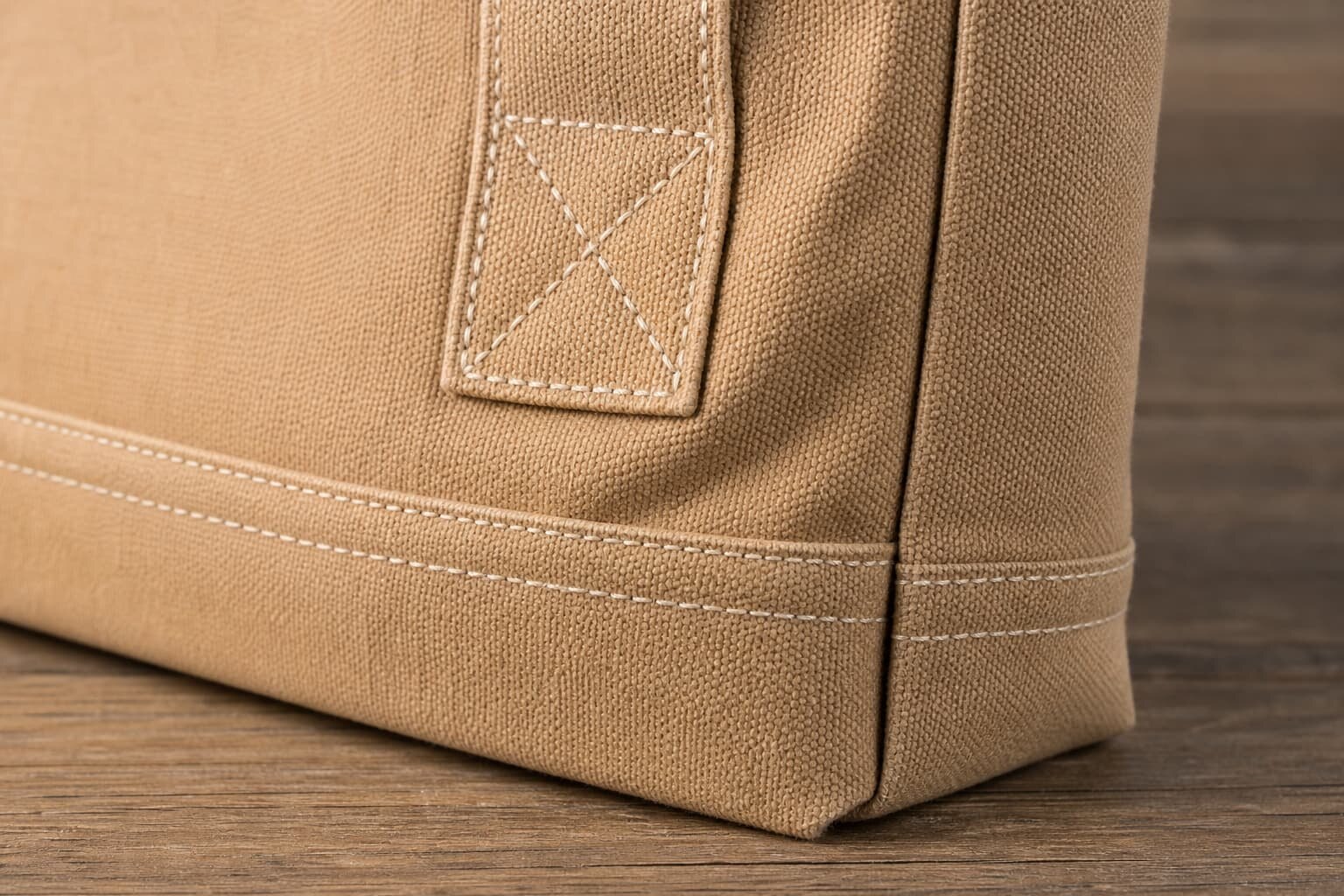
- For high load claims, request box-and-cross stitching or bar tacks instead of simple straight lines.
- For washed canvas, confirm shrinkage impact on both bag body and handle drop.
Print Method Can Limit Handle Placement
Handle drop decisions should be made before final logo approval. On heavy canvas totes, the handle stitch box often enters the upper front panel area. If the buyer chooses a large center logo, embroidery, or heat transfer near the top, the handle reinforcement can interfere with the decoration. Screen printing needs a reasonably flat area; thick handle seams near the print frame can create uneven pressure and poor ink deposit. Embroidery adds another layer of stiffness and should not fight with handle stitching.
For simple one-color logos, screen printing is usually practical on 12-20 oz canvas if the print area stays away from thick seams. Heat transfer can work for detailed artwork, but buyers should test adhesion on coarse canvas texture and check for crease marks from folded handles. Woven labels or side labels are good options when the front panel is crowded, but their position must avoid side seam bulk and top hem stitching. A good RFQ should include artwork size, print position, handle stitch zone, and required clearance.
- Keep 2-3 cm clearance between print edge and handle stitch box when possible.
- For embroidery, test puckering on the exact canvas weight before bulk approval.
- For heat transfer, check adhesion after folding and carton pressure.
- For screen print, ask the factory whether handle seams affect platen setup.
- For side labels, confirm label does not twist or disappear when the tote is loaded.
Cost Impact: Where Handle Drop Changes the Quote
Handle drop affects cost through webbing length, cutting loss, sewing time, reinforcement method, and packing labor. The material difference between a 24 cm drop and a 30 cm drop may look small on one sample, but it becomes visible in bulk production. If the handle is self-fabric canvas, the cost impact is higher because the factory must cut strips, fold them, press or stitch edges, and manage fabric yield. If the tote uses colored webbing, MOQ and dye lot may also affect the quote.
Buyers should not ask factories to reduce price without checking which handle details are being changed. A lower quote may use narrower webbing, shorter insertion depth, fewer stitches, or lighter thread. These reductions are hard to see in a front photo but become obvious when the bag is loaded. Quote comparison should separate body fabric, handle material, decoration, accessories, packing, and testing requirements so procurement can see what is included.
- Material cost: total handle length, webbing width, and webbing weight.
- Labor cost: self-fabric handle folding, edge stitching, and reinforcement sewing.
- Quality cost: load testing, pre-production sample, and inspection requirements.
- Packing cost: flat packing, individual polybags, tissue, hangtags, or retail barcode labels.
- MOQ impact: custom dyed webbing or uncommon width may require higher minimum quantity.
MOQ Logic and Lead Time for Custom Handle Specs
For standard natural cotton webbing in common widths, factories may keep stock or source quickly from local suppliers. This makes standard shoulder-drop tote bags easier to sample and quote. Custom handle color, special width, organic cotton webbing, recycled cotton webbing, or yarn-dyed stripe handles can create higher MOQ because the webbing supplier has its own dyeing or weaving minimum. Buyers should ask whether the MOQ is driven by the bag factory or by the handle material supplier.
Lead time also depends on when handle material is confirmed. A factory cannot safely cut bulk fabric or arrange decoration if the handle color, drop, and placement remain open. For a normal custom heavy canvas tote, buyers should expect sample development, sample review, material booking, bulk cutting, sewing, printing, packing, and final inspection. Exact timing varies by season, order size, and factory capacity, so the purchase order should define approval milestones instead of relying on a loose ready date.
- Standard natural webbing: usually easier for low MOQ and faster sampling.
- Custom dyed webbing: ask for lab dip approval and dye lot tolerance.
- Self-fabric handles: confirm fabric yield and whether handle strips are cut along warp or weft.
- Peak season orders: approve handle drop before artwork proof to avoid schedule changes.
- Repeat orders: reserve the same webbing specification if color and handfeel must match.
Sample Checks Before Bulk Approval
A sample should not be approved only because the logo looks correct. For handle drop, the buyer should check the tote empty, loaded, carried by hand, carried over the shoulder, and packed flat. Heavy canvas can look excellent on a table but become uncomfortable when filled with books or groceries. The handle may also twist if the webbing is too soft or if the stitch-down angle is not balanced.
Ask the factory to send measurement photos with a ruler, but do not rely only on photos. If the order is important, keep a physical approved sample at the buyer office and one sealed counter sample at the factory. The sample should include the same fabric weight, handle material, thread, stitch density, print method, and packing fold as bulk production. Changing any of these after sample approval can change the final handle drop or appearance.
- Measure handle drop, handle width, stitch box size, and distance between handle ends.
- Load the tote with the target weight and hang it for a practical test period.
- Check whether the bag opening collapses or cuts into the shoulder when loaded.
- Inspect inside top hem for seam strain around the handle attachment.
- Fold the bag as packed and check whether handles crease the printed logo.
Packing and Carton Planning for Long Handles
Long handles create packing problems if they are not controlled. They can tangle between pieces, press into screen printed panels, create uneven stack height, or leave crease marks on heat transfers. For distributor stock or retail programs, carton presentation matters because the first inspection may happen at the warehouse, not in the store. A tote that arrives with twisted handles looks lower quality even if the sewing is technically acceptable.
The RFQ should ask for the proposed folding method and carton quantity. Heavy canvas does not compress like lightweight cotton. A 16 oz or 20 oz tote with a bottom gusset and long handles may require fewer pieces per carton to avoid crushing. If individual polybags are required, confirm whether the handle is folded inside the bag, laid flat over the body, or tucked behind a paper band. Each method affects labor, carton size, and the risk of print damage.
- For screen print, avoid placing handle folds directly across fresh ink or thick print areas.
- For heat transfer, add protection paper if carton pressure may mark the surface.
- For retail-ready bags, align handles consistently so unpacking staff do not need to rework them.
- For export cartons, confirm gross weight is manageable because heavy canvas adds weight quickly.
- For barcode or hangtag programs, ensure handles do not hide labels during receiving.
How to Write a Cleaner RFQ for Handle Drop
A strong RFQ gives the factory enough information to quote the same product that procurement expects to buy. It should include finished bag size, gusset, fabric weight or GSM, handle drop, handle material, handle width, reinforcement method, print method, packing method, target load, quantity, delivery terms, and inspection requirements. If any of these are missing, the supplier will fill the gap with their own standard practice, and the cheapest supplier may not be quoting the same construction.
For heavy canvas tote bags, include a simple sketch or marked photo showing handle position and drop. If there is artwork on the front panel, include the logo size and distance from the top edge. If the tote must carry a specific product, mention the product size and weight. This helps the factory recommend whether the handle drop and reinforcement are realistic before sampling, which is cheaper than discovering the problem after bulk sewing.
- Example spec: 16 oz natural cotton canvas, 38 x 42 x 10 cm, handle drop 26 cm, 3.2 cm cotton webbing, box-and-cross stitch.
- Example print note: one-color screen print, 24 x 18 cm, centered, keep minimum 3 cm from handle stitch box.
- Example testing note: load with 8 kg for 24 hours; no seam tearing, no broken stitches, no handle detachment.
- Example packing note: flat pack 50 pieces per export carton, handles aligned, printed panel protected from handle pressure.
- Example tolerance note: handle drop plus or minus 1 cm unless otherwise approved in writing.
Specification comparison for buyers
| Spec decision | Recommended option | When it fits | Buyer risk to check |
|---|---|---|---|
| Hand-carry short drop | 10-14 cm clear drop | Gift totes, bottle totes, compact retail packaging, low load weight | Too short for winter clothing or shoulder use; confirm the opening is still easy to access |
| Standard shoulder drop | 22-26 cm clear drop | Most retail canvas totes, bookstore bags, grocery-style heavy canvas bags | If the bag body is tall, the top edge may sit too high under the arm; test with loaded sample |
| Long shoulder drop | 28-32 cm clear drop | Large beach totes, event merchandise, unisex shoulder carry, outerwear markets | Longer webbing raises cost and can make an empty bag look loose in product photos |
| Handle webbing width | 2.5-3.8 cm cotton webbing | Heavy canvas totes from 12 oz to 20 oz requiring comfortable carry | Narrow webbing cuts into the shoulder under load; wide webbing may crowd small front prints |
| Reinforcement method | Box stitch with X or bar tack plus backstitch | Reusable totes, retail bags, corporate merchandise, heavy grocery loads | Decorative-only stitching can pass photos but fail load testing |
| Print position with long handles | Print below handle stitch zone with 2-3 cm clearance | Screen print, heat transfer, or embroidery on front panel | Handle stitching can distort the print area or create uneven ink deposit |
| Packing style | Flat pack with handles aligned and protected | Export cartons for retail-ready or distributor stock | Long handles may tangle, crease printed panels, or increase carton height if not folded consistently |
Buyer checklist before sampling
- State handle drop as a clear vertical measurement from the highest inside point of the handle to the top edge of the bag, not total handle length.
- Confirm whether the handle is for hand carry, shoulder carry, or both; do not leave this to the factory to assume.
- Match handle drop with bag height, gusset depth, and intended load weight before approving artwork or carton size.
- Specify webbing width, webbing weight, color, fiber content, and whether the handle must match or contrast with the bag body.
- Require loaded sample photos on shoulder and hanging from the handle before bulk approval.
- Check that handle stitch boxes do not enter the print area, label position, snap button area, or internal pocket seam.
- Define load test weight, hanging time, and acceptable seam movement for heavy canvas tote bags.
- Ask whether the quoted handle length includes cutting waste, shrinkage allowance, and sewing turn-in.
- Confirm folded packing method so long handles do not crease screen print or make uneven carton dimensions.
- Keep an approved physical sample or sealed counter sample for handle drop, stitch density, and handle placement comparison.
Factory quote questions to send
- What handle drop are you quoting, measured from the inside top of the handle to the bag opening?
- What is the total cut length of each handle, and how much is inserted into the seam or stitched down the body?
- What webbing width, webbing GSM, and fiber composition are included in the price?
- Is the handle made from self-fabric canvas, cotton webbing, poly-cotton webbing, or another material?
- What reinforcement method is included: box stitch, box-and-cross, bar tack, rivet, or double row stitch?
- What maximum loading weight do you recommend for this handle construction on the selected canvas weight?
- Will the handle stitch position interfere with the logo size, print method, pocket, magnetic snap, or top hem?
- How does changing handle drop from standard shoulder to long shoulder affect unit price, MOQ, and cutting loss?
- Can you provide pre-production sample photos with ruler measurement and loaded carry test before bulk cutting?
- How will the handles be folded in export cartons, and will inner polybags be used to protect printed panels?
Quality-control points to confirm
- Measure handle drop on at least five finished pieces per inspection lot and compare against the approved tolerance.
- Check left and right handle symmetry; uneven handle height is more visible on heavy canvas than on soft cotton bags.
- Pull-test the handle attachment area and inspect for skipped stitches, broken thread, loose backstitch, and seam tearing.
- Verify stitch box size, stitch density, and distance from top edge match the approved sample.
- Inspect whether handle color, webbing width, and texture match the purchase order and sealed sample.
- Check that screen print or heat transfer is not cracked, dented, or shadowed by handle folding during packing.
- Confirm carton packing keeps handles flat and does not create permanent creases across the front logo.
- Review random loaded-hang samples after 12-24 hours if the tote is promoted for grocery, book, or trade show use.