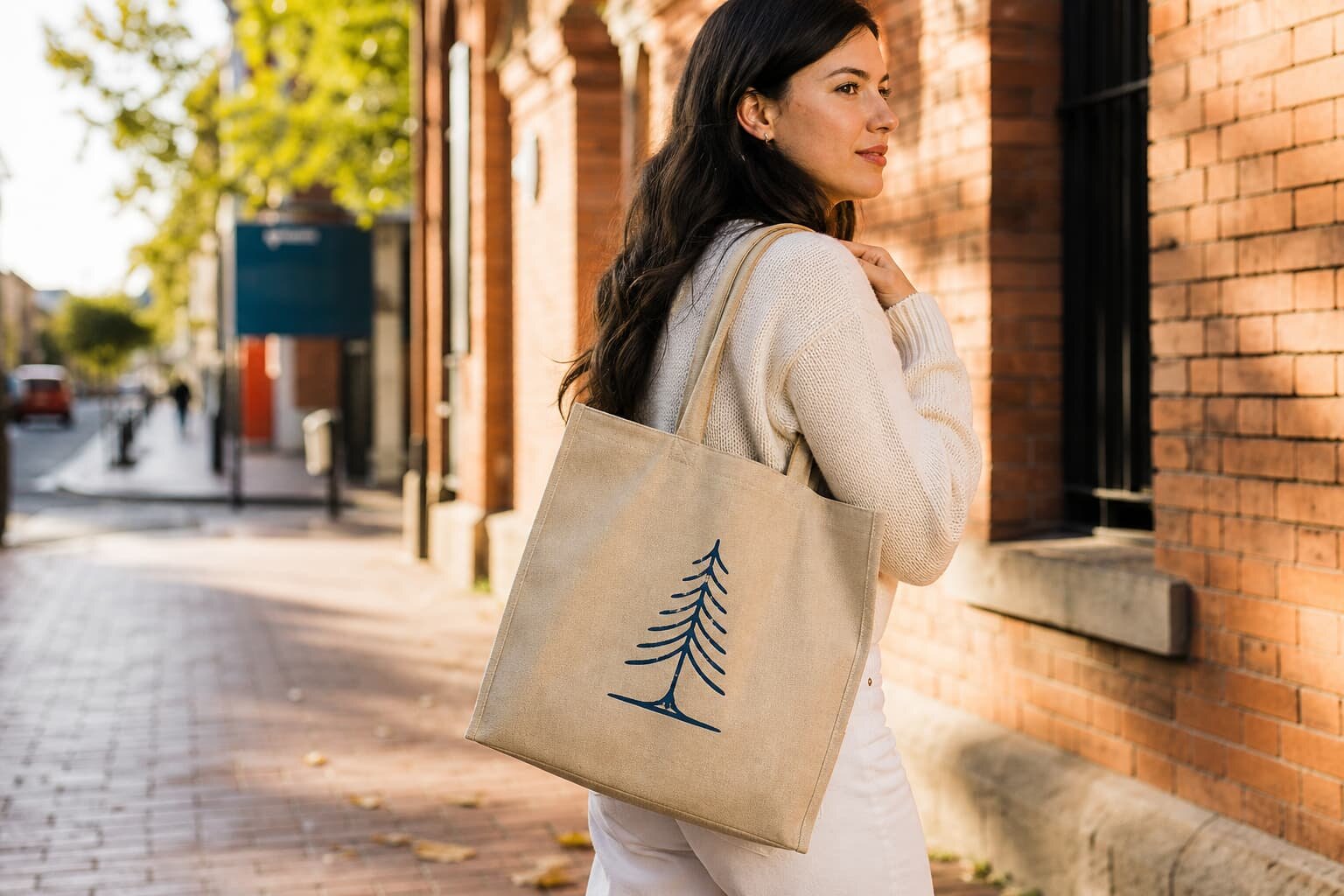
Start With the Proof Purpose, Not the Artwork
A custom logo print proof for a heavy canvas tote bag is a production control tool, not only a visual preview. It must confirm the bag construction, canvas weight, fabric color, print method, logo scale, placement, and packing assumptions that the factory will use in bulk. If the proof only shows a digital logo on a blank tote outline, it may help marketing visualize the layout, but it does not prove whether the logo will print cleanly on textured canvas.
Heavy canvas has a raised weave, visible slub, and more body than lightweight promotional cotton. Those features make the bag feel substantial, but they can also soften print edges, reduce ink coverage, and create fold marks during packing. A useful proof shows how the logo behaves on the real material. It should answer practical questions: Is the logo readable? Is the color acceptable on this fabric? Does the print sit straight when the bag is carried? Will the fold line damage the design?
For procurement teams, the goal is to remove interpretation before the purchase order moves into bulk. The proof should be version-controlled, measured, photographed, and tied to a written approval note. This keeps sales, sampling, printing, sewing, packing, and final inspection working from the same reference.
- Approve a physical sample for first orders or brand-critical programs.
- Use a PDF proof for layout control, but not as the only approval for fabric and print behavior.
- Label every proof with date, artwork file name, bag spec, print method, and revision number.
- Write any allowed variation into the approval note before production starts.
Lock the Base Tote Specification First
The tote bag spec must be fixed before buyers compare print quotes. A 12 oz, 14 oz, and 16 oz canvas tote may look similar in a quote table, but they do not sew, fold, print, or pack the same way. A lighter heavy-canvas option may work for event giveaways or lower-cost retail support. A mid-weight option usually gives a stable print surface with manageable cost. A heavier option can feel more premium, but it increases seam bulk, carton volume, and the chance that folding will mark the print.
Fabric color changes the proof result. Natural canvas has cotton flecks and a warmer tone, so white ink, pale colors, and thin lines can look softer. Bleached canvas gives stronger contrast but may reveal stains or ink variation more clearly. Dyed canvas needs separate color approval because logo ink can shift against a darker or saturated ground. The same logo file can look acceptable on natural canvas and weak on dyed navy or black.
Construction details also matter. Gusset depth affects how the front panel behaves when loaded. Handle length changes how the bag hangs and where the viewer sees the logo. Reinforcement stitching can pull the panel if the fabric is stiff. Buyers should treat the bag as one complete product, not a blank rectangle for printing.
- Confirm finished bag width, height, gusset, handle drop, and seam allowance.
- Specify fabric weight by oz or GSM and ask how the factory measures it.
- State natural, bleached, dyed, washed, or laminated fabric clearly.
- Confirm handle reinforcement, bartack position, and whether seams affect the print panel.
Choose a Print Method That Matches the Risk
Screen printing is usually the first method to review for heavy canvas tote bags with bold one-color or low-color-count logos. It can be cost-efficient at production quantity and gives a direct print look that many buyers expect on canvas. The proof must confirm opacity, edge sharpness, registration between colors, and curing. On rough fabric, small text and thin reversed lines may fill in or break up, so the sample should be judged at real viewing distance and close up.
Transfer methods, including DTF and heat transfer, are useful when the logo has gradients, full-color artwork, or small order quantities that make screen setup less efficient. They can deliver detail that screen print may struggle with, but the buyer must check edge lift, plastic hand feel, cracking on folds, and whether the transfer remains stable after rubbing and packing. These methods are not automatically better or worse; they are different risk profiles.
Embroidery, woven patches, and sewn labels can elevate the bag, especially for premium gifting or retail programs. They also add another production step and can change the panel shape. Dense embroidery may pucker canvas, while patches require clean stitching and consistent placement. Buyers should ask the factory why the method is recommended and what visual trade-off must be approved.
- Use screen print for bold logos, repeat orders, and controlled color counts.
- Use transfer printing for detailed art, gradients, or small runs that need full color.
- Use embroidery or patches for smaller premium marks rather than large flat graphics.
- Avoid hairline rules, tiny reversed type, and fine gradients unless the physical proof proves them.
Prepare Artwork So the Factory Cannot Guess
A strong proof starts with clean artwork instructions. Send vector files such as AI, EPS, or production-ready PDF whenever possible. Include a reference image only as support, not as the production file. The factory also needs the exact logo width and height in millimeters, the number of colors, Pantone or brand color references, and the intended logo position from a measurable point on the bag.
Placement instructions should avoid vague language like centered, medium size, or near the top. Centered can mean centered on the flat panel, centered between handle stitches, or visually centered after the bag is folded. A better instruction is measurable: logo width 220 mm, top of logo 95 mm below top hem, centered between side seams, front panel only. If the tote has a gusset, state whether the side fold is included in the measurement.
Buyers should also flag artwork details that may need adjustment. Thin outlines, distressed effects, small QR codes, and fine serif type can be difficult on heavy canvas. If those elements are important, ask the factory to call them out before sampling rather than silently modifying the file.
- Send editable vector artwork plus a flattened reference image.
- Provide Pantone or brand color values and state whether close match is acceptable.
- Mark logo size, panel, orientation, and measurement reference points.
- Ask the factory to confirm any artwork simplification before making the proof.
Use a Proof Approval Sequence That Is Hard to Misread
The safest approval sequence is straightforward: issue one complete RFQ spec, receive the factory recommendation, approve the artwork layout, make the physical proof, check and revise if needed, then sign a master sample. This process is slower than approving a screen mockup, but it prevents expensive rework when the first bulk pieces reveal print softness, wrong placement, or packing creases.
When the sample arrives, measure it before reacting to the design. Check bag dimensions, handle drop, logo size, logo distance from the top hem or bottom edge, and alignment against seams. Then inspect the print under daylight and normal indoor lighting. Canvas can change the perceived color because of texture and fiber tone, so color approval should happen on the actual fabric, not only on a monitor.
The approval note should be specific. If the proof is accepted with a minor limitation, write the limitation down. For example, natural canvas flecks visible through light ink may be acceptable, but logo shift beyond the agreed tolerance is not. A sealed master sample and a signed note give the inspector a clear reference later.
- Photograph the proof flat, held upright, close up, and folded as packed.
- Measure logo width, height, and distance from fixed construction points.
- Compare the sample to the latest artwork version, not an old email attachment.
- Keep one sealed master sample and one working sample for handling tests.
Build Quotes That Can Be Compared Line by Line
A low unit price is not useful if each supplier is quoting a different tote. Procurement should send one spec sheet and require suppliers to price the same fabric weight, size, handle, print method, logo size, packing, and inspection expectation. If Supplier A quotes a 12 oz stock natural tote with one-color screen print and Supplier B quotes a 14 oz dyed tote with full-color transfer and retail packing, the prices are not comparable.
Ask suppliers to separate base bag cost, logo application, setup, sample, packing, labels, inserts, carton marks, and optional testing. Setup fees can include screens, plates, digitizing, transfer preparation, or color matching. Packaging can include tissue, polybag, belly band, hangtag, barcode label, inner carton, or moisture control. These details often explain why one quote is higher or lower.
MOQ should be tied to the spec. Fabric availability, dyeing, print setup, color count, and packing format can all change minimums. A useful quote gives the MOQ for the requested version and the cost impact of practical alternatives, such as reducing logo colors, using stock fabric, or changing from individual polybags to bulk inner packs.
- Request itemized pricing instead of one blended unit price.
- Ask which costs are one-time setup costs and which repeat on reorder.
- Confirm whether the quote includes a physical proof and how many revisions.
- Compare lead time from approved sample, not only from deposit date.
Run Simple Sample Tests Before Bulk Approval
A buyer does not need a laboratory to catch many proof problems. Start with visual checks: print edge, opacity, color, registration, placement, seam straightness, handle stitching, stains, loose threads, and panel distortion. Then handle the bag like a real user. Open it, load it lightly, carry it, fold it, and inspect the logo again. Heavy canvas can look excellent flat but change shape once the gusset opens.
For printed logos, fold and rub checks are especially useful. Fold the bag along the proposed packing line and see whether the print cracks, lifts, or creates a permanent crease. Rub the print with a clean dry cloth to check whether ink transfers. If the bag will be used for retail or gifting, inspect how it looks after being packed and unpacked, because a damaged first impression can matter as much as the base construction.
Document results with photos and short notes. If the factory needs to adjust curing time, ink layer, print location, or packing fold, make those changes before approving bulk. The purpose of testing is not to reject every natural canvas variation; it is to define what is acceptable before hundreds or thousands of bags are made.
- Check logo readability from normal carrying distance and close range.
- Fold the sample using the proposed packing method and inspect the print line.
- Rub the print with a clean dry cloth and check for smearing or transfer.
- Load the tote with a realistic weight and inspect handle pull and panel shape.
- Review the packed sample after 24 hours if crease risk is a concern.
Define QC Standards Before the Print Run
Quality control must be measurable. The approved sample should define the expected look, but the QC checklist should define pass and fail points. For logo placement, state a millimeter tolerance from the selected reference point. For color, state whether the target is a Pantone match, close visual match, or approved sample match. For print quality, define unacceptable issues such as heavy bleeding, missing ink, obvious registration shift, peeling, cracking, or visible transfer outline.
Sewing inspection should not be separated from print inspection. A distorted front panel can make a correct logo look crooked. Loose handle stitching, uneven side seams, broken bartacks, and bulky bottom seams can also affect how the bag carries and how the logo is seen. Heavy canvas is strong, but it still needs controlled stitching and clean trimming.
Inline inspection is valuable because print setup can drift. Ask the factory to check first pieces from each print setup before continuing. If the order includes multiple bag colors or logo colors, each version needs its own approved reference. Final inspection should confirm product, print, packing, carton labels, and quantities together.
- Set placement tolerance, print size tolerance, and color approval method in writing.
- Inspect first production pieces before the full run is printed or packed.
- Classify stains on the logo panel, peeling print, wrong barcode, and wrong carton count as serious defects.
- Keep the master sample available to the factory QC team and final inspector.
Control Packing Because It Can Damage the Logo
Packing is part of the proof, especially for a heavy canvas tote bag with custom logo print. A bag may leave the print table looking correct and still arrive with a hard fold through the design. Buyers should approve the fold direction, logo-facing side, tissue use, inner pack count, and carton count. If individual polybags are required, confirm size and venting rules. If plastic-free packing is preferred, confirm how abrasion and moisture will be controlled.
Carton planning affects both freight and product appearance. Overfilled cartons can compress the bags and mark the print. Underfilled cartons may collapse or increase freight cost. Ask for target carton dimensions, maximum carton weight, pieces per inner pack, and master carton quantity. If bags will move through retail or e-commerce systems, barcode placement and carton marks should be part of the packing proof.
Moisture control should not be ignored. Cotton canvas can absorb humidity during storage or transit. Depending on destination and shipping route, buyers may ask for dry cartons, clean poly or paper protection, and reasonable warehouse handling controls. The important point is to agree on the packing method before the factory starts bulk packing, not after cartons are sealed.
- Approve the fold line and make sure it does not cut through a critical logo area.
- Use tissue, paper wrap, or inner protection when print abrasion is a risk.
- Set master carton quantity and maximum carton weight to avoid compression marks.
- Confirm barcode, hangtag, insert, and carton label placement with photos.
Approve With a Clear Release Note
The final release note should be short but complete. It should identify the approved artwork file, proof version, bag specification, print method, logo dimensions, placement tolerance, fabric color, packing method, and any approved exception. This note becomes the bridge between sampling and production. Without it, the factory may rely on scattered emails or a salesperson's memory, which increases the chance of rework.
A good supplier should be able to explain the choices behind the proof. If the factory recommends screen print, it should explain how it will manage opacity and curing on heavy canvas. If it recommends transfer, it should explain fold and edge risks. If it recommends embroidery or a patch, it should explain puckering, backing, and placement control. Buyers do not need to manage the factory's process, but they should expect a clear reason for each production decision.
For repeat orders, keep the master sample and approval record. Reorders can still vary if fabric lots, ink batches, or packing crews change. A saved proof record helps the buyer ask the right repeat-order questions: same fabric lot or equivalent, same logo file, same print method, same packing, same tolerance, and same inspection reference.
- Do not release bulk from an unmeasured photo or unfinished mockup.
- Attach the signed proof note to the purchase order or production file.
- Confirm who can approve changes if the factory finds a production issue.
- Keep the proof record for reorders and supplier comparison.
Specification comparison for buyers
| Spec decision | Recommended option | When it fits | Buyer risk to check |
|---|---|---|---|
| Front logo method | Screen print | Solid one- to three-color logos on 12-16 oz canvas with repeat orders | Confirm opacity, registration, edge sharpness, and cure on the actual fabric |
| Full-color artwork | DTF or heat transfer | Gradients, photographic artwork, small runs, or many color transitions | Check edge lift, fold cracking, hand feel, and wash or rub durability |
| Premium brand mark | Embroidery or woven patch | Small logos, retail gift bags, membership bags, or higher perceived value programs | Check puckering, backing, stitch density, placement, and added sewing cost |
| Fabric weight | 14 oz canvas | Balanced body, stable print surface, and manageable cost for most retail or event totes | Verify final GSM or oz, shrinkage, dye lot, and handle reinforcement |
| Heavy-duty upgrade | 16 oz canvas | Premium programs, reusable retail bags, or stronger carry performance | Check needle marks, seam bulk, print distortion near folds, and carton compression |
| Base fabric color | Natural or bleached canvas | Natural for classic texture; bleached for cleaner logo contrast | Approve color on real fabric because flecks, slub, and whitening affect ink appearance |
| Logo placement | Measured from seam, hem, or bottom edge | Any brand-controlled tote where centered placement matters | Set millimeter tolerance and confirm whether measurement is taken before or after folding |
| Retail packing | Flat-fold with tissue, inner bag, label, and carton mark | E-commerce, store delivery, gift sets, or barcode-controlled programs | Confirm crease line, barcode position, carton count, moisture protection, and max carton weight |
Buyer checklist before sampling
- Confirm bag size, gusset depth, handle length, canvas weight, fabric color, lining status, and reinforcement method before discussing print price.
- Send vector artwork, Pantone references, logo size in millimeters, placement measurements, and a simple placement diagram.
- Require the proof to use the same fabric weight, color, print method, and logo size proposed for bulk production.
- Ask for proof photos with a ruler, front view, back view, close-up of the print edge, and handle or seam reference points.
- Separate quote lines for base bag, print, setup, sample, packing, labels, inserts, carton marks, and freight terms.
- Ask for MOQ by fabric color, logo color count, print method, and packing format instead of accepting one general MOQ.
- Define placement tolerance, color tolerance, acceptable weave show-through, and unacceptable defects before signing the sample.
- Check fold, rub, light load, and packing tests before approving bulk, especially when the logo crosses a crease-prone area.
- Seal one approved master sample and keep the signed approval note with version number, date, artwork file name, and supplier reference.
- Lock carton quantity, inner pack format, moisture protection, barcode placement, and carton markings before production release.
Factory quote questions to send
- What exact canvas weight, weave, fabric color, bag dimensions, gusset, and handle construction are included in this quote?
- Is the price based on stock fabric, greige fabric, or custom-dyed fabric, and how does that affect MOQ and lead time?
- Which print method do you recommend for this artwork on this canvas, and what are the limitations we should approve in advance?
- Does the unit price include one logo position, one color, and one side only, or are extra colors and extra panels priced separately?
- What setup charges apply for screens, plates, embroidery digitizing, transfer artwork, color matching, or sample development?
- How many proof rounds and physical sample pieces are included before bulk approval, and what is the cost for an extra revision?
- What is the MOQ at this exact spec, and how does it change if we adjust GSM, bag color, logo color count, or packing?
- What are the measurable tolerances for bag size, handle length, logo placement, color variation, and print size?
- What packing is included: tissue, polybag, belly band, insert card, hangtag, barcode label, inner carton, and master carton label?
- What is the sample lead time, bulk lead time after approval, inspection window, and expected time needed for any approved rework?
Quality-control points to confirm
- Approved master sample must match the final spec for fabric weight, fabric color, print method, print size, and logo position.
- Logo position must stay within the agreed millimeter tolerance from the selected reference edge, seam, handle stitch, or bottom hem.
- Print opacity, edge clarity, color, registration, and surface feel must be compared against the signed sample under consistent light.
- Ink or transfer must not crack, peel, smear, lift, or transfer after folding, dry rubbing, and normal handling checks.
- Handle stitching, bartacks, side seams, bottom seams, and gusset seams must be secure and must not distort the printed panel.
- Fabric must be free from obvious stains, oil marks, dirty fold lines, needle damage, severe slub clusters, or color transfer on the logo area.
- Embroidery or patch applications must not pucker the panel, expose loose backing, miss stitches, or sit outside the approved position.
- Packing must protect the logo from hard creasing, abrasion, moisture, barcode errors, carton count errors, and over-compression.
- Inline inspection should review first pieces from each print setup before the full batch is sewn or packed.
- Any approved exception must be written into the approval note before bulk starts, not discussed verbally after production.