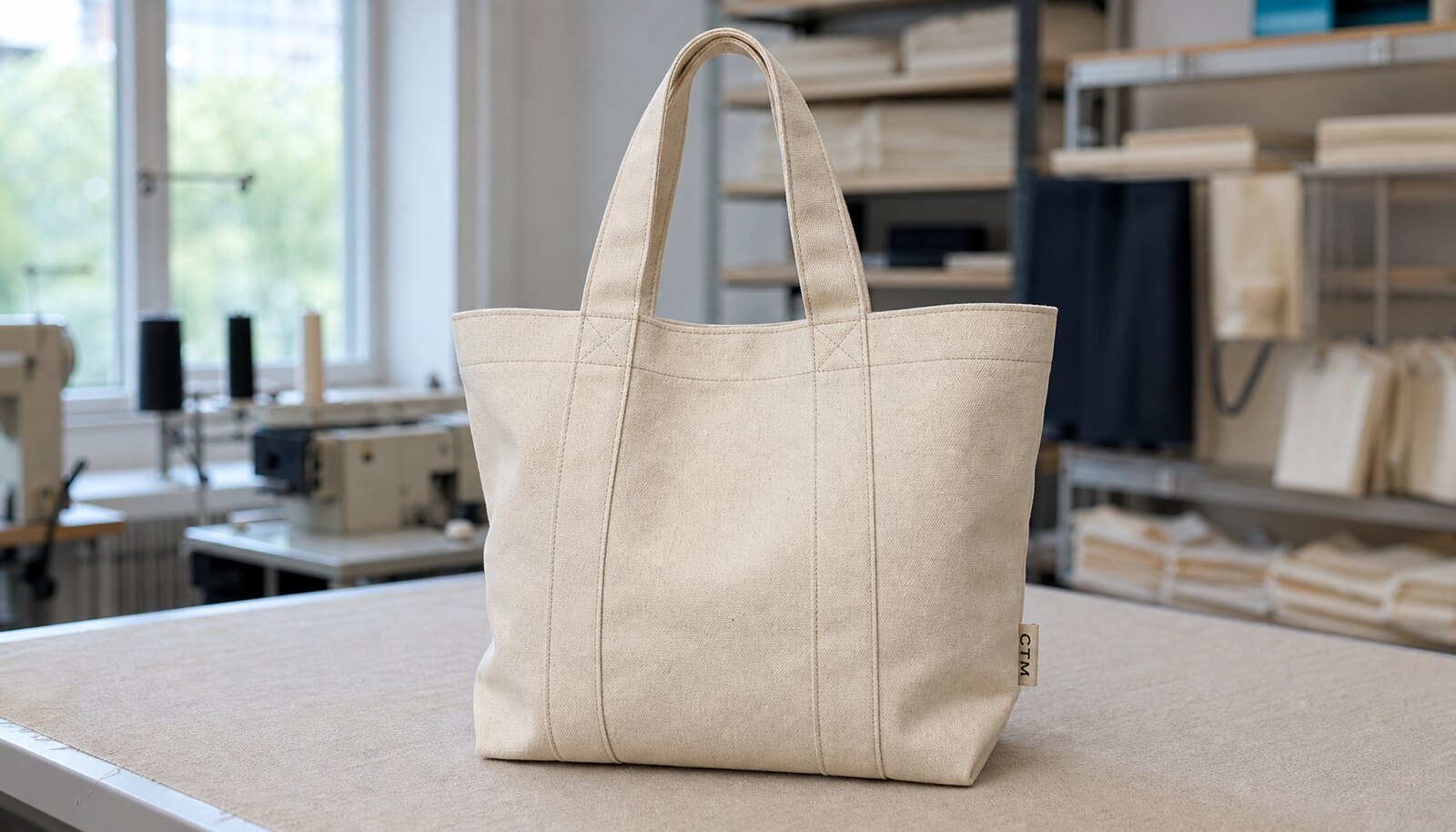
1. Why Handmade Canvas Tote Specs Need a Procurement-Style RFQ
A handmade canvas tote can look simple enough to buy from a single line of text, but procurement teams know that simple descriptions create unstable quotes. One supplier may assume a light promo tote, another may price a retail-weight body with reinforced handles, and a third may include a print method that was never requested. The result is not just a price spread. It is an apples-to-oranges comparison that can hide the real landed cost until the order is already in motion.
The word handmade also needs definition. For some factories, it means visible manual finishing on a standard sewn bag. For others, it means a craft-led build with more labor at the seams, more visible texture, and more natural variation between pieces. Neither is automatically better. What matters is whether the supplier can repeat the chosen build inside the tolerance your program can accept. If you do not define that up front, the quote will reflect the supplier’s default version of quality, not yours.
For B2B buyers, the right approach is to treat the tote as a small production program. That means writing a brief that covers use case, fabric weight, construction, decoration, packing, and inspection criteria. It also means deciding what matters most: price, shelf appearance, repeated carry strength, or quick replenishment. Once those priorities are clear, the supplier can quote a product instead of guessing at a concept.
- Decide whether handmade is a branding signal, a manufacturing method, or both.
- Tie the bag to one use case before price comparison: retail, event, gifting, or resale.
- Use one drawing or one reference sample so every supplier starts from the same spec.
2. Fabric Weight, Feel, and Structure: The First Cost Driver Buyers Should Lock
Fabric weight is the fastest way to distort a quote if it is not controlled. Canvas is commonly discussed in ounces or GSM, but the buyer should care about what that weight does to structure, sewing difficulty, and freight volume. A lighter body may suit a giveaway or brochure carrier, while a heavier body gives the bag a more substantial hand feel and better shape retention on shelf. If the tote is meant to carry products rather than paper inserts, the fabric needs to support that use without overstretching the seams.
For many programs, 8 oz to about 240 GSM is a lighter commercial option. It can work for events, promo packs, and low-load use. Around 10 oz or 340 GSM is often a practical middle ground for retail or branded resale because it gives more body without turning the tote into a heavy, costly item. Around 12 oz or 400 GSM moves into a stronger, more premium feel and is better suited when the buyer wants a bag that stands up more firmly or carries heavier contents. These are not hard rules, but they are useful negotiation anchors when suppliers push vague “good quality” claims.
Fabric is only part of the structure. Buyers should specify whether the tote is unlined, half-lined, or fully lined, and whether the opening is simply turned and stitched or bound for a cleaner finish. Lining adds labor and changes the inside feel, but it can also hide seams and help the bag hold shape. If the bag needs to stand upright for merchandising, ask whether the supplier recommends a bottom insert, heavier canvas, or a wider gusset instead of assuming a thicker fabric alone will solve the problem.
- 8 oz / 240 GSM: lighter use, lower cost, softer drape.
- 10 oz / 340 GSM: balanced option for retail and branded resale.
- 12 oz / 400 GSM: stronger premium feel, better load handling, higher material and labor cost.
- Ask the supplier whether the quoted GSM is finished fabric weight, not just a target estimate.
3. Handle Build, Seam Construction, and the Parts That Actually Carry the Load
The handle usually fails before the body does, so a tote quote that focuses only on body fabric is incomplete. Buyers should specify handle material, width, attachment method, and reinforcement. A self-fabric handle gives a neat, unified look and often fits the handmade style well, but it must be folded and stitched correctly to avoid twisting. Webbing can offer better stability and easier control, though it changes the visual language of the bag. Double-layer canvas handles are common when the program needs a more premium look and better load spread across the shoulder or hand.
Reinforcement matters more than most RFQs admit. Ask how the handle is attached at the opening and whether bartacks, box-stitching, or extra seam reinforcement are included by default. If the factory uses a handmade finishing method, confirm the stitch path and seam allowance so the handle does not pull the opening out of alignment. A clean-looking sample is not enough if the load path is weak. Procurement should be asking where force travels through the bag, not just what it looks like on a table.
The opening and gusset also affect durability. A tote with a wider gusset and a heavy fill load needs a more stable opening seam and tighter control of symmetry. If the bag is open-top, the top edge becomes a wear point, especially if customers repeatedly place and remove product. If the bag has a snap or other closure, confirm whether the closure hardware changes the sewing method or creates a snag risk inside the bag. Every structural choice should be reflected in the quote, because every structural choice changes labor time.
- Confirm handle width, length, drop, and material before quoting.
- Ask whether the factory uses bartack, box-stitch, or double-reinforcement at the handle joins.
- Check seam allowance and opening reinforcement, not just the front panel finish.
- If load is important, ask the supplier what the bag is tested to hold in practical use, not just what it “looks suitable” for.
4. Decoration Method Changes the Economics More Than Buyers Expect
Decoration is often the difference between a cheap tote and a retail-ready item. Screen print is usually the most predictable option for simple logos and repeated artwork because it scales well and gives good opacity on canvas. It is often the right answer when the artwork is limited to one to three colors and the brand wants stable repeatability. Embroidery creates a more tactile, premium appearance, but it increases labor and can pull lighter canvas out of shape. Woven labels, sewn patches, and side labels are useful when the brand wants subtle branding with fewer artwork risks.
The key procurement mistake is to approve the decoration concept before the decoration method. A design with fine detail, gradients, or tiny text may be easy to approve in a mockup and difficult to reproduce cleanly on coarse canvas. Heat transfer can be useful for some short runs or special artwork, but buyers should ask about edge lift, print feel, and durability after handling. If the bag will move through retail, the finish matters as much as the image itself. A soft-looking print that cracks quickly is not a good commercial outcome.
Ask the supplier to quote decoration separately from the base bag. That allows the buyer to see where the economics change if a second color, second location, or larger logo is added. It also helps if the next reorder removes or changes a print. For procurement teams, the best decoration quote is one that makes setup costs visible and separates one-time costs from repeat costs. Otherwise, the second order may not be cheaper even when the bag construction stays the same.
- Screen print: good for stable artwork and repeat ordering.
- Embroidery: premium look, but check fabric distortion and stitch density.
- Woven or sewn labels: lower artwork risk, better for subtle branding.
- Ask for cost impact if artwork is moved to both sides, enlarged, or split across panels.
5. Supplier Route Matters: Direct Factory, Trading Company, Workshop, or Hybrid
For a handmade canvas tote, the sourcing route is part of the product. A direct factory with in-house cutting, sewing, decoration, and packing usually gives the clearest line of responsibility. That is valuable when repeatability matters, because the same site can trace a seam issue, a print drift, or a packing mistake without passing blame between partners. A trading company can be useful when the buyer needs flexibility across styles, lower order friction, or access to multiple workshops, but then the documentation has to be tighter because production may be split behind the scenes.
A small sample-room workshop can be excellent for development, photo samples, and fast iteration on shape or trim. It is often the right place to test whether a gusset width feels correct or whether a handle fold sits naturally. But a development workshop is not automatically the best bulk source. Buyers should confirm whether bulk production will happen in the same place, whether the same workers will sew the order, and what changes once the run scales up. The sample room may produce a beautiful one-off and still fail to hold consistency across a larger batch.
Hybrid sourcing can be useful when the blank tote is sewn offshore and the final branding or kitting is done closer to the market. That can help with retailer-specific labels, inserts, or last-mile customization. The trade-off is more handoffs and more chance for damage or misalignment. The route should therefore be chosen based on where risk sits: in sewing consistency, branding accuracy, speed to market, or freight efficiency. The cheapest route on paper is not always the cheapest route after the first defect report.
- Direct factory: best when you need repeatability and traceability.
- Trading company: useful for flexibility, but confirm who actually makes the tote.
- Sample workshop: ideal for development, not always a bulk benchmark.
- Hybrid route: useful for final branding or market-specific packing, but adds handoff risk.
6. Write the RFQ So Quotes Are Actually Comparable
The RFQ should read like a production brief. If the request is vague, suppliers fill in the blanks using their own assumptions, and those assumptions are exactly what makes pricing unreliable. Start with the finished size, gusset depth, handle length, handle drop, and target load. Add the canvas weight, color, lining status, and whether the opening is folded, bound, or left simple. Then define decoration, folding, and packing. A supplier should be able to price the tote without needing to guess at the product class.
Include the artwork file and state the exact print size and position in millimeters. If the bag needs a woven label, barcode label, hangtag, or care insert, list each item separately. This matters because a tote quote can look competitive while quietly excluding labels, setup, or packing changes. If you want the buyer-to-supplier conversation to be efficient, ask each factory to separate body cost, decoration cost, packing cost, and one-time setup costs. That way a cheap number can be tested instead of admired.
A strong RFQ also asks the supplier for assumptions. If they recommend a heavier canvas, ask why. If they suggest a different handle width or a change from print to embroidery, ask what problem they are solving. This is useful decision logic, not extra admin. The best suppliers will explain trade-offs in plain language, and the weak ones will avoid specifics. Procurement teams should prefer the supplier that explains its number clearly, even if the unit price is not the lowest at first glance.
- Attach a dimension drawing or marked reference sample.
- State the intended carry load or use environment.
- Separate bag body, decoration, packing, and setup into different quote lines.
- Ask the supplier to declare assumptions rather than hide them in the total.
7. Sample Approval Should Prove Repeatability, Not Just Appearance
A sample is not approved because it looks nice in a photo. It is approved because it proves the factory can repeat the design in bulk. For that reason, buyers should ask for a development sample if the shape or artwork is still changing, then a pre-production sample built with the real fabric, the real print method, and the real packing format. The pre-production sample is the one that should carry the most weight in approval, because it is closest to the actual order conditions.
When reviewing a sample, measure the parts that drift most easily in manual production: handle length, opening width, gusset symmetry, print placement, and the straightness of the side seam. Check the bag under load as well. Does the top edge distort? Does the handle pull the opening out of shape? Are the seams still clean after the bag is filled? A handmade style can have slight variation, but the variation has to stay inside the agreed tolerance. If the factory cannot hit the same measurement twice, bulk approval is premature.
Buyers should also freeze the sample logic. Decide which sample is the retained reference, who signs it off, and what changes are allowed afterward. If a supplier wants to change thread color, fabric shade, or label position after approval, that should be documented as a revision, not accepted as a casual adjustment. Keeping one retained gold sample and one measurement sheet with the PO file makes later disputes much easier to resolve.
- Approve the pre-production sample only after checking real materials, not substitute materials.
- Measure handle lengths and opening width, not just overall body dimensions.
- Test the bag under practical load and inspect seam distortion.
- Keep a retained gold sample and signed tolerance sheet in the order file.
8. Packing, Labeling, and Cartons: Small Decisions That Change Freight and Retail Readiness
Packing affects both cost and damage risk. Handmade canvas totes are often bulk packed to keep freight down, but retail buyers may need individual polybags, barcode labels, folded presentation, or insert cards. Those are not cosmetic extras. They change the labor content, carton count, and warehouse handling. If the tote has embroidery, a structured base, or a large front print, the fold method matters because a bad fold can crease the decoration or create an uneven shelf presentation.
Labeling should be decided before the quote. Retail programs may need fiber content, country of origin, SKU, and care information in a specific format. If the tote is moving through a distributor or retailer warehouse, a barcode that is not printed or placed correctly becomes a receiving problem, not just a packing issue. Ask for carton dimensions and gross weight as part of the quotation. Canvas bags are relatively bulky for their value, so carton size can affect freight cost more than many buyers expect.
The carton spec should also match the transit route. Export cartons that travel long distances need enough compression strength to survive stacking and handling. If the quote does not mention pack count, carton strength, or carton marks, the buyer is still missing key landed-cost data. Procurement teams should treat packing as part of the product specification, not as a final detail.
- Define fold size if the tote must fit retail shelves or mailers.
- Specify whether the bags are bulk packed, individually polybagged, or grouped.
- Request carton dimensions, gross weight, and pack count before freight booking.
- Include barcode and label placement in the RFQ if the bag must be retail-ready.
9. MOQ, Lead Time, and Landed Cost: Where Deals Usually Break Down
MOQ on handmade canvas totes is usually driven by fabric sourcing, decoration setup, and batching efficiency. A plain tote may have a lower MOQ if the base canvas is already stocked and the construction is straightforward. Add custom printing, a special handle build, unusual dyeing, or packaging inserts, and the MOQ tends to rise because the factory needs to absorb setup, waste, and changeover time. Buyers should ask why the MOQ exists. If the answer is clear, the number is negotiable through spec simplification. If the answer is vague, the MOQ may be a sales placeholder rather than a real production constraint.
Lead time should be split into sample time, bulk production time, and transit time. That distinction matters because delays often happen before production starts: fabric sourcing, artwork approval, or packaging changes can move the schedule more than sewing itself. For seasonal launches, ask the supplier which step is most likely to become the critical path. Then build a buffer around that step, not just around the ship date. This is more useful than repeating generic “confirm lead time” language, because it tells the buyer where to watch the order.
The final commercial decision should be based on landed cost, not just ex-factory price. A tote with a slightly higher unit cost may be cheaper overall if it has better carton efficiency, fewer packing mistakes, lower rework, or fewer missing labels. Compare quote lines for the bag body, decoration, packing, and one-time setup separately. If a supplier refuses to break the number down, procurement should assume the savings may be hiding in material quality, labor depth, or packing content.
- Ask for MOQ by size, color, artwork version, and fabric source.
- Separate sample lead time, bulk lead time, and transit time in the schedule.
- Use a landed-cost worksheet that includes freight, packing, setup, and any destination handling.
- Treat an unusually low quote as a signal to check exclusions, not as proof of savings.
10. QC Checklist for Handmade Canvas Tote Orders: What to Inspect Before Shipment
Quality control for a handmade canvas tote should be concrete enough that a factory inspector can work from it without guessing. Start with the fabric. Check that the canvas weight matches the approved spec and that the weave is even, without thin spots, excessive slub variation, or color drift beyond tolerance. Then check the measurements: body dimensions, gusset depth, handle length, opening width, and handle drop. Manual construction can introduce variation, but the variation has to be controlled and documented. A product that is “close enough” in a sample room can still fail when packed and shipped in volume.
Next, inspect the construction details that carry stress. The handle attachment area should be reinforced exactly as approved, with clean stitch lines, no skipped stitches, and no loose thread clusters. Seam allowance should be even, and the opening should lie flat without twisting. If the tote uses bartacks, box-stitching, or other reinforcement, verify that the placement and density match the approved sample. If a factory says the bags are handmade, that does not excuse weak workmanship. It simply means the inspector needs more careful standards.
Decoration deserves a separate inspection pass. Print adhesion should be checked for smearing, flaking, poor curing, or image drift. For embroidery, verify that the stitch density is clean and that the fabric is not puckered or pulled out of shape. Check shade variation across the order, especially if body fabric, thread, and label were sourced separately. Final inspection should also include packing: correct count per carton, carton strength, correct marks, and no damage from underfill or overcompression. If the tote is going into retail or wholesale channels, a simple drop or handling test on packed cartons is worth asking for before the shipment leaves the factory.
- Check fabric weight, weave consistency, and shade variation.
- Verify stitch quality, seam allowance, bartacks, and handle reinforcement.
- Test print adhesion or embroidery integrity on the actual production material.
- Inspect carton count, carton strength, and damage risk after handling.
- Require a retained gold sample plus the final measurement sheet for reference.
Specification comparison for buyers
| Spec decision | Recommended option | When it fits | Buyer risk to check | Cost impact |
|---|---|---|---|---|
| Fabric weight | 10 oz / about 340 GSM canvas | Balanced choice for retail, gifting, and repeated carry | Ask whether the supplier is quoting finished fabric weight or nominal greige weight | Medium |
| Handle build | Self-fabric folded handle with bartack reinforcement | Best when you want a cleaner look and better weight distribution | Confirm handle width, stitch count, and whether the seam allowance is folded twice | Medium |
| Decoration | 1–2 color screen print | Good for repeatable artwork, brand marks, and lower setup complexity | Check print size, placement in mm, curing method, and whether the ink sits cleanly on canvas | Low to medium |
| Lining | Unlined body with bound opening or top fold | Works for promo, retail packaging, and lower-cost programs | Verify whether the unlined body still holds shape and whether raw edges are fully enclosed | Low |
| Closure | Open top or simple snap closure | Open top fits shopping and event use; snap closure supports retail resale | Ask whether hardware adds labor, rust risk, or packing damage | Low to medium |
| Production route | Direct factory with in-house sewing and decoration control | Best for repeat orders, tighter defect traceability, and stable sample-to-bulk match | Confirm which steps are in-house and which are outsourced | Low |
| MOQ strategy | Single style with controlled color variants | Best for buyers testing demand without multiplying setup costs | Check whether color, artwork, and packing each create separate MOQs | Medium |
| Packing format | Bulk pack with carton marks unless retail display is required | Suitable for wholesale, distribution, and freight efficiency | Ask for carton count, dimensions, gross weight, and compression limits | Low |
| Price target | Quote broken into body, decoration, packing, and freight assumptions | Best for procurement comparison and landed-cost negotiation | Watch for quotes that hide setup or exclude labels, inserts, or carton changes | High if unbundled |
Buyer checklist before sampling
- Define the end use first: retail resale, event giveaway, grocery carry, gift packaging, or private-label merchandising.
- Specify the exact bag size, gusset depth, handle length, handle drop, and target carrying weight.
- State canvas weight in GSM or oz and note whether the fabric is natural, dyed, bleached, or recycled.
- Choose the construction standard: single stitch, double stitch, folded seam, bound seam, bartack, or reinforced corner.
- Select the decoration method before requesting pricing: screen print, embroidery, woven label, heat transfer, or no decoration.
- Confirm whether the tote is open-top, snap-closure, zippered, or structured with a bottom insert.
- Set the packing format: bulk pack, individual polybag, folding requirement, barcode label, insert card, and carton count.
- Request a pre-production sample, a sealed gold sample, and a measurement sheet with tolerances.
- Ask for MOQ by size, color, artwork version, and fabric source, not just one headline MOQ.
- Ask for lead time split into sample time, bulk production time, and transit time.
Factory quote questions to send
- Can you quote this tote on the exact finished size, handle length, handle drop, and gusset depth shown on our drawing?
- Is the canvas weight based on finished fabric or an estimated nominal weight, and what tolerance do you use?
- How is the handle built: self-fabric, webbing, folded canvas, or double-layer canvas, and how many bartacks are at each join?
- What stitch count or seam reinforcement do you use at the handle attachment, side seams, and opening?
- What decoration method is quoted, and how does price change if we add a second color, second location, or larger print area?
- What is the MOQ by color, by print version, and by size, and which elements can be combined within one production run?
- Which sample stages will you provide before bulk approval, and which sample becomes the production reference?
- What tolerances do you apply for body dimensions, handle length, print placement, and seam alignment?
- How are the bags packed, what is the carton count and carton size, and how many pieces per master carton?
- Which costs are included and excluded in the quote: plates, screens, setup, labels, inserts, fold style, extra packing, or carton artwork?
Quality-control points to confirm
- Fabric weight matches the approved spec and does not show thin streaks, uneven weave, or visible slub variation beyond agreed limits.
- Bag body dimensions, gusset depth, opening width, and handle length are checked against the signed measurement sheet.
- Handle attachment is reinforced at the specified points and shows no skipped stitches, loose thread clusters, or seam popping.
- Stitch quality is consistent: no broken stitches, no skipped stitches, and no wandering seam lines outside tolerance.
- Seam allowance is uniform and enclosed as specified; check that folded edges do not twist or expose raw edges where they should not.
- Bartack length, density, and placement match the approved sample, especially at handle joins and stress corners.
- Print adhesion is tested on the actual canvas: no flaking, smearing, ghosting, excessive cracking, or poor curing after rub handling.
- Print placement is centered and within tolerance; check for image skew, misregistration, and color shift between panels.
- Shade variation is controlled across the order; compare body fabric, thread, label, and lining shade under the same light source.
- Needle damage, oil marks, contamination, puckering, frayed edges, and visible repair marks are rejected or quarantined.