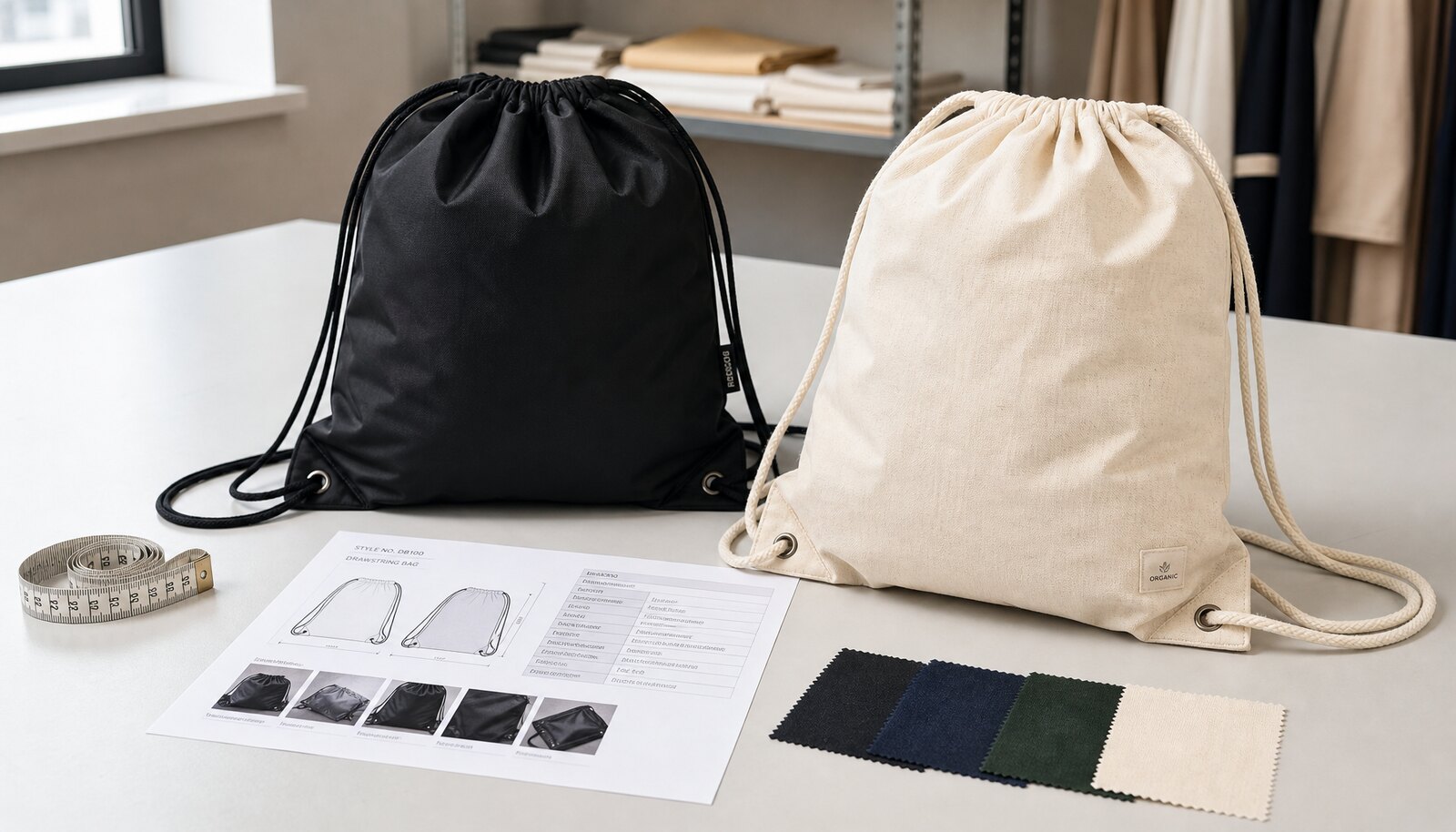
What retail buyers need from a gym drawstring backpack
For retail, a gym drawstring backpack is not just a low-cost bag with a logo. It has to sit on shelf, photograph cleanly for ecommerce, pack efficiently for distribution, and survive everyday use without looking tired after the first week. Buyers are usually balancing three things at once: unit cost, presentation, and the chance of a post-sale problem. A bag that looks good in a mockup but feels flimsy in hand will disappoint. A bag that is built too heavily may exceed the price point the channel can support.
The first sourcing decision should be the use case. Is the bag meant for a shoe-and-water-bottle carry, a private-label apparel add-on, a bundled fitness kit, a seasonal promotion, or a repeat assortment item? Each one calls for a different construction and quote structure. A promotional bag can tolerate a simpler build and a tighter spec. A retail assortment item needs better stitching, clearer labeling, and more repeatable packaging. If the brief is vague, suppliers will fill in the blanks themselves, and the quote becomes hard to compare.
For gym drawstring backpacks for retail, the most useful buyer habit is to define the channel before discussing aesthetics. Store shelf, club retail, ecommerce, and gift-with-purchase programs do not reward the same bag. Shelf programs care about face-out appearance, barcode readability, and neat folding. Ecommerce cares more about transit durability, flat pack efficiency, and a bag that still looks clean after warehouse handling. A good RFQ reflects those channel differences instead of treating every order as a generic drawstring bag.
A practical spec set should answer a few basics upfront: bag dimensions, usable loading size, cord length, fabric weight or denier, print location, packing format, and target shelf price. Those details are more useful than broad descriptions like “premium quality” or “durable construction.” The buyer is not looking for a poetic description. The buyer needs enough detail to compare quotes, approve samples, and keep the reorder consistent.
- Common retail uses: gym shoes, towel, water bottle, light apparel, event kits, and promotional bundles.
- Common channel requirements: flat packing, scannable barcodes, consistent carton counts, and low damage in transit.
- Common buyer objective: a clean, simple bag that feels intentional rather than giveaway-grade.
Fabric choice and construction: where cost, feel, and return risk start
Fabric affects the hand feel, print result, weight, folding behavior, and how the bag ages after several uses. For price-sensitive retail programs, 210D polyester is still a common starting point because it is light, easy to print, and economical at volume. It works well when the bag needs bright graphics, predictable packing, and enough body to hold shape without adding much freight cost. If the program is extremely price-driven, stock polyester is usually the most efficient route.
Cotton and cotton canvas change the retail signal. A 150-180 gsm cotton canvas bag reads more lifestyle or boutique than promo. That can be valuable if the bag is part of a private-label program or if the brand wants a more natural look on shelf. Cotton can also support more premium decoration styles, but it often brings tighter needs around shrinkage, wrinkling, shade control, and seam finish. Buyers should not assume cotton is simply “polyester, but nicer.” It may shift the whole cost structure, including packing labor and reject risk.
Construction matters as much as the cloth itself. A single-layer bag keeps cost and weight down, but it usually has less shape control and less support at the cord tunnel. If the bag is expected to carry heavier gym items, ask for top hem reinforcement, bar-tacks at stress points, and properly set grommets or reinforced eyelets. Those upgrades are not decorative. They are what prevent the common retail complaint that the bag looks fine at launch but starts failing after a few real uses.
For buyers, the most important construction question is not “what is the strongest build available?” It is “what build matches the channel and target price band?” A chain retail bag that must hit a tight retail price may need a lighter structure with carefully chosen reinforcements. A boutique private-label bag can justify a more substantial feel. The best spec is the one that aligns with the way the product will actually be sold, not the one that sounds best in theory.
- 210D polyester: practical for price-sensitive retail and highly printable logo programs.
- 150-180 gsm cotton canvas: useful for natural, lifestyle, or private-label retail positioning.
- Single-layer build: lower cost, but less shape retention and less margin for stress.
- Reinforcement upgrades: bar-tacks, stronger cord tunnels, and better eyelet setting reduce early failures.
Decoration methods: what works in production, not only on a sample
Decoration should be chosen from the artwork, quantity, and retail price target, not from a preference for the most premium-looking mockup. For simple logos with one or two solid colors, screen printing is often the most efficient option on both polyester and cotton. It is familiar to factories, predictable in pricing, and usually durable when the ink system matches the fabric. For retail buying, the key question is not whether screen print exists, but whether the design can stay clean and readable after production, folding, and warehouse handling.
If the art has gradients, multiple colors, or more detail, heat transfer may be a better short-run option. It can preserve complexity that screen printing would simplify, but buyers should check abrasion resistance and whether the finish still looks good after repeated handling. Direct-to-garment is more naturally suited to cotton than to slick polyester surfaces, and it is usually not the first choice for higher-volume retail replenishment. Embroidery can raise perceived value, but it adds cost, can distort light fabrics, and may be a poor fit for small artwork or tight price points.
Placement deserves as much attention as the decoration method. Soft goods shift during printing, so buyers should specify print size, centerline, distance from the top seam, and whether one or both sides are printed. If there are multiple colors or SKUs, ask the supplier to confirm that the artwork sits in the same location across all variants. A logo that is technically printed correctly but sits too high, too low, or too close to the side seam can look sloppy on shelf.
Ask for a real production view of the decoration, not just a digital proof. The best quote includes the exact printing method, color count, ink type or transfer type, and any effect on the fabric hand. If the supplier cannot explain how the artwork will behave on the actual bag, the sample stage is not complete enough for a retail order.
- Screen print: best for simple logos, opacity, and repeatable pricing.
- Heat transfer: useful for detailed art or short runs, but check abrasion and wash resistance.
- DTG: generally better on cotton than polyester, and best for niche or lower-volume runs.
- Embroidery: adds value, but requires careful sizing and fabric support to avoid distortion.
MOQ, price breaks, and the line items that quietly change the quote
MOQ is not one number. It is the point where material sourcing, setup effort, decoration time, and packing labor all become economically workable for the supplier. A factory may accept a low MOQ on a stock-color bag with one print location, then move the minimum sharply upward once the buyer asks for custom fabric, custom cord color, woven labels, or retail-ready packing. That is why MOQ alone is a poor comparison tool. Two suppliers can both say 500 pieces while quoting completely different service levels.
The cleanest way to read pricing is by quantity band. For gym drawstring backpacks for retail, it is useful to ask for 500, 1,000, 3,000, and 5,000 pieces at minimum. Those breaks show where setup cost is being spread out and where the supplier’s real production efficiency starts to appear. Buyers should also ask whether the same spec can be repeated later without changes to dye lot, print feel, or packing format. A low first-order price is less valuable if the reorder forces a new approval cycle.
A quote should never be judged by unit price alone. Ask what is included in the line item and what is not. Some factories quote only the sewn bag and leave out barcode stickers, hangtags, retail folding, insert cards, or carton reinforcement. Others include those items but bury the difference in tooling, freight handling, or packaging language. If the buyer does not ask for the quote to separate bag body, cord, reinforcement, printing, labels, packing labor, carton cost, sample cost, and surcharges, the comparison is not clean enough to approve.
The most common hidden add-ons are small but cumulative: custom cord color, custom woven label, second print location, mixed-color assortment, retail fold requirement, and rush production. None of those are unusual. The issue is that they often appear after the buyer has already built a budget around the base price.
- Low MOQ usually depends on stock fabric, standard size, and one print position.
- Custom dye, custom cord color, woven labels, and retail-ready packing usually raise the minimum.
- Ask for separate pricing at 500 / 1,000 / 3,000 / 5,000 pieces to identify the real cost curve.
- Insist that the quote states whether samples are chargeable and whether the sample fee is creditable against bulk.
Supplier comparison table: cost, control, and retail fit
Use this table as a procurement filter, not a generic summary. It helps decide which supplier route to quote first and where the real risk sits. The lowest ex-factory number is not always the lowest landed cost, especially once labels, carton rules, freight, and receiving labor are added.
When comparing suppliers, keep the spec identical. Same bag size, same fabric target, same print location, same packing format, same Incoterm, same carton count. If one supplier is quoting a stock build and another is quoting a custom build, the numbers are not comparable. The table below highlights where the differences usually show up in retail programs.
- Write decisions in measurable language, not only descriptive wording.
- Ask for sample photos plus one physical approval sample for important orders.
- Keep quotation, sample approval, and inspection notes tied to the same spec version.
Samples and approvals: what to inspect before the PO is released
A sample process should answer a simple question: will bulk production match the approved piece in look, feel, and function? For a drawstring backpack, that means inspecting more than the print. Check the fabric hand, the cord glide, the opening action, the seam alignment, the label positions, and the way the bag folds after being loaded. A photo can be helpful, but it does not reveal whether the cord tunnel binds, whether the print is positioned correctly under real tension, or whether the bag sits neatly when packed flat.
For any meaningful retail order, ask for a physical pre-production sample using the final fabric, the final decoration method, the final cord, and the final label placement. If a physical sample is not possible, ask for measured photos, close-ups of the cord channel, and written confirmation of every material used. A sealed reference sample is worth keeping for repeat programs so later orders do not rely on memory or old email threads.
The sample should also be judged under believable use. Put a realistic load inside, close and reopen it several times, and see whether the cords pull evenly. Confirm that the logo sits where the shopper will notice it and where the warehouse can still scan any barcode after folding. The approval should be based on the actual retail experience, not on whether the bag looks acceptable from a distance.
A useful habit is to note what can change and what cannot change. If the print position, fabric shade, label type, or fold method must remain fixed, say so in writing before bulk starts. That makes it much easier to hold the production line to the approved standard.
- Check sample dimensions with a ruler, not by eye.
- Test cord movement several times to see whether the opening binds or frays.
- Load the bag with realistic retail weight before approving structure and feel.
- Confirm label position, barcode readability, and fold method before bulk release.
QC thresholds, defect examples, and what belongs in the inspection plan
QC works better when the buyer names defects plainly. The usual problem areas are predictable: uneven cord tunnels, skipped stitches at the top hem, print drift, frayed cords, burrs at eyelets, stains, and carton count errors. If the factory only learns these are problems during a final inspection, it may argue that the defects are within normal tolerance. A better approach is to write the acceptance criteria into the PO and the inspection plan before production begins.
Separate major defects from minor ones. Major defects are the issues that make a bag hard to sell or likely to fail in use: open seams, missing bartacks, sharp grommets, severe print misplacement, obvious stains, wrong carton counts, or mixed-color cartons that were not approved. Minor defects may include small thread trims, light packing wrinkles, or tiny position variation that does not affect function. Buyers do not need a complicated quality system to manage this category; they need a consistent one.
AQL language can be useful if your team already uses it, but the practical point is more important than the acronym. Tell the factory which defects are reject-level, which are rework-level, and which are acceptable. For larger or higher-value programs, ask for in-line photos at stitching, print, and packing stages rather than relying only on a final shipment report. Early visibility catches problems when they are still easy to fix.
It also helps to document visual examples. If the logo can be slightly off within a defined tolerance, write that down. If a crooked top hem or a loose cord end is unacceptable, write that down too. The more concrete the standard, the less room there is for a shipment dispute later.
- Reject examples: open seams, missing bartacks, wrong color, severe print shift, sharp grommets, and mixed cartons without approval.
- Rework examples: loose threads, incorrect fold, unreadable barcode, or a label placed outside the agreed area.
- Accept examples: small thread trims, normal packing wrinkles, and tiny position variance within the written tolerance.
- Ask for in-line photo checkpoints at stitching, print, and carton closing stages.
- Use an agreed AQL or defect framework so the buyer and factory are judging the same standard.
Packing, labeling, and carton planning for retail and ecommerce
Packing can change the economics of the order more than many buyers expect. A flat-packed drawstring backpack in a simple polybag is the cheapest and easiest option for ecommerce or distribution centers that unpack downstream. Shelf retail usually needs more than that: barcode stickers, size stickers, hangtags, care labels, or insert cards. If the bag is sold as part of a gift set or seasonal bundle, the fold and stack method must be fixed so every unit presents the same way on opening.
Carton planning deserves the same attention as decoration. Drawstring backpacks compress well, which means a carton can appear full even when count errors or fold differences are hiding inside. Buyers should confirm master carton quantity, gross weight, carton dimensions, and whether the cartons are export-strength or retail-only. If the warehouse scans each unit individually, the barcode format must survive folding and transit. Ask the factory to show where the barcode will sit after packing; a good label in the wrong place becomes a receiving issue.
Where required, polybag packaging should include the proper warning language. Even when that is not a legal issue, the packing spec should state whether cartons may be mixed by color, whether the units need tissue or inserts, and whether the face of the bag should be aligned a certain way. These details sound small, but they affect labor time, warehouse reception, and the polish of the retail program.
- Flat pack is best for lower freight cost and easier carton control.
- Polybag, barcode, and fold spec should be written before production starts.
- Master carton quantity and gross weight should be verified, not assumed.
- Mixing colors in a carton should be forbidden unless it is explicitly approved.
Landed cost, Incoterms, freight, duties, and hidden retail compliance costs
A useful landed-cost model starts with more than the factory quote. Compare the unit price under the same Incoterm, then add the real costs that move the product from factory to shelf. If the supplier quotes FOB, the buyer still needs to budget ocean or air freight, origin charges, destination handling, customs brokerage, duties, and any domestic delivery from port or warehouse. If the quote is EXW, add pickup from the factory gate, export clearance support, inland trucking to port, and any loading or origin documentation fees. The same bag can look inexpensive until the buyer adds the actual movement costs.
For retail buyers, hidden costs often live in the details around packing and compliance. A carton that does not match warehouse requirements can trigger relabeling, repacking, or extra handling after arrival. If the product needs fiber content labels, origin marking, warning labels, or retail barcode logic, those items should be priced before PO release rather than discovered by the DC later. Small differences in folding or bag count per carton also affect freight efficiency and labor on receipt.
Import duty and tax treatment depend on the destination country and product classification, so the buyer should confirm the HS code with their customs team or broker rather than assuming a generic textile rate. Even when the item itself is low cost, the margin can be eroded by freight surcharges, peak-season ocean rates, container space inefficiency, demurrage risk, and extra handling if cartons arrive damaged. For launch planning, build two landed-cost views: one for the first order and one for the reorder. The first order may carry sample, setup, and compliance steps that should not be blended into steady-state pricing.
The most practical rule is simple: compare supplier quotes only after the same freight terms, packing requirements, and compliance duties are assigned to each one. Otherwise the cheapest quote is only the cheapest line on paper.
- Plan freight, origin charges, customs brokerage, duties, destination handling, and inland delivery as separate line items.
- Treat FOB, EXW, and CIF differently; they are not interchangeable price points.
- Add costs for relabeling, repacking, and warehouse handling if the quote’s packing spec does not match your DC.
- Build separate launch and reorder landed-cost views so one-time setup does not distort ongoing margin.
Which specs matter most by channel tier and target price band
The right specification depends on where the bag will be sold and what the retailer can charge. A budget promo or entry shelf item usually needs a stock polyester body, one-color or two-color print, standard cord, and flat pack. That spec keeps cost down and makes replenishment easier. It is the right lane when the merchandising job is to deliver a simple gym carry bag at an accessible price point.
Mid-tier retail gives the buyer more room to improve the look without overbuilding. In that band, thicker polyester, cleaner stitching, better reinforcement, a more intentional label, and tighter folding are often worth the added cost. The product needs to look more designed and less disposable. For this band, buyers should watch visible finish quality: seam trim, cord neatness, print sharpness, and the way the bag presents after unpacking.
Premium or private-label programs often justify cotton canvas, a more deliberate decoration method, woven labels, stronger packaging presentation, and stricter shade control. Here the buyer is not just buying a bag; they are buying an item that supports brand perception. The unit price can be higher, but the spec has to earn that increase through presentation and repeat consistency. If the brand story depends on the product feeling more natural or more substantial, the supplier needs to understand that from the first RFQ, not after sample round two.
A helpful way to think about it is this: the lower the retail price band, the more the spec should protect margin and throughput; the higher the retail price band, the more the spec should protect finish and consistency. That is the real tradeoff, and it should shape every sourcing decision from fabric to packaging.
- Budget channel: stock polyester, simple print, standard cord, flat pack.
- Mid-tier channel: better reinforcement, cleaner finish, more controlled folding, and more visible label quality.
- Premium/private label: cotton canvas or upgraded material, tighter color control, stronger packaging presentation.
- Do not overspec a budget bag or underspec a premium bag; both create margin problems.
Specification comparison for buyers
| Procurement route | Typical cost impact | Best retail scenario | Buyer risk to check |
|---|---|---|---|
| Factory direct with stock materials | Usually lowest unit price at higher quantities; setup and communication sit more on the buyer side | Repeat retail basics, promo programs, and replenishment orders with stable artwork | Spec drift if fabric, print size, fold, or carton count are not locked in writing |
| Factory direct with custom materials | Higher setup cost, but better control over color, feel, and brand consistency | Private label launches, premium retail, or programs where the bag itself is part of the brand story | Shade variation, longer lead time, and higher minimums for custom dye or custom cord |
| Trading company or sourcing agent | Usually a higher unit price, but easier coordination across labels, inserts, and mixed SKUs | Smaller buying teams, multi-item programs, or orders that need one point of contact | Less visibility into the real factory process and fewer chances to audit line-level QC |
| Regional or domestic supplier | Higher manufacturing cost, but lower freight complexity and faster response | Short lead-time launches, test orders, or compliance-sensitive retail | Confirm they are not substituting lower-grade components to protect margin |
| Importer/distributor stock route | Fastest access, especially when immediate shelf fill matters | Urgent replenishment, short seasonal windows, or low-complexity retail programs | Limited artwork options, less control over carton format, and possible mismatch to your shelf spec |
| Stock bag plus local decoration | Moderate cost with faster turnaround; decoration is usually the main variable | Retailers testing designs before committing to a full factory program | Print placement and color matching can be less consistent across batches |
| Custom bag plus retail-ready packing | Higher total cost, but the bag arrives closer to shelf-ready | Programs that require barcode labeling, hangtags, or exact folding format | Packing and label specs can quietly become the biggest source of rework |
| Low-MOQ pilot order | Lowest commitment, but usually highest unit cost per piece | Market tests, store trials, or ecommerce validation orders | Pilot pricing can hide setup fees, weak reinforcement, or packaging shortcuts |
| High-volume seasonal buy | Best spread of setup cost and usually strongest quote leverage | Back-to-school, fitness promotions, holiday bundles, and chain retail rollouts | Need stronger QC planning because a defect lot can affect more cartons at once |
Buyer checklist before sampling
- Confirm final bag dimensions, usable loading size, cord length, and whether a bottom gusset is required.
- Specify fabric type, fabric weight or denier, color standard, and acceptable shade tolerance before requesting quotes.
- Send vector artwork, define print size and placement, and list acceptable logo colors or Pantone references.
- Ask for a physical pre-production sample or sealed sample reference before bulk approval; do not rely on photos alone for critical orders.
- Agree on retail packaging, barcode format, fold method, master carton count, and carton marking before production starts.
- Write QC thresholds into the PO: stitching defects, print shift, stain limits, measurement tolerance, and carton count tolerance.
- Ask the supplier to confirm whether sample cost is credited against bulk and whether quote pricing includes labels, inserts, and packing labor.
Factory quote questions to send
- What exact fabric specification are you quoting, including denier or gsm, coating if any, and whether it matches the front, back, and bottom panels?
- Which items are included in the unit price: print setup, one or two print positions, labels, barcode stickers, hangtags, and retail folding?
- Can you quote at 500, 1,000, 3,000, and 5,000 pieces, and show where the price drops because setup costs are spread out?
- What reinforcement is standard on your line: bar-tacks, top hem reinforcement, cord tunnel reinforcement, and grommet setting?
- What are your actual sample and bulk lead times for this specific specification, and what would change the schedule if artwork or materials are revised?
- Can you share recent production photos or line-check images for a similar bag build, including stitching, print area, and packing stage?
- What carton quantity, gross weight, and carton dimensions are included in the quote, and do you support export marks or retail barcode application?
- If we approve a sample, what exactly can still change in bulk production, and how do you control color lot matching on repeats?
- Are there any surcharges for custom cord color, custom label, mixed color assortments, or a second print location?
- What is your policy on replacing or crediting defects found in inspection, and what defect threshold triggers rework before shipment?
Quality-control points to confirm
- Fabric weight tolerance: keep within ±5% of the approved gsm or denier target unless the buyer authorizes a wider range in writing.
- Measurement tolerance: bag width and height should stay within ±1 cm for standard retail programs unless a tighter tolerance is specified.
- Print placement tolerance: keep the main logo within 5 mm of the approved position for simple placements; larger artwork needs its own written tolerance.
- Seam quality: no skipped stitches, open seams, loose thread chains, broken bartacks, or puckering at the cord tunnel and top hem.
- Cord and opening function: cords must slide smoothly, have matching lengths, and not cut into the fabric or bind at the channel.
- Grommet and eyelet quality: holes must be clean, flat, and free from sharp burrs or metal deformation that could fray cords or tear fabric.
- Visual appearance: no obvious oil stains, ink smears, needle marks, severe wrinkling from packing, or shade mismatch within the same color lot.
- Label and barcode quality: labels must be legible, aligned, securely attached, and machine-readable after folding and packing.
- Carton count and assortment: unit count must match the packing list exactly, with no mixed-color cartons unless the buyer approved them beforehand.
- AQL reference: use a documented inspection plan such as a standard major/minor defect framework, and define what counts as reject, rework, or accept before shipment.