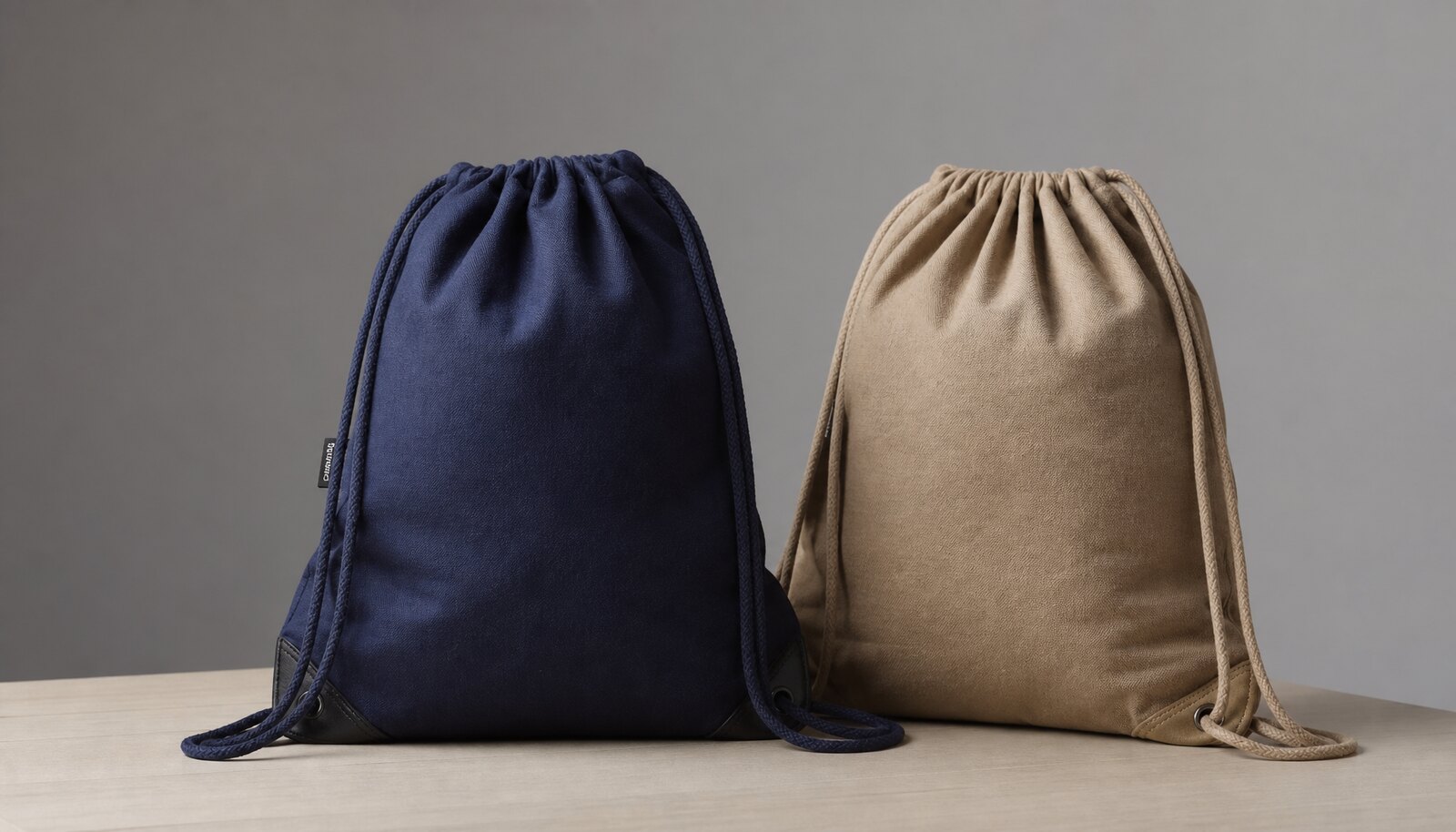
What hotels are actually buying
For hotels, gym drawstring backpacks are not a fashion accessory. They are a controlled-use item that has to survive room-to-gym traffic, guest handling, housekeeping turnover, and repeated packing with shoes, towels, or a water bottle. That is why the right brief starts with function, not decoration. If the bag is only used for an in-room amenity kit, the spec can be lighter. If it is meant for guests to keep and reuse, the construction has to tolerate abrasion, load, and damp items.
A practical baseline for most hotel programs is a finished size around 35 x 45 cm to 40 x 50 cm, with reinforced lower corners, a clean top channel, and drawcords long enough to open and close the bag without strain. For polyester programs, 210D or 300D is common; for cotton, 8 oz to 10 oz canvas is the point where the bag starts to feel substantial enough for guest reuse. The buying mistake is over-specifying a retail backpack when the use case only needs a durable amenity bag.
- Guest-use bags need better stitching and cord security than one-time giveaway bags.
- If the bag will carry wet items, prioritize wipeability and print durability over heavy fabric alone.
- If housekeeping will pre-pack them, the opening and closure must be easy to handle quickly.
Pick the material by use case, not by habit
The cheapest quote is often built on a fabric that passes on paper but fails in guest use. For hotel gyms and spas, 210D polyester is a sensible value choice because it is light, easy to clean, and usually stable in volume production. If the bag needs more body, 300D polyester gives a slightly firmer hand and better resistance to wrinkling. If the hotel brand wants a more premium or natural look, cotton canvas is stronger visually, but the cost rises and the bag absorbs moisture more readily.
For cotton, the most useful quoting language is not just "canvas". Ask for ounces and finished GSM. An 8 oz canvas is roughly in the 270 GSM range, while 10 oz is closer to 340 GSM. That extra weight changes print behavior, folding, and carton efficiency. If a supplier only quotes a generic cotton bag, they may switch to a lighter cloth after approval. For polyester, ask whether the quote is based on finished fabric weight and whether any coating is included, because coating changes both feel and price.
- 210D polyester: best for controlled cost, lighter cartons, and easy wipe-clean use.
- 300D polyester: better when the bag must feel sturdier in hand or hold slightly heavier contents.
- 8 oz cotton canvas: a balanced premium option for hotels that want reuse value without overbuilding.
- 10 oz cotton canvas: better when you want a more durable, heavier brand impression and less wrinkling.
Decoration should survive handling, folding, and cleaning
Branding on a hotel gym bag has a different job from retail branding. It has to stay legible after being packed, folded, pulled open, and handled by guests who are not gentle with it. Screen print is usually the best value for simple logos on polyester or cotton when the artwork is clean and the print area is predictable. It scales well and keeps the quote structured, but the factory must match the ink system to the fabric or the print will crack or wash out too early.
Embroidery looks strong, but on lightweight drawstring backpacks it can create puckering and add unnecessary cost unless the logo is small and the fabric is heavy enough. Heat transfer works for short runs and detailed artwork, but it is the decoration most likely to create a soft-touch mismatch or edge lift if the substrate is wrong. A woven side label or sewn-in brand tab is often the safest hotel choice when the main logo needs to stay subtle and the product has to look clean in room photography and at check-in.
- Use screen print for simple logos and larger quantity runs.
- Use woven or sewn labels when the logo should be durable and understated.
- Use embroidery only when the fabric weight and logo size support it.
- Avoid glossy print effects if the bag will be handled in humid or wet areas.
Compare sourcing routes before you compare unit price
A hotel buyer often gets quote noise because every supplier is pricing a different sourcing route. A direct factory quote is usually the cleanest if you already know the spec and volume. A trading company may look more flexible, but you need to know whether they are managing real production or simply forwarding a factory price with margin added. An amenity supplier can be efficient when the backpack is part of a larger guest kit, yet the bag itself may be a stock shape with limited customization.
The right route depends on the size of the program, the number of delivery locations, and how much risk the buyer can absorb. For a one-property opening, a local stock importer or low-MOQ print house can solve timing, but that route usually gives you less control over fabric weight and reinforcements. For a chain rollout, direct factory sourcing or a dual-source model works better because it allows one approved sample to feed repeat orders while keeping the price structure visible.
- Direct factory: best control, lowest noise, strongest for repeatable hotel programs.
- Trading company: useful when you need one contact for multiple categories or countries.
- Local stock route: good for urgent openings, but limited on branding and construction.
- Dual-source: useful when you want a fast sample path without paying long-term premium pricing.
What belongs in a real factory quote
A useful quote is not just a unit price. It should show the fabric basis, print method, labor assumptions, packing format, and the cost of any extra handling. If a supplier gives only one number, you cannot tell whether the price is being driven by lighter fabric, weaker cord, simpler print, or cheaper packing. That is where hidden quality loss shows up later. Hotels often buy in volume, so a small spec downgrade compounds into real budget waste across a chain rollout.
A better RFQ asks for line-item structure. You want separate pricing for sample, bulk unit, print setup, woven label, hangtag, barcode label, inner polybag, carton packing, and inland freight to the export point. You also want the MOQ logic by color and decoration version, because one logo variant may be economical while two or three variants force higher minimums. If the supplier will not separate these items, the quote is too opaque to compare fairly.
- Ask for a price break by 1,000, 3,000, and 5,000 pieces if the program may scale.
- Separate the bag price from print, label, and packing costs.
- Confirm whether the quote includes export carton packing or only loose packed bags.
- Make sure the MOQ changes are tied to the actual production setup, not arbitrary policy.
Sample approval is where most hotel mistakes are prevented
Do not approve a gym drawstring backpack on appearance alone. The sample should be treated like a production control point. Review the fabric hand feel, stitch finish, cord movement, print alignment, and overall capacity with the intended contents inside it. A bag can look correct on a table and still fail once a pair of shoes, a towel, and toiletries are placed inside. The hotel buyer should test the closure, pull the cords repeatedly, and check whether the fabric corners deform under load.
The best sample flow is usually a pre-production sample followed by a golden sample that both sides sign off on. If the project is large, request a strike-off for the print or label before the sewn sample is finalized. That prevents a situation where the bag construction is approved first and the logo color or placement is discovered to be off later. For repeat hotel orders, keep a sealed reference sample with the tech pack so the next production run is judged against the same standard.
- Test with actual contents, not an empty bag.
- Pull the cords 20 to 30 times to see whether the channel or eyelets wear quickly.
- Check logo placement against the folded and open states.
- Keep a signed golden sample for future reorders.
QC thresholds that matter in guest use
The most useful QC points are the ones that prevent guest complaints and replacement costs. For drawstring backpacks, the first failure points are usually corner reinforcement, cord fraying, print wear, and inconsistent bag size. A hotel bag does not need luxury finishing, but it does need predictable stitching and a clean edge. If the product is sold as reusable, any early seam opening becomes a brand problem, not just a product defect.
Set acceptance criteria before production begins. If the fabric is cotton canvas, make sure the finished weight matches the approved reference. If it is polyester, confirm the denier and coating are stable. Request pull tests on cord attachment points and sample packs from multiple cartons, not just the top carton. The idea is to catch variation early enough that the factory can rework the run without disrupting the hotel opening or the next refill schedule.
- Check corner reinforcement and seam integrity on every sampling point.
- Inspect print wear after rubbing and light folding.
- Measure size consistency across cartons, not just across one sample batch.
- Reject any batch with mixed shade or mixed packing format unless pre-approved.
Packing choices affect labor, presentation, and damage
Hotel programs often underestimate packing. A drawstring backpack can be packed loose, folded with a card insert, or placed into a polybag with barcode labeling. Each choice changes labor, carton density, and how the bag arrives at the property. If housekeeping will insert amenity sets, a flat-folded bag with a clear packing method is usually easier to handle than a randomly stuffed carton. If the bag is given to guests directly, the presentation needs to be neat enough that the first touch feels deliberate, not warehouse-driven.
Packing also drives damage risk. Overstuffed cartons crush fabric, crease print areas, and deform cord ends. Underfilled cartons waste freight and raise the unit cost. Ask the supplier to quote carton count, carton dimensions, and gross weight so you can compare freight efficiency across vendors. If the hotel group needs regional distribution, add barcode labels and outer carton marks that match the warehouse receiving process. Those small details save time at property level and reduce mis-picks.
- Choose a flat-fold method if the bags will be replenished through hotel stores.
- Use individual polybags only if presentation or cleanliness requires it.
- Standardize carton counts so every property receives the same unit density.
- Match carton labels to the receiving process, not to the factory's convenience.
Lead time risk and landed-cost comparison
Lead time for gym drawstring backpacks is usually determined by three things: sample approval speed, material availability, and print complexity. A plain stock bag can move fast, but a custom fabric, a special label, or a multi-color logo can add waiting time before bulk production even starts. The biggest schedule mistake is approving art late and assuming sewing can start while the print is still unresolved. In practice, the factory cannot lock the line until the final decoration spec is approved.
When you compare landed cost, do not stop at the ex-works number. Include freight, duty, inland delivery, storage, and the cost of any replacement cartons or rejects. A slightly higher factory price can still be cheaper if the supplier ships in cleaner carton counts, with lower defect rates and fewer rework issues at arrival. For a hotel rollout, the cheapest quote is the one that lands on time, matches the approved sample, and does not create a replenishment scramble after opening.
- Build the schedule backward from the hotel opening or replenishment date.
- Allow time for sample approval, print strike-off, and pre-shipment inspection.
- Compare freight efficiency by carton size and gross weight, not by unit price alone.
- Include rework and replacement cost in the buying decision.
Specification comparison for buyers
| Spec decision | Recommended option | When it fits | Buyer risk to check |
|---|---|---|---|
| Direct cut-and-sew factory | Best for custom sizes, custom labels, and stable repeat orders | Use when you need control over fabric, cord, print, and carton spec | Confirm the factory is sewing the bags in-house, not outsourcing the cut panel or print step |
| Trading company | Useful for mixed hotel kits and multi-category procurement | Works when one buyer manages bags, towels, slippers, and pouches together | Ask for factory names, audit evidence, and which step they actually control |
| Hotel amenity supplier | Good when the bag is part of a guest-use bundle | Fits spa, gym, and room-drop programs that need coordinated packing | Check whether they are quoting the bag itself or reselling a standard stock item |
| Local stock importer | Best for urgent openings and small replenishment runs | Use when lead time matters more than exact branding depth | Watch for inconsistent shade, weak cord reinforcement, and limited print options |
| Low-MOQ digital print house | Practical for pilots and one-property tests | Fits trial runs, seasonal promos, or soft launches | Verify print durability on the actual fabric, not just on a print swatch |
| Dual-source route | Sample from a local supplier, volume from an offshore factory | Useful when you want faster approval without paying retail volume pricing | Lock the approved sample as the production reference before splitting the order |
| Domestic contract packer | Strong for hotel groups that need kitting and distribution | Fits multi-location rollouts with barcode labeling and set assembly | Confirm who owns the bag inventory and what happens to overruns or shortages |
| Recycled-material factory | Best for ESG-led brands or green hotel positioning | Works when recycled polyester or organic cotton is part of the brand story | Ask for proof of fiber content and whether recycled claims apply to fabric, thread, and label |
Buyer checklist before sampling
- Define the use case: guest gym bag, spa bag, pool bag, or in-room amenity bag.
- Set the target size in centimeters and the minimum useful internal volume.
- Choose fabric by cleaning burden: wipeable polyester or heavier cotton canvas.
- Lock the decoration method based on abrasion, not on lowest quote only.
- Specify cord diameter, cord length, and whether the bag needs metal eyelets or stitched channels.
- Decide if the bag needs a side label, hangtag, barcode, or woven brand mark.
- Request a pre-production sample with the exact fabric, print, cord, and packing.
- Confirm carton counts, carton marks, and whether inner polybags are required.
- Ask for lead time split by sample, bulk production, inspection, and dispatch.
- Compare landed cost, not factory price alone, including freight, duty, and domestic delivery.
Factory quote questions to send
- What is the exact fabric specification, including denier or GSM, coating, and finished weight?
- Is the bag sewn in-house, and which process is outsourced if not?
- What are the MOQ breaks by color, print version, and packaging format?
- Which print method is quoted, and how many color passes are included?
- What stitch reinforcement is included at the corners and drawcord channels?
- What sample stages are included before bulk approval?
- What is the carton pack count, carton size, and gross weight per carton?
- What is the production lead time after sample approval and deposit?
- What defects are excluded from the quote, and what is the rework policy?
- Can you separate unit price, print setup, sampling, packing, and inland freight on the quote?
Quality-control points to confirm
- Finished size matches the approved tech pack within agreed tolerance, usually plus or minus 5 mm on key dimensions.
- Fabric weight or denier matches the approved reference and is not replaced with a lighter alternate without approval.
- Corner bar-tacks or reinforcement stitches are present, even, and secure under pull testing.
- Drawcords run smoothly through the channel or eyelets and do not snag, twist, or fray easily.
- Print alignment is centered or positioned to spec, with no peeling, cracking, bleeding, or ghosting on the approved fabric.
- Color shade is consistent across the batch and between production lots when repeat orders are placed.
- Seams are straight with no skipped stitches, open seams, loose threads, or puckering at stress points.
- Packing is clean, dry, and odor-free, with correct carton marks, counts, and barcode labels.