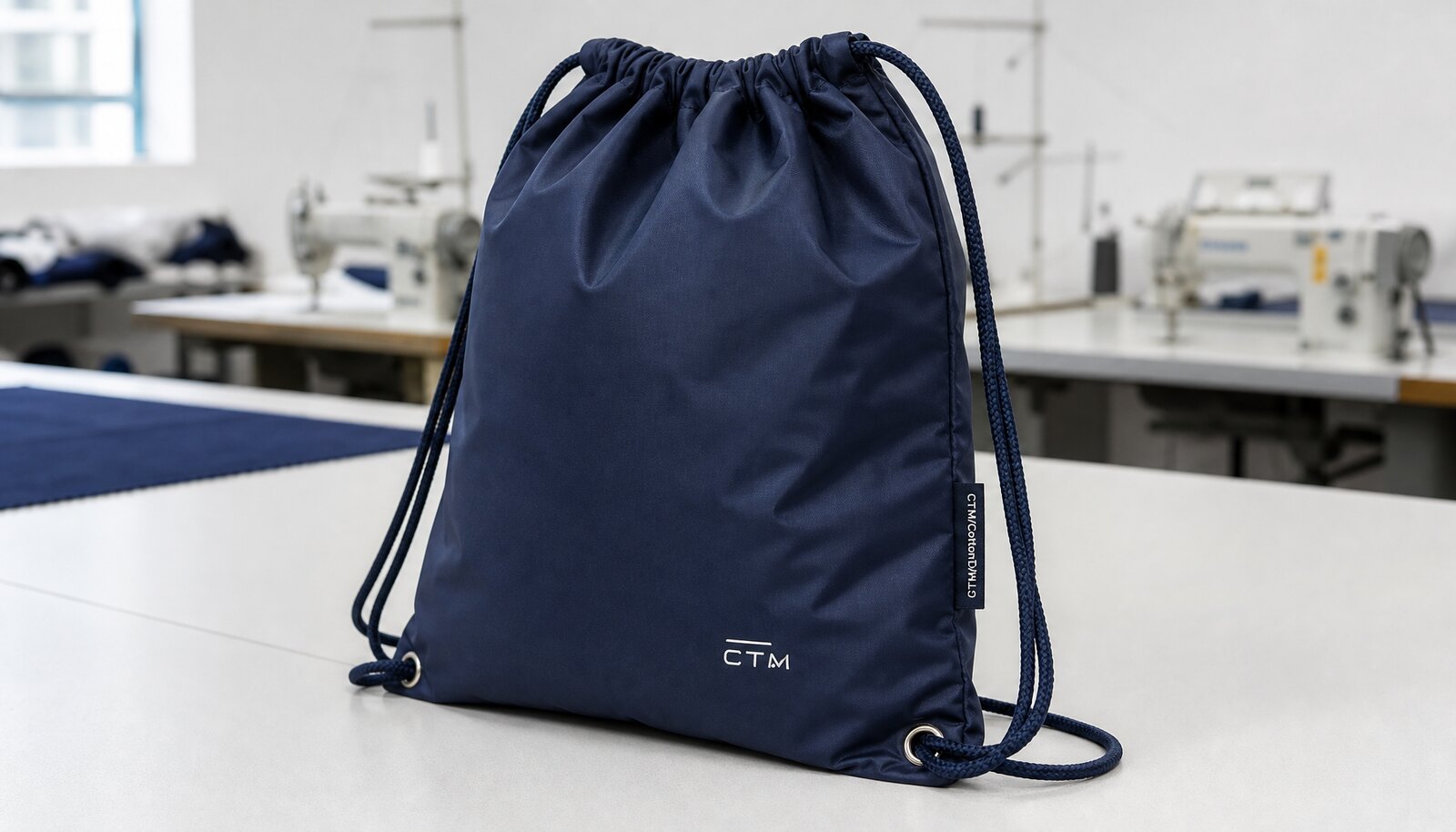
Start With the Corporate Gift Use Case
Gym drawstring backpacks for corporate gifts should be specified from the use case outward, not from a stock catalog inward. An employee wellness kit, a conference giveaway, and a retail-adjacent partner gift all use the same basic shape, but they do not need the same construction standard. A wellness kit may need to carry shoes, a bottle, and a change of clothes for repeated use. A conference giveaway may only need to survive a day of travel and light personal items. A branded gift sold through a channel partner needs to look presentable long after the event is over.
That difference matters because the wrong spec creates waste or complaints. If the bag is too light, it feels disposable and weakens the brand message. If it is overbuilt for a one-day event, procurement pays for fabric, stitching, and packing the audience will never use. The practical brief should define who gets the bag, what it will carry, how long it needs to last, and whether the bag is meant to look premium, durable, or simply efficient. Once those choices are clear, the rest of the RFQ becomes much easier to compare.
The fastest way to improve quote quality is to describe the contents, not just the product name. A bag that needs to hold trainers, a T-shirt, and a shaker bottle should be sized and reinforced differently from a bag that only holds a water bottle and a lanyard. If the gift is part of a wellness launch, also state whether the bag must stand up on its own, fit into a mailer, or fold flat for distribution. Those constraints change the pattern, the packing method, and the freight cube.
- Define the audience first: employees, event attendees, customers, or channel partners.
- State the load profile: shoes, clothes, bottle, or light giveaway items.
- Decide whether the bag is meant to look premium, practical, or low-cost before requesting quotes.
Set the Size and Build Before You Ask for Price
For most corporate gift programs, a useful size range is roughly 34 to 42 cm in body height and 30 to 38 cm in body width, with a gusset of 0 to 10 cm depending on what the bag must carry. A flatter body reduces freight and is easier to pack into gift kits. A modest gusset improves real-world utility when the bag needs to carry bulkier items such as shoes or a towel. If the pack-out includes a box or mailer, confirm that the finished bag still fits the chosen carton size after folding. That is where many quote surprises begin.
Fabric selection is where procurement gets the biggest difference in both price and perceived quality. 210D polyester is a standard entry point for high-volume promo work because it keeps weight and cost down and prints cleanly. 300D polyester usually feels more substantial and gives a better balance of durability and price for reusable corporate gifts. Cotton and cotton canvas improve hand feel but raise freight weight, storage volume, and shade-control requirements. Recycled polyester can be a good commercial choice, but the supplier should state the yarn content, lot consistency, and whether the quote changes with recycled feedstock availability.
Construction should be specified with as much care as fabric. Ask for reinforcement at the cord channel, side seams, and bottom corners, because that is where failure risk sits. For a production brief, it is reasonable to ask for a clear stitch target, such as a consistent double-stitch or reinforced backtack at stress points, plus a pre-agreed tolerance for finished dimensions. If the bag will be loaded often, add a minimum seam allowance and ask the factory how they prevent puckering at the tunnel and eyelet area. Seam details often separate a gift that gets reused from one that gets discarded after the first event.
- Use 34 to 42 cm body height as a common starting range, then adjust for contents and pack-out.
- Ask for 210D polyester for low-cost giveaways, 300D polyester for a stronger feel, and cotton canvas only when the gift needs a more premium hand.
- Require reinforcement details, not just a fabric callout, because construction quality drives failure risk.
Choose Decoration That Survives Use
Decoration should follow the logo and the use case, not the factory's easiest setup. One-color screen print remains the most efficient choice for many corporate gift runs because it is legible, fast to set up, and easy to compare across suppliers. If the artwork includes more detail, a second print color, or a small tonal accent, it can still work, but the buyer should expect higher setup cost and more room for registration error. For lower-volume or premium programs, a woven label, sewn patch, or restrained embroidery often creates a better long-term impression than a large front-panel print.
Placement matters as much as method. The main logo should avoid the drawstring tunnel, side seam, and fold line so it remains visible when the bag is in use and does not distort when the bag is cinched closed. On lightweight fabric, large embroidery can pucker the panel or pull the body out of shape, so it should be limited to small marks or reinforced panels. For corporate gifting, understated branding often ages better than oversized artwork. A clean side label or small front print can make the bag more usable after the event, which is usually the point of a branded gift.
Print durability needs to be specified in practical terms. A supplier should be able to explain the ink system, curing method, and what tests they use to avoid cracking, smearing, or powdery transfer. For screen print, ask whether the finish is soft-hand or standard plastisol and whether the ink is cured for the fabric type. For transfer or heat-applied graphics, ask for peel resistance and edge-lift checks. The quote should also clarify whether logo setup is reusable on reorders, because that affects the real cost of a repeat corporate program.
- Use screen print for simple logos and scale efficiency.
- Use woven labels or sewn patches when the bag needs a quieter, more premium look.
- Keep artwork clear of tunnels, seams, and fold points, or it will distort in use.
Write an RFQ That Forces Comparable Quotes
A weak RFQ creates noisy quotes that cannot be compared. A strong RFQ specifies the finished size, fabric, cord, logo method, packing format, carton expectations, and destination terms in plain language. It should also state whether the bag will be used for employee gifts, event handouts, or retail-adjacent promotions because those scenarios carry different quality thresholds. The goal is not to over-spec the bag. The goal is to remove ambiguity so factories and decorators quote the same product, not three different interpretations of it.
The RFQ should also distinguish between the product and the service layers. Sample cost, artwork setup, print screens, special sewing, packing labor, and freight should be separated when possible. When those costs are bundled, the buyer cannot see whether a low base price is actually backed by a high setup fee or a packing surcharge. Ask suppliers to quote the same assumptions on quantity, color count, and destination. If one supplier includes bulk cartons and another assumes individual polybags, the unit price is not actually comparable.
A practical RFQ should include a clear approval sequence. For example: digital proof, pre-production sample, top sample from the first production batch, then shipment photos before release. That sequence avoids the common trap of approving a mockup and discovering later that the actual tunnel stitch or label placement is different. If the order will be repeated, ask the supplier to note which elements are reusable on reorders and which need to be repeated, such as screen setup or special labels. That helps procurement calculate the true lifetime cost of the program rather than only the first purchase.
- Specify the finished product, not just the logo and bag type.
- Separate sample, decoration setup, packing, and freight wherever possible.
- Build the approval sequence into the RFQ so production cannot drift from the approved sample.
Compare Quotes by Landed Cost, Not Just Unit Price
The cheapest factory price is often not the cheapest program. For gym drawstring backpacks for corporate gifts, landed cost usually depends on where the product is made, how much packing labor is required, and how the shipment moves to the destination. A direct factory quote can look stronger on unit price, but the real total may rise if the factory charges separately for artwork setup, carton markings, or additional inspection. A local decorator can look expensive on unit price and still win on time-to-delivery or lower logistics complexity. Procurement needs the same comparison frame for each route.
Compare quotes on the same basis: same fabric, same dimensions, same decoration count, same packing method, same carton size, same destination term. Then add freight, duty, handling, and receiving labor. A low ex-works price can disappear once the order is packed in small cartons or shipped in a way that burns volume. If the program has a fixed event date, write the delivery date into the award decision and include a time-risk margin. Air freight can be the correct answer for a launch or an executive event, but it should be treated as an exception cost, not the default planning assumption.
Negotiation is more effective when the supplier sees the decision points. Instead of asking for a general discount, ask for pricing at two or three volumes, or for a variant with bulk packing versus individual polybags. This often reveals where the real cost sits. If a supplier is strongest on a simple stock build, push for standardization and repeatability. If a supplier is strongest on premium gifting, ask whether they can simplify the insert or carton spec while preserving the visible brand value. That is usually a better negotiation path than squeezing the base bag alone.
- Compare ex-works, packing, freight, and destination costs together.
- Use volume breakpoints to expose where unit cost actually changes.
- Treat rush air freight as a timing fix, not a normal sourcing model.
Inspect the Construction That Fails First
Quality control on drawstring backpacks should focus on the places where a defect would hurt the brand or cause a return. Start with seams. Check side seams, bottom corners, cord tunnels, and any reinforcement tabs for skipped stitches, loose thread tails, or uneven seam width. For a corporate gift, a loose thread may be acceptable if it can be trimmed; a broken cord anchor is not. That distinction should be written down before production starts so the factory is not guessing at the acceptance level.
Next, inspect the print and the finish. Confirm logo placement, registration, and color match against the approved sample under normal lighting. Then check rubbing or transfer resistance on the actual fabric after curing or drying. If the bag uses cotton or canvas, examine shade consistency and shrink behavior between panels. If it uses polyester, inspect for print cracking, ghosting, or gloss differences across the fabric lot. A well-run inspection also checks the bag opening, cord smoothness, and whether the bag cinches evenly when loaded. Those small usability details are often what customers notice first.
Use an AQL-style final inspection process rather than an informal glance. For promotional bags, many procurement teams work with major and minor defect categories and a fixed sampling plan before shipment release. The exact AQL should be agreed with the supplier, but the process matters more than the number: sample from multiple cartons, open the bag, check the print, measure the dimensions, and verify carton counts. If the shipment is for a time-sensitive gift program, require photo evidence of open cartons, sealed cartons, and pallet or master-carton labeling before final balance payment.
- Define major and minor defects before production, not after a problem appears.
- Inspect load-bearing seams, not only the front panel appearance.
- Use an AQL-style sampling plan and require carton photos before release.
Tie Compliance to Destination and Materials
Corporate gift buyers do not usually need the same compliance stack as performance sportswear, but textile restrictions still matter. At minimum, many buyers request azo dye restriction confirmation, REACH compliance for chemical safety when selling into Europe, and material declarations for recycled content or fiber content claims. If the bag is distributed in the United States as a general promotional item, ask for the declarations relevant to the destination market and identify whether any embellishment includes PVC, phthalates, or other regulated components. The point is not to overload the supplier with paperwork; it is to make sure the product can move through the intended market without a compliance surprise.
Testing language should be specific enough to be useful. For colorfastness, suppliers commonly reference standards such as ISO 105 for rubbing and washing behavior, while fabric tensile performance may be checked to ISO 13934-1 or an equivalent method if the order justifies lab testing. For seam strength, a supplier can also use internal pull tests or comparable methods to confirm the load-bearing areas will not fail under normal use. If the bag is made from recycled polyester, ask for traceability of the claimed content and whether the same yarn lot will be used across the run. Consistency matters as much as the claim itself.
Do not ask for every possible test unless the commercial value justifies it. Instead, tie testing to the risk. A premium employee gift that will be reused should have stronger colorfastness and seam checks than a one-day conference giveaway. A low-cost event item may only need a basic material declaration and a visual QC standard. The supplier should understand which tests are mandatory, which are desirable, and which are only required if the design changes. That keeps the program commercially realistic without weakening the buyer's position.
- Ask for azo restriction, material declaration, and destination-market compliance as baseline documentation.
- Use ISO 105 references for colorfastness discussions and ISO 13934-1 or an equivalent for tensile testing when lab data is required.
- Tie the test burden to the risk profile instead of requesting every test by default.
Specify Packing for Kitting and Presentation
Packing often decides whether a bag feels like a corporate gift or a loose promo item. Bulk packing is the cheapest route and works well when the bags will be kitted later, stored in a warehouse, or distributed in large quantities. Individual polybags, insert cards, and hangtags increase labor and plastic use, but they can make the product look finished and improve receiving control. If the bags are part of a new-hire pack or a direct mail campaign, the pack format should be designed around the kitting operation, not just the factory's default. That includes inner pack count, outer carton count, and whether each piece needs a barcode or SKU label.
Carton controls deserve the same attention as the bag itself. Ask for target carton dimensions, gross weight, packing tolerance, and the allowed overrun or underrun range. If the destination warehouse has cube or weight limits, a carton that is too large can create hidden logistics cost even when the unit price looks fine. Moisture protection is also worth specifying for cotton or canvas styles, especially if the shipment will sit in transit or storage. Simple details such as a polybag liner, desiccant, or carton sealing method can preserve appearance and reduce complaints when the boxes are opened.
For gift programs, presentation and efficiency need to be balanced. A premium insert card can improve perceived value, but only if the message is ready and the card size is confirmed before production. Otherwise the factory will either guess or delay. If the bag is going into a larger branded kit, ask for a carton packing map so the kitting team can pull the right quantity without counting each unit. That is a small process step, but it often saves labor and prevents receiving errors.
- Align packing with the downstream kitting or distribution workflow.
- Require carton dimensions, gross weight, and count tolerance in the quote.
- Add moisture protection for cotton or canvas when storage or transit time is long.
Protect Reorders and Keep the Program Repeatable
A good corporate gift program is repeatable. The first order should not become a one-off negotiation that has to be rebuilt from scratch every time. Ask the supplier which setup items can carry forward, including print screens, label tooling, cutting patterns, and carton artwork. Then ask what changes would trigger a new setup fee. That one question often reveals whether the supplier has a real repeat-order process or only a first-run price. If the bag will be used in seasonal campaigns or annual wellness programs, repeatability is worth more than a small unit-price win.
The approval trail should also be reusable. Keep the approved sample, approved artwork files, and final spec sheet together, and make sure the supplier references the same revision on every reorder. If the factory changes fabric lots, cord finish, or packing format, it should notify the buyer before production starts. Small changes are where quote disputes happen later. A clean record of the last approved run, including carton count and inspection notes, reduces that risk and makes it easier to compare the new quote against the previous one.
The best next step is not a generic request for price. It is a complete brief that lets the factory quote the same thing every time. Send the bag size, fabric weight or denier, decoration method, packing format, quantity, destination, and the QC standard you expect. Add your acceptance standard up front, including whether a top sample is required before bulk release. That usually shortens back-and-forth and makes the first quote commercially usable rather than just informational.
- Ask which setup items are reusable on reorders and which trigger a new fee.
- Keep the approved sample and spec revision tied to the same purchase history.
- Requote only when the brief changes, not when the supplier guesses at the spec.
Specification comparison for buyers
| Decision point | Recommended default | When it fits | Price / MOQ driver | Buyer risk to check |
|---|---|---|---|---|
| Supplier route | Direct factory with in-house cutting, sewing, printing, and packing | Best for repeat programs, tighter specs, or multiple reorder cycles | Lower unit price at volume; MOQ often tied to fabric color, print setup, and packing labor | Confirm the factory actually owns the sewing and decoration steps, not only the sales quote |
| Supplier route | Domestic decorator or promo reseller | Useful for rush orders, short delivery windows, or simple one-color branding | Higher unit price but lower logistics complexity and often faster change control | Verify whether the bag is stock inventory or a special order from another source |
| Fabric | 210D polyester | Good baseline for event giveaways, wellness kits, and high-volume corporate gifting | Lowest-cost common option; quote rises if you add heavier denier, lining, or reinforcement | Thin fabric can telegraph print defects and feel disposable in hand |
| Fabric | 300D polyester | Better for stronger hand feel and repeat use without moving to premium canvas | Moderate cost increase over 210D, often justified by perceived quality | Check whether seams, cords, and artwork placement were upgraded to match the stronger shell |
| Fabric | Cotton or cotton canvas in a controlled GSM or ounce spec | Best for premium employee gifts, retail-adjacent gifting, or tactile brand programs | Higher fabric and freight cost; shrinkage and shade control matter more | Require clear tolerance for shrink, panel shade variation, and rub performance |
| Decoration | One-color screen print | Best for simple logos, large runs, and clean unit economics | Lowest setup cost at scale; extra colors add screens and labor | Confirm curing and rub resistance so the print does not crack or transfer in handling |
| Decoration | Woven label, sewn patch, or small embroidery | Good for understated branding and higher perceived value | Decoration cost rises, especially on small orders or dense thread counts | Avoid large embroidery on thin fabric that can pucker the panel |
| Packing | Bulk packed in master cartons | Best for warehouse distribution, kitting, or lowest pack cost | Cheapest pack-out, but count accuracy and carton markings become critical | Require carton count, gross weight, and moisture protection details |
| Packing | Individual polybag with insert card or hangtag | Useful for new-hire kits, direct mail, or gift-with-purchase programs | Adds labor, materials, and cube | Confirm who supplies the artwork and how the insert is packed to avoid delays |
Buyer checklist before sampling
- Approved finished dimensions in centimeters, including body height, body width, and gusset depth if used
- Fabric spec with denier or GSM, weave type, coating if any, and recycled-content requirement if applicable
- Cord spec, including diameter, material, end finishing, and whether knots, tipping, or stoppers are required
- Decoration method, print color count, logo placement, print area, and file format for artwork
- Packing spec: bulk pack or individual polybag, insert card, hangtag, inner pack count, and carton count
- Target order quantity by color and whether mixed colors can share the same setup or must run separately
- Destination country, delivery term, and whether freight should be quoted separately or as landed cost
- Required compliance or test standard, such as REACH, azo dye restriction, colorfastness, or material declaration
- QC acceptance plan: pre-production sample, top sample, in-line check, and final shipment review
- Overrun and underrun tolerance and how it affects invoicing, replacement, or acceptance
Factory quote questions to send
- What exact fabric is included in the base price, and is it 210D, 300D, or a different denier or GSM build?
- What is the final bag size in centimeters, and what tolerance do you hold on body width, height, and gusset depth?
- What cord material and diameter are included, and are the ends tipped, knotted, heat-sealed, or left raw?
- How many print colors are included, what is the setup fee per extra color, and is screen reuse allowed on reorders?
- What MOQ applies by color, by artwork version, and by packing format, not just total quantity?
- What is the sample fee, and is it credited back if the bulk order proceeds?
- What seam reinforcement is used at the cord channel, side seams, and bottom corners?
- What inspection standard do you use before shipment, and can you share AQL targets or defect definitions?
- What packing is included by default, and what is the surcharge for individual polybags, inserts, or hangtags?
- What overrun or underrun tolerance do you allow, and how do you invoice short or excess quantities?
Quality-control points to confirm
- Check finished dimensions against the approved spec and allow only the agreed tolerance on body size, gusset depth, and cord length.
- Inspect side seams, bottom corners, and cord channels for skipped stitches, loose thread ends, broken needles, or weak backtack.
- Verify that eyelets or cord openings are centered, secure, and free from cracking, distortion, or sharp edges.
- Apply a simple pull check to cord anchors and reinforcement points so normal gym loading does not tear the attachment area.
- Compare print placement, registration, and color match against the approved sample under normal light, not only on a white proof sheet.
- Rub-test printed areas for smearing, cracking, or powder transfer after curing or drying.
- Check whether the bag cinches evenly when loaded with a bottle, shoes, or other agreed contents, since uneven draw performance is a common user complaint.
- Use an AQL-style final inspection plan with major and minor defect categories agreed before production starts.
- Open cartons to confirm piece count, carton marks, inner packing, and moisture protection before shipment release.