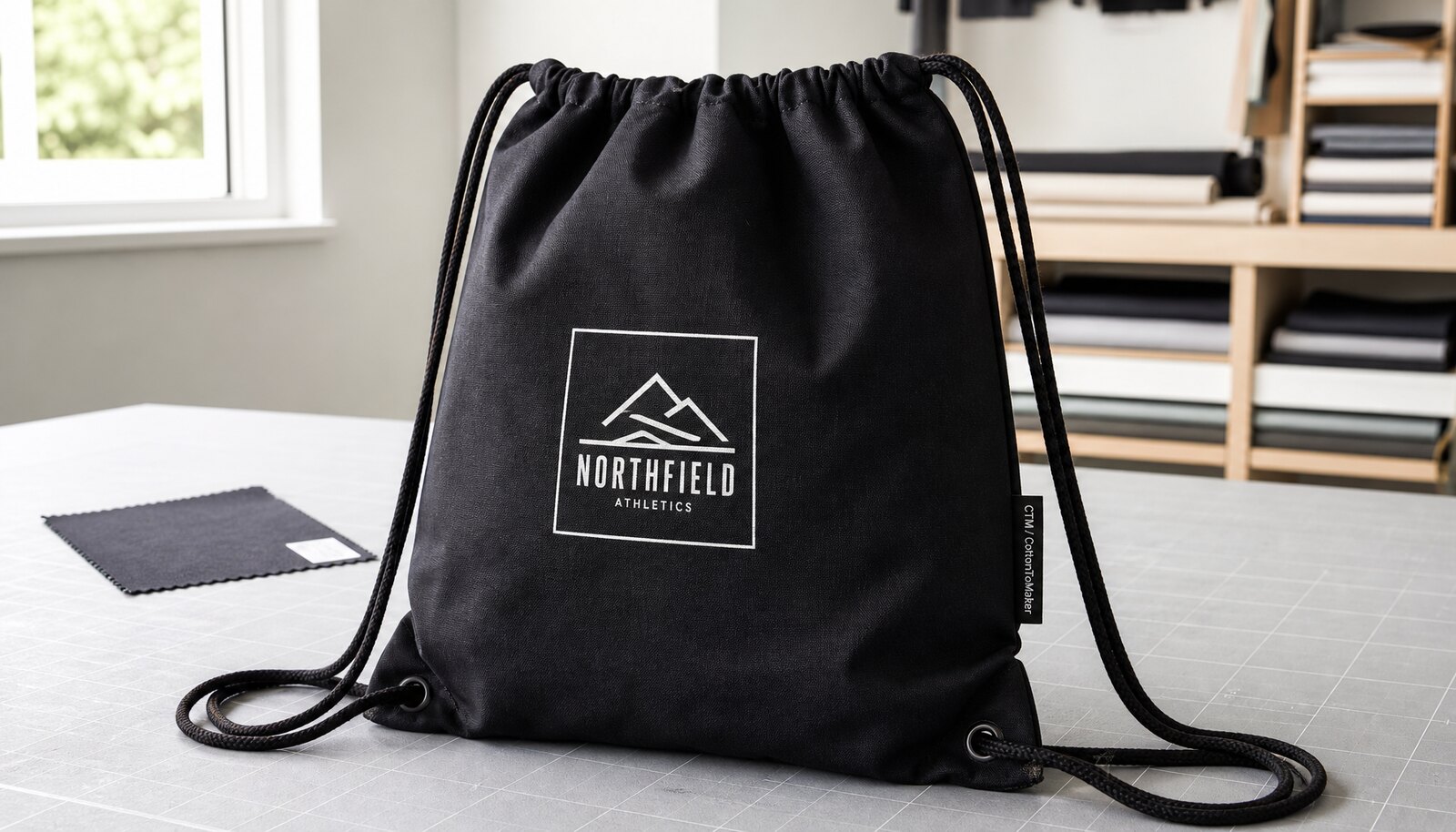
Why gym drawstring backpacks need a procurement-first brief
Gym drawstring backpacks can look like a simple soft good, but procurement knows the cost of simplicity that is not specified. The moment a buyer says only “black drawstring gym bag with logo,” suppliers begin making assumptions about fabric weight, cord thickness, print size, reinforcement, packing, and compliance. Those assumptions are where quote mismatches start. A supplier may quote a light 210D polyester promotional bag while the buyer expects a more structured retail bag. Both can technically be called a gym drawstring backpack, yet they behave very differently in use, freight, and inspection.
The best RFQ brief is not a long shopping list; it is a commercial definition of what the bag must do. For gym programs, that usually means repeated opening and closing, enough strength for shoes or a bottle, a print area that survives folding, and packaging that fits the channel. If the bag is for member giveaways, the lowest landed cost may be the right objective. If it is sold through retail or e-commerce, perceived quality, label accuracy, and carton discipline matter more because returns and brand damage are more expensive than the initial price difference.
Procurement should also decide whether the order is a one-time activation or a replenishable SKU. A one-time promotion can tolerate broader color variance and simpler packing. A repeat program needs spec discipline: same fabric source, same print file, same carton count, and a repeatable QC standard. That distinction changes the supplier type, the acceptable MOQ, and the amount of validation needed before the first production run. In practice, many failed orders are not caused by poor manufacturing. They are caused by a buyer using the wrong sourcing model for the channel.
- Define the bag by use case first, then by appearance.
- Separate promo-grade and retail-grade requirements in writing.
- Treat repeatable quality as a procurement objective, not just a design preference.
What to specify before you ask for a quote
A quote for gym drawstring backpacks should be comparable across suppliers, which means the buyer has to eliminate open-ended language. Finished size should be stated as exact dimensions with an acceptable tolerance, not just “standard size.” Fabric should be written in a material-and-weight format, such as 210D polyester or 120–140 gsm canvas, with finish notes if coating or water resistance matters. Cord length, diameter, and color must also be fixed because the cord often affects both comfort and cost more than buyers expect.
Artwork definition is another common gap. If the logo is one color and large, screen print is often economical. If the artwork has gradients or small text, heat transfer may be better, but only if the buyer accepts the risk of film edge wear or cracking. If the bag is meant to feel premium, a woven label, patch, or embroidery can improve the perception of value, but those options add setup and labor. The RFQ should also state whether the supplier must quote with or without the print setup fee, sample fee, and carton labels, because hidden extras distort comparisons.
A useful RFQ for gym drawstring backpacks also includes the commercial assumptions. State the target market, the pack count per carton, whether retail hangtags are required, and whether the supplier must provide test documents. These details determine whether the quote is a true landed comparison or just a factory price. If your organization buys through multiple regions, specify the destination market because compliance and labeling requirements vary. The same bag may be acceptable in one channel and non-compliant in another.
- Write finished size, fabric, cord, logo, packing, and compliance in measurable terms.
- Ask suppliers to separate base bag price from setup, sample, and packing charges.
- Identify the destination market early so documentation is quoted correctly.
Fabric choices and the tradeoffs buyers actually feel
For most bulk orders, the conversation begins with polyester. A 210D or 230D polyester body usually delivers the lowest unit cost and a predictable print surface. It folds compactly, helps carton efficiency, and is easy for factories to cut and stitch. That is why it remains common for event giveaways and school or gym member packs. If the buyer wants a slightly firmer body and better shelf appearance, 300D polyester is often the next step up. It usually gives a more substantial hand-feel, though the improvement comes with higher fabric cost, a little more weight, and modestly slower sewing.
Natural-fiber looks are popular in retail and lifestyle channels, which is where cotton canvas enters the conversation. Canvas around 120–140 gsm can look premium and photograph well, but procurement should be realistic about the tradeoffs. It usually costs more to sew, occupies more freight cube, and may arrive with more crease memory than polyester. It can also make print behavior less predictable if the weave is coarse. A soft, branded look may justify the cost if the bag is sold, but it rarely makes sense for a low-value giveaway unless the channel actively rewards the natural aesthetic.
Recycled polyester or RPET can be a strong fit if the buyer has sustainability requirements, but this is where documentation matters. The material claim needs support, and the factory should be clear about whether the yarn is certified, whether the claim is chain-of-custody based, and what wording can legally appear on the product or carton. Buyers should not assume that “recycled” means the same thing across suppliers. Some can support documentation; others can only provide a generic statement. If sustainability is part of the commercial promise, the order should include the exact evidence required, not a vague green claim.
Fabric finish also matters. A PU-coated surface can add water resistance and improve appearance, but it may stiffen the bag and change the way the print cures or feels after folding. A brushed or softened finish can make the bag more retail-friendly, yet it may increase cost and, in some cases, create more shade variation. The procurement question should therefore be functional: what is the minimum fabric performance needed for the intended channel, and what extra finish features would actually improve sell-through enough to justify the cost?
- Polyester is usually best for price, printability, and freight efficiency.
- Canvas can lift perceived value but increases weight and sewing cost.
- Sustainability claims require documentation, not just supplier statements.
A more useful comparison of sourcing routes, pricing, and risk
Gym drawstring backpacks are commonly sourced through three routes: factory direct, trader or agent, and stock-supported supply. Each route is valid, but each has a different cost structure and a different risk profile. Factory direct usually gives the best control over fabric, print, and packing, especially once the order becomes repeatable. Traders can be useful when the buyer needs smaller volumes, multilingual coordination, or access to several factories. Stock-supported programs are often the fastest path for urgent promotions, but they limit customization and may reduce consistency if different body lots are mixed.
The key procurement question is not “Which route is cheapest?” but “Which route gives the most reliable combination of landed cost, schedule, and spec control?” A factory direct order of 1,000–5,000 pcs often makes sense when the buyer can live with a standard material palette and wants repeatability. If the order is 300–1,000 pcs and needs immediate shipment, a trader or stock base may be more efficient even at a higher per-piece price. For retailers, the hidden cost of the wrong route is often rework: labels to replace, cartons to relabel, or print inconsistencies that must be manually sorted at the warehouse.
The table below is more useful when treated as a decision aid rather than a price list. It compares likely specs, commercial implications, and the quality risks that matter most in real buying programs. Buyers should still request quote breakdowns by size, color, and logo version because one route may be low-cost only for a narrow spec range.
How to compare quotes so you are not comparing different bags
Many quote comparisons fail because suppliers are not pricing the same product. One supplier may quote a light polyester bag with no label and simple bulk packing. Another may include a heavier fabric, reinforced seams, barcode stickers, and a more durable print. The per-piece difference looks large, but the inputs are different. To avoid false comparisons, procurement should force all suppliers to quote the same baseline and then quote the differences as add-ons.
The clearest way to do this is to divide the quote into modules: body fabric, cord, reinforcement, logo method, packing, and compliance documents. Ask the supplier to show the price impact of a change in each module. For example, how much does the unit price rise if the logo moves from one-color screen print to a woven label? How much does MOQ change if the bag moves from stock black fabric to custom dyed navy? These questions reveal whether the supplier understands the real cost drivers or is simply giving a generic number.
When comparing quotes for gym drawstring backpacks, buyers should also ask for the price ladder by quantity. A credible supplier can usually show 300, 500, 1,000, 3,000, and 5,000 pcs without hesitation. That pricing curve often exposes setup costs, waste assumptions, or hidden inefficiencies. A large gap between 500 and 1,000 pcs might be normal if print setup or special fabric purchase is involved. But if two suppliers have radically different curves, the buyer should ask why. The answer is often found in fabric stock levels, subcontracted printing, or hidden packing labor.
The other commercial variable is the Incoterm. EXW, FOB, CIF, and DDP are not interchangeable, and comparing them as though they are can lead to bad decisions. A low EXW price can become expensive once export handling, freight, duty, and inland delivery are added. For B2B buyers, a landed-cost view is always more honest than a factory-price view, especially when the bags are bulky relative to their value.
- Quote the same base spec across all suppliers.
- Request add-on pricing for material, logo, packing, and document changes.
- Compare by landed cost, not just ex-factory unit price.
Logo methods, branding choices, and where defects show up
Branding on gym drawstring backpacks is not just a visual decision; it affects production yield. Screen print is still the most common option for simple logos because it is cost-efficient and works well on flat panels. It is usually the best fit for one-color or two-color artwork with a clean edge. The buyer should still specify print size, ink tone, and placement because even a good print method can look poor if the artwork is too close to a seam or if the print area is too large for the fabric panel.
Heat transfer is useful when the artwork includes small text, gradients, or multi-color details. The tradeoff is that it introduces cure and adhesion variables. If the supplier’s temperature, pressure, or dwell time is inconsistent, the print can crack or edge-lift after flexing. This matters for gym bags because they are folded, stuffed, and pulled often. Buyers should ask for a rub/flex check on the sample if transfer printing is quoted.
Woven labels and patches are worth considering when the bag needs a more premium retail impression or when the design calls for a smaller but more durable brand mark. Embroidery can also look strong, but on thin fabrics it may pucker or distort the panel. A procurement team should look at logo methods as a cost-quality triangle: setup cost, durability, and aesthetic value. The right choice depends on the channel. For giveaways, durability and speed often win. For retail, the cleanest-looking option that survives handling is usually worth the extra cost.
One practical sourcing tip: do not accept a supplier’s generic “logo included” statement. Ask whether the price includes screen setup, film, color separation, label sewing, and any extra labor for aligning the logo panel. Many disputes begin when the buyer assumes logo pricing includes everything and the factory assumes it covers only one print pass. That mismatch is easy to prevent if the quote sheet separates artwork, setup, and production cost.
- Use screen print for simple logos and high-volume programs.
- Use heat transfer only when artwork detail justifies the added risk.
- Ask whether the logo price includes setup, alignment, and rework allowance.
Sample approval: the point where most avoidable failures can still be stopped
The pre-production sample is not a formality. For gym drawstring backpacks, it is the last chance to validate that the factory can reproduce the approved spec in bulk. A sample made from different fabric, a different cord, or a hand-applied logo is not a reliable approval piece. The sample should reflect the same inputs the factory intends to use on the production line. If the supplier cannot match the final fabric or print method in the sample stage, the buyer should treat the sample as informational rather than approval-grade.
A good approval process checks both appearance and function. The bag should be filled with a realistic load—shoes, towel, and a bottle are usually enough to reveal stress behavior. The buyer should open and close the bag repeatedly, look for even pull closure, and check whether the cord drifts in the channel or cuts into the panel. On the visual side, inspect logo placement, label alignment, seam straightness, and panel symmetry. For retail items, even small asymmetries become obvious at shelf distance.
Approval should also be tied to written tolerances. Size tolerance, print position tolerance, cord length tolerance, and label placement tolerance should all be recorded. If those numbers are never written down, inspectors cannot enforce them later. Buyers often think they have “approved the sample,” but what they approved was only the general appearance. That is not enough for a repeat order. The goal is to create a reference standard that production can be measured against when the first cartons arrive.
If the order includes multiple colors, approve each colorway rather than assuming one sample covers the full run. Fabric shade, print contrast, and label visibility change from color to color. Black, navy, and heather tones often behave differently under the same print method. That is why a clean sample approval process should document the exact sample code, sample date, photos, and any approved deviations. When the shipment reaches inspection, that record becomes the only practical reference for deciding whether the bulk goods match what was agreed.
- Approve only samples made from the intended bulk materials and methods.
- Test with realistic contents, not only with an empty bag.
- Write size, print, cord, and label tolerances into the approval record.
Production details that most affect durability in gym use
The most common failure area in gym drawstring backpacks is the cord tunnel, where repeated pulling concentrates force in a small area. If the seam is weak, the channel can distort or open after use. Bartack reinforcement is often the most effective low-cost upgrade because it concentrates stitching where the stress is highest. Double stitching can also help, but the buyer should not assume any extra line of thread is automatically enough. The real question is whether the seam geometry and stitch density match the intended load.
Cord choice affects both comfort and failure rate. A 6 mm cord may be adequate for light promotional use, but a bag intended to carry shoes, a bottle, and toiletries often benefits from a wider or denser cord. The buyer should also specify how the cord ends are finished. Heat-sealed ends, capped ends, or a secure knot reduce fraying and give the bag a more complete retail appearance. Loose, fuzzy cord ends are one of the fastest ways for a product to look cheap on arrival, even when the body fabric is acceptable.
Bottom corners deserve attention because they bear the weight when the bag is slung over a shoulder or set down on the floor. A bag that survives a visual inspection can still fail after a few weeks of sports use if corner stitching is weak or if the seam allowance is too narrow. In a procurement spec, it is worth stating whether the supplier must reinforce the corner area with extra stitches or patches. That small line item often does more to lower complaint risk than a cosmetic upgrade anywhere else on the bag.
Another often overlooked issue is how the fabric behaves when the bag is pulled shut under load. If the panel bunches awkwardly, the opening may not close evenly and the logo can distort. For some buyers, especially retail brands, that visual behavior matters almost as much as tear strength because it affects shelf appeal. The best QC programs therefore combine structural checks with a simple use simulation. Bags should be loaded, closed, lifted, and inspected again. That is the most efficient way to catch construction flaws before the full run is packed.
- Reinforce the cord tunnel and stress corners; do not rely on appearance alone.
- Specify cord diameter and end finish to reduce fraying.
- Test closure behavior under load, not only flat on the table.
Compliance, country-of-origin, and documentation by market
Compliance for gym drawstring backpacks is usually manageable, but it is still market-specific. The buyer should first identify where the product will be sold, because documentation needs vary by country and channel. In the EU, buyers often want REACH-related evidence and clear fiber-content labeling, especially if the product is going into retail. In the United States, the material and any claims around child use, age grade, or chemical restrictions may require additional attention. If the bag is intended for children’s programs, CPSIA-related expectations become more relevant than they would be for an adult gym promotion.
Country-of-origin marking is another point that should not be left until the final week. Some suppliers can print or sew origin information into the label structure; others rely on carton labeling only. Retail and customs requirements may differ, so the buyer should specify where the origin mark must appear and in what language or format. Recycled-content claims also need caution. If the product is sold with an RPET claim, the supplier should be asked for the evidence available to support that wording. Procurement should not accept a sustainability claim without deciding who owns the proof and where it will be stored.
Documentation usually includes material composition, test reports, packing list consistency, and commercial invoice accuracy. Some buyers also need a supplier declaration of conformity, azo dye checks, SVHC-related declarations, or buyer-specific test formats. The important sourcing nuance is that different supplier types support documentation differently. A large factory may have a clearer test file and more formal controls, while a trader may need extra time to collect documents from the actual producer. If the order is going into a regulated market or a retail chain with strict vendor onboarding, ask for the documentation package before you approve bulk, not after the shipment is already finished.
A practical procurement habit is to ask, “What can you provide without delay, and what must be tested?” This prevents a common mistake: assuming that the supplier has the compliance file simply because the product looks standard. For gym drawstring backpacks, the product may be simple, but the chain of evidence still needs to be specific if the buyer wants customs clearance and channel acceptance without last-minute compromise.
- Map compliance to the destination market before issuing the PO.
- Separate claims that need evidence from claims that are only marketing language.
- Request documentation before bulk approval, not after production is finished.
Packaging, carton planning, and warehouse-ready delivery
Packaging is part of the product because it affects freight, receiving time, and damage risk. Gym drawstring backpacks are often shipped flat, usually with a polybag and packed by SKU in master cartons. That sounds straightforward, but small differences in pack count and carton size can materially change freight cost. An overstuffed carton can crush printed panels and deform cord ends. A carton with too much unused space can move the bags around, causing abrasion and crumpling. Procurement should ask the factory to propose a carton pack count based on the actual folded size, not a rounded estimate.
Retail programs often need more than a polybag. If there is a hangtag, barcode, or insert card, the supplier should confirm whether those elements are applied before or after final inspection. That matters because a late-stage label change can create pack errors. When multiple colors or multiple logo versions are in one order, carton segregation becomes more important. One SKU per carton is usually safer for receiving and reduces the risk of mixed counts. If mixed packing is unavoidable, the carton marking and inner pack labeling must be very clear.
From a QC perspective, packaging verification should include carton strength, tape quality, correct outer labeling, and pack count reconciliation. The buyer should also define whether shipping marks, barcode labels, and SKU labels must be on the top panel, side panel, or both. Some retailers reject inbound cartons simply because the carton label is in the wrong location or the code does not match the PO. This is not a manufacturing defect in the narrow sense, but it is a commercial defect because it slows warehouse receiving and can trigger chargebacks.
For importers, one of the best cost-control habits is to ask for the folded dimensions of the finished bag before the quote is finalized. That one measurement helps calculate carton efficiency, palletization, and freight utilization. It also gives the buyer a practical clue about whether the product will arrive with too many creases or whether the carton can protect the printed surface. A few extra millimeters in folded thickness can change the entire carton plan.
- Ask for carton dimensions based on the folded bag, not a generic estimate.
- Keep one SKU per carton where possible to simplify receiving.
- Verify labels, barcode placement, and carton count before shipment.
Specification comparison for buyers
| Decision area | Options to compare | Procurement impact | Buyer risk to check |
|---|---|---|---|
| Body fabric | 210D/230D polyester, 300D polyester, RPET polyester, cotton canvas, poly-cotton blends | Drives unit price, hand-feel, print clarity, freight cube, and perceived retail value | Thin fabric can feel translucent; heavier fabric raises sewing cost and shipping weight; recycled yarns may require documentation and shade tolerance |
| Fabric finish | Uncoated, PU-coated, water-resistant finish, lightly brushed surface | Affects texture, stain resistance, and how well the bag folds and packs | Coating can stiffen the bag, complicate print adhesion, or raise odor/consistency risk |
| Closure cord | 6–8 mm braided polyester cord, round rope, flat drawcord, recycled cord | Changes comfort, durability, and sewing time; also affects MOQ if cord is custom dyed | Too-thin cord can cut into shoulders; poor end finishing frays during packing and use |
| Reinforcement | Bartack, double-stitch, bar-tack plus seam tape, reinforced corner patches | Directly affects defect risk, load performance, and return rate | Low reinforcement can pass visual inspection but fail during real use with shoes, towel, and bottle |
| Logo method | Screen print, heat transfer, woven label, embroidery, deboss/patch | Impacts setup cost, lead time, artwork limits, and premium positioning | Fine detail can blur in screen print; transfer films can crack if cure settings are poor |
| MOQ route | Factory direct, trader, stock base, mixed-color production, stock body + custom logo | Affects pricing tiers, color flexibility, and control over compliance documents | Very low MOQ often hides higher unit price, weaker color control, or limited customization |
| Packing format | Bulk packed, polybag + insert card, retail hangtag, barcode label, master carton by SKU | Impacts warehouse efficiency, carton damage risk, and retail readiness | Overpacked cartons crush print and cord ends; unclear labels cause receiving errors |
| Compliance route | REACH, CPSIA, SVHC declaration, azo dye checks, fiber content label, recycled-content documentation | Determines whether goods clear customs and can be sold in the target market | Skipping market-specific documentation can delay clearance or trigger re-testing |
| Commercial terms | EXW, FOB, CIF, DDP, landed-cost quote with duty/freight allowance | Changes what is truly comparable across suppliers | A low unit price can become expensive after freight, testing, and last-mile costs are added |
Buyer checklist before sampling
- State the end use: gym membership giveaway, sports club retail, promotional event, e-commerce retail, or bundled merchandise set.
- Define finished size with tolerance: width, height, gusset or flat depth, cord length, and any pocket or zipper requirement.
- Specify body fabric by material, denier or GSM, color standard, and whether the fabric must be stock-dyed, custom dyed, or recycled-content verified.
- Choose logo method, artwork placement, print size, Pantone references, number of colors, and whether the print must survive repeated flexing.
- Set strength expectations: cord diameter, seam type, bartack count, bottom corner reinforcement, and any target load assumption.
- Confirm packaging: inner polybag size, insert card, hangtag, barcode format, carton pack count, carton label content, and whether retail-ready packing is needed.
- List compliance needs by destination market: REACH/SVHC, CPSIA, California Prop 65, fiber labeling, country-of-origin marking, recycled-content claims, or buyer-specific test reports.
- Ask for a quote basis that is explicit: EXW, FOB, CIF, or DDP; and separate sample cost, tooling cost, freight, and any test-report fees.
- Request photos or samples that show stitching, cord exits, label placement, and printed area close-up—not only a studio image of the finished bag.
- Decide whether the order is a one-time promotion or a repeat program, because MOQ, color approval, and spare-part logic differ for each scenario.
Factory quote questions to send
- What exact body fabric is quoted: material, denier or GSM, weave, finish, and whether it is stock color or custom dyed?
- If recycled yarn or RPET is claimed, what documentation can you provide for the recycled-content source and the exact claim wording on the label or carton?
- What cord type and diameter are included, and is the cord color stock or custom dyed? Is the cord end heat-sealed, knotted, or capped?
- What reinforcement is included at the cord tunnel, bottom corners, and stress points? Please separate standard stitching from bartack or patch reinforcement if priced differently.
- Which print method is quoted, what is the maximum print size, and what is the surcharge for extra colors, extra location, or larger artwork?
- Will the pre-production sample use the same fabric, cord, label, and print process as bulk, or only a close substitute?
- What is the MOQ by color, by logo version, and by packaging variation? What is the price at 300, 500, 1,000, 3,000, and 5,000 pieces?
- What packing structure is assumed in the quote: inner polybag, carton pack count, carton dimensions, and gross weight?
- Which defects are covered by your final inspection standard, and what AQL level do you use for general defects, major defects, and critical defects?
- What compliance documents can you provide for the target market, and which tests are included versus charged separately?
Quality-control points to confirm
- Fabric verification: confirm material composition, denier or GSM, and finish against the approved sample; check for shade consistency and obvious thin spots by light-box or backlight examination.
- Color and print: compare print color against approved reference under standardized light if possible; check registration, edge sharpness, cure quality, and rubbing resistance after flexing the printed area.
- Seam security: inspect the cord tunnel, top hem, and bottom corners for straight stitching, balanced tension, no skipped stitches, and no loose thread tails longer than the agreed tolerance.
- Load behavior: test with a realistic load such as shoes plus towel plus bottle; lift and shake repeatedly, then inspect for seam opening, tunnel distortion, or cord slippage.
- Cord performance: verify cord diameter, length, and free movement; ensure ends are heat-sealed or otherwise secured so they do not fray in packing or first use.
- Size and tolerance: measure finished width and height on a flat table, and confirm fold size if the bag must fit a retail sleeve or inner carton.
- Label and documentation: confirm fiber-content label, care label, country-of-origin mark, barcode, and SKU label placement; ensure the artwork matches the approved version.
- Packaging verification: count inner packs and master cartons; check carton strength, tape quality, carton markings, and whether bags arrive without severe creasing or print abrasion.
- Odor, cleanliness, and finish: reject oil marks, mold odor, stains, visible glue, broken needle damage, crushed corners, or inconsistent label placement.
- Inspection logic: use a written defect catalog before mass production; align AQL target with channel risk—stricter for retail and lower-risk tolerances for giveaways only if the buyer accepts them in writing.