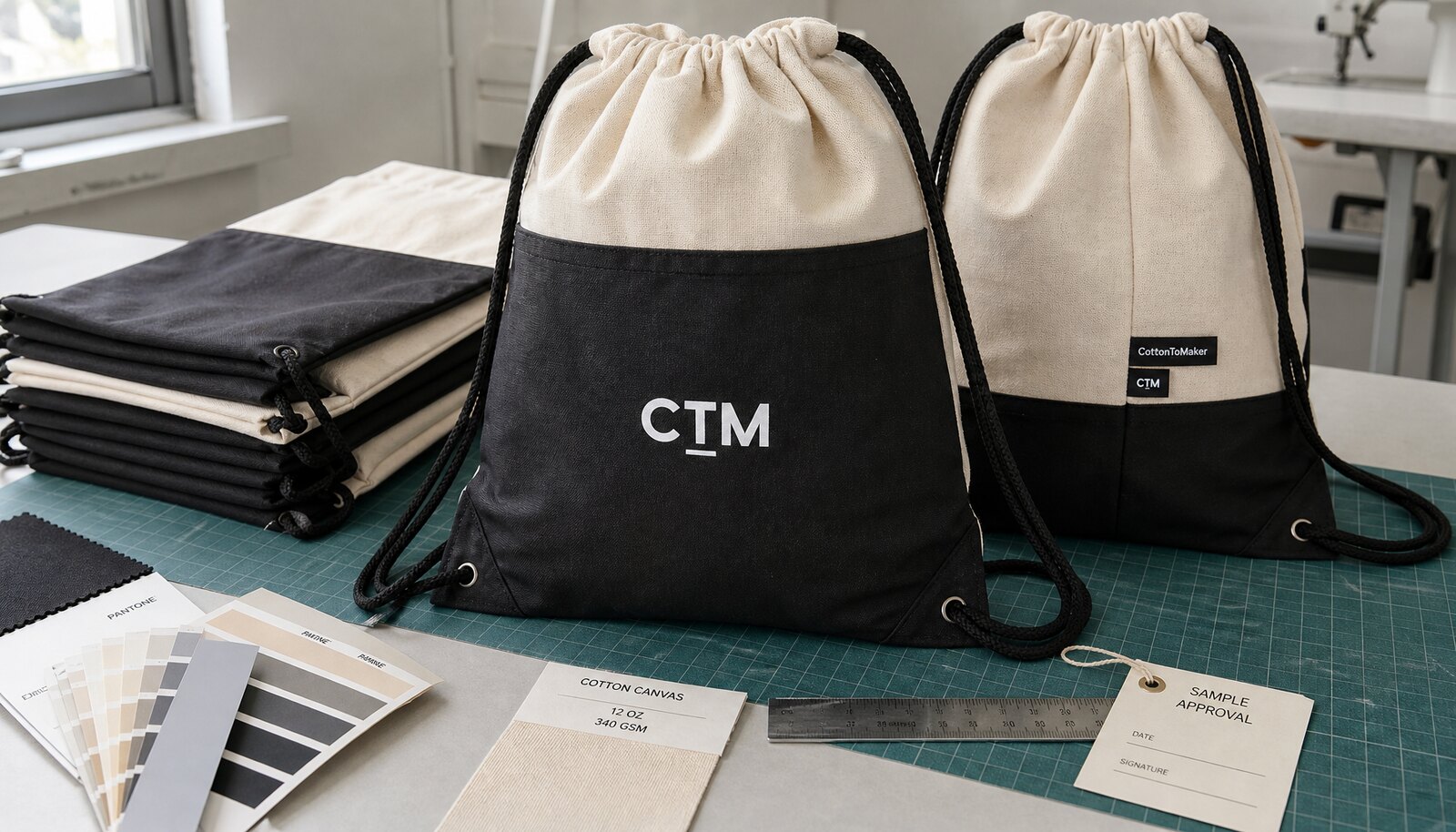
Why the print proof controls the whole order
For a gym drawstring backpack, the logo proof is not just a visual approval. It controls fabric choice, print method, placement, MOQ, sampling cost, and inspection criteria. A buyer can receive a clean-looking digital proof and still get bulk bags with a logo that sits too close to the cord channel, cracks on coated polyester, sinks into coarse cotton canvas, or creases across the fold line in packing.
Procurement teams should treat the proof as a production document. It should define what the factory must reproduce in bulk, not simply show what the logo looks like. The best proof package includes the artwork file, Pantone color references, logo size, placement measurements, selected print method, fabric specification, and any tolerance that will be used during final inspection.
- A useful proof answers where the logo is printed, how large it is, which color system controls it, and which production method will be used.
- A weak proof only shows the logo centered on a flat illustration with no fabric, seam, or packing information.
- If the bag will be used for sports events, gyms, schools, retail kits, or distributor resale, approve a real sample before bulk production.
Start with the bag construction before judging the logo
Logo quality depends on the drawstring backpack construction. A 210D polyester event bag, a 300D oxford gym bag, an 8 oz cotton canvas backpack, and a heavy recycled cotton drawstring bag do not print the same way. The surface texture, coating, absorbency, and fabric movement all affect ink coverage and final appearance.
For basic gym promotions, buyers often choose 210D polyester because it is light, economical, and resistant to damp towels or shoes. For a more retail or wellness-brand feel, 6-10 oz cotton canvas is common because it feels more natural and supports a premium message. If the bag carries shoes, a bottle, or heavier gym accessories, ask for reinforced bottom corners, stronger drawcords, and bartacks instead of approving only the front logo.
- 210D polyester: light, low-cost, suitable for events, but can show heat marks or print shine depending on coating.
- 300D polyester or oxford: better structure and durability for gym kits, with a firmer print panel.
- 6 oz cotton canvas: natural look, lighter hand feel, good for simple logos but less structured under load.
- 8-10 oz cotton canvas: stronger retail feel, better opacity, and more stable print surface, but higher unit cost and freight weight.
- Recycled cotton or blended fabric: attractive for sustainability programs, but color flecks and uneven yarn can affect fine logo clarity.
Choose the logo method based on artwork and fabric
Screen printing is usually the practical first choice for custom logo gym drawstring backpacks when the design uses solid colors. It gives a clean result on cotton canvas and many polyester fabrics, especially for one-color or two-color logos. It also scales well for bulk orders because setup cost is spread across quantity. However, screen print is not ideal for very small text, photographic gradients, or logos with many color transitions.
Heat transfer can handle gradients, small details, and full-color graphics, but buyers should check hand feel, edge finish, and resistance to cracking or peeling. Sublimation is suitable mainly for white or light polyester panels and is better for all-over designs than a small front logo on cotton. Embroidery can look premium, but on a thin drawstring backpack it may pucker the panel and add cost. A woven label or sewn patch can be a good alternative when the brand mark is small and the buyer wants repeat consistency.
- Use screen print for bold 1-3 color logos, campaign marks, club names, and corporate fitness programs.
- Use heat transfer when the artwork includes gradients, photo elements, or very fine registration.
- Use sublimation only when the fabric and artwork are designed for it, usually light polyester.
- Use embroidery for small premium logos on stronger fabric, not for large front-panel graphics on thin bags.
- Use woven labels or rubber patches when a repeat program needs a consistent branded detail across many bag colors.
What a proper logo proof should show
A buyer-ready proof should include more than a logo placed on a template. It should state the actual logo width and height, the distance from the top edge or drawcord channel, the distance from side seams, and the orientation of the bag when printed. For gym drawstring backpacks, the upper part of the bag gathers when the cords are pulled, so a logo that looks balanced on a flat panel may appear too high when worn.
The proof should also show print colors with Pantone references or agreed color standards. If the brand color is critical, do not approve only from a monitor because screen brightness changes the visual result. Ask the factory to confirm whether the color is matched on white base fabric, black fabric, natural cotton, or dyed polyester. The same ink can look different on each surface.
- Logo size: confirm exact width and height in centimeters or inches.
- Logo position: confirm distance from top edge, bottom edge, and side seams.
- Print color: provide Pantone references and note whether exact match or close commercial match is acceptable.
- Print surface: identify whether the logo sits on coated polyester, uncoated cotton, canvas, or recycled blend.
- Approval basis: specify whether bulk will follow digital proof, physical sample, or signed pre-production sample.
Fabric weight and GSM affect logo appearance
Fabric weight is not only a durability issue. It changes how the print sits on the bag. A thin polyester drawstring backpack may wrinkle under the screen, causing uneven ink edges. A coarse cotton canvas may absorb ink differently across the weave, making small text less sharp. A very heavy fabric may hold the print well but increase folding thickness, carton volume, and freight cost.
When comparing quotes, buyers should not accept descriptions like 'standard material' or 'good quality polyester' without a number. Ask for GSM on cotton and nonwoven fabrics, denier on polyester fabrics, and coating details if relevant. If two suppliers quote the same bag size but one uses 190T polyester and another uses 210D polyester, their prices and print performance are not directly comparable.
- For lightweight promotional gym bags, 210D polyester is common and easy to pack in bulk.
- For stronger gym merchandise, 300D polyester or oxford fabric gives better body and print stability.
- For cotton drawstring backpacks, 6 oz is lighter, while 8-10 oz gives better structure and opacity.
- Natural cotton may show small specks and shade variation; approve this as part of the material character before bulk.
- Dark fabric often needs a white underbase for bright logo colors, which can affect cost and hand feel.
MOQ logic behind custom logo print orders
MOQ is often misunderstood because the buyer sees one finished backpack, while the factory sees several production variables. MOQ can change by body fabric color, cord color, print color count, logo version, packing type, and whether the material is in stock. A supplier may accept a low quantity for one stock black polyester bag with one white screen print, but require a higher MOQ for custom-dyed cotton canvas with three logo colors.
For distributors and retail buyers, the safest RFQ structure is to separate each variable. If you need 5,000 bags split across five body colors, ask whether the MOQ is 5,000 total or 1,000 per color. If the same logo is printed in different colors for different gyms or branches, ask whether each print color requires a separate setup and minimum. This prevents a quote that looks attractive but changes after artwork review.
- State quantity by bag color, not only total order quantity.
- State whether the same logo artwork is used on all colors or if each color has a different logo version.
- Ask whether screen charges apply per logo color and per artwork size.
- Ask whether custom cord color, metal tips, woven labels, or special packing increase MOQ.
- Confirm whether sample cost is refundable or separate from the bulk order cost.
Sample approval checks before bulk production
The physical sample is where many hidden problems appear. Check the logo when the bag is flat, when it is filled, and when the cords are pulled closed. A drawstring backpack changes shape during use, and the print panel may curve around shoes, a towel, or a bottle. If the logo becomes distorted under normal loading, the artwork may need to be smaller, lower, or moved away from stress areas.
Also check the printed surface after basic handling. A production sample should be rubbed by hand, lightly folded, and packed in the intended method. For dark fabric with light print, inspect pinholes and uneven coverage. For heat transfer, check whether the edge lifts or feels too plastic for the brand requirement. For screen print on cotton, check whether the ink fills the weave enough without becoming too thick.
- Measure the finished bag size because fabric cutting and sewing tolerance can change logo balance.
- Pull the cords tight to see whether gathering hides or bends the top of the print.
- Load the bag with realistic gym items and check stress around eyelets, bottom corners, and side seams.
- Rub the print with a clean white cloth to check obvious transfer or loose ink.
- Fold the bag as it will be packed and confirm the fold line does not damage the print.
Common proof mistakes that cause bulk disputes
The most common dispute is not that the factory printed the wrong logo. It is that the proof did not define enough production details. A buyer approves a centered logo, but the factory centers it on the fabric panel before sewing or on a flat finished bag, while the buyer expected visual centering after the drawcord is closed. Both sides believe they are correct unless the approval document defines the measurement basis.
Another frequent mistake is approving color on a white digital background while the actual bag is black, navy, natural cotton, or recycled grey. Ink color changes with base material. If the logo color is a brand-critical red, blue, or green, ask for a strike-off or printed fabric swatch. If exact matching is not commercially necessary, state an acceptable tolerance so the inspection team does not reject usable goods for minor shade differences.
- Do not approve a proof without measurements for logo size and placement.
- Do not use low-resolution JPG artwork for final production if vector artwork is available.
- Do not assume one ink color looks identical on cotton, polyester, black fabric, and natural fabric.
- Do not place large logos across bottom fold lines or reinforced corners.
- Do not skip a sample when changing fabric, supplier, print method, or logo color.
Packing decisions that protect the printed logo
Packing can damage a good print. Freshly printed bags may be stacked, folded, compressed, and shipped for weeks. If the print surface touches dark cords, rough hardware, or another printed panel under pressure, buyers may receive transfer marks or surface impressions. This is especially important for retail buyers, event distributors, and brands that need clean presentation straight from the carton.
Ask the factory to show the packing method during sample approval or pre-production confirmation. Flat packing reduces fold creases but increases carton size. Folding lowers freight volume but can create a crease through the logo if not planned. Individual polybags improve presentation and keep bags clean, but add cost and packaging material. Master polybags or bulk carton packing may be acceptable for giveaway programs if the logo is protected.
- Confirm whether bags are packed flat, half-folded, or quarter-folded.
- Keep the logo facing inward or protected if the print surface may rub during transit.
- Use tissue, interleaving, or controlled stacking for sensitive prints when presentation matters.
- Specify carton quantity, carton size, gross weight, and whether cartons need shipping marks or retail labels.
- Check whether packed cartons compress the printed panel or bend reinforced corners.
Lead time and quote data buyers should require
A realistic lead time begins after artwork, material, sample, payment, and proof approval are complete. If the buyer delays Pantone confirmation or changes the logo after sampling, the production clock should reset. For custom logo gym drawstring backpacks, the timeline usually includes artwork checking, digital proof, material confirmation, sample making, sample approval, bulk cutting, printing, sewing, inspection, packing, and export preparation.
A strong quotation should make comparison easy across suppliers. It should not only show a unit price. It should identify fabric specification, bag dimensions, print method, logo color count, setup charges, sample cost, packing method, carton details, production lead time, payment terms, and quote validity. Without these details, a cheaper quote may simply exclude costs that will appear later.
- Ask for lead time by stage: proof, sample, bulk production, packing, and export readiness.
- Confirm whether lead time is counted from deposit, artwork approval, sample approval, or material arrival.
- Request itemized charges for screens, films, setup, sample, special packing, labels, and carton marks.
- Ask whether the quoted price changes if logo size, color count, or fabric GSM changes after proof review.
- Keep the approved proof, signed sample, and final PO specification together for inspection reference.
Specification comparison for buyers
| Spec decision | Recommended option | When it fits | Buyer risk to check |
|---|---|---|---|
| Fabric weight for gym use | 210-300D polyester or 6-10 oz cotton canvas depending on brand positioning | Polyester suits wet towels and sports events; cotton canvas suits retail, wellness, and premium fitness gifts | Thin fabric can distort the logo, show contents, or tear around eyelets after loading shoes and bottles |
| Main logo print method | Screen print for solid logos; heat transfer for gradients; embroidery only for small premium marks | Screen print works for bulk promotional orders with 1-3 spot colors and clean artwork | Factory may quote a cheaper method that cannot hold fine text or may crack on coated fabric |
| Logo proof approval | Digital proof plus physical pre-production print sample for new artwork or new fabric | Required when color accuracy, placement, retail presentation, or repeat order consistency matters | Digital proofs do not show ink absorption, fabric texture, drawcord interference, or folding distortion |
| Logo position | Centered front panel, clear of drawcord channel and bottom reinforcement zone | Best for gym campaigns, retail club merchandise, and corporate fitness kits | Logo placed too high can be hidden by gathered fabric; too low may crease at packing fold |
| MOQ logic | Separate MOQ by fabric color, print color count, and size, not only total bag quantity | Useful when buyers need multiple logo colors, club branches, or assorted body colors | A low advertised MOQ may not include custom dyed fabric, special cord color, or separate print screens |
| Packing method | Flat packed or lightly folded with logo protected by tissue or inner facing direction | Best when print surface must arrive clean for retail, events, or distributor repacking | Heavy compression can cause ink transfer, cord indentation, or permanent creasing across the logo |
Buyer checklist before sampling
- Confirm final bag size, fabric type, fabric GSM or denier, cord type, corner reinforcement, and whether the logo will sit on a flat printable panel.
- Send vector artwork in AI, EPS, or PDF format and include Pantone references for every print color, not only a JPG or PNG preview.
- Ask the factory to mark logo width, height, distance from top edge, and distance from side seams on the proof.
- Approve the print method based on fabric surface and artwork detail: screen print, heat transfer, sublimation, embroidery, woven label, or rubber patch.
- Request one physical print sample before bulk production if this is a new logo, new fabric, new supplier, or retail-facing order.
- Check the sample after drawcord tightening because the upper fabric gathers and may visually shift the logo.
- Rub the printed area with a dry cloth and slightly damp white cloth to check obvious ink transfer before approval.
- Load the sample with realistic gym items such as shoes, towel, bottle, and clothing to check logo distortion, seam stress, and cord comfort.
- Confirm bulk packing direction so freshly printed panels do not press against dark cords, metal tips, or unprotected printed surfaces.
- Include inspection criteria in the purchase order: logo placement tolerance, color tolerance, print defects, stitch defects, packing method, and carton marks.
Factory quote questions to send
- Which fabric options are you quoting for this gym drawstring backpack: material composition, GSM or denier, coating, shrinkage, and available stock colors?
- Which logo method do you recommend for our artwork and why: screen print, heat transfer, sublimation, embroidery, woven label, rubber patch, or another method?
- Is the quoted MOQ based on total quantity, each bag color, each logo design, each print color, or each size?
- What artwork file format do you need, and will you provide a proof showing exact logo dimensions and placement measurements?
- Does the quotation include screen charges, film charges, sample fee, color matching fee, setup fee, and packing materials?
- Can you make a physical pre-production print sample using the same bulk fabric, ink, cord, and reinforcement details?
- What is the lead time for artwork proof, material sourcing, sampling, bulk production, inspection, and packing after deposit and proof approval?
- What logo placement tolerance, print color tolerance, and acceptable defect limits do you use during in-line and final inspection?
- How will the bags be packed to protect the print: flat, folded, individual polybag, master polybag, tissue protection, or carton bulk pack?
- What quote validity period applies, and which items may change if fabric, ink, labor, or freight conditions change before order confirmation?
Quality-control points to confirm
- Measure logo position from fixed bag edges before and after drawcord tightening; do not judge placement only by eye on a flat table.
- Check print color under consistent light and compare against Pantone or approved sample, not against a phone screen.
- Inspect fine text, thin strokes, registration between colors, pinholes, ink bleeding, and incomplete coverage on textured fabric.
- Test adhesion by gentle tape pull or hand rubbing if suitable for the print method and fabric surface.
- Check whether folded packing creates a crease through the printed logo or transfers ink to the opposite panel.
- Confirm cord channels, eyelets, bartacks, corner patches, and bottom seams are not weakened by print curing heat or handling.
- Review random cartons from beginning, middle, and end of packing because logo defects can change as screens, ink viscosity, or heat settings drift.
- Keep one approved master sample with signed date, material reference, and print approval note for bulk inspection comparison.