Why This RFQ Needs More Than Size and Logo
A gym drawstring backpack looks simple, but a bulk order can go wrong quickly when the RFQ only says “drawstring bag, logo printed, quote 5,000 pcs.” Suppliers then make assumptions on fabric weight, cord thickness, reinforcement, print method, packing, and carton quantity. The cheapest quote may be based on a thinner fabric, smaller size, lighter cord, or no bottom reinforcement. By the time the sample arrives, the buyer is comparing different products instead of comparing suppliers.
For procurement teams and importers, the RFQ should remove guesswork before price comparison. The goal is not to over-engineer a basic bag. The goal is to define the parts that affect cost, user experience, failure rate, and freight. A gym bag normally carries shoes, towel, bottle, and clothing. That is heavier and rougher than a flat brochure giveaway. If the quote does not reflect that use, the bag may look acceptable in photos but fail after a few uses.
- State whether the bag is for a promotional event, gym welcome kit, retail sale, sports club, school program, or distributor stock.
- Tell the factory the expected load, such as light apparel only or shoes plus bottle and towel.
- Ask suppliers to quote the same construction, not just a similar-looking drawstring backpack.
- Require every quote to list fabric, size, cord, reinforcement, print, packing, lead time, and carton data.
Start With the Use Case and Load Requirement
The intended use controls the specification. A one-day gym opening giveaway can use a lighter polyester bag if the buyer accepts a shorter service life. A fitness brand selling the bag as merchandise needs better fabric, cleaner stitching, and more controlled print quality. A sports team or school program may need stronger bottom corners because users carry shoes and water bottles every day. These are different products even if the outside shape is similar.
Include a simple use statement in the RFQ. For example: “Adult gym drawstring backpack for membership kit, expected to carry shoes, towel, 750 ml bottle, and clothes, repeated use for at least one season.” This helps the factory select fabric, cord, and reinforcement correctly. It also gives your inspection team a basis for acceptance. If the bag is only for lightweight event handouts, say that too, because it may allow a more cost-effective construction.
- Light promo use: 210D polyester, simple screen print, basic cord, bulk packing.
- Gym kit use: 300D polyester or reinforced 210D, stronger cord, bottom tabs, controlled print.
- Retail or brand merchandise: heavier polyester, cotton canvas, better label options, stricter packing.
- Team or school use: reinforced eyelet zones, color separation, name label area if required.
Fabric Weight and Material Choices That Change the Quote
Fabric is usually the biggest specification gap in gym drawstring backpack quotes. Polyester is often described by denier, such as 210D, 300D, or 600D. Cotton and canvas are usually described by GSM or ounces, such as 140 gsm cotton, 180 gsm cotton, 8 oz canvas, or 10 oz canvas. If the RFQ only says “polyester” or “cotton,” one supplier may quote a light giveaway fabric while another quotes a more durable bag. The unit prices will not be comparable.
For gym use, 210D polyester can be acceptable for promotional distribution when the budget is tight and the load is light. 300D polyester gives a more substantial hand feel and better resistance for repeated use. Cotton around 140-180 gsm feels natural but may not carry a heavy gym load unless construction is well controlled. Canvas at 8-10 oz works better for a premium bag but increases unit cost, weight, and freight. If water resistance matters, ask whether the polyester has PU coating and whether the coating affects print adhesion.
- Quote fabric by measurable weight: denier for polyester, GSM or oz for cotton and canvas.
- Ask for weight tolerance, because fabric can vary between batches.
- Confirm whether the color is stock fabric or custom dyed fabric; MOQ and lead time change.
- Request a fabric swatch or sample bag before approving bulk color and hand feel.
- Do not compare 210D polyester pricing with 300D polyester or 8 oz canvas pricing as if they are equal.
Size, Cord, and Reinforcement Details Buyers Should Lock
A common adult gym drawstring backpack size is around 34 x 43 cm, but finished size should be stated clearly with tolerance. A smaller bag may reduce cost, but it can be frustrating if shoes or a towel do not fit. A larger bag may look better in photos but increases fabric consumption and carton volume. For bulk buyers, even 1-2 cm changes can affect the material yield and freight calculation, especially at high quantity.
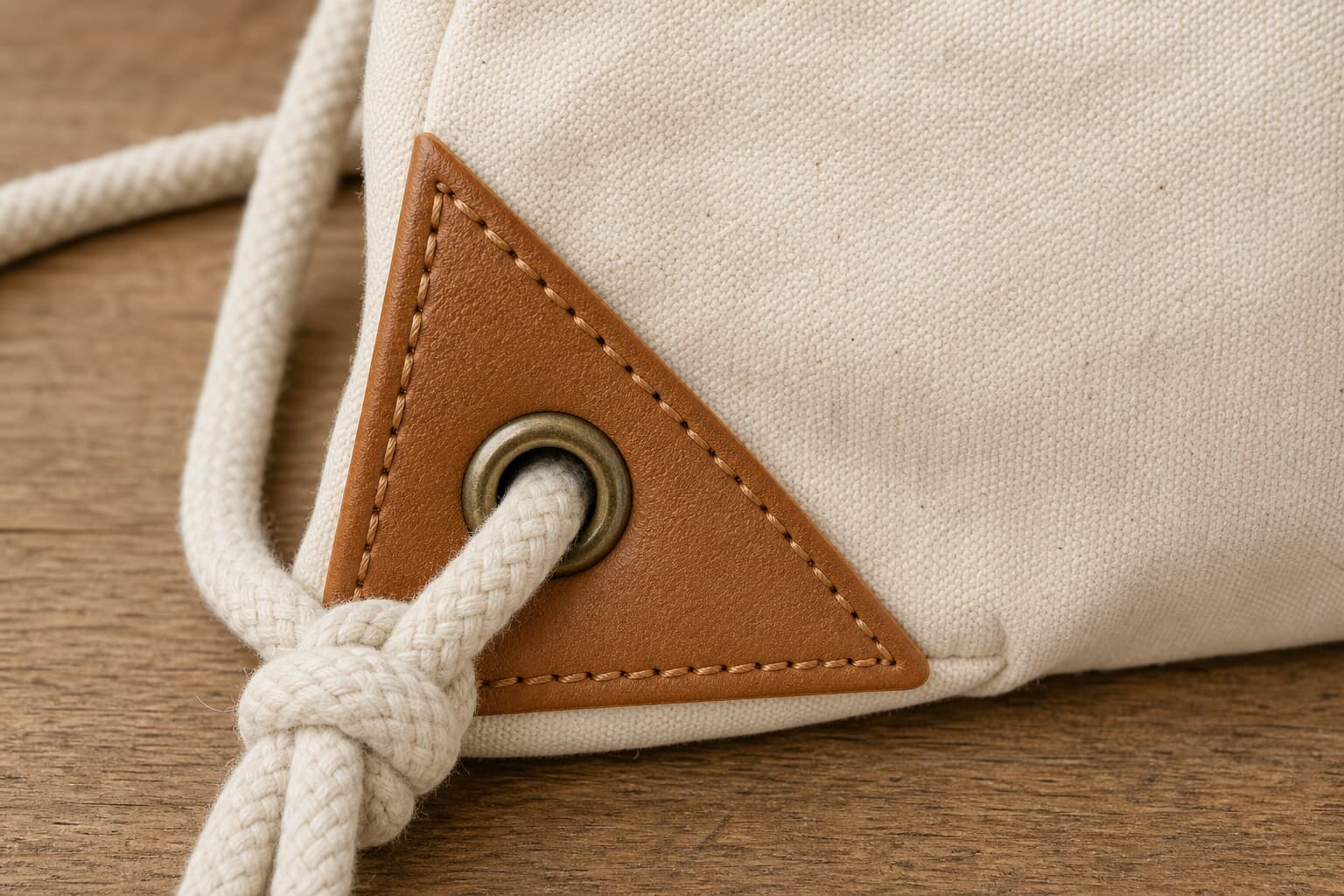
The cord and reinforcement are where many low-cost bags fail. A thin cord may pass a quick visual check but feel uncomfortable on shoulders and cut into the fabric at the bottom corner. Ask for cord diameter, material, color, and construction. Bottom reinforcement can be made with synthetic leather tabs, Oxford fabric tabs, self-fabric patches, or reinforced stitching around eyelets. Metal eyelets may look clean, but poor setting or sharp edges can tear fabric. Stitched buttonholes or reinforced tabs may be better for some lightweight bags.
- Specify finished size and measurement method: flat bag, excluding cord, before packing.
- Set a practical tolerance, such as plus or minus 1 cm, if acceptable for your program.
- Request 5-6 mm cord for better shoulder comfort on repeated-use gym bags.
- Use bar tacks or reinforced stitching at load points, not only a decorative patch.
- Check cord length on a real body fit, because too-short straps make the bag hard to wear.
Logo Method: Match Artwork to Fabric and Quantity
Logo printing is not only a decoration choice; it affects sample approval, production schedule, defect rate, and cost. Screen printing is usually efficient for simple spot-color logos and medium-to-large quantities. It works well on many polyester and canvas bags, but large solid areas need proper ink coverage and curing. Heat transfer can handle more complex artwork, gradients, and small details, but buyers should check hand feel, edge bonding, and cracking risk. Sublimation is useful on white or light polyester panels but is not a direct replacement for screen print on dark stock fabric.
If the buyer provides only a JPEG logo and asks the factory to “print as shown,” disputes are likely. The RFQ should include vector artwork, logo size, placement distance from the top or bottom, Pantone colors, and whether the print must match a brand color under a specific lighting condition. For retail or premium programs, a woven side label, sewn patch, or rubber label can be used, but this adds MOQ, mold or setup time, sewing steps, and inspection points.
- Screen print: good for simple one-to-three color logos and competitive bulk pricing.
- Heat transfer: useful for gradients, detailed artwork, or short runs, but test adhesion and hand feel.
- Sublimation: works best on white polyester panels; not suitable for every fabric color.
- Woven label: good for subtle brand identity but requires label MOQ and sewing accuracy.
- Embroidery: possible on heavier fabric but may pucker light polyester and increase cost.
MOQ Logic: Why the Same Bag Has Different Quantity Breaks
MOQ is not only a factory policy. It comes from fabric availability, dyeing minimums, print setup, label production, cutting efficiency, and packing labor. A stock-color 210D polyester gym drawstring backpack with one-color screen print may have a lower MOQ than a custom-dyed canvas bag with woven label, retail hangtag, and barcode polybag. When buyers understand this logic, they can adjust the specification intelligently instead of only pushing for a lower number.
Ask suppliers for quantity tiers, such as 1,000, 3,000, 5,000, and 10,000 pieces, using the same specification. Also ask which cost elements are fixed and which reduce with volume. Screen setup, sample work, label weaving, and carton label setup may not move much with quantity. Fabric purchasing and sewing efficiency improve when production is larger. If the initial order is small but repeat orders are expected, state that in the RFQ so the factory can suggest a practical starting MOQ and repeat production plan.
- Stock fabric color usually supports lower MOQ and faster sampling.
- Custom fabric color can trigger dye lot MOQ and longer lead time.
- Multi-color printing increases setup and registration control.
- Retail packing raises labor cost and slows final packing speed.
- Mixed colors split production quantity and may increase per-color MOQ.
Sample Approval: What to Check Before Bulk Cutting
The pre-production sample should represent the real bulk product, not just a shape sample made from available fabric. A first sample may be useful for checking size and construction, but final approval should use the correct fabric, print method, cord, reinforcement, label, and packing if timing allows. If the buyer approves a sample with substitute fabric or temporary print, the factory should clearly mark what will change in bulk. Otherwise, the approved sample becomes a weak control document.
Do not approve the sample only from photos. Photos can hide fabric weight, cord feel, print hand, and seam strength. If timing is tight, ask for a short sample video showing the bag opened, loaded, cord pulled, and print area flexed. For important orders, keep one signed sample at the factory and one with the buyer or inspection team. The inspector should compare production against that physical sample during final inspection.
- Measure flat width and height at multiple points.
- Check fabric hand feel and weight against the quoted specification.
- Load the sample with typical gym contents and pull the cords several times.
- Rub the print area lightly and bend it to check adhesion or cracking.
- Inspect bottom tabs, eyelets, channel stitching, and seam ends.
- Confirm packing layout, barcode position, and carton mark format before bulk.
Packing and Freight Data That Affect Landed Cost
Packing is often treated as an afterthought, but it can change landed cost and warehouse handling. Bulk packing is usually cheaper and faster for distributor stock or event delivery. Individual polybags may be required for retail, kitting, or clean warehouse receiving. Barcode polybags, hangtags, warning labels, and color-size separation add labor and material cost. If the RFQ does not define packing, suppliers may quote the cheapest method and then revise the price later.
For freight planning, ask for estimated carton dimensions, gross weight, net weight, and pieces per carton. Gym drawstring backpacks are soft goods, so carton compression and packing method affect volume. A slightly heavier canvas bag may be acceptable at unit price level but increase shipping cost. A retail-packed bag with hangtag and individual polybag may reduce pieces per carton. Importers comparing FOB quotes should still request carton data so forwarders can estimate freight before order confirmation.
- Bulk pack: lower plastic use, lower labor, good for event distribution.
- Individual polybag: cleaner receiving, useful for retail or kitting.
- Barcode polybag: required by many retailers and marketplaces; test scanability.
- Hangtag: adds branding but needs correct attachment point and anti-snag control.
- Master carton marks: include PO number, item number, color, quantity, gross weight, and carton sequence.
Lead Time Planning From Artwork to Shipment
A realistic timeline starts before mass production. Artwork confirmation, fabric sourcing, sample making, sample courier time, buyer review, sample revision, bulk material purchase, printing, sewing, inspection, and packing all take time. A factory may quote production lead time after sample approval, but the buyer’s internal approval cycle can add one or two weeks. For seasonal gym campaigns or retail launch dates, the RFQ should state the required delivery date and ask the factory to work backward.
Lead time also depends on the specification. Stock fabric and a one-color screen print move faster than custom-dyed fabric, complex heat transfer, woven labels, and retail packing. If the buyer needs urgent delivery, it may be better to simplify the product: use stock fabric, standard cord, screen print, and bulk pack. If the product is for resale and quality is more important than speed, protect enough time for sample revision and proper pre-shipment inspection.
- Ask for sample lead time separately from bulk production lead time.
- Define when the production clock starts: after deposit, artwork approval, or sample approval.
- Confirm whether fabric is in stock before relying on the lead time.
- Reserve time for buyer comments and sample revision.
- Schedule final inspection before carton sealing if retail packing is complex.
Quote Data Needed to Compare Suppliers Correctly
A useful quote is more than a unit price. Procurement teams need enough data to compare product quality, landed cost, risk, and timeline. Ask each supplier to quote against the same specification sheet and return the same fields. If one supplier includes individual polybag and another does not, the price difference is not meaningful. If one quote uses 210D polyester and another uses 300D, the cheaper quote may not be a saving; it may be a different product.
Request pricing by quantity tier and ask suppliers to separate extra charges. Screen charges, sample fees, label setup, mold charges, artwork adjustment, special packing, and courier cost should be visible. Also request quote validity because fabric and exchange rates can move. For importers, include trade term, loading port, carton data, and estimated production capacity. These details help your team compare offers without going back and forth for basic missing information.
- Product data: fabric, size, cord, reinforcement, print method, logo size, packing.
- Price data: unit price, quantity tiers, setup charges, sample cost, packing adders.
- Schedule data: sample lead time, bulk lead time, approval cut-off date.
- Logistics data: pieces per carton, carton size, gross weight, net weight, trade term.
- Quality data: tolerances, inspection checkpoints, approved sample control method.
Specification comparison for buyers
| Spec decision | Recommended option | When it fits | Buyer risk to check |
|---|---|---|---|
| Main fabric | 210D polyester for light promo use; 300D polyester or 8-10 oz cotton canvas for stronger retail or club use | Use 210D for event giveaways and 300D/canvas for repeated gym, school, or team use | Suppliers may quote lower denier or lighter GSM unless the RFQ states fabric weight and tolerance |
| Bag size | Around 34 x 43 cm for standard adult gym use | Fits shoes, towel, water bottle, and folded activewear without oversized shipping volume | Small changes affect fabric consumption, carton size, and user fit; confirm finished size tolerance |
| Drawcord | 5-6 mm polyester cord or PP cord with reinforced bottom tabs | Good balance for shoulder comfort and pull strength | Thin cord cuts into shoulders and may fail pull testing when the bag is loaded |
| Bottom reinforcement | PU, PVC-free synthetic leather, Oxford fabric, or self-fabric patch with bar tack | Needed when users carry shoes, bottles, or training gear | Unreinforced eyelet holes can tear during use, especially on 210D fabric |
| Logo method | Screen print for simple spot color; heat transfer for gradients; woven label for premium side branding | Choose based on artwork, fabric, quantity, and wash/rub expectations | Artwork quoted without size, Pantone, and placement creates later setup charges or color disputes |
| Closure design | Double drawcord shoulder straps with top channel stitching | Standard gym drawstring backpack construction with simple operation | Weak channel stitching causes cord pull-out; ask for stitch density and seam reinforcement |
| Packing | Individual polybag only when needed; bulk inner packing for lower plastic and faster handling | Retail buyers may require barcode bags; distributors may prefer bulk pack | Unclear packing instructions can change carton weight, carton count, and warehouse receiving |
Buyer checklist before sampling
- Define intended use: one-day promo giveaway, gym membership kit, sports team pack, school program, or retail resale.
- State finished bag size with tolerance, not only a reference photo.
- Specify fabric type and weight: denier for polyester or GSM/oz for cotton and canvas.
- Confirm whether fabric needs coating, water resistance, recycled content, or colorfastness requirements.
- Provide logo artwork in vector format and state print size, placement, color count, and Pantone references.
- Choose the print method before comparing quotes, because screen print, heat transfer, sublimation, and woven label pricing are not interchangeable.
- Request cord material, cord diameter, cord color, and reinforcement method at bottom corners.
- Ask whether eyelets are metal, plastic, stitched holes, or reinforced tabs, and confirm corrosion or nickel restrictions if relevant.
- State packing format: bulk packed, individual polybag, barcode polybag, hangtag, carton marks, or master carton label.
- Request sample cost, sample lead time, bulk lead time, production capacity, and quote validity in the same RFQ.
Factory quote questions to send
- What exact fabric are you quoting, including denier or GSM, coating, yarn type if known, and weight tolerance?
- Is the quoted size measured flat before filling, and what finished size tolerance do you apply in bulk production?
- Which print method do you recommend for this artwork and fabric, and what are the limits for fine lines, gradients, or large solid ink areas?
- What is the MOQ for this specification, and what changes if we reduce quantity, change fabric color, or add individual barcode packing?
- Are setup charges, screen charges, artwork adjustment, sampling, and courier fees included or listed separately?
- What cord diameter, cord material, and bottom reinforcement construction are included in the quote?
- Can you provide a pre-production sample using the correct bulk fabric, logo method, cord, reinforcement, and packing?
- What is the sample lead time, bulk production lead time after approval, and recommended latest approval date for our delivery window?
- How many bags are packed per carton, and what are the estimated carton size, gross weight, and net weight?
- What quality checks do you perform during fabric cutting, printing, sewing, and final packing?
Quality-control points to confirm
- Check fabric weight against approved sample using GSM or denier documentation and hand-feel comparison.
- Measure finished bag size flat at top, middle, bottom, and height; record tolerance before shipment.
- Verify print color, logo size, logo position, edge sharpness, ink coverage, and cure adhesion.
- Perform a cord pull test at the top channel and bottom reinforcement points with a practical loaded weight.
- Inspect seam allowance, stitch density, skipped stitches, loose threads, and bar tack position.
- Check eyelets or reinforcement patches for tearing, rust risk, sharp edges, and poor alignment.
- Load the bag with typical gym contents to test cord comfort, shoulder length, and top closure function.
- Review packing count per carton, barcode scanability, carton marks, polybag suffocation warnings if required, and mixed color separation.
- Compare final production with the approved pre-production sample, not only with the original artwork file.
- Hold shipment if print cracking, fabric shade mismatch, wrong cord color, incorrect carton count, or missing labels exceed the agreed acceptance criteria.