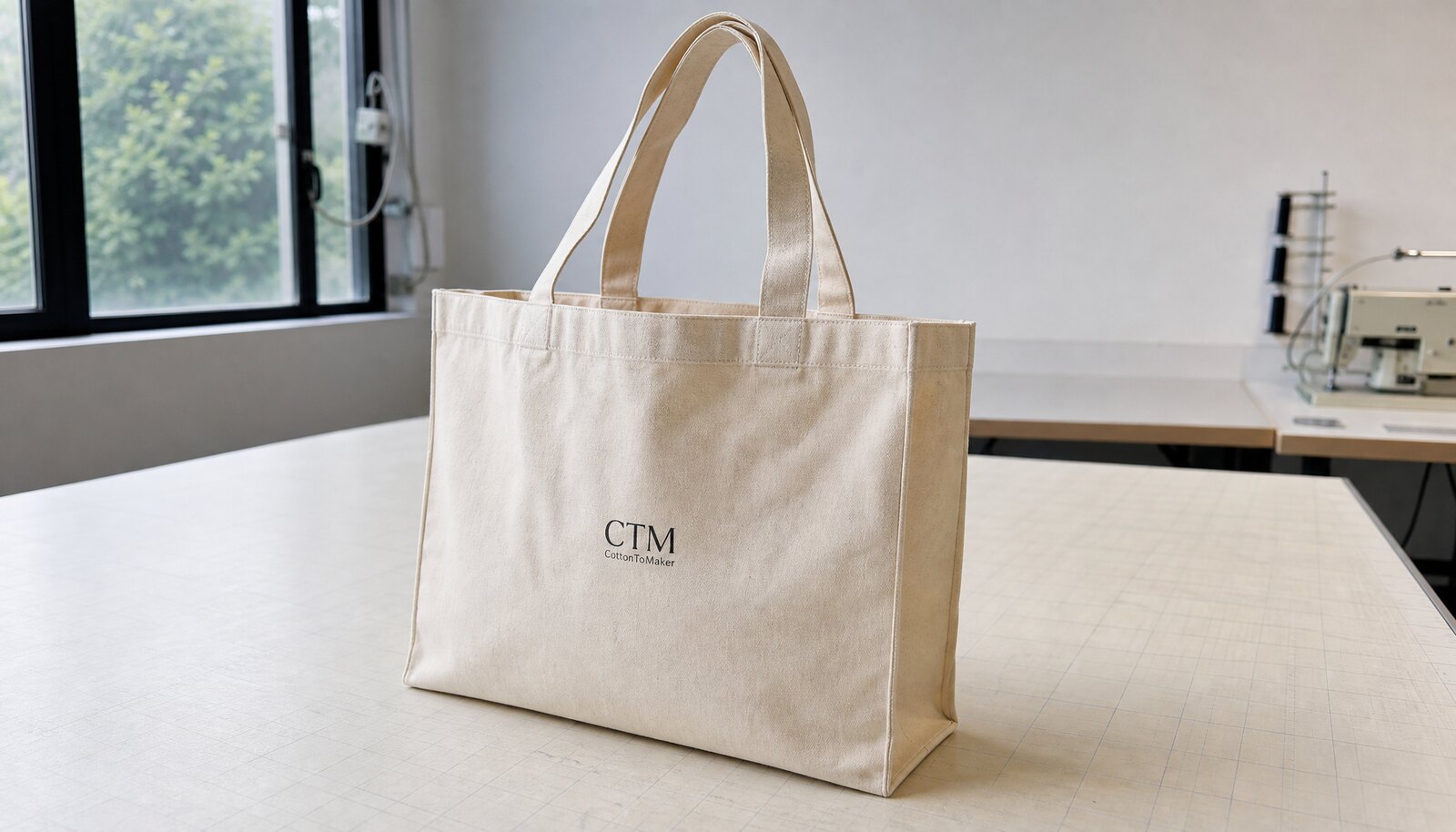
Why gusseted canvas tote bags work better at launch than flat totes
A gusset is not just an extra seam. For a brand launch, it changes how the bag behaves on shelf, during packing, and in the customer’s hands. A flat tote looks thinner and can feel more promotional. A gusseted canvas tote bag gives the bag a usable profile, more internal volume, and a more retail-ready shape without moving to a fully structured bag.
For procurement teams, the real issue is not whether the tote looks nice in a sample photo. It is whether the bag can hold the launch kit, fold cleanly for shipment, print well, and still meet margin targets after sewing, packing, and freight. That is why gusset depth, fabric weight, and handle construction need to be set together, not one by one.
- Better fit for boxed products, catalogs, apparel, and event kits.
- Cleaner standing shape for in-store merchandising and brand photos.
- More useful volume without jumping to a much heavier bag category.
- Easier to justify as a retail SKU or premium giveaway item.
Start with the right canvas weight, not the cheapest quote
For gusseted canvas tote bags for brand launches, the most common mistake is buying a fabric weight that looks good on paper but performs poorly in sewing and print. Light canvas can collapse at the gusset, show ink penetration, and feel underbuilt. Heavy canvas can improve structure, but if the branding is simple and the bag is not carrying dense items, excess weight adds cost faster than it adds value.
In practice, 10 oz canvas can work for lower-cost event use, but many launch programs land better at 12 oz. If the bag is intended for retail resale, premium gifting, or repeat use, 14 oz often gives a more substantial hand feel and less wrinkling around the gusset seam. The right answer depends on how the bag will be sold and what is going inside it.
- 10 oz: lower cost, lighter shipping, suitable for simple giveaways and short-term use.
- 12 oz: balanced option for most branded launch programs, with better print stability.
- 14 oz: more structure, stronger retail perception, higher sewing and freight cost.
- Ask for fabric weight in finished oz or GSM, not only vague terms like 'heavy canvas'.
Gusset depth changes both utility and production risk
A gusseted tote can be built with a side gusset, a bottom gusset, or both. Side gussets help the bag open wider and improve packability for flat merchandise. Bottom gussets support volume and improve stand-up shape. For brand launches, many buyers prefer a combined side-and-bottom gusset because it handles a wider range of use cases, but it also creates more sewing complexity.
Keep the depth realistic. A 10–14 cm gusset usually gives enough volume without making the bag floppy. Once the gusset gets too deep, the panel proportions can distort, print placement can shift visually, and the sewing line has more opportunity to wander. If your artwork must stay centered and square, the cutting layout matters as much as the dimensions on the quote sheet.
- Confirm finished gusset depth after sewing, not only cut size.
- Check whether the gusset is folded, boxed, or seam-joined.
- Review how the gusset affects print area on the front panel.
- If the bag must stand upright, request a sample filled with standard launch contents.
Print method decisions should follow the artwork, not the supplier’s default
Most brand launches use a logo, a short slogan, or a simple graphic. That means screen print is often the best cost-to-quality method for one to three solid colors. It gives clear edges, stable repeatability, and manageable unit cost at volume. If the design has fine gradients, very small text, or a limited run, DTF or heat transfer may be acceptable, but those methods need tighter approval on feel, adhesion, and wash or rub performance.
The buyer should define print area in millimeters and specify where the artwork must sit relative to the top hem and side seam. This avoids the common problem where the logo is technically on the bag but visually too low, too small, or too close to the gusset fold. The print file alone is not enough; a dimensioned placement spec protects the launch look.
- Screen print: best for simple logos and scalable launch quantities.
- DTF or heat transfer: useful for short runs or more detailed artwork.
- Embroidery: premium look, but usually slower and costlier on canvas totes.
- Request a strike-off or printed pre-production sample for color and placement sign-off.
How MOQ logic affects launch pricing and repeat orders
MOQ is not just a factory policy number. It usually reflects how much fabric the mill can dye economically, how many screens or plates the printer must set up, and how much sewing changeover time the line needs. For a new tote launch, a practical MOQ often starts at 1,000 to 3,000 pieces per color and style, but the best number depends on artwork simplicity, fabric availability, and whether you need separate cartons for different channels.
A low MOQ can help a brand test demand, but there is a tradeoff. You may pay more per piece, receive less flexible fabric selection, or lose control over shade consistency if the factory is cutting from leftover stock. If the product is meant to roll into a repeat program, ask the supplier how the second order is priced and whether the same fabric lot can be reserved for replenishment.
- Small launch runs usually carry higher setup cost per unit.
- Color changes increase labor and can add per-color print charges.
- Repeat orders should have a separate pricing ladder if the style is retained.
- Do not compare a 500-piece sample run to a 5,000-piece bulk quote as if they are the same job.
Supplier options: direct factory, trading company, or local converter
For gusseted canvas tote bags for brand launches, the sourcing route matters because it affects accountability. A direct factory with sewing and printing in-house usually gives the buyer better control over fabric consistency, seam construction, and packing. A trading company can be useful if you need multi-product consolidation or support with smaller order management, but the buyer should understand where the real production happens and who owns QC when a problem appears.
A local converter or domestic decorator can shorten communication and make samples easier to approve, but unit cost is often higher and the scale options can be limited. For launch programs that may grow into replenishment, buyers should weigh the first-order convenience against the ability to repeat the same construction at the same cost later.
- Direct factory: best for construction control, cost transparency, and repeatability.
- Trading company: useful when consolidating categories, but require factory disclosure.
- Local converter: quicker samples, often higher landed cost, useful for urgent programs.
- Compare based on the same fabric, print, and packing assumptions.
A fair quote comparison needs the same assumptions on every line
Most tote quote comparisons fail because each supplier answers a slightly different job. One quote may include bulk packing, another may assume individual polybags. One may quote 10 oz canvas, another 12 oz. One may include one-color print only, while another hides a second color surcharge. The cheapest number is often only the cheapest assumption set.
A cleaner way to compare is to build a simple landed-cost view. Start with unit price, then add sampling, print setup, carton cost, inland handling, and estimated freight by carton weight and volume. If your launch window is fixed, include the schedule risk of rework or delayed sample approval. A quote that is slightly higher but stable on delivery can be the better commercial decision.
- Quote the same size, gusset, fabric weight, and print area.
- Clarify whether prices are ex-factory, FOB, or CIF.
- Ask for carton count, carton size, and gross weight.
- Include sample and setup charges in the comparison sheet.
Use sample approval to remove the most expensive mistakes
For launch orders, sample approval should not be a quick email saying 'looks fine.' A pre-production sample needs to show the actual fabric shade, seam construction, gusset depth, handle length, print registration, and label placement. If the CTM or brand logo is off by even a small amount, it can make the whole run look inconsistent on shelf or in photographs.
The best sample process is simple: approve the blank construction first if the style is new, then approve the printed sample, then lock the pre-production reference. Keep one physical signed sample and one high-resolution image record with dimensions marked. That reference becomes the standard for bulk inspection, especially if a second factory line is used later.
- Verify handle drop against the intended hand carry and shoulder carry use.
- Measure gusset depth, body width, and bag height on the sample.
- Test the print for rub resistance and edge clarity.
- Document the approved sample with date, dimensions, and sign-off name.
Packing decisions affect freight, shelf readiness, and complaint rate
Packing is often treated as a final detail, but it changes landed cost and retailer satisfaction. Bulk-packed totes reduce labor and carton volume, which is useful for distributors and warehouse channels. Individual polybagging protects print quality and keeps retail presentation cleaner, but it adds material, labor, and disposal cost. If you need barcode stickers, folded insert cards, or hangtags, those must be quoted before order release, not added later.
Ask for a packing ratio sheet that shows exactly how many pieces are in each carton and how colors or sizes are separated. This matters when a launch uses multiple variants. Mixed cartons can save freight, but they also create picking errors if the receiving team is not prepared. A clean packing plan reduces sorting time and helps the buyer avoid surprise shortages at the distribution center.
- Bulk pack for wholesale efficiency and lower freight cost.
- Individual polybag for retail presentation and print protection.
- Label every carton with style, color, quantity, and PO number.
- Review carton dimensions early to estimate chargeable air or sea freight.
Schedule risk comes from approvals, not only sewing capacity
Most tote programs miss the date because of slow approvals on fabric shade, print placement, carton artwork, or hangtags. Sewing capacity is important, but it is rarely the only constraint. If the supplier needs to source a particular canvas width or custom webbing, lead time can stretch before cutting even starts. For a typical launch order, 25–40 days after sample approval is a realistic planning band, but only if the buyer responds quickly and the supplier actually has materials in hand.
Build buffer into the launch calendar for pre-production sample sign-off and transit. If the bags are going to multiple markets, customs clearance and inland delivery can add more time than the sewing line. A buyer who sets the deadline backward from the shelf date usually gets a cleaner result than one who starts from the PO issue date.
- Separate sample approval time from bulk production time.
- Confirm whether fabric, webbing, and print consumables are stock or made to order.
- Include transit and warehouse receiving time in the launch plan.
- Keep one fallback artwork version in case print setup needs adjustment.
Specification comparison for buyers
| Spec decision | Recommended option | When it fits | Buyer risk to check |
|---|---|---|---|
| Fabric weight | 12 oz canvas for balanced hand feel; 14 oz for premium retail positioning | Launches that need structure, better print appearance, and less see-through than light canvas | Overweight fabric can raise unit cost, slow sewing, and increase carton weight without improving sell-through |
| Gusset depth | 10–14 cm side or bottom gusset | When the bag must stand open, hold boxed products, or carry merchandise with volume | Too shallow limits utility; too deep can distort the front panel and reduce print flatness |
| Print method | Screen print for simple 1–3 spot colors; heat transfer or DTF only for short-run or detailed art | Brand logos with clean shapes and medium to large print areas | Fine detail, gradients, and small text may blur; confirm wash/rub resistance before mass production |
| Handle construction | Cross-stitch plus stress point reinforcement, 2.5–3 cm webbing or self-fabric handles | Retail and event bags expected to carry heavier contents | Short handles can feel cheap; weak bartacks fail under load even when fabric weight is adequate |
| Supplier route | Direct factory with tote specialization and in-house print/sewing | When you need tighter control on fabric shade, construction, and replenishment | Trading layers can hide the real factory, weaken QC accountability, and add margin without adding capability |
| MOQ strategy | 1,000–3,000 pcs per color/style as a practical launch target; sample run lower if factory allows | New brand launches with uncertain sell-through and limited forecast history | Very low MOQ may raise price sharply, limit custom options, or lead to inconsistent dye lots across repeats |
| Packing method | Bulk packed or polybagged with carton label and size ratio sheet | Wholesale, distributor, and DTC replenishment orders | Loose packing can crease prints and create count errors; retail-ready packing adds labor and carton volume |
| Lead time structure | 25–40 days production after sample approval, plus transit buffer | Standard launch calendars with fixed go-live windows | Missing fabric, print plate approval, or carton sign-off can shift the schedule by 1–3 weeks |
| Quote comparison basis | Quote on same fabric spec, same gusset, same print area, same packing, same overage allowance | When comparing multiple suppliers fairly | Different assumptions make the cheapest quote look attractive while hiding add-ons in sampling, packing, or carton charges |
Buyer checklist before sampling
- Define the end use first: retail giveaway, product packaging, brand merch, trade show bag, or resale item, because gusset depth and fabric weight should follow the load and presentation target.
- Lock the fabric spec in writing: canvas type, finished GSM or oz weight, weave density, color, and whether washed, bleached, or natural untreated fabric is acceptable.
- Set print requirements: artwork size, PMS match tolerance, number of colors, print side(s), and whether the logo must stay centered within a measured tolerance.
- Confirm construction details: gusset type, handle length, handle drop, seam allowance, stitching density, reinforcement at stress points, and any inner binding or top hem requirement.
- Request sample photos and a pre-production sample with actual logo placement, not just blank fabric swatches.
- Compare quotes on the same basis: fabric, size, gusset, print method, packing, carton spec, and delivery terms.
- Ask for carton loading data and gross weight so freight can be estimated before PO approval.
- Approve packaging mockup or carton artwork before bulk production if retail labels or barcode stickers are required.
Factory quote questions to send
- What exact canvas construction are you quoting, including fabric weight in oz or GSM, weave density, and whether the fabric is finished or raw?
- Is the gusset side-only, bottom-only, or combined side-and-bottom, and what finished depth do you guarantee?
- What print method is included, how many colors are covered in the base price, and what is the surcharge for extra colors or larger print area?
- What are the handle specs, including material, finished width, finished length, drop length, and reinforcement stitch pattern?
- What is the MOQ by color and by artwork version, and does a repeat order have a lower MOQ after the first run?
- What is included in the sample charge, and is the sample refundable after bulk order placement?
- What are the standard lead times for sample, pre-production sample, and bulk production after approval?
- How do you pack the goods: individual polybag, bulk packed, carton count, and what carton dimensions and gross weight do you expect?
- What QC standards do you apply for print registration, seam strength, measurement tolerance, and needle damage or stain rejection?
- Can you provide factory photos, sewing line photos, and a recent inspection report or internal QC checklist for this tote style?
Quality-control points to confirm
- Fabric weight tolerance: accept within a reasonable production range of the approved spec, and reject obvious substitution to lighter cloth.
- Gusset measurement: measure finished depth on multiple pieces; large variance usually signals cutting inconsistency or poor seam control.
- Handle strength: inspect bartacks or cross-stitches, tug test the handle attachment, and reject loose thread or skipped stitches at stress points.
- Print placement: verify centered logo position, consistent color density, and no smearing, pinholes, or image distortion on the gusset edge.
- Seam quality: check inside seam finish, seam allowance consistency, corner shaping, and whether the bag body stands square.
- Odor and stain control: reject oil stains, glue marks, or strong chemical smell that can cause retail complaints.
- Packing count: carton tally must match PO quantity, with size/color ratio clearly labeled and no mixed lots unless pre-approved.
- Sample-to-bulk match: approve the pre-production sample against the signed off reference; bulk production should not drift in color, print, or construction.