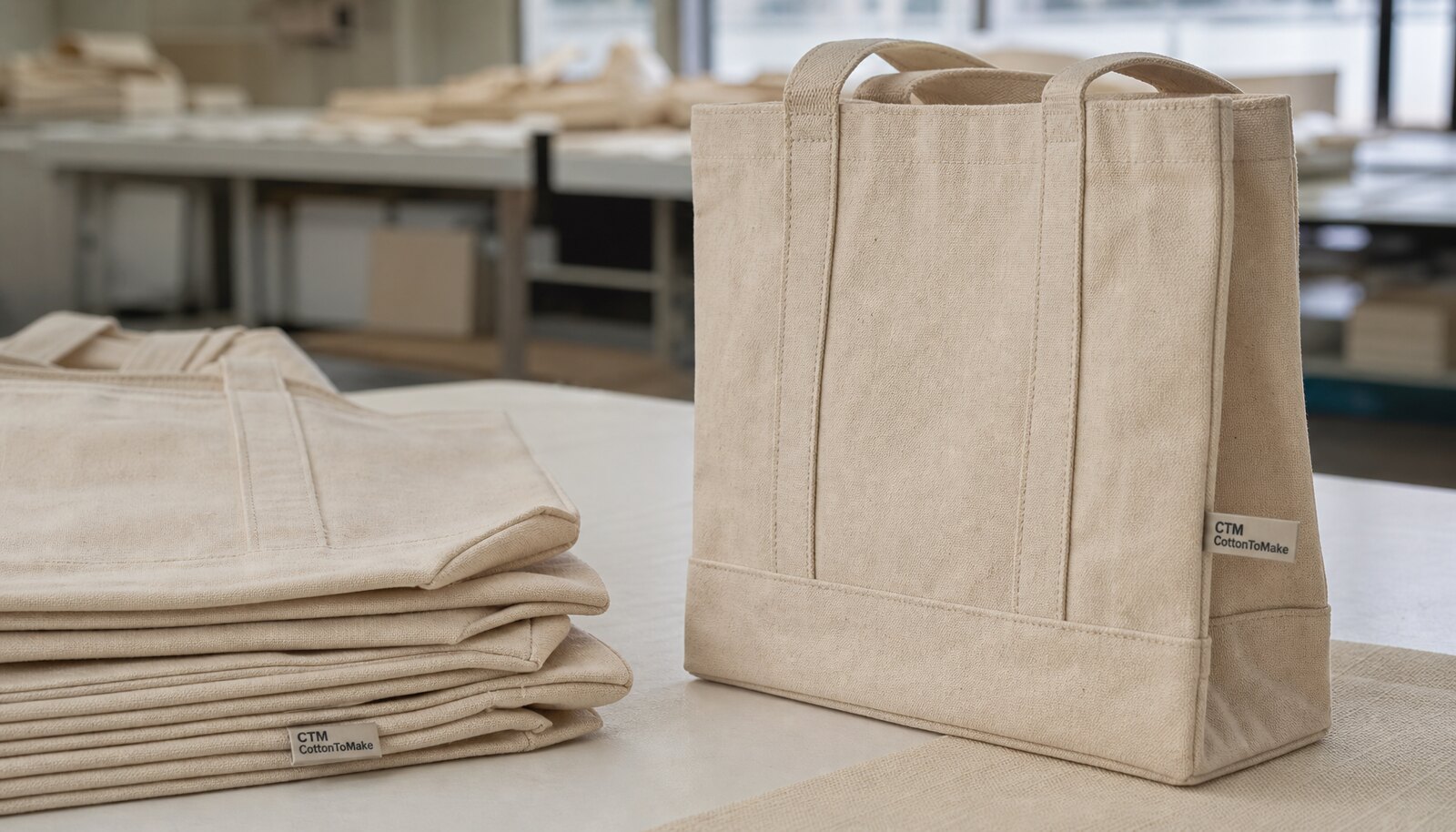
Why gusseted canvas tote bags need a different buyer lens
Gusseted canvas tote bags are not simply flat totes with more material sewn into the sides. The gusset changes usable volume, loading behavior, carton efficiency, and the visual impression of the bag on shelf or in hand. In procurement terms, that means you are buying a construction, not just a footprint. The same nominal width and height can produce very different capacity depending on whether the gusset is side-only, bottom-only, or both.
This matters because many quote comparisons break down at exactly that point. One supplier may quote a flat 15 x 16 in tote, while another quotes a 15 x 16 x 4 in gusseted tote and both line items look close enough to compare at a glance. They are not close enough. The gusseted version typically consumes more fabric, requires more seam control, and can create a more retail-ready silhouette. If the bag is intended for store resale, museum shops, bookstore merchandising, corporate gifting, or packaged product delivery, the gusset is often what makes the bag commercially useful rather than merely usable.
Procurement teams should therefore start with commercial intent before talking about artwork or colors. Ask where the bag will sit, what it will carry, how it will be packed, and whether the buyer expects a premium appearance or just a functional carrier. A tote intended to hold flat brochures can be built differently from one intended to display boxed candles, bottled products, or folded apparel. Once the use case is clear, the rest of the spec becomes easier to defend in a quote review and much easier to audit at inspection.
- Gusseted bags generally cost more than flat totes, but they can justify that premium through better capacity and shelf presence.
- The gusset affects both capacity and sewing complexity, so compare like-for-like structures only.
- Buyers should define the use case first: retail resale, event distribution, gifting, or warehouse packing.
Choose the gusset structure before you lock the rest of the spec
The first construction decision is whether the bag needs a side gusset, a bottom gusset, or both. Each configuration affects both commercial value and production risk. A side gusset helps the tote open wider and improves packing capacity for flat or layered products. A bottom gusset helps the bag sit level, carry boxed items, and stay upright on shelves or counters. A bag with both gussets offers the strongest all-round retail performance, but it also uses more fabric and introduces more opportunities for seam distortion if the factory is not disciplined about cutting and folding.
For buyers, the decision should follow product geometry. If the bag will hold books, catalogs, apparel, or brochures, a side gusset may be enough. If it must carry cosmetics, food packs, candles, or rectangular boxes, a bottom gusset becomes more important because the base shape matters as much as the overall size. If the bag is for gifting or resale and you want it to feel like a finished retail item rather than a simple carrier, side plus bottom gusset is usually the best commercial choice. It gives the bag a more structured profile and improves how the print sits on the front panel.
There is a cost threshold to watch. A deeper gusset is not always better. Once the gusset becomes too large relative to the bag height, the tote can look boxy, bulge at the corners, and fold awkwardly in packing. That is often a sign the buyer is overbuying capacity that will never be used. On the other hand, a gusset that is too shallow may save a little money but create a bag that feels cramped or collapses when loaded. The commercial sweet spot is the smallest gusset depth that reliably meets the product volume and display requirement.
- Side gusset only: better for flat or semi-flat contents and lower sewing complexity.
- Bottom gusset only: useful when the bag must stand upright or carry boxed goods.
- Side + bottom gusset: best for mixed retail use and stronger shelf presentation, but requires tighter pattern control.
Canvas weight, weave, and finish determine structure, not just price
For gusseted canvas tote bags, the biggest mistake is treating canvas weight as a simple cost lever. Weight matters, but so does weave density, yarn quality, finish, and whether the fabric has been washed or pre-shrunk. In the market, buyers often work around 8 oz to 16 oz canvas, with 10 oz to 12 oz being the most practical range for everyday retail use. In GSM terms, that usually means roughly 340 to 400 gsm. That band is popular because it balances body, sewing efficiency, and freight cost.
An 8 oz bag can be suitable for low-cost promotional programs, but it may sag if the tote is expected to stand on a counter or hold heavier packaged goods. A 12 oz bag, by contrast, gives a more substantial handfeel and can support better shape retention, but the machine operators feel the difference immediately. Thicker fabric can slow seam speed, increase needle wear, and raise the chance of skipped stitches if the factory does not adjust settings. That matters because some suppliers quote lower labor assumptions on lighter fabric and then add hidden cost when the spec changes.
The finish also changes the buyer experience. Natural canvas offers a classic look and is common for branding. Bleached canvas gives a brighter print base but can be more sensitive to shade variation. Dyed canvas changes color consistency and may require separate shade approvals. Washed or softened canvas feels more premium, but it may behave differently after sewing or in wet conditions. If your print or label placement is tight, ask whether the fabric is pre-shrunk or whether the supplier is adding shrinkage allowance into the cutting pattern. That is a procurement question, not a design question, because it affects both bulk consistency and rejection risk.
- 8 oz to 10 oz: lower-cost carrier bags, light contents, short reuse cycles.
- 10 oz to 12 oz: best all-round range for retail, gifting, and repeated consumer use.
- 14 oz to 16 oz: premium structure, better stand-up quality, and higher sewing/freight cost.
Handles, reinforcement, and carry load should be specified as a system
Handle design is not an accessory decision; it is a structural one. A gusseted canvas tote may look strong on the table, but the handle build is what determines whether the bag survives repeated consumer use. Buyers should specify the handle material, width, stitching pattern, anchor length, and expected carry load together. If you only define the handle length, you leave too much room for interpretation.
There are two common approaches. Self-fabric handles maintain a clean, uniform look and can be cost-effective, especially on lighter canvas. Webbing-reinforced handles, or heavy self-fabric with reinforcement stitching, are better when the bag is meant to carry 5-8 kg or more, or when the tote will be resold at retail and customers will expect durability. The key question is not whether the handle looks nice in the sample room. The question is whether it will hold after repeated flexing, overpacked use, and the inevitable customer behavior of carrying the bag by one handle.
Handle drop matters too. If the drop is too short, consumers struggle to carry the bag over a coat or shoulder. If it is too long, the bag hangs low and can drag against clothing or product displays. Buyers should therefore ask the supplier to state handle drop in the spec sheet and to show how that drop is measured after sewing. This avoids a common dispute where the prototype looks acceptable but the bulk lot lands short because of seam take-up or cut variation.
- Self-fabric handles: cleaner look, generally lower cost, suitable for light-to-medium loads.
- Webbing or reinforced handles: better for heavier loads and higher repeat-use expectations.
- Ask for stitch count, anchor length, and reinforcement method, not just handle length.
Printing choices: balance art complexity, batch size, and durability
The right print method depends on artwork complexity, order volume, and the durability your channel requires. Screen printing is usually the best starting point for gusseted canvas tote bags with simple logos, solid shapes, and repeat orders. It offers strong color laydown on canvas and can be economical when the artwork is stable. The tradeoff is that each additional color adds setup cost and creates another registration point that must be controlled on a sewn bag surface.
Heat transfer and digital transfer methods are better when the order is smaller, the art has many colors, or the design changes frequently between drops. Those methods can reduce setup friction, but the buyer should ask for rub resistance and surface adhesion proof. A print that looks sharp on day one may not survive repeated folding, abrasion, or rough carton packing if the transfer layer is weak. For buyers in apparel, gift, or lifestyle channels, the real question is whether the print still looks deliberate after the bag is handled in stores or used by consumers.
Placement on gusseted bags requires special attention. Artwork positioned too close to a seam can distort after folding. Artwork crossing a gusset should be checked on a production pattern or strike-off, not just on a flat PDF. A logo that appears centered on screen can move visually once the bag body is assembled. For that reason, many retail buyers prefer one clean front print, a small side mark, or a restrained layout that avoids the gusset transition area. That approach lowers registration risk and keeps the bag looking intentional instead of crowded.
- Screen print: best for 1-3 colors, larger quantities, and repeat orders.
- Heat transfer / digital transfer: better for short runs or multicolor artwork, but test durability first.
- Embroidery: suitable only on heavier canvas and small mark areas; not ideal for large filled graphics.
Supplier route decisions: what factory direct, trading, and local conversion really mean
The supplier route changes more than price. It changes who controls the spec, who absorbs coordination work, and how much visibility you get into material substitution. Factory direct is usually the best fit when the order is repeatable, the construction is stable, and your team wants to control cost at the sewing and fabric level. In that model, the buyer can push harder on dimensional consistency, seam details, and packing assumptions because the organization making the bag is the one answering the technical questions.
Trading companies and sourcing agents make more sense when the order is complex, the SKU mix is broad, or your team needs help coordinating multiple factories, packaging components, or documentation steps. They can reduce internal labor, but the buyer must still guard against spec drift. A quoted fabric weight can sound right while the actual lot arrives lighter; a handle spec can be described well while the stitched reinforcement changes from batch to batch. That is why trading-route orders need the same rigor in the RFQ and sample approval process as factory-direct orders.
Local converters or domestic decoration partners can be practical when the lead time is critical or when the order is too small to justify an offshore program. The tradeoff is usually price. Buyers often pay more per unit for the speed and convenience, but they may save internally on communication, inspection logistics, and freight risk. For procurement teams, the right route is the one that best fits the order pattern. If the tote is a recurring program with stable artwork, direct factory sourcing typically offers the best commercial control. If the tote is part of a mixed promotional package with multiple deliverables and short deadlines, a converter or trading partner can be the lower-risk operational choice.
- Factory direct: best for repeat orders, tighter construction control, and lower ex-works cost.
- Trading company: useful when you need mixed SKUs, multilingual coordination, or one contact for several materials.
- Local converter: useful for urgent programs and small orders, though often at a higher unit price.
How to compare quotes on a landed-cost basis, not a headline price basis
A quote for gusseted canvas tote bags should be evaluated as a cost stack, not a single number. The headline unit price often hides the real commercial differences: the fabric basis, the print setup, the handle reinforcement, the folding labor, the carton spec, and the freight weight. A low ex-works quote can easily become the more expensive landed cost once packing, dimensional weight, customs duties, and rework risk are added. Procurement teams should therefore normalize all quotes to one agreed product description and one agreed delivery assumption before they compare suppliers.
The simplest way to do that is to force each supplier to quote the same reference brief. That brief should include finished dimensions, gusset depth, fabric weight, handle build, print method, packing format, and carton count. If one supplier proposes a 10 oz canvas tote with side gusset only and another quotes a 12 oz bag with side plus bottom gusset, do not compare the prices directly. Ask both suppliers to re-quote the same spec. If the buyer cannot get a clean re-quote, the commercial comparison is not reliable enough for award.
You should also understand where cost increases become unavoidable. Moving from 10 oz to 12 oz canvas raises fabric cost and often slows sewing. Adding a bottom gusset adds seam work and can lower sewing efficiency. Switching from one-color to two-color screen print adds setup and registration control. Retail folding, inner polybags, and barcode labels add labor and carton volume. None of these are surprise charges if they are in the spec, but they become expensive if they are discovered late. That is why landed-cost analysis is often the difference between a profitable bag program and a program that looks good only on paper.
- Normalize all quotes to the same size, same gusset type, same print method, and same packing format.
- Ask suppliers to separate material, labor, printing, packing, and carton cost where possible.
- Include freight basis, carton volume, and expected duty impact before awarding the order.
MOQ and lead time need tighter conditions than most quotes provide
MOQ and lead time are often quoted too loosely to be useful. A supplier may say the MOQ is 500 pieces, but the actual minimum may be 500 pieces per color, per artwork, or per fabric lot. That difference matters because it changes inventory exposure. If you need three colors and the MOQ is 500 per color, your effective order size is 1,500 pieces whether you want that or not. Buyers should never accept a quote without clarifying whether the MOQ applies to style, color, print, or all three.
Lead time is equally conditional. A quoted 15-25 day production window may be realistic only if the factory has stock canvas, approved artwork, simple packing, and no special trims. Add dyeing, custom labels, or retail folding and the timeline can stretch quickly. Also, production lead time usually starts after sample approval and deposit, not after first inquiry. That means sample iteration time, corrections, and approval delays all sit outside the quoted cycle. Procurement teams should therefore separate commercial lead time from sample lead time in their internal planning.
A useful rule is to treat tight lead times as a spec simplification problem. If you need bags quickly, use standard canvas color, one-color print, standard handle build, and bulk packing. If you need custom shade, multiple print colors, and retail-ready presentation, plan more time. There is no free speed. Either the factory holds stock materials and keeps the build simple, or you pay for expedited coordination and accept a higher risk of variation. The best buyer decision is to match the commercial deadline to the complexity of the build rather than trying to force a premium tote into a promo timeline.
- Ask whether MOQ is by style, by color, by artwork, or by fabric lot.
- Confirm whether the lead time starts after sample approval, after deposit, or after final artwork sign-off.
- For urgent programs, simplify the spec before you push for speed.
Sample approval should validate construction, not just the artwork
A sample for gusseted canvas tote bags should be treated as a construction gate, not a design courtesy. Buyers often focus too heavily on the print color and overlook the gusset shape, the handle drop, the seam finish, and the fold behavior. That is a mistake because the print can be corrected relatively easily while a poor gusset or weak handle structure is much harder to fix after bulk sewing begins. The sample should prove that the bag can be manufactured consistently, not just that it looks good in a photo.
At minimum, ask for a physical pre-production sample if the order is commercial and repeatable. For lower-risk or smaller orders, high-resolution sample photos may be acceptable, but they should show the front, back, side gussets, bottom seam, handle attachment, inside finish, and any labels or inserts. If the bag is going to retail, the sample should also show folding method and packed carton arrangement. Otherwise, you may approve a beautiful specimen that becomes distorted once folded at scale.
Buyers should also be careful about sample interpretation. Some factories use hand-finished samples that are cleaner than bulk production, so the sample can overstate the final result. To reduce that risk, ask whether the sample is made on the same line or from the same process route as bulk production. Where possible, keep a sealed approval sample and tie it to the PO. That gives inspection teams a concrete reference if the bulk lot starts to drift.
- Check the sample as a built bag, not just a printed panel.
- Ask for photos of the inside seams and gusset fold lines.
- Keep one sealed reference sample linked to the order and inspection report.
QC checkpoints and defect thresholds buyers should define before production
Most quality issues in gusseted canvas tote bags are not mysterious. They cluster around the same stress and alignment points: handle anchors, gusset corners, bottom seam ends, and print placement near folded edges. Buyers reduce risk by setting defect thresholds before production starts. That means defining what is acceptable, what is minor but allowable, and what is a hard rejection. Without that framework, inspection becomes a subjective argument rather than a supply-control process.
A practical QC plan begins with in-line checks. The factory should inspect early pieces from the first sewing run to verify seam alignment, handle placement, and print location. After that, a pre-shipment inspection should check random cartons from the packed lot for dimensions, stitch integrity, shade consistency, and packaging accuracy. If the order is large or the customer-facing risk is high, add a load test on multiple samples using realistic contents rather than a generic weight. A tote can look fine empty and fail when filled.
Set the acceptance thresholds in measurable terms. For example, finished dimensions may need to stay within +/- 0.5 cm for smaller retail totes, while larger bags may tolerate a slightly wider band if the product fit is not tight. Print should sit within a defined position window and not intrude into seam allowance. Minor loose threads may be trimmed, but broken stitches at the handle anchor or seam opening should be treated as major defects. Stains, oil spots, visible shade mismatch, and gross carton quantity errors should be rejectable without debate. The point is not to demand perfection. The point is to define predictable commercial quality so the supplier knows what “pass” actually means.
- Measure finished dimensions against the approved spec, not against the original pattern idea.
- Treat handle-anchor failure, seam opening, and print misplacement as major defects.
- Use a practical load test with intended contents or equivalent weight.
- Inspect packed cartons as well as individual bags; many problems show up only after folding and packing.
Specification comparison for buyers
| Decision area | Option A | Option B | Commercial tradeoff | Procurement threshold to use |
|---|---|---|---|---|
| Canvas weight | 10 oz / 340 gsm | 12 oz / 400 gsm | 10 oz is easier to sew and cheaper to freight; 12 oz gives better stand-up structure and a more premium handfeel | Choose 10 oz for promo retail or lighter contents; choose 12 oz when the tote must hold boxed items or sell as a premium reusable bag |
| Gusset construction | Side gusset only | Side + bottom gusset | Side gusset-only bags cost less and pack flatter; combined gussets improve volume and shelf presence but increase sewing time and seam-risk | Use side-only when the bag carries flat items; use both when the tote must stand upright or carry mixed retail goods |
| Handle build | Self-fabric handles | Webbing-reinforced handles | Self-fabric keeps the look clean and can reduce cost; webbing improves pull strength and durability under repeated use | Use self-fabric for light-to-medium carry; specify webbing or heavy reinforcement when target load is 5-8 kg or the bag is sold as reusable |
| Print method | Screen print | Heat transfer / digital transfer | Screen print is lowest-cost for simple one- to three-color logos at volume; transfers suit small runs or complex artwork but need rub and heat testing | Use screen print for repeat orders and simple branding; use transfer methods for short runs, multicolor art, or frequent artwork changes |
| Supplier route | Factory direct | Trading company / sourcing agent | Factory direct usually gives better control over construction details and lower ex-works cost; trading routes are easier for mixed programs but can hide spec substitutions | Go factory direct when the spec is stable and recurring; use trading support when you need multiple SKUs, documentation help, or faster coordination |
| MOQ structure | MOQ by style and color | MOQ by style only | Color-based MOQs increase inventory risk but improve dye consistency; style-only MOQs are easier for buyers with multiple colorways | Ask whether MOQ is split by color, print, or fabric lot before you compare suppliers |
| Lead time expectation | 15-25 days after approval | 30-45+ days after approval | Shorter lead times usually depend on stock fabric, simple printing, and standard packing; longer lead times are common if dyeing, special labels, or retail-ready folding are required | Use 15-25 days only for stock fabric and simple branding; budget 30-45+ days for dyed canvas, special trims, or tight retail packaging |
| Packing format | Bulk packed in master cartons | Retail-folded with inner polybag and label | Bulk packing lowers cost and carton volume; retail-ready packing increases labor and carton count but may be mandatory for store programs | Choose bulk packing for wholesale distribution and retail folding only when your channel requires shelf-ready presentation |
| Landed cost driver | Fabric + sewing + print | Fabric + sewing + print + packing + freight + duties | The lowest ex-works quote can be the more expensive landed cost once carton density, chargeable weight, and packing labor are added | Always compare the fully loaded landed cost before award, not just unit price |
Buyer checklist before sampling
- Confirm the finished bag size, gusset depth, handle drop, and target carry load in one spec sheet.
- Specify canvas type, finished GSM/oz, color standard, shrinkage expectation, and whether the fabric is pre-washed or pre-shrunk.
- Define print position, print size, color count, Pantone references, and whether the artwork crosses a seam or gusset fold.
- State the required packaging format, carton quantity, barcode or hangtag needs, and ship marks before the factory begins cutting.
- Request a pre-production sample or sealed approved sample, plus photos of front, back, sides, bottom, and inside seams.
- Set acceptance criteria for stitching, print placement, shade variation, stains, and dimensional tolerance before mass production.
- Ask the supplier to confirm what is included in the quote: fabric, handles, print setup, packing labor, cartons, and sampling.
- Build a QC plan that includes in-line checks, pre-shipment inspection, and a carton count verification against the purchase order.
Factory quote questions to send
- What is the exact canvas specification you are quoting: fiber content, finished GSM/oz, width, and whether the weight is based on finished fabric or greige cloth?
- Is the gusset side-only, bottom-only, or side plus bottom, and what is the finished gusset depth after sewing and shrinkage allowance?
- What handle construction is included in the quote: self-fabric or webbing, handle width, stitch density, anchor length, and reinforcement method?
- How many print colors are included, what is the setup fee, and is the quoted print price for one side or both sides?
- What MOQ applies by style, color, and artwork, and can any components be shared across variants to reduce setup cost?
- Is a physical pre-production sample included, and will you provide production photos, cut-panel photos, or a sealed reference sample before bulk release?
- What packing format is assumed: flat bulk pack, folded retail pack, inner polybag, barcode sticker, hangtag, tissue, or insert card?
- What carton size, pack quantity, and gross weight are you assuming, and will the carton spec change if we adjust packing or folding?
- What is the production lead time after sample approval, and what conditions can extend it—fabric delay, print approval, dyeing, or packing changes?
- What inspection standard can you support before shipment, and will you accept third-party inspection or buyer-appointed QC?
Quality-control points to confirm
- Finished dimensions: measure length, height, and gusset depth against the approved spec; define tolerance in advance, commonly +/- 0.5 cm for smaller totes and tighter if retail packaging requires precise fit.
- Gusset symmetry: side gussets and bottom gusset should fold evenly, with no visible twist, no one-sided depth difference, and no puckering at the seam corners.
- Seam strength: inspect handle anchors, side seams, and bottom seam ends for skipped stitches, broken backstitching, loose thread tails, and weak reinforcement.
- Handle consistency: confirm handle drop, spacing, width, and stitch pattern are identical across the lot; uneven handles change carry comfort and shelf appearance.
- Print registration and placement: verify the logo sits within the approved print box and does not drift into the seam allowance or gusset fold line.
- Surface quality: check for stains, slubs, weaving defects, shade variation, oil marks, lint, and lint-embedded print areas before packing starts.
- Load performance: perform a practical load test using the intended contents or an agreed weight; watch for seam opening, handle stretch, or bag-body collapse.
- Packing accuracy: confirm fold direction, unit count, polybag use, barcode placement, carton markings, and master carton quantity against the packing instruction.
- Carton condition: ensure cartons are strong enough for the route, with no crushing, moisture damage, or overfill that distorts the bags inside.
- Reference retention: keep one sealed approval sample, one photo set, and one signed spec sheet linked to the purchase order and inspection report.