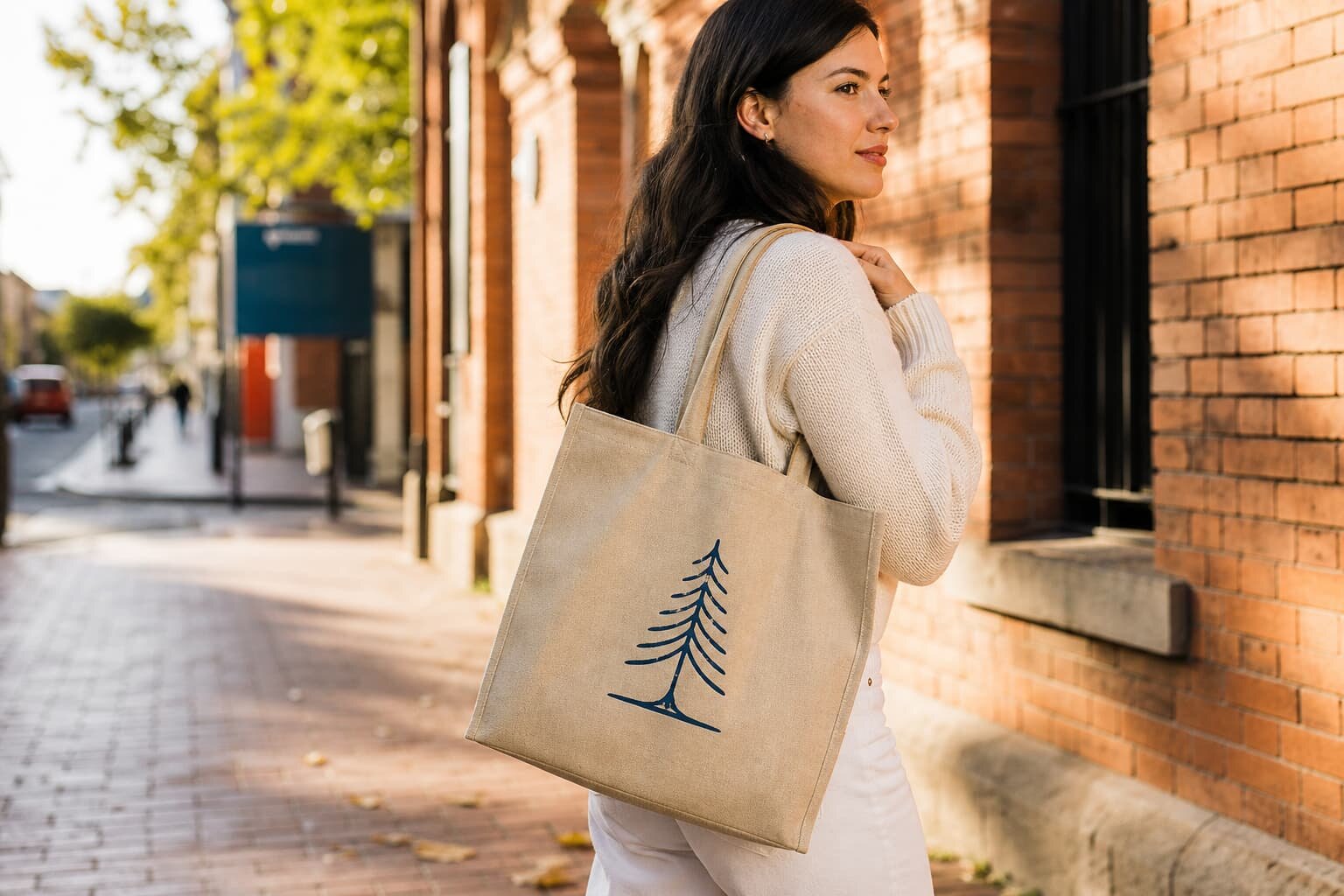
Start With the Tote's Shape, Not the Artwork
A gusseted canvas tote bag is not a flat poster. The front panel, side gussets, bottom gusset, top hem, and handle attachments all change how a logo lands after sewing, folding, and packing. If you approve a placement on a perfect flat mockup, the final bag can still shift the print into a seam, squeeze the artwork with a fold, or make the logo look lower than expected once the bag is filled. That is why buyers should treat placement as a production issue, not a design preference.
For importers and brand owners, the first question is not "where does it look best?" It is "where will it survive production and warehouse handling?" A logo that reads well on a 10 oz or 12 oz bag may need a wider safe zone on 16 oz canvas because thicker cloth holds a fold differently. Start by defining the finished bag shape, the likely fill level, and whether the bag is a promo item, a retail carry bag, or a premium private label piece.
- Define logo placement on the finished bag and the flat pattern.
- Treat seams, folds, and handle stitches as hard no-print zones unless the factory approves otherwise.
- Match the placement to the way the bag will be sold, carried, and packed.
Map the Placement Zones Before You Ask for Quotes
A factory can quote faster and more accurately when you name the exact placement zone. On a gusseted canvas tote, the main options are the front panel center, upper front below the hem, lower front above the bottom seam, side gusset, and a side seam label. Each zone has a different print risk. The front panel is the easiest to register. The side gusset is narrower and more sensitive to seam shift. The lower front can be squeezed by contents or fold lines if the bag is shipped flat.
Do not write "logo on front" and expect every supplier to interpret it the same way. Give the factory a placement map with measurements from the top hem, side seam, and bottom seam, then state whether the artwork is centered on the finished bag or on the flat cut panel. If the bag size changes from 35 x 40 cm to 38 x 42 cm, the same logo can look smaller or sit too high. Good buyers specify the coordinates, not the vibe.
- Use mm measurements for logo width, height, and distance from each edge.
- Ask the supplier to confirm the placement on the exact pattern piece they will cut.
- Separate front, back, and gusset placements into different RFQ line items if needed.
Choose the Placement That Matches the Sales Channel
The best logo position depends on how the bag is sold and used. For retail shelves and brand awareness, a centered front logo usually gives the strongest visibility. For corporate gifts or event bags, a clean upper-front logo often looks more controlled and avoids the appearance of the artwork being crushed by whatever is inside the bag. If the bag is meant for a higher-end retail program, a smaller, well-placed front mark or side label may look more premium than a large print that covers the whole face.
The gusset is useful when you want the brand visible from the side or when the front panel must stay clean for aesthetic reasons. It is not the easiest place to print, though. Narrow panels, fold tension, and the transition into seams can distort lines or make text hard to inspect. If the bag will be carried under the arm, a side gusset mark can still be seen, but if shelf impact is the goal, the front panel usually wins. Buyers should choose based on channel, not habit.
- Retail shelf: favor a clear front-panel logo with strong contrast.
- Corporate gift: use upper-front placement or a restrained side label.
- Premium private label: consider a smaller mark plus a woven side label.
Match Print Method to the Placement
Placement and print method should be decided together. Screen print is usually the best value on flat front panels when the artwork is one or two colors and the order quantity is high enough to absorb setup. It gives good coverage on natural canvas and usually reads well from a distance. Heat transfer or DTF can work for smaller runs and more detailed art, but buyers should be careful if the logo sits near a fold or seam because the film can show wear sooner in those zones. Embroidery and patches feel premium, but they add thickness and need more room away from seam intersections.
A small logo on the side gusset may be better as a woven label or sewn patch than as a full print, especially when the gusset is narrow. Heavy embroidery on thick canvas can pucker if it crosses a seam, and a large printed block on a folded edge can crack in carton compression. The right method depends on the logo size, the number of colors, the canvas weight, and whether the bag will be folded tightly for export packing. Ask the supplier which method is most stable for your exact placement, not just the cheapest per piece.
- Screen print: best for flat panels, simple art, and better unit economics at higher MOQ.
- Heat transfer or DTF: useful for small runs and detailed art, but check fold durability.
- Embroidery or patch: good for premium positioning, but keep clear of seams and thick joins.
- Woven label: strong as a secondary brand element, not as the only visible logo on a retail bag.
Specify Artwork Like a Production Drawing
The most useful RFQ is built like a production drawing. State the bag size, the exact canvas GSM, the bag color, the print method, the logo size in mm, the number of colors, and the position relative to the stitch lines. A buyer should also state whether the logo is printed on finished bags or on cut panels before sewing. That detail matters because a print on the cut panel can move slightly during construction, while a print on the finished bag must avoid every seam and reinforcement point. The supplier cannot quote accurately if the artwork is only described as "medium size" or "somewhere centered."
Canvas weight changes how the logo looks. A 240 GSM or 8 oz promotional bag may show more ink strike-through, while a 340-410 GSM or 10-12 oz retail bag usually gives a cleaner print base. Heavy 16 oz canvas can support a bolder imprint, but it may need a wider safe zone and slightly larger artwork to stay legible after sewing and folding. If the logo uses thin text or fine lines, tell the supplier to review the minimum stroke width on the actual cloth. The right answer is often not a bigger design, but a clearer one.
- Give logo size in mm, not "large" or "small."
- State seam clearance and no-print zones on the same drawing.
- Require the proof on the exact bag size and canvas color you plan to buy.
Use MOQ and Sampling to Avoid Expensive Rework
MOQ is not just a number in the quote. It is tied to how many setups the factory needs. One front print in one color on a single tote style may have a relatively simple MOQ, but adding a second location on the gusset, changing to embroidery, or asking for multiple ink colors can split the production into extra setups. That means more screens, more registration checks, more sewing or labeling time, and a higher chance of rejects. Buyers who understand that logic can compare quotes more fairly and avoid assuming that every placement option costs the same.
Sampling should follow the same logic. A flat digital proof is useful for layout, but it is not enough if the logo sits near a seam, fold, or handle reinforcement. Ask for a blank sample first if needed, then a printed sample on the actual canvas weight, then a pre-production sample with trims and packing confirmed. If the logo is meant to cross a panel transition or sit close to the gusset, approve it on sewn goods, not on paper. A sample that looks perfect on screen can still fail once the bag is stitched and folded.
- Expect MOQ to rise when you add color counts, extra locations, or special branding methods.
- Use the sample stage to test real fabric, real ink, and real seam behavior.
- Do not approve a seam-adjacent logo from a digital proof alone.
Ask for Quote Data That Separates Real Cost from Noise
A useful quote should break out the bag cost, the branding cost, and any extra setup charges. For a gusseted canvas tote, that may include screen making, art separation, printing labor, label sewing, patch attachment, packing, carton marks, and polybag cost. If the logo is placed on the gusset or near a seam, the supplier may also need special jigs or slower production speed to maintain alignment. Buyers should ask whether the quoted price includes one placement only or whether a second location is priced separately. Otherwise, a low quote can hide the real cost of the branding scope.
When comparing suppliers, keep every variable identical: bag size, fabric weight, print method, logo dimensions, number of colors, and packing method. A supplier quoting a front-only 10 oz bag in one color is not really competing with a supplier quoting a front print plus side label on 12 oz canvas. Ask for the same carton count, the same inner pack, and the same sample stage so the comparison is clean. If a quote looks cheaper, check whether it leaves out proof revisions, screen storage, or a second placement charge. The lowest number is not the best number if it excludes your real spec.
- Separate blank bag cost from branding setup and per-piece print cost.
- Normalize all quotes to the same GSM, size, color count, and packing style.
- Ask the factory to show any exclusions in writing.
Packing and Carton Rules Affect Logo Placement
Packing can damage a logo even after the print has passed approval. If the artwork sits on the fold line, carton pressure can leave a crease through the ink or film. A large logo placed too close to the bottom gusset may also rub against the bag stacked next to it in the carton. That is why buyers should ask how the bag will be folded, which panel will face outward, and whether the print will be protected by tissue or interleaf. The placement should work not only on the shelf, but also in transit.
For retail-ready programs, the packing plan needs to match the branding plan. A barcode sticker, hangtag, or folded instruction card can interfere with the logo area if the factory is not told where to place them. Ask for the printed side to face outward in the carton if the print is delicate, and confirm whether the bag will be folded logo-in or logo-out. If the order will move by sea freight and sit in hot containers, test whether the chosen print method can tolerate pressure and heat without blocking or sticking. Small packing choices can make a big logo look cheap.
- Keep the logo clear of the fold line and carton compression points.
- Confirm fold direction and logo orientation before bulk approval.
- Ask for a carton sample if the print is large, glossy, or placed near a crease.
Know the Common Failure Points Before Inspection
Most logo problems on gusseted canvas tote bags are not dramatic. They are small deviations that become obvious only when the buyer opens the carton. The print may sit a little too low, drift toward the side seam, or lose definition near the edge of the panel. A woven label may be stitched slightly crooked. Embroidery can pucker if the stabilizer is not matched to the canvas weight. On natural cotton canvas, a little texture variation is normal, but the logo still needs to be clean, readable, and placed where the approved sample said it would be.
Set acceptance criteria before bulk begins. Decide how much placement shift is acceptable, what counts as color variation, and whether a slight seam touch is a pass or a fail. Put the standard in writing, especially if the logo is close to a gusset or handle bar tack. Without clear rules, the inspection team and the supplier will argue about what "close enough" means. A good buyer protects the quote by protecting the acceptance standard. That is how you avoid rework, partial shipment disputes, and unnecessary chargebacks.
- Check the approved sample and bulk goods under the same lighting.
- Inspect both empty and lightly filled bags to see how the logo sits in use.
- Write defect thresholds for position, color, distortion, and sewing quality.
Build a Buyer-Friendly RFQ That Gets Better Quotes
If you want cleaner pricing, put all the critical data in the RFQ up front. Include the bag dimensions, canvas GSM, color, logo file format, artwork size, placement diagram, print method, quantity, packing instructions, sample target, and destination. Add the required lead time only after the supplier understands the scope. A clear RFQ lets the factory calculate the correct screen count, labor time, and waste allowance. It also reduces the number of revision rounds, which matters when the logo position is the main buying issue.
If the program includes multiple SKUs, do not bundle different placements into one vague description. A front-only version, a front-plus-gusset version, and a version with a woven side label should be quoted separately. That makes it easier to compare apples to apples and prevents a supplier from pricing the cheapest configuration while assuming the buyer will accept it. The better the RFQ, the less time you spend correcting assumptions later. For this type of bag, placement clarity is a cost control tool, not just a design detail.
- Use one line per SKU and one placement map per SKU.
- State whether the quote must include samples, screens, labels, and packing.
- Ask the factory to call out any assumptions instead of leaving them hidden.
Specification comparison for buyers
| Spec decision | Recommended option | When it fits | Buyer risk to check |
|---|---|---|---|
| Front panel center logo | Single screen print on the main face | Best for retail visibility, trade show giveaways, and simple brand marks | Can look hidden if placed too low or if contents block the print |
| Upper front placement | Logo 40-60 mm below the top hem | Good when the bag is often carried folded or partially filled | Avoid handle stitch lines and leave room for top edge compression |
| Side gusset branding | Small logo or repeat mark on the gusset | Useful when profile visibility matters or the front must stay clean | Narrow panel width increases distortion and seam interference risk |
| Secondary woven label | Small woven label or side seam label | Fits private label programs and premium retail bags | Too subtle if you need strong shelf visibility, and sewing position must be consistent |
| Two-location branding | Front print plus side label or gusset mark | Best for branded retail sets and higher perceived value | Extra setup, more rejection points, and a higher MOQ logic |
Buyer checklist before sampling
- Confirm final bag size, fabric weight, and whether the quoted GSM is for finished fabric or raw canvas.
- Mark the logo position on a flat pattern drawing and on the finished bag measurement map.
- Specify print method, number of colors, and exact Pantone or ink reference if color matters.
- State minimum clearance from seams, top hem, handles, and bottom gusset stitch lines.
- Request a sample on the actual canvas color and the exact placement, not only a digital proof.
- Confirm how the bag will be folded, packed, and oriented inside the carton.
- Ask for setup charges, repeat-order screen storage terms, and any fee for extra placement locations.
- Check whether the logo must stay readable when the bag is full, folded, or pressed in transit.
Factory quote questions to send
- Where exactly will you place the logo on the pattern piece, and can you mark the safe area in mm?
- What is the minimum seam clearance you recommend for this print method and bag construction?
- Does your quote include artwork setup, screen making, color separation, and proof revisions?
- What MOQ applies to one front logo, and how does MOQ change if we add a side gusset mark or woven label?
- Which canvas GSM do you recommend for this logo size and print method, and why?
- Will the sample be made on the exact bag size, fabric weight, and packing method we will bulk order?
- How will the bags be folded and packed, and can the logo face outward in the carton?
- What placement or print defects do you consider acceptable, and what triggers a remake?
Quality-control points to confirm
- Logo position matches the approved sample within the agreed tolerance, typically about 5 mm on a flat panel.
- Artwork does not cross into seam allowance, stitch lines, or handle reinforcement zones unless approved in writing.
- Print color is even, with no pinholes, streaking, ghosting, or heavy ink buildup at the edges.
- The logo remains legible after a fold test and does not crack along the carton fold line.
- Gusset prints or side labels sit straight and do not tilt toward the seam after sewing.
- No puckering, needle damage, or print abrasion appears around embroidery, patches, or sewn labels.
- Packing direction matches the approved sample, including logo orientation and fold direction.
- Bulk inspection uses the same lighting and viewing distance as the signed-off sample.