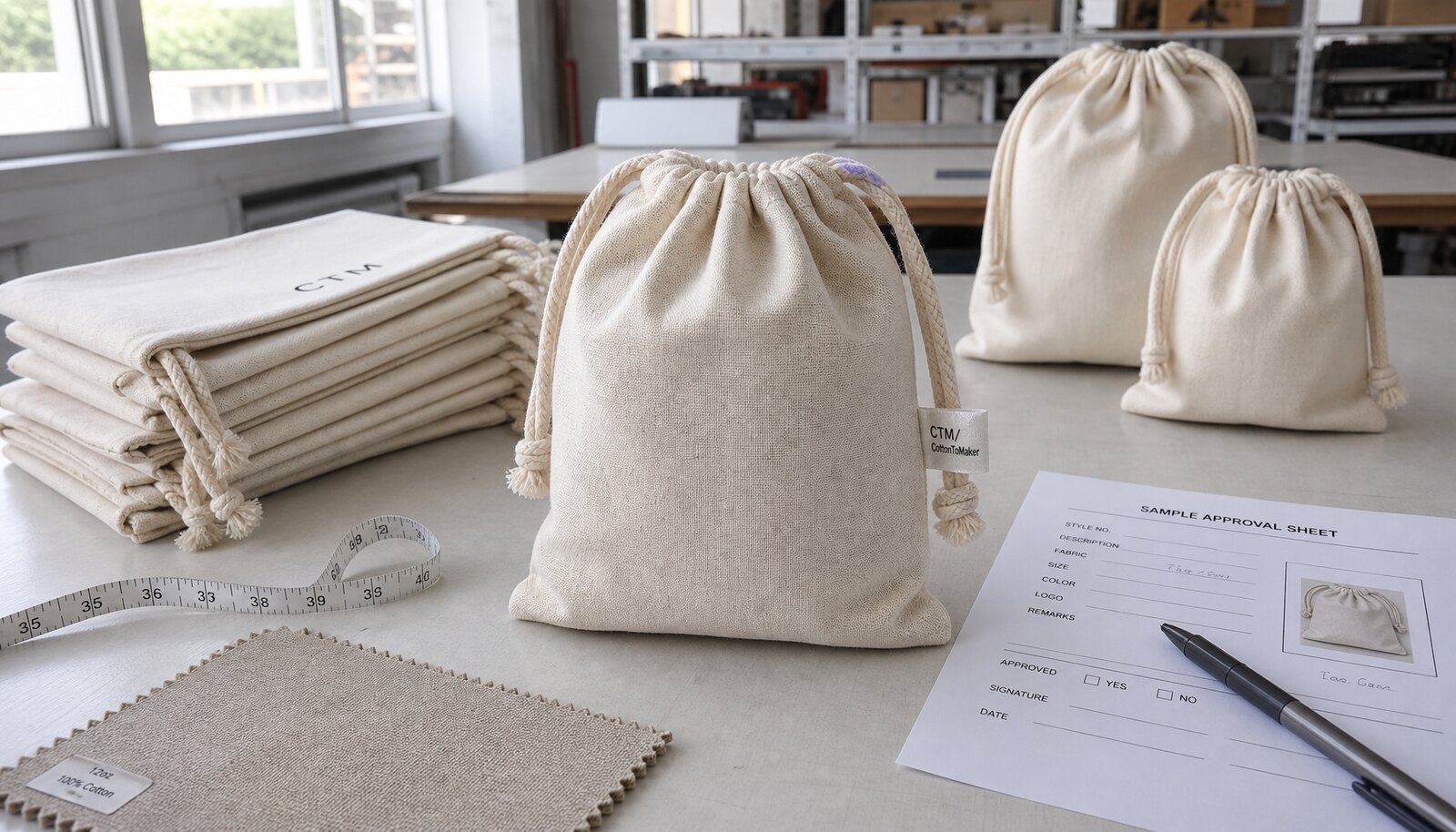
What gift-shop buyers actually need from a pouch
Cotton drawstring pouches look simple, but the buying decision is not simple. A gift shop is not only buying a container. It is buying shelf appearance, product protection, handling speed at checkout, and the impression a customer gets when they touch the bag. The wrong spec does not usually fail in the sample room. It fails later as a pouch that feels thin, closes badly, prints poorly, or arrives in cartons that need rework before store use.
The main procurement error is treating every cotton pouch as interchangeable. A pouch used only as inner packaging can be lighter, simpler, and packed in bulk. A pouch that sits on a shelf or ships as part of a gift set needs a cleaner handfeel, tighter seams, and a more deliberate closure. The buyer should decide whether the pouch is packaging, merchandising, or retail merchandise before anyone talks about price. That one decision controls fabric weight, closure strength, decoration, and packing.
- Price the sellable unit, not the sewing cost alone.
- Decide whether the pouch is hidden packaging or visible retail presentation.
- Freeze the spec before you compare supplier quotes.
Choose GSM and weave by use case, not by habit
GSM is the quickest way to move from vague sourcing to a real buying decision. For low-value inserts, event giveaways, and other packaging-only use cases, 100 to 120 GSM is usually enough. It keeps cost and freight low, but it can look thin when backlit or when the pouch is displayed empty. For most gift-shop retail programs, 140 to 160 GSM is the practical middle ground. It gives the pouch enough body to feel intentional and gives print a more stable surface. For premium sets, reusable pouches, or heavier contents, 180 to 220 GSM gives a denser handfeel and better structure.
Weave matters almost as much as weight. Plain weave is the default because it is predictable, easy to source, and easy to quote. Light twill can add a more refined look and can hide minor surface unevenness better than a loose plain weave. If the bag will be handled often, ask the factory for pre-shrunk or controlled-finish fabric and set a dimensional change limit of no more than 3 percent from the approved sample after conditioning. That keeps reorder lots from drifting too far from the first approval.
- 100 to 120 GSM: packaging inserts, short-run promos, low-value items.
- 140 to 160 GSM: standard gift-shop retail, best general-purpose range.
- 180 to 220 GSM: premium presentation, heavier contents, reusable pouches.
Construction details that separate sample quality from bulk quality
Two pouches can use the same cloth and still feel completely different because construction is where the quality shows up. The top channel should be wide enough for the cord to move freely without collapsing the opening. For a 3 to 4 mm cord, a practical channel width is usually in the 12 to 15 mm range, with bartacks at both ends so the channel does not tear under repeated pulls. If the pouch is gusseted, the gusset depth should be consistent on both sides and the corners should sit flat when filled.
Stitch density is another detail buyers should stop leaving vague. Standard pouches usually work well at 8 to 10 stitches per inch, while heavier or premium pouches benefit from 10 to 12 stitches per inch. The exact number matters less than consistency, but a loose seam on a cotton pouch is a visible defect and often a durability problem. Ask for trimmed thread ends, straight seam lines, and no puckering around the channel or corners. If the pouch will be opened and closed often, require reinforced channel ends and clean cord entry points so the opening does not distort over time.
- Flat pouches are cheaper and easier to pack.
- Gusseted pouches hold volume better and display more neatly.
- Bartacks and a properly sized channel prevent early seam failure.
Match decoration to artwork, not to what the factory prefers
Decoration should follow artwork complexity and reorder frequency. For most gift-shop programs, one- to three-color screen printing is the best balance of cost, clarity, and repeatability. It works well for logos, short copy, and simple seasonal graphics. The buyer should lock the ink count, print area, placement, and color reference before sample approval. Otherwise the factory may quietly simplify the art or change the print process to fit its own setup.
Embroidery, woven labels, and sewn patches are not interchangeable. Embroidery gives tactile value, but it adds cost and can distort a lightweight pouch if the stitch area is too dense. Woven labels and sewn patches work well when the body fabric should stay simple and the branding should remain consistent across rotating artwork. Heat transfer is useful for complex art and short runs, but it should be used intentionally because it can change the handfeel and may age differently from the fabric. In procurement terms, the question is not which decoration looks good in isolation. The question is which method is stable across reorders and matches the margin on the gift-shop shelf.
- Use screen print for simple logos and repeat replenishment.
- Use embroidery only when fabric weight can carry the stitch load.
- Use woven labels or patches when you want branding without heavy print setup.
Normalize supplier quotes before comparing price
A usable quote should describe the same object across vendors. That means the RFQ must specify fabric GSM, weave, finished size, seam allowance, cord type, decoration method, packing format, and the carton assumption. If a supplier leaves one of those out, it is not giving you a lower price. It is giving you a different product. This is why procurement teams get trapped by quotes that look close but are not comparable in practice. One supplier may be quoting a 120 GSM bulk-packed pouch, while another is quoting a 160 GSM pouch with a more controlled print and retail-ready inner packing.
You also need the quote to separate unit cost from setup cost. Print screens, artwork prep, dye work, labels, and sample fees should be visible. Freight matters too, because cotton pouches are light and can be pushed around by carton volume more than by material cost. Ask for carton dimensions and gross weight, not just unit price. A slightly higher unit cost can still be the better buy if the factory packs more efficiently, protects the print, and reduces receiving labor. The right comparison is landed cost per sellable pouch, not ex-factory price per piece.
- Force every supplier to quote the same fabric, size, print, and pack assumptions.
- Break out setup, sample, and tooling costs so they do not hide inside unit price.
- Compare carton dimensions and gross weight because freight can outweigh sewing differences.
MOQ, sampling, and change control without the boilerplate
MOQ is usually not one number. It changes with fabric availability, custom dye, print complexity, multiple sizes, and pack format. Stock natural fabric with one-color print will usually give the lowest entry point. Add custom dye, several print colors, woven labels, or size splits, and the minimum order rises because the factory must manage more fabric lots and more setup changes. That is not a sales tactic. It is the real cost of stopping and starting production across different materials.
Sampling should follow a strict sequence: size sample, print strike-off, then pre-production sample made with final fabric, final cord, final label, and final packing format. Do not approve a sample made with substitute materials and assume the bulk order will match. Once a sample is approved, treat any change to size, fabric, cord, print, or pack as a revision that needs a new sign-off. That discipline prevents the common failure mode where procurement thinks the order is fixed but the factory still believes it has room to substitute a cheaper detail.
- Lowest MOQ usually comes from stock fabric and one-color print.
- Custom dye, multiple SKUs, and special packaging lift MOQ quickly.
- No bulk release until the final-material pre-production sample is signed and dated.
Packing choices that change cost, handling, and shelf readiness
Packing format is a commercial decision, not a cosmetic one. Bulk packing keeps labor and material cost down and often works best for warehouse distribution, but it can leave the buyer with extra handling before store use. Individual polybags protect the print and keep the goods clean, yet they add cost, plastic, and pack labor. Inner bundles can be the best middle ground for retail programs because they keep units organized without forcing each pouch into a separate bag. The right answer depends on whether the retailer wants fast shelf setup or the distributor wants the lowest incoming cost.
Carton design deserves the same attention as fabric selection. Overfilled cartons crush the pouch body and bend the channel. Underfilled cartons let the contents shift and crease. A practical rule is to keep gross carton weight manageable for hand handling, then build the carton count around that target rather than around whatever number happens to fit on the sewing line. Carton marks should show SKU, size, color, and quantity clearly enough that the warehouse team does not need to open boxes to sort them. If the pouch is sold in a gift shop, packaging errors can create more labor than a fabric defect.
- Bulk pack is cheapest to ship and easiest to warehouse, but it creates more handling work later.
- Polybags protect print and cleanliness, but they add cost and can trap wrinkles.
- Use readable carton marks and exact counts so store teams do not sort mixed cartons by hand.
QC should be measurable, not just "good quality"
Quality control needs thresholds the factory can actually follow. For cotton drawstring pouches, the inspection plan should name the defect classes, the sample size, and the acceptance limit before production starts. Use ANSI/ASQ Z1.4 with AQL 2.5 for major defects and 4.0 for minor defects, and keep critical defects at zero tolerance. Pull samples randomly from at least 5 cartons and from different positions inside each carton so the inspection is not cherry-picked from the top layer.
The most useful physical checks are simple but specific. Measure finished size on laid-flat units and keep the tolerance within plus or minus 0.5 cm for pouches up to 20 cm and plus or minus 1.0 cm for larger sizes. Check GSM against the approved spec with cut-and-weigh or a matching test report, and keep it within plus or minus 5 percent. Confirm stitch density at 8 to 10 SPI for standard pouches and 10 to 12 SPI for heavier versions, with no open seams and no more than one skipped stitch on any seam line. For the closure, run 10 open-close cycles by hand and reject pouches that fray, tear, or jam.
- Use AQL 2.5 major and 4.0 minor, with zero tolerance for critical defects.
- Measure size, GSM, stitch density, and print position against the signed sample.
- If the pouch is reusable retail merchandise, add a wash or care test before approval.
Verify factory capability, compliance, and traceability
A supplier does not become safer because it says it is a factory. Ask which steps are truly in-house and which are subcontracted. Cutting, sewing, printing, embroidery, packing, and carton assembly may all happen in different places. If subcontracting exists, you need the actual production location, the QC owner, and the traceability method in writing. The answer should be clear enough that you can tell which lot came from which material batch and which line produced it. If the supplier cannot explain that, it does not have enough control for repeat retail orders.
The document request should match the market, but it should always be order-specific. For certified cotton, ask for a current scope certificate and an order-linked transaction record for the exact shipment. For restricted-substance or market-compliance requirements, ask for the test reports your market actually needs, not a generic bundle of paperwork. Also ask how the factory records incoming fabric lots, cut lots, and carton marks. A practical supplier can show you how the production lot links back to the fabric roll and forward to the packed carton. That traceability is what makes reorders and claims manageable.
- Ask for the in-house versus outsourced process map before you award the order.
- Tie any certificate or test report to the exact order and production lot.
- Require lot codes on the production record and carton marks so traceability survives shipping.
Choose the sourcing route for the program type
The right sourcing route depends on how stable the program is. If you are testing a seasonal gift idea, a stock natural pouch with a simple screen print and a straightforward bulk pack is the lowest-risk way to learn what sells. You get faster quoting, faster sampling, and fewer moving parts. If the item proves itself, then you can upgrade the fabric or packaging on the next round without changing the basic size and closure spec.
For an evergreen gift-shop program, repeatability matters more than chasing the lowest quote. A full-package factory is usually the cleanest answer because one party owns the fabric, sewing, print, and pack outcome. A sourcing trader only makes sense if the coordination value is real and the actual factory is named. Split sourcing can work for premium or certified fabric programs, but it adds lead time and QC points. The most stable strategy is often to keep the pouch body constant and rotate only the print or label. That keeps reorder comparisons simple and protects MOQ from ballooning every season.
- Test program: stock fabric, simple print, lower MOQ, faster feedback.
- Evergreen program: stable fabric source, repeatable QC, one accountable factory.
- Seasonal program: keep the pouch body fixed and change only the artwork or label.
Specification comparison for buyers
| Spec decision | Recommended option | When it fits | Buyer metric to lock | Cost or risk to check |
|---|---|---|---|---|
| Light promotional pouch | 100 to 120 GSM plain weave, 3 mm cord, flat body, one-color screen print | Short-run giveaways, inserts, or low-value items | Finished size tolerance, cord diameter, and bulk pack count | Looks thin under light and may feel flimsy on shelf |
| Core retail pouch | 140 to 160 GSM plain weave or light twill, 3 to 4 mm cord, 8 to 10 SPI, one-color print | Most gift-shop programs that need a clean retail feel | GSM tolerance within plus or minus 5 percent and closure test | Best value, but only if the sample matches the bulk fabric |
| Premium gift pouch | 180 to 220 GSM dense plain weave or twill, 4 to 5 mm cord, gusset if volume matters | Higher-priced sets, reusable pouches, or heavier contents | Stitch density, seam reinforcement, and shrinkage limit | Higher fabric cost and more carton volume per unit |
| Closure spec | Cotton or polyester cord with a smooth channel and bartacks at both ends | Any pouch that will be opened often or displayed filled | Cord diameter, channel width, and pull-cycle test | Too narrow a channel causes fray and poor closure |
| Decoration method | 1 to 3 spot-color screen print, woven label, or small sewn patch | Simple logos and repeat replenishment orders | Print position, color reference, and rub resistance | Complex art raises setup cost and approval risk |
| Pack format | Bulk pack for warehouse use, inner bundles for retail handling, polybag only when protection matters | Depends on distributor flow and shelf presentation | Inner count, carton marks, and barcode location | Polybag adds labor and material cost, bulk adds handling risk |
| Supplier route | Full-package factory for repeat orders, trader only when coordination value is real | When one party must own sewing, print, and packing | Named factory, production location, and QC owner | Hidden subcontracting can break traceability |
| Certified cotton route | Use certified material only with current scope and transaction paperwork | Premium sustainability-led programs or retailer requirements | Certificate scope, order-specific transaction records, and lot traceability | Paperwork is useless if not tied to the actual shipment |
Buyer checklist before sampling
- Define the end use first: packaging insert, retail pouch, or reusable gift item, because the right GSM and closure strength change with the contents.
- Set the finished size with a tolerance, not just a nominal number, so the factory cannot quietly ship undersized or oversized units.
- Choose the fabric weight and weave together: 100 to 120 GSM for low-cost packaging, 140 to 160 GSM for standard retail value, and 180 to 220 GSM for premium or heavier contents.
- Lock the cord diameter, cord material, channel width, and bartack requirement before quoting, since a weak closure creates returns and shelf complaints.
- Select the decoration method based on artwork complexity and reorder pattern, not on habit; simple logos usually belong on screen print or woven labels.
- Specify the pack format in detail: bulk, inner bundle count, polybag, carton count, carton marks, and barcode placement.
- Approve the final-material pre-production sample only, not a substitute sample made with different cloth or cord.
- Ask for the factory's in-house versus outsourced process map before placing the order, so traceability and QC ownership stay clear.
Factory quote questions to send
- What exact GSM, weave, finish, and shrinkage allowance are you quoting, and how do you measure it?
- What is the finished size tolerance, seam allowance, channel width, and cord diameter in the production sample?
- What is the MOQ per size, color, and print design, and which changes reset the minimum order?
- Which steps are in-house and which are subcontracted, including cutting, printing, embroidery, and packing?
- What print method are you pricing, how many colors are included, and what is setup versus unit cost?
- Can you provide the sample path in sequence, including size sample, print strike-off, and pre-production sample made with final materials?
- What packing format is included in the unit price, including inner counts, polybags, carton dimensions, and carton marks?
- What compliance, traceability, and test documents can you provide for the exact production lot, not just for the factory in general?
Quality-control points to confirm
- Use ANSI/ASQ Z1.4 normal inspection with AQL 2.5 for major defects and 4.0 for minor defects; critical defects should be zero tolerance. Pull samples randomly from at least 5 cartons and from top, middle, and bottom positions inside the cartons.
- Fabric GSM should stay within plus or minus 5 percent of the approved spec, verified by cut-and-weigh or a supplier lab report matched to the production lot.
- Finished dimensions should stay within plus or minus 0.5 cm for pouches up to 20 cm and plus or minus 1.0 cm for larger sizes, measured on laid-flat units.
- Stitching should be consistent at 8 to 10 stitches per inch for standard pouches and 10 to 12 stitches per inch for heavier or premium pouches, with no open seams and no more than 1 skipped stitch in any seam line.
- The closure should survive 10 open-close cycles by hand without channel tear, cord fray that reaches the sheath core, or knot slippage.
- Print placement should stay within 1.5 mm of the approved position for simple logos, with no visible cracking or flaking after a 10-rub tape test on a representative sample.
- Shade variation should not exceed the approved master sample when viewed under daylight; mixed dye lots in the same carton should be treated as a major defect unless approved in writing.
- Carton count must be exact, with no mixed SKUs, wrong labels, or missing barcodes. If the pouch is sold as reusable retail merchandise, add a 30 degree Celsius wash or equivalent care test on 3 samples before approving the artwork and fabric combination.