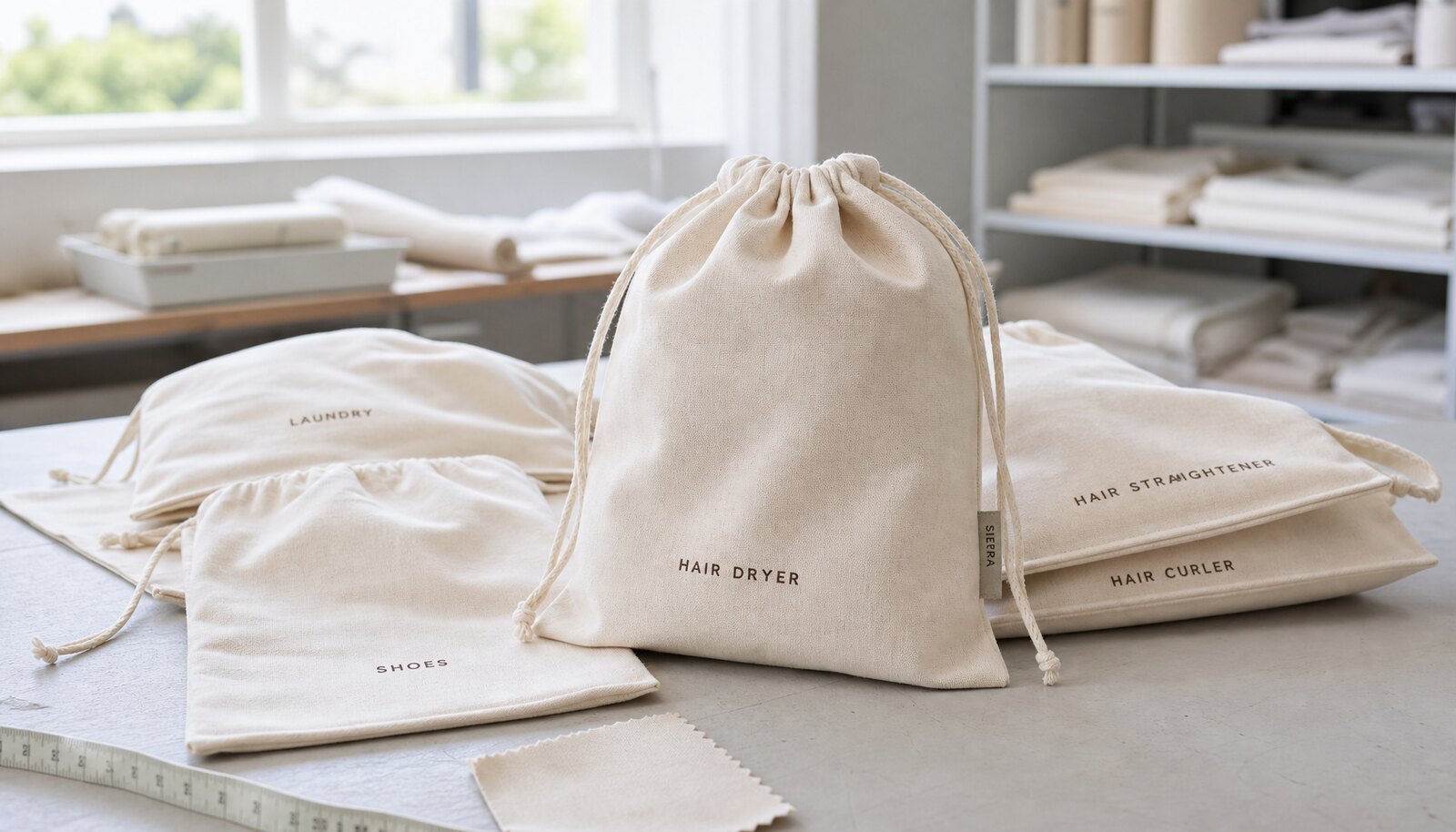
What hotel buyers are really buying
Gift drawstring pouches for hotels are not just small bags with a logo. They are a packaging decision that affects guest perception, housekeeping handling, and the cost of the entire amenity program. A pouch used for a welcome set has a different job from a pouch used for spa products, conference giveaways, or retail resale at the front desk. The right spec depends on whether the pouch will be opened once, handled daily by staff, or kept by the guest after checkout.
That is why the first mistake is to source from a visual reference only. A nice-looking pouch can still fail if the opening is too narrow, the fabric is too thin, the logo rubs off, or the packing format slows down hotel receiving. Build the spec around the contents first, then choose the fabric, closure, and print method that supports that use case.
- Light items like tea, soap, samples, and cards usually fit 100 to 120 gsm cotton.
- Heavier contents such as slippers, candles, or small bottles usually need 140 gsm or above.
- If the pouch is meant to be reused by guests, the seam finish and logo durability matter more than the lowest unit price.
- For housekeeping replenishment, bulk packing and clean carton labeling matter as much as appearance.
Choose the fabric weight before you choose the price
For hotel gift pouches, fabric weight drives the hand feel, opacity, and cost more than most buyers expect. A 100 gsm cotton pouch is usually enough for lightweight gifts and keeps the bag soft and flexible. A 120 gsm version gives a little more structure and better print appearance. Once you move into 140 to 180 gsm cotton or canvas, the pouch starts to feel more premium and holds shape better, but sewing time, fabric consumption, and freight weight all rise.
The actual choice should match the content and the expected perception at guest touchpoint. A luxury hotel welcome pouch with a printed logo can still look refined at 120 gsm if the sewing is clean and the fabric is well scoured. A pouch that carries heavier items or is meant to be kept as a souvenir should move up to canvas or a heavier plain-weave cotton so the cord channel, seams, and base do not distort.
- Use pre-shrunk fabric or request a wash test if steam or laundry exposure is likely.
- Ask for fabric width and yield because a narrow roll can change the cutting cost.
- Confirm whether the fabric is bleached, natural, or dyed, since color matching adds risk and lead time.
- If the pouch must look crisp on a hotel bed, ask the factory how it packs flat without creasing the logo area.
Branding choices that survive handling
For most hotel programs, one-color screen printing is the cleanest option because it keeps the logo readable and the cost predictable. It works well on natural cotton, bleached cotton, and canvas as long as the print area is flat and the curing is controlled. Multi-color artwork is possible, but every extra color increases setup time, registration risk, and the chance that the final print looks less sharp than the proof.
If the pouch is intended for a premium welcome kit or repeated guest-facing use, a woven side label or sewn patch can create a more durable brand cue than ink alone. That route works especially well when the hotel wants a restrained look and does not want a large logo printed across the front panel. Embroidery can also work on heavier fabric, but it adds cost and bulk, so it should be treated as a premium construction choice rather than the default.
- State the exact print size in millimeters, not just the logo artwork file.
- Keep the logo placement away from the cord channel so the image does not distort when the pouch is closed.
- Require a rub or tape test on the printed area before bulk approval.
- If the pouch will be folded repeatedly, avoid fragile metallic inks or overly thick print layers.
Compare supplier routes before you compare unit prices
The supplier route changes what the quote actually means. A direct factory quote can be the best value when the spec is stable, the volume is repeatable, and the buyer wants control over sewing and packing details. A trading company can be useful when the order includes other hotel items, when the buyer needs one contact for multiple factories, or when the internal team does not have time to manage production detail. A regional stockist may be the fastest route, but it is usually the least flexible on logo placement, size changes, and packing format.
For a hotel buyer, the right route depends on the risk you are trying to remove. If the priority is consistency across properties, direct factory sourcing usually gives the best control. If the priority is speed for a campaign or event, a stockist or local converter may be acceptable. The key is to compare each source on the same spec, same Incoterm, same packing, and same inspection standard so the cheap quote does not hide extra work elsewhere.
- Direct factory: best for repeat orders and tighter control of construction details.
- Trading company: useful for mixed procurement, but verify factory identity and quality oversight.
- Regional stockist: fast, but usually limited on customization and price leverage.
- Bag specialist factory: usually the safest route when seam quality and drawcord finishing matter.
Build a quote that can actually be compared
A usable quote for hotel gift pouches should break out the cost elements, not hide them inside one unit price. The buyer needs to see the fabric GSM, pouch size, cord type, print method, label type, packing format, and carton details. If the supplier only sends a single number, it is impossible to know whether they assumed a lighter fabric, a smaller logo, looser packing, or a different carton count.
The fastest way to make quotes comparable is to submit a spec sheet with fixed points and a few open items. Fix the finished size, the logo size, the target fabric weight, and the packing requirement. Leave room only where the buyer is willing to compare options, such as 100 gsm versus 120 gsm or screen print versus woven label. Then ask each supplier to quote the same target quantity, sample fee, lead time, and shipping term.
- Request separate lines for fabric, sewing, printing, label, packing, carton, and freight if freight is included.
- Ask for carton size, gross weight, and CBM so freight comparisons are not guesswork.
- Make the supplier state whether the quoted MOQ is by design, by color, or by total order.
- If artwork is involved, require a note on setup cost and how many color separations were included.
MOQ logic and the real cost drivers
MOQ is usually driven by fabric stock, print setup, and packaging complexity more than by the pouch shape itself. A natural cotton pouch with one-color print and bulk packing often carries the lowest MOQ because the factory can cut and sew from standard materials. Once the buyer asks for custom dyed fabric, multiple logo colors, special cord tips, or retail-ready individual packing, the MOQ climbs because the factory must manage extra material, setup, and line changeover.
Buyers should treat MOQ as a production efficiency question, not just a seller preference. If a hotel group is opening several properties, it can often reduce unit cost by keeping the pouch body the same and changing only a small label or insert card by property. That approach gives the factory one cutting plan and one sewing flow, which usually makes the pricing more stable and the timeline easier to manage.
- Fabric changes are usually more expensive than print changes.
- Extra logo colors and label versions can multiply setup cost even when the bag shape stays the same.
- Retail-style individual packing can add labor and carton volume quickly.
- If the buyer wants a lower MOQ, keeping to stock fabric and one print color is usually the cleanest tradeoff.
Sample approval should test more than appearance
A sample for hotel gift pouches should be judged like a production tool, not a display item. Ask for a material swatch or fabric hand sample first if the fabric choice is still open. Then request a pre-production sample that reflects the real size, cord, logo method, and packing style. For larger programs, a top-of-production sample or first-batch reference piece is worth keeping because it becomes the benchmark for the rest of the order.
The practical sample review is simple: compare the sample against the spec sheet, put the intended contents inside it, pull the cord repeatedly, and look at the print after light rub contact. If the pouch looks good but the cord jams, the logo sits too close to the seam, or the bag twists when filled, the sample is not ready. A small adjustment now is cheaper than sorting cartons after production starts.
- Set a size tolerance and do not approve a sample that only looks right by eye.
- Confirm print alignment and logo placement against a measured template.
- Test cord smoothness, seam strength, and the way the pouch closes when full.
- Review the sample under the same lighting where guests will see it, not only under studio light.
QC limits that prevent avoidable rejects
Quality control on drawstring pouches is mostly about consistency. Hotels do not want one pouch that sits neatly on the bed and another that looks twisted or undersized. A clear QC standard should cover dimensions, stitching, print clarity, cord function, odor, contamination, and carton labeling. For production control, AQL 2.5 for major defects and 4.0 for minor defects is a common starting point, but the buyer can tighten that if the logo is highly visible or the pouch is part of a premium set.
The most common failures are not dramatic. They are small but visible: slightly off-center logos, uneven seam allowances, weak cord knots, or pouches that vary enough to look inconsistent in a hotel set. Define what matters most before the order starts. For a guest-facing pouch, print placement and seam finish may matter more than tiny thread ends. For a housekeeping supply pouch, strength and correct count may matter more than cosmetic perfection.
- Reject holes, broken stitches, and missing cords as major defects.
- Treat logo misplacement, severe color mismatch, and distorted shape as major defects.
- Record the acceptable tolerance for size variance and print shift in writing.
- Ask for in-line photos and final inspection photos before the shipment is released.
Packing for hotel operations, not retail shelves
Hotels usually want practical packing, not fancy retail presentation. Bulk packing into clear polybags and master cartons is often the best choice because it lets housekeeping or purchasing count quickly and store cleanly. If the pouch is part of a gift set, individual packing can make sense, but it should be specified deliberately because it adds labor, material, and carton volume. A quote that ignores packing details is not complete because packing affects both handling and freight.
Carton marks matter more than many buyers expect. A hotel receiving team needs to see product code, size, color, quantity per carton, and gross weight without opening every box. If the pouches are being shipped by sea, request a moisture-aware packing approach and confirm whether desiccant is needed. If the pouches are compressed too tightly, the drawcord can crease or the logo area can flatten in a way that looks poor when opened.
- Specify exact units per polybag and per master carton.
- Request carton labels that match the purchase order and SKU structure.
- If multiple hotel properties are included, separate them clearly by carton mark.
- Avoid strong-smell packing materials because guest-facing products should arrive neutral.
Lead time and landed cost are where the order is won or lost
Lead time should be broken into sample approval, material booking, production, inspection, and shipping handoff. A supplier that says 20 days without explaining whether that excludes sample signoff is not giving a usable schedule. The schedule becomes more fragile when the order uses custom dyed fabric, multiple logo versions, or a new carton size. Add extra time if the purchase falls near peak manufacturing periods or holiday shutdowns.
Landed cost should be the final comparison point, not unit price alone. The real number includes the pouch price, setup charges, sample cost, packaging, carton cost, inland freight, ocean or air freight, duty, inspection, and a small buffer for variation. Two quotes can look close at the factory door and still diverge sharply after freight and packaging are added. Compare them only after the same Incoterm, the same carton count, and the same inspection standard are in place.
- Freeze artwork early so print approval does not push the sewing schedule.
- Approve fabric and color before cutting full production.
- Keep one backup option for cord color or label style if stock tightens.
- Ask for estimated carton dimensions before you commit to freight booking.
Specification comparison for buyers
| Spec decision | Recommended option | When it fits | Buyer risk to check |
|---|---|---|---|
| Sourcing route | Direct factory for the pouch and print process | Repeat hotel programs, stable artwork, and volume that justifies a dedicated run | Verify the factory really cuts, sews, prints, and packs in-house; some sellers only trade the order |
| Sourcing route | Trading company or sourcing agent | Mixed hotel packages, multi-item consolidation, or buyers who need one contact for several factories | Ask for the actual maker, inspection access, and whether any markup is hidden in freight or packing |
| Fabric weight | 100 to 120 gsm cotton | Light gift items, amenity sets, and low-cost room drops where the pouch should feel simple but neat | Check for see-through fabric, weaker hand feel, and shrinkage after steam or ironing |
| Fabric weight | 140 to 180 gsm cotton or canvas | Premium hotel gifts, heavier contents, and programs where the pouch is kept by the guest | Confirm the extra cost, seam strength, and whether the fabric stays flat after pressing |
| Branding method | One-color screen print | Most hotel logos, medium volumes, and natural fabric where a clean front logo is enough | Require ink cure and rub resistance; weak curing leads to cracking or smudging |
| Branding method | Woven side label or sewn patch | Guest-facing premium sets and repeated programs that need a sharper brand cue | Check label hand feel, edge finish, stitch alignment, and whether it adds bulk inside the pouch |
| Supplier type | Bag specialist factory | When pouch construction, cord finish, and packing consistency matter more than lowest headline price | Request sample photos of inside seams, cord channels, and carton packing before you compare quotes |
| Packing route | Bulk polybag and master carton | Hotel operations, housekeeping replenishment, and B2B gift distribution | Specify exact count per bag and carton; wrong pack counts create receiving delays and rework |
Buyer checklist before sampling
- Confirm the pouch use case: welcome gift, room amenity, conference kit, spa set, or resale item.
- Lock the finished size, allowable tolerance, and the contents that must fit without bulging.
- Specify fabric type, GSM, color, and whether the fabric must be pre-shrunk or lightly washed.
- Define the closure style, cord diameter, cord end finish, and whether the pouch needs a hanging loop.
- Send vector logo art, print placement, print size, and one-color or multi-color assumptions.
- State packing format, carton count, carton marks, and whether individual polybags are required.
- Set the inspection standard, defect limits, and whether a pre-production sample is mandatory.
- Ask for quoted lead time by stage: sample, material booking, production, inspection, and shipping handoff.
Factory quote questions to send
- What is included in the unit price: fabric, cutting, sewing, drawcord, print, label, packing, and cartons?
- What fabric GSM and width are you quoting, and what tolerance do you allow on shrinkage or color variation?
- How many logo colors, screens, or setup charges are assumed in this quote?
- What is the MOQ by color, by artwork version, and by packing style?
- Can you quote sample cost, sample lead time, and whether the sample cost is refundable against order?
- What are the finished size, carton size, gross weight, and CBM for the quoted version?
- Which Incoterm is used, from which port, and how long is the quotation valid?
- What inspection report, in-line photo set, or pre-shipment check do you include before dispatch?
Quality-control points to confirm
- Measure finished size after pressing, not before, and define a realistic tolerance for the pouch dimensions.
- Inspect stitch density, seam straightness, and reinforcement at the cord channel and bottom corners.
- Run the drawcord several times to confirm smooth movement, no snags, and no loose knots or frayed ends.
- Check logo placement, print sharpness, and color consistency under normal indoor light and daylight.
- Rub-test the print or label area to catch weak curing, peeling, or ink transfer before shipment.
- Open a random carton to check odor, dust, stain, moisture, and correct quantity packing.
- Verify carton marks, SKU labels, and packing counts against the purchase order before goods leave the factory.
- Use a clear defect definition for major issues such as holes, broken stitches, misprints, or wrong size, and minor issues such as uneven fold or slight thread ends.