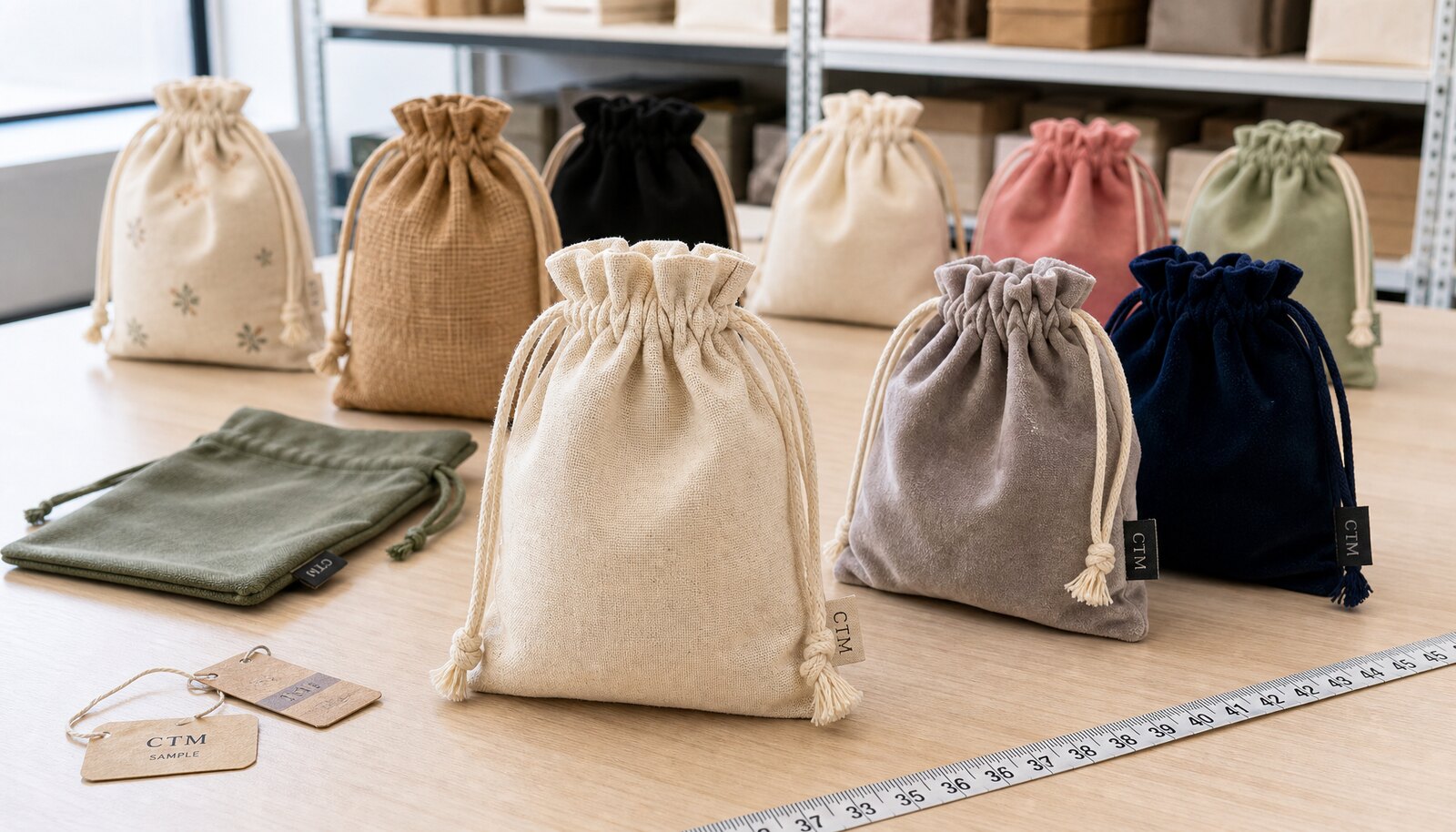
1) Why event buyers should spec gift drawstring pouches by use case, not by category
Gift drawstring pouches for events are often purchased as a line item, but they behave like a packaging component, a brand carrier, and sometimes a reusable keep item all at once. The right spec depends on what goes inside, how the bag will be handled, and whether the pouch needs to look premium enough to keep after the event. A conference sponsor pouch that holds a notebook, pen, and charger has very different needs from a jewelry pouch handed out with a small presentation box.
Procurement teams usually get better results when they start with the contents and the handling path. Will the pouch be packed in advance at a warehouse? Will it be filled on-site by staff? Will guests carry it home in a tote or airline luggage? Those questions matter because the pouch must be easy to open, easy to close, and durable enough for the actual journey. A nice-looking pouch that tears at the channel or shows the contents through thin fabric will create a bigger perception problem than many buyers expect.
It helps to classify the order into one of three use cases. First is presentation packaging, where the pouch mainly improves the unboxing moment. Second is protective packaging, where the pouch has to reduce scratching, dust, or minor impact. Third is reusable merchandise, where the pouch becomes part of the guest’s post-event use. Those three categories lead to different GSM targets, stitch requirements, and print expectations. The same artwork can work across all three, but the construction usually should not.
For procurement, that means the spec sheet should start with function. Once the function is clear, the sourcing team can decide whether cotton, muslin, jute, velvet, or nonwoven PP makes sense, and whether the pouch needs a label, a screen print, or no decoration at all. This approach also makes vendor comparison simpler because each quote can be measured against the same end use instead of a loose description like “premium event pouch.”
- Define the pouch job first: presentation, protection, or reuse.
- Measure the actual filled item before you choose pouch dimensions.
- Treat event handling and transit as part of the product spec, not an afterthought.
2) Material selection: how fabric, density, and finish change the buyer outcome
The material choice has the largest effect on how the pouch feels in hand and how consistently it can be made. Cotton muslin is often the default because it prints cleanly, folds well, and is easy for factories to sew at scale. For many event programs, it offers the best balance between price, appearance, and repeatability. Heavier cotton or cotton canvas gives more structure and a less transparent look, which helps when the gift has a hard edge or when the customer will inspect the pouch before opening it.
For buyers comparing fabric quotes, a single GSM number is not enough unless the fabric type is the same. A 120 gsm muslin and a 120 gsm canvas do not behave the same way in the factory or in the hand. Ask suppliers to confirm the fabric composition, weave or construction, measured weight, and any finishing process. If the material is dyed, ask how shade consistency is managed from lot to lot and whether the factory uses a reference swatch or lab dip approval. These details matter more than a round number on the quote.
Jute and other textured natural materials are common for rustic or eco-positioned events. They can work well for a kraft-paper aesthetic or for gifting themes that want a raw, earthy look. The tradeoff is that the surface is less forgiving. Fine text, thin lines, and multi-color artwork are harder to reproduce cleanly. Jute also tends to feel more abrasive than cotton, so it is a better fit for sturdy contents than for delicate cosmetics, accessories, or polished surfaces that could be marked by rough fibers.
Velvet or velvet-like fabrics are usually used when the pouch itself needs to feel like part of the gift. They can elevate small jewelry, bottle, or keepsake programs, but they require careful handling because pile direction, crush marks, and shading differences show up easily. Nonwoven PP can be attractive on cost and can be useful for large volume promotional programs, but it is usually less premium in feel and may not meet the expectations of buyers who want a fabric hand-feel. In other words, the material selection should follow the event’s positioning, not only the target unit price.
- Cotton muslin: the most flexible option for most event programs and easiest to print.
- Heavier cotton or canvas: better structure and less transparency, especially for hard-edged gifts.
- Jute: stronger visual texture, but less suitable for fine artwork and soft-touch presentation.
- Velvet: premium feel with higher sensitivity to pile crush and shade variation.
- Nonwoven PP: useful for lower-cost promotions, but not ideal when hand-feel is part of the brand experience.
3) Size, shape, and closure: the details that prevent packing problems
The best pouch size is based on the real product dimensions after any outer box, wrap, or filler has been added. Buyers often estimate by gift category and end up with a pouch that is either too tight or too loose. Too tight creates packing delays and can distort seams when the item is inserted. Too loose wastes fabric, increases freight volume, and makes the event set look less considered. A practical rule is to allow enough clearance for easy insertion and closure, then test the fit with the actual item before approving the production size.
Shape matters too. A flat pouch is efficient for slim items like cards, tea sachets, small cosmetics, or jewelry. A gusset or slightly deeper body helps when the contents are boxy or irregular. If the gift has a hard corner, the buyer should pay close attention to whether the pouch bottom has enough reinforcement to avoid seam strain. Small changes in shape can have a large effect on line efficiency, especially when the same pouch is packed hundreds or thousands of times at an event warehouse.
Closure style is often treated as decorative, but it directly affects usability and perceived quality. Single drawstring versions are acceptable for simple, low-cost gifting, but the pull can feel uneven if the cord channel is not reinforced. Double drawstring versions usually close more evenly and look more balanced on the shelf or in the hand. Ribbon ties can be visually attractive but are slower for staff to close. Cord locks and other hardware improve control but add parts, cost, and potential supply variability. For procurement, the right question is not which closure looks best in a mockup, but which one supports your packing speed and presentation target with the least operational risk.
When the pouch will be reused, the closure should be tested multiple times rather than just once. A pouch that closes well on the first pull but frays after repeated use may pass a photo review and still fail in the field. Ask the supplier to show the exact channel construction, cord exit point, and reinforcement at the stress areas. If the drawstring is expected to carry repeated opening and closing, that is a real wear point and should be reviewed like any other functional component.
- Size the pouch to the actual packed item, not the product category label.
- Test pouch geometry with the real gift and any insert or filler.
- Use double drawstring and reinforced channel for a cleaner close and better durability.
- Consider gusset or deeper body construction for harder, boxier contents.
4) Print and decoration methods: matching artwork to the material
The most efficient pouch decoration is the one that matches the artwork complexity and the fabric surface. For simple event branding, one-color or two-color screen printing is usually the most procurement-friendly option because it is repeatable, comparatively durable, and easy to quote. It is also easier to keep consistent across reorders when the artwork does not change. The main limitation is that the design needs to stay clean and legible without relying on gradients, tiny type, or photographic detail.
Heat transfer can be a useful alternative for shorter runs or artwork that needs finer detail, but it should be tested on the exact material planned for production. Some fabrics show edge lift, a glossy patch, or poor flex performance after transfer. That is especially relevant for fabrics that wrinkle, have a strong weave texture, or are used in high-touch event settings. For procurement, heat transfer should not be assumed to work because it looked fine on a sample. It should be rubbed, folded, and checked for adhesion before the bulk order is released.
Embroidery adds texture and a more premium feel, but small pouches are not always the best canvas for it. Dense stitching can pull the fabric, reduce opening flexibility, and add cost quickly. On fine muslin or lightweight cotton, the stitch density has to be controlled carefully to avoid puckering. In many cases, a woven label or a sewn-on side label gives a cleaner result than embroidery, especially if the pouch surface is textured or the logo is small. That makes labels a smart option when the buyer wants branding without overloading the fabric with dense thread work.
Other decoration methods can make sense in specific cases. Foil or deboss styling is more relevant to velvet-like or specialty surfaces. A plain pouch with a branded hangtag may also be the best choice when the pouch is secondary to the gift itself. The procurement point is simple: choose the decoration process based on reproducibility, not just the mockup photo. If the artwork is too small for the chosen method, the supplier should say so before sampling rather than after production starts.
- Screen print works well for simple logos and stable repeat orders.
- Heat transfer can handle more detail, but must be tested on the actual fabric.
- Embroidery is premium-looking but can pucker small or lightweight panels.
- Woven labels are often the safest branding option on textured or uneven materials.
5) Comparison table buyers can actually use: material, closure, and print tradeoffs
A procurement-grade comparison should show the real tradeoffs between appearance, cost, production risk, and repeatability. Event teams often want a pouch that looks premium, ships safely, and stays within budget, but those goals do not line up perfectly on every material. The table below is meant to help buyers narrow the spec before they enter the RFQ stage.
If your program is a seasonal event with a fixed date, prioritize material consistency and fewer setup variables. If the event is a high-visibility launch or sponsor package, prioritize appearance, print clarity, and sample approval discipline. The more complex the artwork or multi-SKU mix, the more important it becomes to choose a material and closure that your supplier has already produced at scale.
6) MOQ, lead time, and price: where generic quotes mislead buyers
MOQ and lead time are often quoted as if they were fixed facts, but in practice they depend on material availability, color complexity, size changes, and the decoration method. A factory may be able to sew a simple cotton muslin pouch in a shorter window than a velvet or embroidered version because the latter needs more process control and more inspection. Similarly, a single-size, single-color pouch is easier to plan than a mixed event set with multiple pouch sizes and brand variations. Buyers should ask for MOQ by each variable, not just one overall number.
Lead time should be read as a chain of steps: sample approval, material booking, printing or embroidery prep, sewing, finishing, inspection, and packing. A supplier who says production takes 25 to 40 days is giving a range, not a promise. The actual number depends on whether materials are in stock, whether the artwork is finalized, and whether the factory has capacity during the event season. Ask the supplier to split lead time into sample days and bulk production days, then ask what triggers delay. That will tell you more than the headline number alone.
Price comparison also needs more discipline than many RFQs get. Two factories may quote the same unit price, but one uses heavier fabric, better stitching, and cleaner packing while the other quotes a thinner base cloth and bulk loose packing. Another supplier may quote a lower ex-factory price but charge separately for screens, labels, barcode stickers, or special carton marks. For procurement, the more useful question is: what does the finished, packed, and shipped pouch actually cost once the event team receives it? That is where landed cost matters.
Seasonal demand matters too. Event pouches are often ordered before conferences, holidays, launches, trade fairs, wedding seasons, or corporate roadshows. A factory that is efficient in off-peak months may slow down when the line is full. Buyers can reduce that risk by freezing artwork early, approving samples fast, and clarifying whether any color or label substitutions are allowed. If the event date is non-negotiable, the order should be planned as if schedule risk is a cost element, not a separate problem.
- Ask for MOQ by size, color, print method, and packing format.
- Split lead time into sampling, material booking, sewing, finishing, and packing.
- Compare landed cost, not just ex-factory unit price.
- Treat event season capacity as part of the commercial risk.
7) Supplier vetting hierarchy: how to choose a source beyond the first quote
For event procurement, supplier selection should follow a simple hierarchy. First, confirm that the supplier is real and capable of making the pouch you need. Second, determine whether they control the sewing and finishing in-house or are managing the work through a downstream partner. Third, check whether their documentation and QC practices are strong enough to support your order size and timeline. This is more useful than simply asking whether they are a factory or a trading company.
Start with legal and traceability checks. Ask for the business registration, factory address, and a company profile that matches the contact name on the quote. If the supplier says they are a factory, look for evidence of actual sewing capability: production-line photos, sample room photos, cutting and finishing area photos, and recent product images that are consistent with the exact material and construction you need. If they are a trading company, ask which factory will make the goods and whether you can see the upstream source documents or at least the production photos. The goal is not to exclude trading companies automatically; it is to understand the real production chain.
Then check their document readiness. A supplier handling procurement-grade orders should be able to provide a clear spec sheet, signed sample confirmation, basic QC records, carton details, and, where relevant, any test reports or certification claims they are using in their marketing. If a supplier mentions organic cotton, recycled content, azo-free dye claims, or other material claims, ask for the exact supporting document and scope. Buyers should not rely on broad statements like “eco-friendly” without asking what that means in the actual material and process.
Finally, verify whether the supplier understands event-driven packaging. This means asking how they handle carton markings, mixed SKUs, count accuracy, and packing photos before shipment. A supplier who can discuss these basics clearly is usually better prepared than one who only talks about a low unit price. In many orders, documentation quality is the easiest way to separate a reliable source from a risky one before you commit to bulk.
- Check business registration, factory address, and source-of-truth contact details.
- Verify actual production capability with line photos, sample-room photos, and recent batch photos.
- Ask for the upstream factory if a trading company is quoting the order.
- Request proof for any material or sustainability claims, not just marketing language.
- Review whether the supplier can handle carton marks, SKUs, and pre-shipment photo records cleanly.
8) Sample approval and QC: what to inspect before you release bulk
The sample is not a formality; it is the control point for the whole order. A pouch sample should be approved only when the material, size, closure, sewing structure, and decoration process all match what will be made in production. If the supplier makes a hand sample with nicer cloth or a different print technique, that sample cannot be treated as a reliable reference. Keep the approved sample sealed and signed so incoming inspection has something concrete to compare against.
Before bulk production, review the sample under the same conditions it will face in use. Insert the actual gift, pull the drawstring several times, check how the pouch sits when partially filled, and make sure the print or label remains centered after handling. Examine seam ends, channel stitching, and any areas where the cord exits the pouch. A good-looking sample that fails under normal handling is not an approved sample; it is a warning sign.
For production QC, the buyer should define the inspection plan in advance. Use a recognized AQL standard or an internal buyer standard and say whether inspection happens during pre-production, in-line, or at final random inspection. Many event buyers skip this and only inspect at the receiving dock, when rework options are limited. It is better to define major and minor defects early: broken seam, wrong size, print misalignment, wrong color, wrong cord, missing label, dirty mark, or carton count error. Once these categories are set, the supplier knows exactly what will trigger rework or rejection.
The best inspection checklist is specific. For stitching, confirm stitch count consistency and seam strength at the corners and drawstring channel. For print, verify the center position, color match, no bleeding, and no cracking after flexing. For color, use an approved reference under consistent lighting and allow a documented tolerance. For packaging, count the pieces per bag and per carton, confirm labels, and check whether the cartons are clean, dry, and not crushed. If the event is shipping by sea or moving through multiple warehouses, ask for carton compression or drop checks on representative packed cartons. That is the simplest way to catch packaging failures before the goods reach the event team.
There is also a practical receiving check that buyers should not skip. When the shipment arrives, open a sample from several cartons, not just the top carton, because shade and packing issues often appear in the middle of a batch. Compare the goods with the sealed approved sample and check whether the first carton and the last carton look the same. This protects the buyer from hidden variation that can happen when multiple sewing lines or packing shifts are involved.
- Approve a sample only if the final material and process are the same as bulk production.
- Keep a sealed master sample for incoming comparison.
- Define major and minor defects before production starts.
- Inspect size, stitching, print, color, and packing separately.
- Add carton compression or drop checks when shipping conditions are rough or long-distance.
9) Packaging, freight, and receiving: the part of the order that often gets underpriced
Packaging is not just a logistics detail; it can change the customer experience and the freight bill at the same time. If the pouches are going into a retail channel or event-kit assembly line, the packaging format needs to support fast counting and clear identification. Inner polybags by size or color reduce confusion at receiving and lower the chance of mixing versions. Carton labels should show the PO number, item code, size, color, and quantity so the warehouse can reconcile the shipment quickly.
Freight planning should be done with the packed carton, not the loose pouch. A lightweight pouch may compress well, but over-compression can damage print, flatten pile fabric, or make the pouch look wrinkled when it is opened. Ask the factory for gross weight, carton dimensions, and the expected carton count per pallet if palletized. This gives your forwarder enough information to estimate volume and cost accurately and prevents surprise charges later.
If the pouches are going by sea, the cartons need enough integrity to survive stacking, handling, and transit vibration. If they are moving by air, weight becomes more important and over-packaging can make the shipment unnecessarily expensive. Buyers should also think about receiving conditions at destination. A warehouse team may not have time to sort mixed sizes or count loose bags one by one. That is why the packing plan should match the receiving workflow, not just the factory’s easiest packing method.
One practical rule: the more event versions you have, the more disciplined your packing must be. If there are multiple colors, pouch sizes, or logo versions in the same campaign, the supplier should label them clearly and provide a packing list that mirrors the carton marks. That simple step reduces receiving errors and saves time when the event team needs to stage goods quickly.
- Use inner bag, carton marks, and packing list structure that matches warehouse receiving.
- Confirm gross weight and carton size before freight booking.
- Avoid over-compression on textured or printed pouches.
- Match packing complexity to the number of SKU variants in the event program.
10) RFQ structure, decision tree, and FAQ for procurement teams
A clean RFQ makes sourcing faster and makes the supplier quote easier to compare. At minimum, include the pouch purpose, exact gift dimensions, target quantity, event date, preferred material, approximate fabric weight or thickness, closure style, logo artwork, print method, packing format, and delivery terms. If there are multiple event tiers, list them as separate line items. A supplier can only quote reliably when the program structure is clear; otherwise, they will build in risk or return a price that is hard to defend later.
A simple decision tree helps buyers choose the right pouch fast. If the gift is small and flat and the event is cost-sensitive, a cotton muslin pouch with one-color screen print and bulk packing is usually enough. If the gift is premium or reusable, move to a heavier cotton or canvas with double drawstring and reinforced channel. If the event has a luxury feel or needs a special tactile experience, look at velvet-like material or a woven-label solution, but ask for a sample because these materials are more sensitive to handling and compression. If the artwork is complex, test whether the design still works after reducing line thickness and removing tiny details.
The last step is to document the acceptance criteria in plain language. That means writing down the approved reference, size tolerance, print placement tolerance, acceptable shade range, stitching expectations, packaging count, and who signs off on the final sample. When those points are fixed, the sourcing team is not guessing at inspection time. It also helps the supplier price the order correctly because they know how much control is expected.
For buyers managing events with hard deadlines, a disciplined RFQ is one of the quickest ways to reduce risk. It removes ambiguity, limits rework, and creates a clearer basis for supplier comparison. More importantly, it turns gift drawstring pouches for events from a generic commodity request into a controlled packaging specification that can be sourced, checked, and received without last-minute surprises.
- Include purpose, gift dimensions, quantity, date, material, closure, artwork, packing, and delivery terms in one RFQ.
- Use a simple decision tree to match spec to event value and handling needs.
- Write acceptance criteria into the RFQ so sample approval and bulk inspection use the same yardstick.
Specification comparison for buyers
| Spec decision | Recommended options | When it fits | Buyer tradeoffs to check |
|---|---|---|---|
| Fabric base | Cotton muslin, cotton canvas, jute, velvet, or nonwoven PP | Choose by event feel, gift weight, print detail, and reuse expectation | Cotton/muslin print well but can wrinkle; jute looks premium-rustic but is rougher and less forgiving for fine logos; velvet feels premium but shows pile marks and shade variation; nonwoven is cost-efficient but less premium in hand-feel |
| Fabric weight / density | Cotton or muslin often quoted around 90-150 gsm; canvas and heavier cotton above that; nonwoven by grams per square meter and thickness | Budget promo, reusable gift bag, or premium presentation can each sit in a different range | Do not compare GSM alone across fabric types; a 120 gsm muslin is not equivalent to a 120 gsm woven canvas. Ask for measured finished fabric weight, yarn count, or material thickness parameters where relevant |
| Closure variant | Single drawstring, double drawstring, reinforced channel, flat ribbon tie, or cord lock | Use double drawstring and reinforced channel for higher-end gifting and frequent handling | Single cords are cheaper but can feel less balanced when closed; ribbon ties look decorative but are slower to pack; cord locks add parts and cost but improve repeat opening |
| Print or decoration method | 1-color or 2-color screen print, heat transfer, embroidery, woven label, deboss/foil on velvet, or plain no-print | Match to logo complexity and event positioning | Screen print is durable and economical for simple artwork; heat transfer suits short runs and more detail but needs fabric testing; embroidery adds texture but can pucker small panels; woven labels reduce risk when the pouch surface is uneven or textured |
| Size strategy | Standard sizes for jewelry, cosmetics, candles, tea, or custom fit by actual gift dimensions | Use a custom size when the gift is high-value or oddly shaped | Oversizing increases fabric cost and carton volume; undersizing causes bulging, poor closure, or damaged contents |
| Supplier route | Direct factory, qualified trading company, or local decorator with verified upstream sewing source | Direct factory is usually best for repeat orders and tighter QC control | A trading company may bundle items but can reduce visibility into the real sewing line; local decorators may be faster but may not control base fabric or stitching quality |
| Packing format | Bulk packing, inner polybag by size/color, barcode label, carton marks, or retail-ready insert card | Use retail-ready or event warehouse-friendly packing when distribution is complex | Loose mixed packing lowers efficiency and raises counting errors; over-compression can crease print or flatten texture |
| Commercial terms to clarify | Sample fee, tool/screen fee, deposit, balance timing, Incoterms, and repeat-order pricing | Best practice for procurement comparison and cost control | A low unit price can hide setup charges, packaging surcharges, or higher freight weight; compare landed cost, not only ex-factory price |
Buyer checklist before sampling
- Measure the actual gift in its final packed form, including any box, filler, or wrap, before choosing pouch size.
- Write down the intended use: presentation only, reusable keepsake, or protective packaging, because that changes fabric, closure, and QC.
- Request material details beyond the general fabric name: composition, GSM or thickness, yarn count where applicable, and color standard.
- Confirm logo method, artwork size, and the smallest text or line thickness that can reproduce cleanly.
- Ask for a pre-production sample made with the same fabric, string, stitch construction, and print process planned for mass production.
- Specify size tolerance, print placement tolerance, color tolerance, stitch quality, and packaging count on the PO or spec sheet.
- Ask the supplier for carton dimensions, gross weight, pallet plan if applicable, and whether the cartons pass compression expectations for sea freight.
- Compare at least two sourcing routes: direct factory and one alternative supplier type, so you can benchmark cost and documentation quality.
- Before approving bulk, verify supplier documents: business license, factory address, recent product photos, material declarations, and any certification claims that support the program.
- Set an inspection plan before production starts, including AQL level, sampling stage, defect classification, and who pays for rework if the batch misses spec.
Factory quote questions to send
- What is the exact fabric composition, construction, and measured fabric weight or thickness for this pouch, and can you share a specification sheet rather than a generic description?
- What closure style are you quoting, and what is the difference in cost, lead time, and defect risk between single drawstring, double drawstring, and reinforced channel versions?
- Which decoration method are you quoting for this artwork, and what are the limits on color count, line thickness, and repeat-order cost?
- Please quote the same pouch with and without polybag, barcode sticker, insert card, and carton marking so we can compare true landed cost.
- What is the MOQ by size, color, print version, and packing format, and what changes if we consolidate several event SKUs in one order?
- Can you confirm the sample will match the final production material and process, or note any provisional elements that are not yet locked?
- What inspection standard do you normally apply in production, and can you accept our AQL target and defect list in writing?
- What are the finished size tolerance, stitch tolerance, and color tolerance you can hold consistently across the batch?
- What is the expected gross weight per carton and carton size, and do you have a packaging plan that avoids crushing print or pile texture during transit?
- Can you share photos of a current or recent production batch with the same fabric and print method, plus the production-line QC photos, not just a studio sample image?
Quality-control points to confirm
- Incoming material check: verify fabric composition, weight/thickness, shade, width, and accessory quality before cutting starts; do not wait for sewn goods to discover the wrong material.
- Cutting control: check pattern alignment, grain direction, panel size, and symmetry so the pouch hangs evenly when filled.
- Sewing quality: inspect seam straightness, seam allowance, side seam strength, bottom seam closure, and drawstring channel construction; look for skipped stitches, seam puckering, and loose ends longer than the approved limit.
- Stitch density and consistency: confirm stitch count per inch or per 3 cm is stable across the batch, especially at stress points around the channel, corners, and drawstring exits.
- Print quality: verify alignment, color density, edge sharpness, no bleeding, no cracking after flexing, and no unwanted shine or transfer marks; compare against the approved master sample under daylight-equivalent lighting.
- Color control: define acceptable color tolerance before production, ideally against an approved physical standard or Pantone reference where the fabric and print process allow it; inspect cartons from different sewing lines for shade drift.
- Functional test: open and close each sampled pouch several times to check drawstring glide, friction, snagging, and whether the pouch remains balanced when pulled closed.
- Fit test: place the actual gift item inside and verify clearance, closure performance, and whether the pouch shape distorts unacceptably when full.
- Packaging audit: count pieces per inner bag and per carton, check label accuracy, verify carton marks, and inspect whether cartons are clean, dry, and free from corner crush.
- Transport-related checks: perform carton compression and drop checks on representative packed cartons when the shipment will move by sea, long-distance truck, or multiple handoffs; confirm contents do not burst seams or shift excessively.