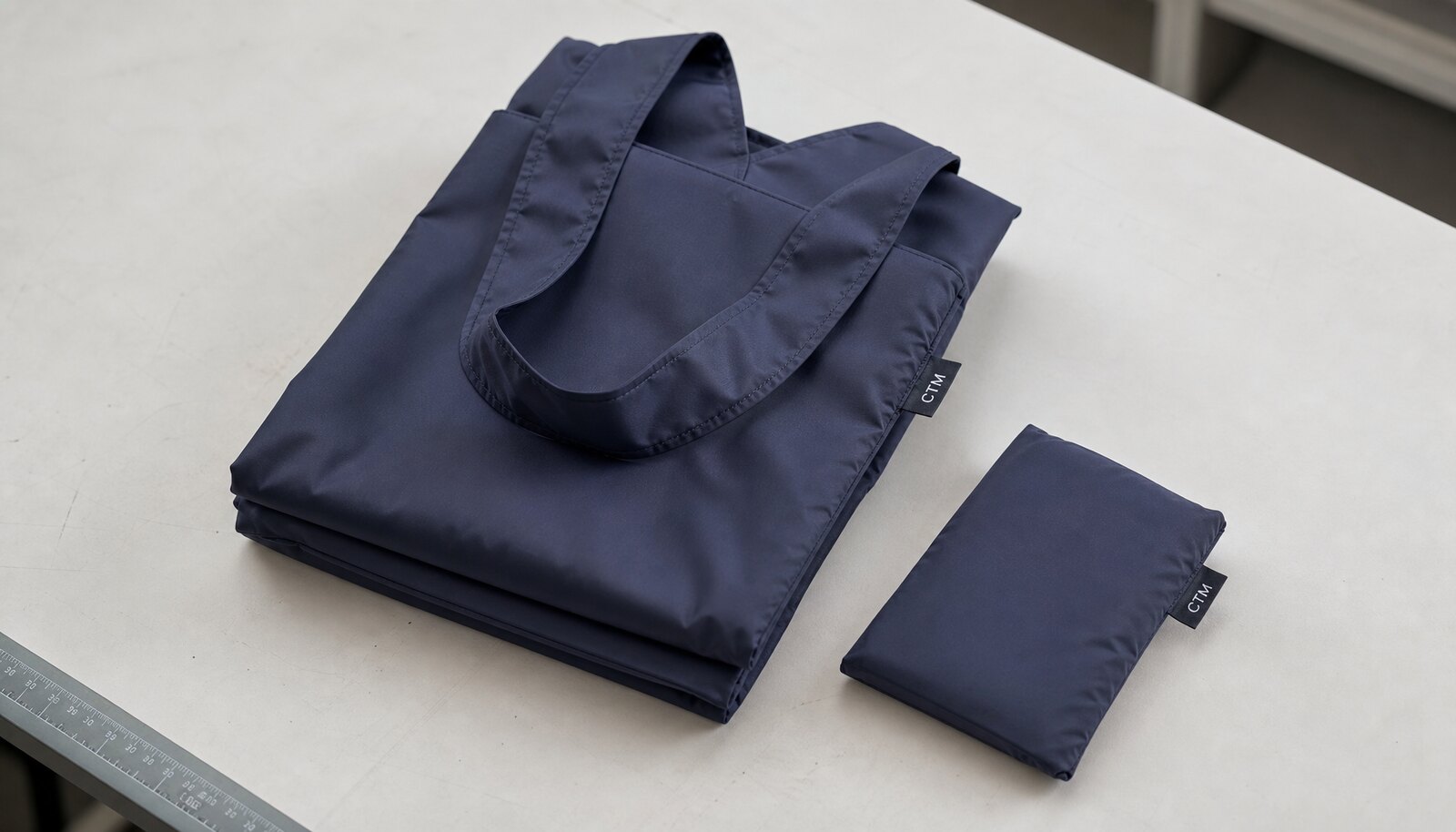
Why foldable retail bags need a tighter spec than a plain tote
A foldable shopping bag for retail is a packaging, merchandising, and durability problem at the same time. Buyers are not just paying for a bag that opens and closes. They are paying for a product that looks good on shelf, folds back into itself cleanly, and survives enough retail handling to avoid complaints. That is why a vague RFQ tends to create bad comparisons. Two suppliers can quote what looks like the same bag and still deliver very different retail outcomes.
The usual failure mode is not dramatic. It is a bag that feels slightly cheaper than expected, folds inconsistently, or arrives with a pouch that barely closes once the artwork is printed. Those issues matter because they affect sell-through and returns without being obvious on the first quote. If you are buying for retail, the spec has to cover the visual product, the fold behavior, the packing format, and the repeat-order risk.
- Treat the pouch and closure as part of the product, not as accessory details.
- Compare suppliers on the same spec sheet, not on a broad category name.
- Assume a small change in fabric or trim can change both cost and customer perception.
Start with the retail use case, not the fabric
The right bag depends on how it will be sold. A checkout add-on needs an easy story, a simple print, and a fold that customers can understand in seconds. A shelf SKU can justify a firmer handfeel, a better label, or a more finished closure because the shopper is evaluating it as a small accessory rather than as an impulse item. A campaign bag should usually be simpler than a core SKU because the buying decision is tied to cost control and timing, not long-term repeat use.
Write the channel into the brief. If the bag is hanging on a peg, the hang loop, header area, and bar code placement matter. If it is sold in a retail box, the box dimensions, artwork, and pack count matter more. If the bag is intended for warehouse distribution to multiple stores, pack discipline and carton labeling become a real sourcing issue. Buyers often lose money by under-specifying the channel and then paying for preventable repacking later.
- State whether the product is a checkout add-on, shelf item, gift-with-purchase, or loyalty item.
- Specify how it will be displayed: peg, hook, shelf, carton, or counter.
- Define the fold behavior the customer should see when they open the product in store.
Choose construction by tradeoff, not by habit
For foldable shopping bags for retail, 190T polyester, 210D polyester, 300D polyester, nonwoven polypropylene, and rPET are the most common starting points. The best choice depends on what the buyer is protecting. If compact fold size and low sell price matter most, a lighter woven construction is easier to keep small. If the brand needs a firmer look and better seam stability, 210D or 300D usually performs better. If the bag is promotional and price-sensitive, nonwoven can work, but it usually gives up some retail appeal and long-term wear.
The useful question is not which fabric is best in the abstract. It is which construction best matches the channel, the expected use count, and the retail price point. Buyers should ask suppliers to quote the same bag in at least two constructions when the program is still being shaped. That makes the tradeoff visible. A slightly heavier fabric may add a small amount of unit cost but reduce failure risk and improve perceived value enough to justify the difference at retail.
Do not let the factory leave the spec vague. Write the fabric construction, finished weight or denier, seam allowance, thread type, and reinforcement points into the RFQ. If the supplier wants to substitute a lighter cloth or a different backing material, the change should be priced and approved, not hidden inside a generic bag description.
- Use a lighter woven body when compact fold and low shelf price are the main constraints.
- Move up to 210D or 300D when the bag needs a firmer retail feel or better seam stability.
- If the program is promotional, keep the spec simple and avoid trim that does not improve sell-through.
Supplier selection: what separates a real production partner from a quoting middleman
A supplier that can quote a foldable bag is not automatically a good production partner. Buyers should check whether the company is actually controlling the pattern, fabric booking, sewing line, inspection process, and packing. If the supplier is only relaying prices from another factory, the quote may look fine but the control over repeat orders will be weak. For retail programs, that weak link shows up when the second order does not match the first.
Ask for proof of process, not just price. A credible supplier should be able to explain the sewing flow, the inspection point before packing, how color lots are managed, and who signs off on the pre-production sample. If they cannot answer those questions clearly, the risk is not just quality. It is also schedule slippage, because every missing decision gets pushed into the production window. For repeat retail SKUs, that is a serious problem.
When volume matters, ask whether the supplier has archived patterns, approved swatches, and reorder records for similar bags. That evidence matters more than broad claims about capacity. It tells you whether they can repeat the same product without starting from zero every time.
- Ask whether you are buying from the factory, a trading company, or a decorator using stock blanks.
- Request photos or a short description of the sewing line, inspection point, and packing area.
- Ask how the supplier controls fabric lots and approvals on repeat orders.
Print and branding choices that affect retail presentation and cost
Print method is one of the biggest cost and risk levers in the program. Simple screen print is still the most practical choice for many retail bags because it is durable and easy to quote. It also tends to hold up better in everyday handling than more delicate decoration methods. If the artwork is more complex, the factory may suggest digital print, heat transfer, or sublimation depending on the fabric. That is not automatically better. It is only better if the method fits the artwork, the fabric, and the acceptable defect rate.
Logo placement should be checked in both the open and folded states. On a foldable bag, a perfect logo can be ruined by a fold line, seam break, or pouch distortion. Ask for a layout that shows the product in both states before approval. If the design depends on a large area of coverage, the buyer should also ask the factory how they handle registration tolerance and what happens when the graphic crosses a seam. These questions save money because they force the supplier to reveal where the design is likely to fail.
For retail buyers, a simple, bold mark often sells better than a crowded graphic. If the product is meant to sit near checkout, the pouch or folded face should read fast. Use a smaller secondary brand element only if it does not complicate print setup or create a second point of failure.
- Use one-color screen print when durability and quote clarity matter most.
- Use more complex print methods only when the artwork truly requires them.
- Approve the artwork in both open and folded states before bulk production.
Quote structure: make the supplier price the same product every time
A useful quote separates the bag from the surrounding work. At minimum, buyers should ask for the body material, sewing, print, pouch or closure, packaging, and carton cost. If those pieces are lumped together, it becomes impossible to tell whether a supplier is truly competitive or simply hiding cost in a broad line item. This is one of the most common mistakes in retail bag sourcing, and it creates bad re-order decisions because the buyer cannot see which part of the quote changed.
Volume breaks matter just as much as the headline price. A supplier who looks expensive at 1,000 pieces may be reasonable at 5,000 or 10,000 if the setup cost is being amortized properly. Ask for tiered pricing so you can see whether the first order is carrying a one-time setup penalty or whether the supplier is simply overpriced. That separation is especially important when comparing direct factories with traders or domestic decorators, because the margin structure is different.
If the supplier cannot or will not itemize the quote, treat that as a sourcing signal. It does not necessarily mean the supplier is bad, but it does mean the buyer has less leverage later when something needs to be changed. Retail programs need comparability first, then negotiation.
- Ask for separate lines for fabric, sewing, print, trim, packing, and cartons.
- Request tiered pricing at multiple volume points instead of a single unit number.
- Ask the supplier to identify any assumptions that could change the final price.
MOQ, reorder logic, and pricing that does not surprise the margin team
MOQ is not just about how many units the factory will accept. It is about which parts of the spec are locking the minimum. A stock body may allow a lower MOQ, while a custom pouch, special label, or new trim can raise it quickly. Buyers should ask the supplier what specifically drives the MOQ so they can decide whether to simplify the design or accept a larger opening order. That answer is more useful than a blanket minimum number.
Reorders deserve their own discussion. A bag that is easy to repeat should have a held pattern, approved swatch, and clear note on whether the factory can source the same fabric lot later. If the supplier cannot reserve material or repeat the same color and handfeel, the program may need a tighter reorder window or a backup spec. Without that discipline, a successful retail launch can turn into a quality drift problem on the second or third order.
When comparing quotes, do not focus on the first run alone. A low first-run price that requires a higher rework risk or a forced spec change is not really cheaper. Retail buyers need a price path they can live with across the full program, especially if the item is likely to sell through and reorder.
- Ask which spec element is driving the MOQ: fabric, print, pouch, trim, or packaging.
- Confirm whether the same fabric and trim can be repeated for reorder runs.
- Keep the first order simple if you need to prove sell-through before scaling.
QC thresholds that are specific enough to use in a commercial buy
A retail bag should be checked against measurable limits, not just a feeling that it looks good. Set size tolerances in the spec before bulk starts. A practical starting point is +/- 5 mm for dimensions up to 300 mm and +/- 10 mm for longer dimensions. If the folded pouch is important to the retail presentation, keep the pouch tolerance tighter, around +/- 3 mm, because a loose fold can make the product look sloppy on shelf even when the bag itself is usable.
Stitching and load performance should be defined with the same care. Ask the supplier to state the stitch density, reinforcement method, and seam strength target. For lighter retail bags, 40 N per 25 mm can be a workable starting point; for heavier 210D or 300D constructions, 60 N per 25 mm is a better baseline. For load testing, tie the test to the claim. If the bag is sold as a 10 kg bag, test to 20 kg for 30 minutes and reject any handle tear, seam opening, or deformation that changes function.
Print quality needs its own acceptance standard. Use a placement tolerance of +/- 2 mm for small logos and +/- 3 mm for larger graphics. Check color with a delta E target under 2.0 for logo colors and under 3.0 for fabric shade against the approved swatch when you have the equipment to measure it. Also run dry rub and wet rub checks on the printed area. If the ink smears, lifts, or cracks in simple handling, it will not survive retail use. For coated or treated fabrics, ask for an adhesion test such as ASTM D3359 or an equivalent internal standard if the material supports it.
The last QC step is packing. Count the inner packs, master carton count, and barcode placement before goods move into the warehouse. If the product is going to distribution centers, require carton corners, top seals, and labels to survive normal handling. A bag that passes sewing inspection but arrives with bad pack counts still causes receiving trouble.
- Use measured size tolerances rather than approving by eye.
- Define seam strength and load targets before sample approval.
- Set print placement and color targets in writing so the factory knows the pass/fail line.
Packing and merchandising are part of the product, not an afterthought
Foldable shopping bags for retail are often judged at the point of display, so packing affects how the product sells. If the bag is sold folded into the pouch, the buyer should specify the final look, not just the storage method. The pouch needs to close cleanly without forcing the seams, and the bag should unfold without awkward distortion. If the bag is packed loose, it may be better protected in transit but less persuasive on shelf. The right choice depends on whether the channel values presentation or warehouse efficiency more.
Inner pack logic also matters. A carton that is too densely packed can make the product hard to access and may crush the fold. A carton that is too loose increases shipping volume and can lead to wrinkling or miscounts. Tell the supplier how the bags will be received, where they will be stored, and whether they will be redistributed by store or by ecommerce node. Those details help the factory choose the right packing format and carton strength.
If the bag includes a zip, snap, or hook-and-loop closure, the closure should be tested after repeated open-close cycles. That detail is easy to overlook and often becomes the point where a product feels fine in sample but fails in real handling. Good merchandising needs a product that still looks tidy after many touches, not just on day one.
- Specify whether the bag ships loose, polybagged, banded, or with a hangtag.
- State the inner pack count and master carton count in the RFQ.
- Confirm that the folded thickness works for the intended retail display.
Lead time, landed cost, and the reorder window
Lead time is a sequence of steps, not a single number. For a custom bag, the schedule usually includes sample approval, material booking, sewing, packing, and shipment. If any step is vague, the delivery date will drift. Ask the supplier to break out the timeline in the quote. That reveals where the risk is. For example, a fast sewing line does not help if the artwork is still being approved or the fabric has not been reserved.
Landed cost is where the real buying decision lives. The ex-factory price may look attractive, but freight, duty, carton size, inner pack count, and warehouse handling can change the total cost materially. A bag that folds thicker than expected can cost more to ship even if the unit price is lower. Buyers should compare delivered cost per sellable unit, not just quote price per bag. That is the number the margin team actually feels.
The reorder window matters because retail programs often succeed or fail after the first shipment. If you think the bag could become a repeat item, ask the factory how long they can hold the same fabric, trim, and print setup. If they cannot commit to repeatability, build a backup plan into the buying decision. A good first order is not enough if the second order forces a visual change.
- Ask for a step-by-step schedule: sample, materials, production, packing, shipment.
- Compare landed cost after freight, duty, packing, and warehouse intake.
- Ask early whether the fabric and trim can be repeated for a reorder.
Specification comparison for buyers
| Buyer scenario | Recommended sourcing route | Typical unit-cost impact | Lead-time impact | Main risk to check |
|---|---|---|---|---|
| Launch order with uncertain demand | Stock blank plus local print or label add-on | Often 10% to 25% higher than a stable custom run at scale | Usually 1 to 3 weeks faster | Color drift or print position changes across stock lots |
| Ongoing private-label program | Direct factory cut-and-sew with locked spec | Usually lowest once the order reaches repeat volume | Setup can add 2 to 4 weeks upfront | Higher MOQ and sample approval must be frozen before bulk |
| Budget promotional campaign | Nonwoven or light polyester with simple artwork | Can be 15% to 30% lower than a heavier woven build | Often 1 to 2 weeks faster | Lower shelf appeal and weaker long-term durability |
| Premium retail add-on | 210D or 300D body with woven label or better closure | Usually 10% to 25% above a basic 190T bag | Sewing and trim can add 3 to 7 days | Closure failure, trim defects, or higher scrap rate |
| Chain-store distribution | Factory that can pack by store, SKU, or barcode | Packing adds a small per-unit cost, often 1% to 3% | Packing logic can add 3 to 5 days | DC mis-picks if carton marks and inner packs are not defined |
| Low MOQ test order | Trading company or domestic decorator using existing blanks | Usually 15% to 35% above direct factory pricing | Can be 3 to 10 days faster | Less transparency on fabric origin and weaker process control |
| Reorderable core SKU | Factory with archived pattern, approved swatch, and reorder record | Unit cost stays stable if fabric and trim are reserved | Fastest on repeat orders | Shade drift if the factory changes fabric lots without notice |
| Short seasonal campaign | Simplified spec with a clear end date and limited trim | Reduces hidden engineering cost and waste | Typically 1 to 2 weeks faster | Overdesign that bloats cost without improving sell-through |
Buyer checklist before sampling
- Define the retail use case first: checkout add-on, shelf SKU, gift-with-purchase, or loyalty redemption.
- Write open size, folded size, pouch style, handle drop, and intended load claim into the RFQ.
- State fabric by construction and weight or denier, not just by generic name.
- Specify print method, color count, logo size, and exact artwork position on both open and folded views.
- Ask for tiered pricing at 1,000, 3,000, 5,000, and 10,000 pieces so the cost curve is visible.
- Separate bag body, print, trim, packing, and carton costs if the supplier can itemize them.
- Require a pre-production sample against a signed reference sample, not against memory or photos alone.
- Lock carton count, inner pack count, barcode placement, and carton markings before bulk sewing starts.
- Confirm whether the factory is quoting direct, through a trading company, or from stock blanks, because that changes control and landed cost.
- Ask for the supplier's acceptance limits for size, color, print placement, and seam quality in writing.
Factory quote questions to send
- What exact fabric, denier, weave, and finished weight are you quoting, and can you name the backup fabric if the first choice is unavailable?
- Is the pouch sewn from the same fabric as the body, and what closure method is included in the quoted price?
- Which print method are you using for this artwork, how many colors are included, and what setup charge applies?
- What is the MOQ by color, by print version, and by carton pack configuration?
- Please quote 1,000, 3,000, 5,000, and 10,000 pieces so we can compare the price curve correctly.
- What is the sample charge, sample lead time, and what is included in the approval sample versus the bulk sample?
- What seam reinforcement, thread type, and stitch density do you standardize at the handle root and pouch stress points?
- What is your acceptance tolerance for open size, folded size, print placement, and shade variation?
- How will you test load capacity, and what is the pass/fail criterion for the sample and the bulk run?
- How will you pack the bags for retail, how many pieces per inner pack and master carton, and what carton markings do you use?
Quality-control points to confirm
- Measure open size and folded size against the signed sample. A practical starting tolerance is +/- 5 mm for dimensions up to 300 mm and +/- 10 mm for larger dimensions.
- Set folded pouch tolerance tighter than the body if the bag must fit back into the pocket cleanly. A starting point is +/- 3 mm on pouch width and height.
- Inspect handle stitching, bartacks, and reinforcement points for skipped stitches, loose thread, pulled seams, or uneven tension.
- Require seam strength testing on a small sample from production. For light retail bags, a starting acceptance level of 40 N per 25 mm is reasonable; for heavier 210D or 300D builds, 60 N per 25 mm is a better baseline.
- Use a load test tied to the retail claim. If the bag is sold as a 10 kg bag, test to 20 kg for 30 minutes and reject any seam opening, handle tear, or permanent deformation that affects use.
- Check print placement against artwork with a starting tolerance of +/- 2 mm for small logos and +/- 3 mm for larger graphics.
- Check color against the approved swatch with a spectrophotometer when possible. A practical starting target is delta E under 2.0 for logo colors and under 3.0 for fabric shade.
- Run dry rub and wet rub checks on the printed area. Reject visible smearing, ink transfer, or cracking that can be seen after routine handling.
- If the fabric or coating supports it, ask for an adhesion standard such as ASTM D3359 or an equivalent internal test, and define the pass level before bulk starts.
- Verify carton counts, inner pack counts, barcode placement, and carton condition on receipt. For export cartons, require no crushed corners, no open seams, and no mislabeling.