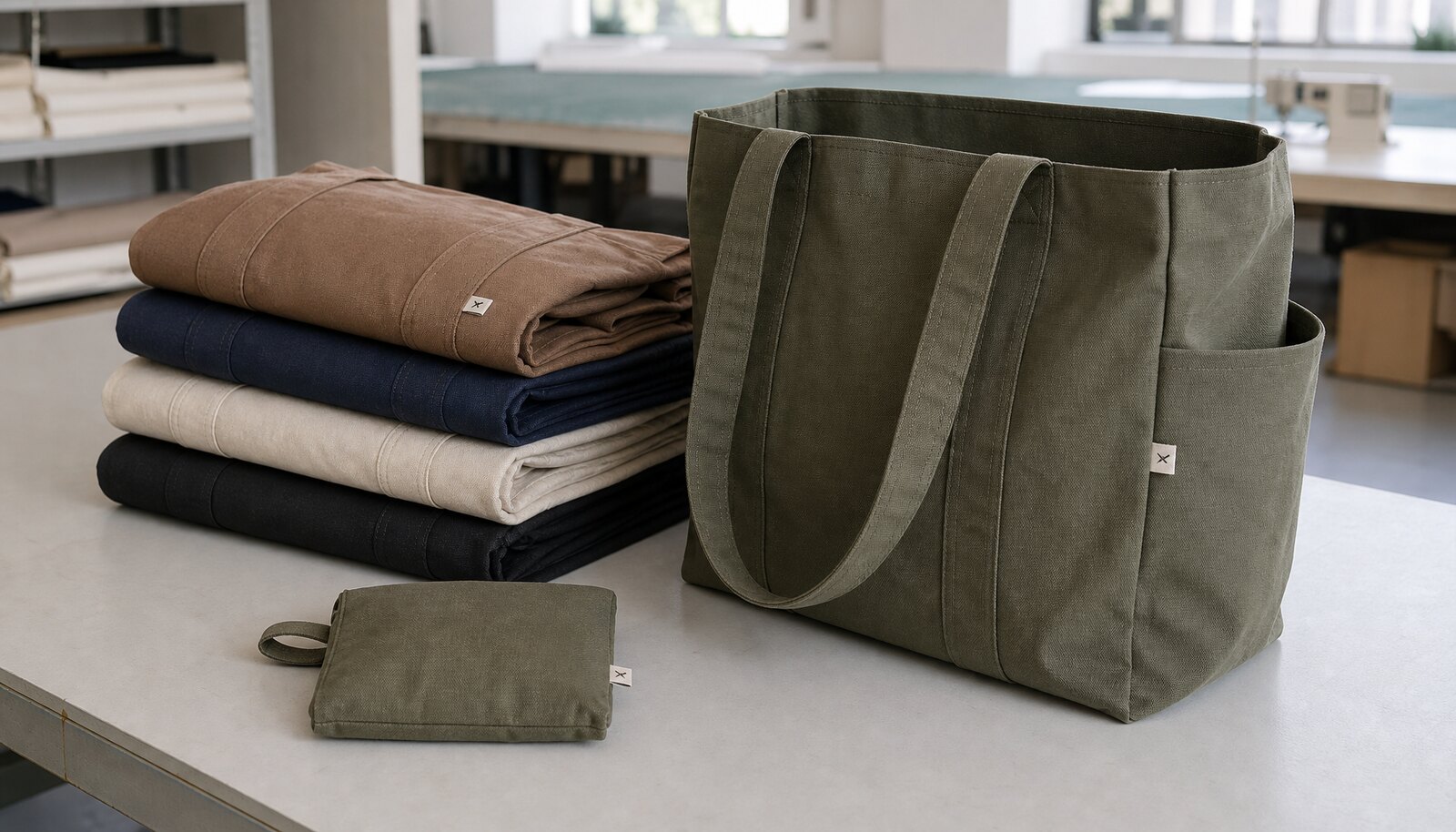
Why foldable bags create a different sourcing problem
Foldable shopping bags for ecommerce are not just smaller tote bags. They have a second function: they must collapse into a compact size, survive repeated folding, and still look presentable when the customer opens the parcel. That means the buyer is really sourcing three things at once: a carry bag, a compact packing item, and a retail presentation piece. If any one of those fails, the bag may still pass a basic spec sheet but underperform in the channel.
The sourcing risk is usually not the visible print. It is the hidden build: seam strength, folding consistency, closure tension, and packed dimensions. For ecommerce, the bag has to fit into parcel fulfillment, storage bins, and shipping cartons without wasting cube. If the factory has only made simple tote bags, the quote can look fine while the actual production creates loose folds, crooked pocket stitching, or bulk that inflates freight.
- Treat folded size as a shipping spec, not just a convenience feature.
- A bag that folds well but feels flimsy will drive higher returns and poor reviews.
- The best quote is the one that includes packing logic, not only unit price.
Fabric choices that work in ecommerce fulfillment
For most foldable shopping bags for ecommerce, the practical range is 70–120 GSM polyester or 100–160 GSM recycled polyester. This range keeps the bag light, dries quickly, and can fold small without becoming paper-thin. If the brand wants a smoother, more premium handfeel, 190T or 210T nylon is worth comparing, especially for compact pouch-style bags. For a more eco-positioned line, recycled PET fabric is common, but the actual yarn quality matters more than the marketing language on the quote.
Buyers often make the mistake of asking only for material names. That is not enough. You need the fabric weight, weave, coating if any, and whether the printed area changes the feel or stiffness. A 90 GSM polyester bag with a dense print can behave like a stiffer product than a 120 GSM bag with a light logo. That difference affects folding, pouch closure, and carton loading. Ask the factory to quote the same artwork across at least two fabric weights so you can compare handfeel, fold performance, and landed freight.
- 70–90 GSM: lighter and cheaper, but more likely to feel thin in hand.
- 100–120 GSM: safer for retail branding and better seam support.
- 130–160 GSM: better for heavier daily use, but usually increases packed bulk and freight.
Which fold style fits your channel
There are three common routes: a self-pocket bag, a sewn-in pouch, and a simple elastic-wrap or snap-loop format. A self-pocket bag is useful when you want the bag to fold into its own storage pocket and display a neat branded front. A sewn-in pouch version is easier for ecommerce fulfillment because the folded state stays controlled. Elastic-wrap styles can be very compact, but the elastic must be tested for retention after repeated use or it becomes loose and sloppy.
The right fold style depends on how the customer will actually use it. If the bag is a promotional add-on or retail impulse item, the compact folded state matters more than load capacity. If it is a grocery or everyday reuse bag, the unfolded dimensions and handle comfort matter more. The wrong choice often shows up as a product that looks clever in photos but is annoying to refold after first use. That is a user-experience failure, not just a style issue.
- Self-pocket: best for branded presentation and controlled folded size.
- Sewn pouch: best for repeat packing consistency at the factory.
- Elastic or loop closure: best only if the material and elastic are tested for retention.
Print method and artwork decisions that change the quote
For a simple one-color logo, screen print is usually the most economical option. It works well on polyester and nylon when the ink is matched to the fabric finish and cured properly. If the artwork uses gradients, multiple colors, or full-coverage graphics, heat transfer or sublimation may be more appropriate. Sublimation is strongest on light-colored polyester, while heat transfer is often used when the design demands sharper detail on smaller quantities. A woven label or sewn side label can also be a smart choice for premium minimal branding, especially when the bag itself needs to stay soft and foldable.
The print quote should never be treated as a fixed commodity. Costs change with color count, print area, setup method, and whether the artwork hits seams or folds. Large graphics across the front panel can distort the fold, and some buyers only discover that after the first sample. A good factory will tell you where the logo should sit so the print remains visible after folding and does not crack at the pouch seam. That practical advice is worth more than a cheap unit price.
- 1-color logo: usually the simplest setup and best for MOQ control.
- 2–4 colors: expect extra setup, more inspection, and more color variation risk.
- Full-coverage artwork: compare print durability against added stiffness and folding problems.
MOQ logic: what lowers the minimum and what pushes it up
MOQ is not just a factory preference; it reflects how many units are needed to absorb setup, print plates, cut waste, and packing labor. Plain bags with one simple logo often start around 500–1,000 pieces if the factory has stock fabric or a standard base pattern. Once you add custom pouch construction, special folding, barcode stickers, hangtags, or multi-color print, 1,000–3,000 pieces becomes more realistic. If a supplier offers extremely low MOQ, the buyer should understand what has been simplified to make that possible.
The risk is hidden price drift. A low-MOQ quote can look attractive until the factory adds charges for color matching, artwork revision, label application, or carton marking. For ecommerce, it is usually better to pay a more transparent setup charge and secure repeatable packing than to chase the lowest piece price. The right MOQ is the one that supports launch testing without forcing you into a design that cannot scale.
- Plain stock fabric plus one logo: lowest MOQ route.
- Custom size, custom pouch, or custom packing: higher MOQ and more labor.
- Low MOQ without detailed packing terms usually means more excluded costs.
How to compare supplier routes without getting fooled by unit price
A useful quote comparison must separate product cost, print cost, packing cost, and freight impact. One supplier may offer a low unit price but ship loose-packed bags in large cartons, while another quotes a slightly higher unit price but gives you tighter folding, smaller cartons, and barcode labeling that saves labor in your warehouse. For ecommerce, the second option can be cheaper on a landed-cost basis even if the factory price is higher.
Direct factories usually win when the design is repetitive and the buyer needs consistent packing. Trading companies can help if artwork changes often or if the buyer wants multiple bag formats in one order. Local converters can be useful for urgent small runs, but the unit cost and material choices are often less efficient. The key is to compare the route, not just the quote number. If the supplier cannot explain seam method, packed dimensions, and carton loading, the quote is incomplete.
- Direct factory: best for repeatable, customized ecommerce packing.
- Trading route: useful when you need coordination across multiple product types.
- Local small-batch route: useful for speed, but usually less efficient on landed cost.
Comparison table: sourcing routes for foldable shopping bags
Use the table below to compare real sourcing routes, not just fabric names. For foldable shopping bags for ecommerce, the buyer’s job is to protect the landed cost, packed size, and consistency of the fold. A good route gives you repeatability; a weak route gives you a cheap sample and an expensive production problem.
If two quotes look close, compare the packed dimensions, barcode application, and sample approval process. That is where the actual savings or risk usually sits.
- Write decisions in measurable language, not only descriptive wording.
- Ask for sample photos plus one physical approval sample for important orders.
- Keep quotation, sample approval, and inspection notes tied to the same spec version.
Sample approval: what must match before bulk production
A sample should prove more than appearance. It should prove that the bag folds back into the target size, the print stays clear after the fold, and the seam structure does not deform the pouch. If the sample only shows an open bag photographed on a table, it does not answer the ecommerce requirement. Ask for a full sample set: open bag, folded bag, packed bag, and carton detail. That is the fastest way to spot a bad design before tooling or mass production starts.
The sample approval stage is where many mistakes are still cheap. If the folded bag is 2 cm wider than planned, the carton count may change. If the logo sits across a crease, the print may crack after folding. If the pouch closure is too tight, workers will fold inconsistently and packed size will drift. The sample should be accepted only when the product can be folded by production staff, not by a skilled technician using extra care.
- Approve finished open size, folded size, and packed carton layout together.
- Inspect one sample for repeated folding and refolding, not only first appearance.
- Make the factory show the actual packing sequence used on the line.
QC thresholds that prevent ecommerce returns
For ecommerce, quality failures often appear after the customer opens the parcel. That means the QC standard needs to cover appearance, function, and packed consistency. A practical tolerance for standard reusable bags is usually ±1 cm on main dimensions, but the buyer can tighten this if the bag uses a defined pouch or retail insert. The important point is consistency: mixed sizes in the same carton are a problem even if each size is technically within range.
The most useful QC checks are simple and physical. Handle seams should survive a pull test, stitch lines should remain straight, and the print should not show cracking at the fold line. If the bag uses a self-pocket or pouch, the folded piece must return to its target shape after repeated opening and closing. Barcode labels must scan reliably, and carton markings must match the PO. These are not cosmetic details; they directly affect inbound labor and customer experience.
- Reject mixed sizes, mixed colors, and mixed artwork in the same carton.
- Test handle and side seam strength on the actual production sample.
- Check print durability after folding, not only before packing.
Packing, cartonization, and freight planning
Packing is where foldable bags often lose their cost advantage. A bag that seems cheap per piece can become expensive once the factory adds individual polybags, header cards, larger carton cube, or unnecessary empty space. For ecommerce, the best packing plan is the one that protects the folded shape and minimizes air volume. Flat bulk packing can work if the warehouse is ready for it, while individual polybagging is better when the bag must arrive retail-ready or FBA-ready.
Ask for carton quantity, gross weight, and packed dimensions in the quote. This data lets procurement estimate freight before the order is approved. If the supplier cannot give a credible packed size, they probably have not fully worked through the fold sequence or carton loading. For a lightweight item, freight can be a major part of the landed cost, so the carton plan deserves the same attention as the fabric choice.
- Bulk flat packing: lower packing cost, but more inbound handling.
- Individual polybagging: cleaner retail presentation, higher labor and material cost.
- Barcode sticker application: useful for fulfillment but must be tested for adhesion.
Specification comparison for buyers
| Spec decision | Recommended option | When it fits | Buyer risk to check |
|---|---|---|---|
| Source route | Direct factory with folding/packing experience | Best for private label ecommerce and repeat buys | Confirm the factory actually controls stitching, printing, and final packing, not only trading the order |
| Fabric choice | 70–120 GSM polyester or 100–160 GSM recycled polyester | Best when the bag must fold small, dry fast, and stay lightweight in parcel shipping | Very thin fabric can fray at seams and feel cheap after one or two washes |
| Alternative fabric | 190T or 210T ripstop nylon | Useful for premium compact bags with a smoother handfeel and stronger tear resistance | Surface can be slippery for some prints and may need better seam reinforcement |
| Handle construction | Same-fabric handles with cross stitching or boxed reinforcement | Works for low-weight retail use and keeps unit cost down | Check handle length, stitch density, and whether the handle seam will pop when loaded |
| Closure style | Built-in pouch pocket, elastic wrap, snap loop, or sewn-in self-pocket | Choose based on how the customer will re-fold the bag after use | A closure that is too tight or too loose creates return complaints and bad reviews |
| Print method | Screen print for simple logos; heat transfer or sublimation for multicolor art; woven label for a premium minimalist look | Select by artwork complexity, quantity, and required wash resistance | Artwork size, color count, and fabric coating can change print cost and failure rate |
| Packing route | Bulk packed flat with fold instruction card or individual polybag with barcode sticker | Best for ecommerce fulfillment and FBA-style scanning | Packed size and carton count affect freight more than many buyers expect |
| MOQ logic | 500–1,000 pcs for plain or one-color versions; 1,000–3,000 pcs for custom print and special packing | Fits most brand launch and seasonal test orders | Low MOQ can hide setup costs, weak QC, or a quote that rises sharply at approval |
| Lead time model | 7–15 days for samples; 25–40 days for production after sample approval | Standard when artwork is final and fabric is in stock | Delay risk increases if color matching, special folding, or barcode application is unclear |
Buyer checklist before sampling
- Confirm finished folded size, open size, and target parcel-friendly carton size before RFQ.
- State fabric GSM, handle length, seam reinforcement, and whether the bag must fold into its own pocket or a separate pouch.
- Provide print artwork in vector format with Pantone targets and the exact logo placement size.
- Specify whether barcode labels, hangtags, or retail-ready polybags are required.
- Request sample photos of stitching, print detail, folding method, and packed carton layout before mass production.
- Ask for carton quantity, gross weight, and packed dimensions in the quote, not only unit price.
Factory quote questions to send
- What fabric options do you recommend for this bag style, and what is the finished GSM after coating or printing?
- How many stitches per inch do you use on the handles and side seams, and where do you add reinforcement?
- What is your MOQ for plain, printed, and custom-packed versions, and what setup costs change at each level?
- Which print method is included in your quote, and what extra charges apply for extra colors, larger print areas, or repeat setup?
- Can you quote open size, folded size, carton size, carton quantity, and estimated gross weight for freight planning?
- What sample stage do you provide before bulk production, and what changes are still allowed after sample approval?
- How do you control folding consistency so the bag fits the stated packed size every time?
- What inspection standard do you use for seam strength, print alignment, color variation, and barcode legibility?
Quality-control points to confirm
- Finished size must stay within agreed tolerance, typically ±1 cm on width and height for standard ecommerce bags.
- Fabric GSM or denier must match the approved sample; random thin panels or mixed lots should be rejected.
- Print alignment should stay centered within an agreed tolerance, with no cracking, smearing, pinholes, or visible color banding.
- Handle seams should survive a practical pull test and show no skipped stitches, broken thread, or loose bar-tacks.
- Folded size must match the approved packing method and fit the stated polybag or carton without forcing the seam.
- Edge stitching should not unravel after light abrasion, and overlock or hem finishing should be clean at all stress points.
- Barcode labels, care labels, and carton marks must scan and read correctly after packing.
- Carton count should match the purchase order exactly, with no mixed colors, mixed artwork, or short-packed units.