Start With the Launch Use Case
Foldable shopping bags for brand launches are not ordinary reusable bags with a logo added later. They sit at the intersection of packaging, merchandise, and brand presentation. That changes the buying decision. The right bag for a press kit may need a compact fold and a polished finish, while a store giveaway can tolerate a lighter handfeel if the goal is broad distribution. A retail-facing bag has a different bar again: the folded face becomes part of the shelf story, so print sharpness, closure quality, and panel consistency matter more than raw unit price.
Procurement gets better quotes when the launch workflow is explicit. State where the bag will be handed out, whether it needs to sit in a box, whether it must fit into a welcome kit, and how visible it is when customers first see it. A launch bag that is only judged as a carry item is usually under-specified. A launch bag that is written as a display item, a pack-out item, and a reuse item at the same time produces clearer samples and fewer surprises at approval.
- Define the launch channel before you talk about material.
- Treat the folded face as part of the product, not packaging waste.
- Use different standards for giveaway, retail, and distributor kits.
- Write the spec around use, presentation, and pack-out together.
Choose Fabric and Construction Together
Fabric weight controls both perceived value and logistics. A 190T polyester bag, often around 55-60 GSM, is a sensible option when the priority is compact folding and lower cost. A 210D polyester bag, usually around 90-120 GSM, gives a firmer handfeel, better structure, and a more substantial retail impression. rPET in the 75-90 GSM range can work well when the launch story needs recycled content, but it should not be treated as a simple material swap. Buyers still need to check yarn traceability, shade repeatability, and whether the supplier can replenish the same lot later.
Construction matters as much as fabric. A lighter fabric with a good seam plan can outperform a heavier fabric that is poorly balanced at the stress points. The practical question is not whether the material sounds premium. It is whether the full assembly, from seam allowance to handle reinforcement and pocket geometry, can hold up in actual use without turning the folded bag into a bulky, awkward shape. For cotton or canvas, the same logic applies: a heavier body may improve perceived quality, but it also changes the packed cube and freight cost fast.
- 190T polyester: compact, lower cost, and better for tight fold targets.
- 210D polyester: stronger handfeel and a cleaner retail look.
- rPET: useful when the launch message includes recycled content, but only if traceability is documented.
- Cotton or canvas: use only if the buyer accepts a larger pack size and higher freight load.
Make the Fold Geometry Part of the Spec
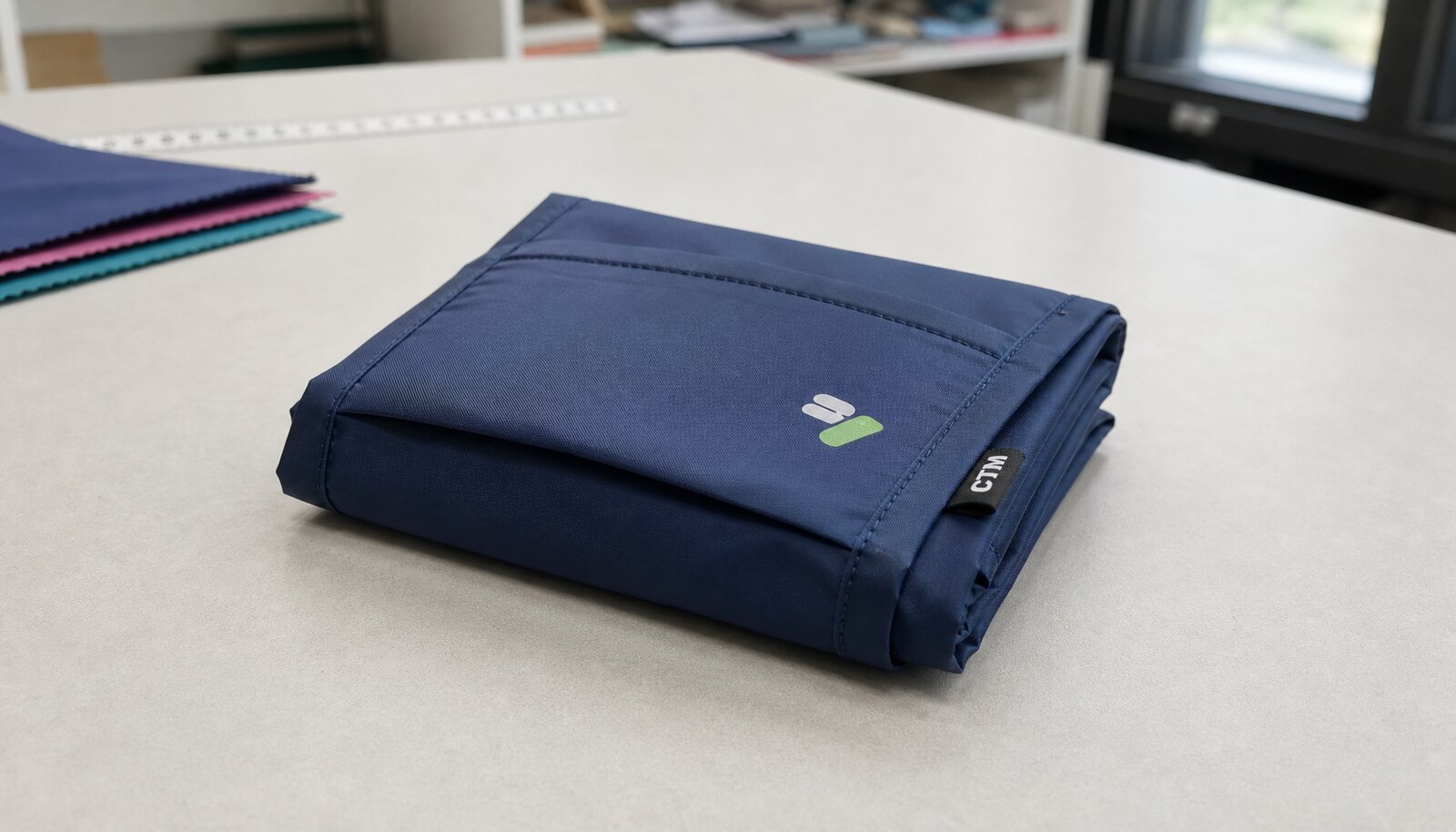
The fold style is where launch bags either feel refined or become fragile. A self-pocket design usually gives the cleanest retail face and keeps the folded footprint predictable. An elastic wrap is cheaper and simpler, but it often looks less finished and is easier to stretch out during transit. A zippered pouch can look premium, yet it adds another component, another sewing operation, and another failure point if the zipper tape or slider is weak.
Review the fold as a stress map, not as a visual flourish. The pocket seam, closure line, handle anchor, and the point where the bag refolds into itself are the places that split first. If the sample needs force to tuck into the pocket, the geometry is too tight or the stitch line is fighting the fold. If the closure opens too easily, the bag will not hold a stable shape in transit. A good sample folds smoothly, keeps the print aligned, and stays flat without wrinkling the face panel.
- Use a self-pocket when shelf presentation matters.
- Use an elastic wrap only when cost outweighs appearance.
- Use a zipper pouch only if the added hardware risk is acceptable.
- Reinforce the pocket ends and handle anchors with real bartacks, not decorative stitching.
Lock the Print Spec Before You Compare Prices
For a launch bag, the print has to read clearly at arm's length and survive folding, handling, and shelf display. Screen print is usually the safest choice for one or two solid colors because it is repeatable and predictable. Heat transfer and digital transfer are better when the artwork needs gradients, fine text, or more complex detail, but they should be validated on the actual fabric and on the actual fold path. A clean artwork file is not enough if the ink lifts at a seam or cracks where the pocket creases.
Artwork placement matters more on foldable bags than on ordinary shoppers because the folded face becomes the first thing a customer sees. Keep the main logo away from seams, zippers, and sharp fold edges. Ask the supplier to show the artwork position in both states: open bag and folded bag. If the logo crosses a fold line, the print may look correct on a proof but distort in real use. Approve a strike-off on production fabric, and check it under daylight rather than only under showroom lighting.
- Use screen print for bold logos and simple shapes.
- Use transfer methods only when the artwork needs detail that screen print cannot hold.
- Position the logo so it remains readable when the bag is folded.
- Approve a strike-off on production fabric, not a paper mockup.
- Check registration where seams and corners are most likely to distort the art.
Compare Suppliers on the Same Basis
A useful quote is more than a unit price. For this product, the buyer needs the cost logic behind fabric, cutting, sewing, print setup, closure parts, packing, and export terms. If one supplier quotes a 210D bag with screen print and another quotes a lighter fabric with a different closure, the numbers do not compare cleanly. The RFQ needs one basis: the same open size, the same folded size, the same print count, the same closure style, the same pack count, and the same delivery term.
The more important sourcing question is not just what the supplier charges. It is how they control the order. Ask whether cutting, printing, sewing, and packing happen in one legal entity or move across sister plants. If steps are split, the quote should say so plainly. That matters because hidden handoffs increase the risk of color drift, size variation, mixed cartons, and missed labeling. For a launch item, subcontracting risk should be visible before you place the order, not discovered when the shipment is already booked.
- Ask each supplier to quote exactly the same spec sheet.
- Separate bag body, decoration, packing, tooling, and freight in the quote.
- Name the production site, not just the sales office.
- Require the supplier to disclose subcontracted steps and who owns final inspection.
- Compare sample photos from the actual factory line, not a generic catalog image.
Use QC Thresholds Buyers Can Actually Enforce
Sampling should have two gates. The first is appearance and function: the buyer checks the logo, the fold, the closure, the handfeel, and the overall finish. The second is pre-production approval, which confirms that the final fabric, final tooling, and final packing method still produce the same result. If either gate is skipped, small changes can hide until bulk production is already complete. For launch goods, that is a preventable failure.
The inspection plan needs concrete thresholds, not just a promise to check quality. Set size tolerances, stitch density, bartack length, load capacity, and fold-cycle performance in advance. A practical buyer spec is more useful than a generic factory promise. For example, require the bag to carry a realistic load for 30 minutes without seam opening, then run repeated fold cycles to see whether the pocket loosens or the closure drifts. If the supplier cannot explain the test method and the acceptance limit, the QC claim is not actionable.
- Approve both a visual sample and a pre-production sample.
- Use a realistic load test tied to the intended use case.
- Run at least 25 fold-and-unfold cycles before approving the closure.
- Require no seam opening greater than 2 mm after load testing.
- Treat open seams, wrong artwork, broken closures, and mixed cartons as critical defects.
Pack for Shelf, Ship for Cube
Packing affects both presentation and landed cost. A neatly folded bag that is packed loosely still wastes carton space, while a bag with attractive artwork but unclear pack labeling causes receiving work at the destination. Decide early whether the bag ships as a loose folded piece, in a polybag, with a hangtag, or in a retail-ready insert format. Those choices change labor time, carton density, and how the product is received by stores or distribution centers.
Barcode and SKU handling should be fixed before production starts. For distributor launches, mixed cartons slow down receiving and create errors downstream. For retail programs, the folded face should stay clean enough to go to shelf without rework. If the bag is being compressed for mailers, test that route once and inspect whether the fold, print, or closure still looks correct after compression. A packing spec that exists only in email usually becomes expensive in the warehouse.
- Use one packing method per SKU whenever possible.
- Specify carton labels, barcode placement, and pack count in the RFQ.
- Keep the folded orientation consistent so every carton opens the same way.
- If you use an insert card, make sure it does not distort the fold or crease the logo.
- Avoid mixed cartons unless the receiving team is ready to sort them immediately.
Estimate Landed Cost, Not Just Unit Price
The real cost of a launch bag shows up after the order is packed, shipped, cleared, and received in saleable condition. A lower factory price can disappear if the carton cube is too large, if decoration rejects are high, or if extra handling is needed to refold the product before distribution. Compare fabric weight, print method, packing format, carton density, freight basis, and expected rework together. A stronger fabric may raise the unit cost but reduce damage and complaint risk. A simpler closure may save assembly time but look less premium on shelf.
Lead time also affects cost because delay can force premium freight or compress the launch schedule. The critical path usually sits in fabric booking, print approval, accessory sourcing, and final packing. Ask the factory for a dated production calendar, not a vague lead-time promise. If they cannot map approval, cutting, printing, sewing, and packing clearly, the schedule risk is probably being hidden in the quote. For launch bags, a slightly higher quoted price with a clear calendar is often better than a lower price with vague timing.
- Compare landed cost with freight, duty, carton cube, and rework risk included.
- Ask where the price break occurs and what actually drives it.
- Request carton dimensions and gross weight before approving the freight plan.
- Watch for delay in strike-off approval and accessory sourcing.
- Use a simple landed-cost model: factory price, tooling, packing, inland transport, freight, duty, brokerage, and expected defect allowance.
Standardize the First Launch So Reorders Stay Clean
A good first order should create a reusable spec, not just fill a one-time launch need. Once the bag lands in market, the reorder should not require a new round of interpretation. Standardize the fabric code, print placement, closure spec, carton count, and packed dimensions while the first order is still in production. If the launch needs multiple colorways or region-specific versions, keep the construction identical so the factory can reuse tooling and the warehouse can receive with less confusion.
The common failure is drift. Teams approve small tweaks during the first order, then later discover that the product is no longer easy to reorder because no one has a clean master reference. Build one final approval sheet that records the approved sample, approved artwork, approved pack format, and approved QC limits. Keep that file attached to the purchase order and the reorder history. The next buyer should be able to quote the same standard without reconstructing design intent from old email threads.
- Freeze one master spec after pre-production approval.
- Record fabric, print, closure, and packing details in a reusable approval sheet.
- Limit launch variations to artwork or color when possible.
- Store the approved strike-off and packed sample for reorder comparison.
- Attach the final spec to the PO so future buyers do not have to reconstruct it.
Close the Loop Before Bulk Approval
Before you release bulk production, make sure the order is fully traceable from spec to shipment. The supplier should be able to answer who made the bag, where each step happened, what testing was run, and how the packed units will be labeled when they reach the warehouse. For foldable shopping bags for brand launches, that traceability matters because the product is both functional and visible. If the fold format, print position, or carton labeling drifts, the launch story becomes inconsistent even if the bags technically still carry product.
The best procurement outcome is not just a low quote. It is a launch bag that arrives cleanly, looks right on first opening, holds up through actual customer use, and can be reordered without re-litigating the spec. That means the supplier comparison, QC gate, packing plan, and landed-cost model all need to agree before the PO is released. If one of those pieces is still vague, the launch is not ready.
- Confirm the factory can trace every step from fabric to carton.
- Verify the approved sample matches the final purchase order language.
- Make sure the warehouse knows the carton label and SKU logic in advance.
- Do not approve bulk until the fold, print, and packing standard are fixed.
Specification comparison for buyers
| Decision area | Option compared | Best fit | What to lock in | Buyer risk to check |
|---|---|---|---|---|
| Sourcing route | Direct factory with in-house cutting, printing, sewing, and packing | Single-launch orders where the bag, fold, and print all need tight control | Legal entity, site address, and which steps are actually internal | Hidden subcontracting can change quality and timing after sample approval |
| Sourcing route | Converter or trading company with a named factory network | Multi-SKU programs or launches that need flexible sourcing across product families | The exact production site for each step and who owns final inspection | Quoted lead time may come from the broker, not the real plant schedule |
| Fabric | 190T polyester, usually about 55-60 GSM | Low-cost giveaways, mailers, and tight folded-size targets | GSM range, yarn type, and opacity on the approved sample | It can feel thin, show print show-through, and lose premium value |
| Fabric | 210D polyester, usually about 90-120 GSM | Retail-facing launch bags that need a firmer handfeel and cleaner structure | Fabric width, GSM tolerance, and seam allowance at stress points | Packed size is larger, so freight cube and carton density matter |
| Fabric | rPET around 75-90 GSM | Launches that need recycled-content messaging without giving up too much structure | Traceability, color consistency by lot, and replenishment plan | Shade drift and raw-material changes can break consistency across reorders |
| Decoration | Screen print, 1-2 solid colors | Bold logos, simple artwork, and repeatable launch orders | Artwork position, color target, and strike-off on production fabric | Ink can crack on fold lines or register poorly across seams |
| Decoration | Heat transfer or digital transfer | Gradients, small text, or more detailed launch graphics | Rub/fold performance and edge lift after handling | The print may look correct at first but fail after repeated use |
| Fold closure | Self-pocket with snap or stitched flap | Shelf-facing retail presentation and controlled folded size | Pocket seam reinforcement and closure life-cycle test | Weak pocket geometry or poor hardware can make the bag pop open |
| Fold closure | Elastic band or wrap | Lower-cost giveaways where presentation is secondary | Elastic recovery and appearance after repeated folding | It is easier to lose tension and looks less polished on shelf |
Buyer checklist before sampling
- Define the launch use case first: giveaway, retail add-on, press kit, or distributor pack.
- Lock open size, folded size, and target packed size before asking for quotes.
- Specify fabric type and GSM range, not just a generic material name.
- State the print method, number of colors, and exact artwork placement on the open and folded bag.
- Define handle length, reinforcement points, seam allowance, and closure style in the RFQ.
- Confirm whether the bag needs a self-pocket, hangtag, insert card, barcode sticker, or retail sleeve.
- Ask for photos of the exact fold style and seam finish, not a similar product.
- Require carton count, master carton labeling, SKU barcode rules, and gross carton weight in the quote.
- Ask the supplier to break out bag body, print, packing, and freight basis separately.
- Request the same sample standard from every supplier so the comparison is apples-to-apples.
Factory quote questions to send
- Which legal entity and which physical site will cut, print, sew, and pack this order?
- What exact fabric type, GSM range, and fabric width will you use for the production run?
- Is the quoted price based on screen print, heat transfer, woven label, embroidery, or a combination?
- What is the MOQ by color, artwork version, and packaging format?
- Which steps are done in-house, and which steps are subcontracted or moved to a sister plant?
- Can you provide a pre-production sample, a strike-off, and a folded-size photo before bulk approval?
- What size tolerance do you guarantee for the open bag and the folded bag?
- What is the stitch specification, bartack length, and reinforcement method at the handle and pocket stress points?
- How will the bags be packed per carton, and what are the carton dimensions, gross weight, and carton count per SKU?
- Which in-process and final tests do you run for seam strength, fold function, and print adhesion?
Quality-control points to confirm
- Set a critical defect threshold of zero for open seams, wrong artwork, wrong SKU, broken closures, and mixed cartons.
- Target a size tolerance of plus or minus 5 mm for smaller bags and plus or minus 8 mm for larger formats on both open and folded dimensions.
- Require main seams to hold a consistent 8-10 stitches per inch, with no skipped stitches, loose tension, or exposed seam starts.
- Require bartacks at handle anchors and pocket stress points to measure about 18-22 mm long, with clean ends and no needle skips.
- Use a load test that matches the fabric choice: 3 kg for 30 minutes on lighter 190T bags and 5 kg for 30 minutes on 210D or rPET launch bags.
- After load testing, allow no seam opening greater than 2 mm, no handle slip, and no permanent stretch greater than 10 mm at the anchor points.
- Run 25 full fold-and-unfold cycles and require the pocket or wrap to remain functional, with no seam split and no closure failure.
- After 25 fold cycles, the print should show no visible cracking from normal viewing distance and no lifting at seam edges.
- Check color against the approved standard, with a target delta E at or below 2.0 if the supplier measures color scientifically; otherwise require daylight side-by-side approval.
- Inspect carton labels, SKU counts, and pack counts against the pack list before release, with no mixed styles in a launch carton.