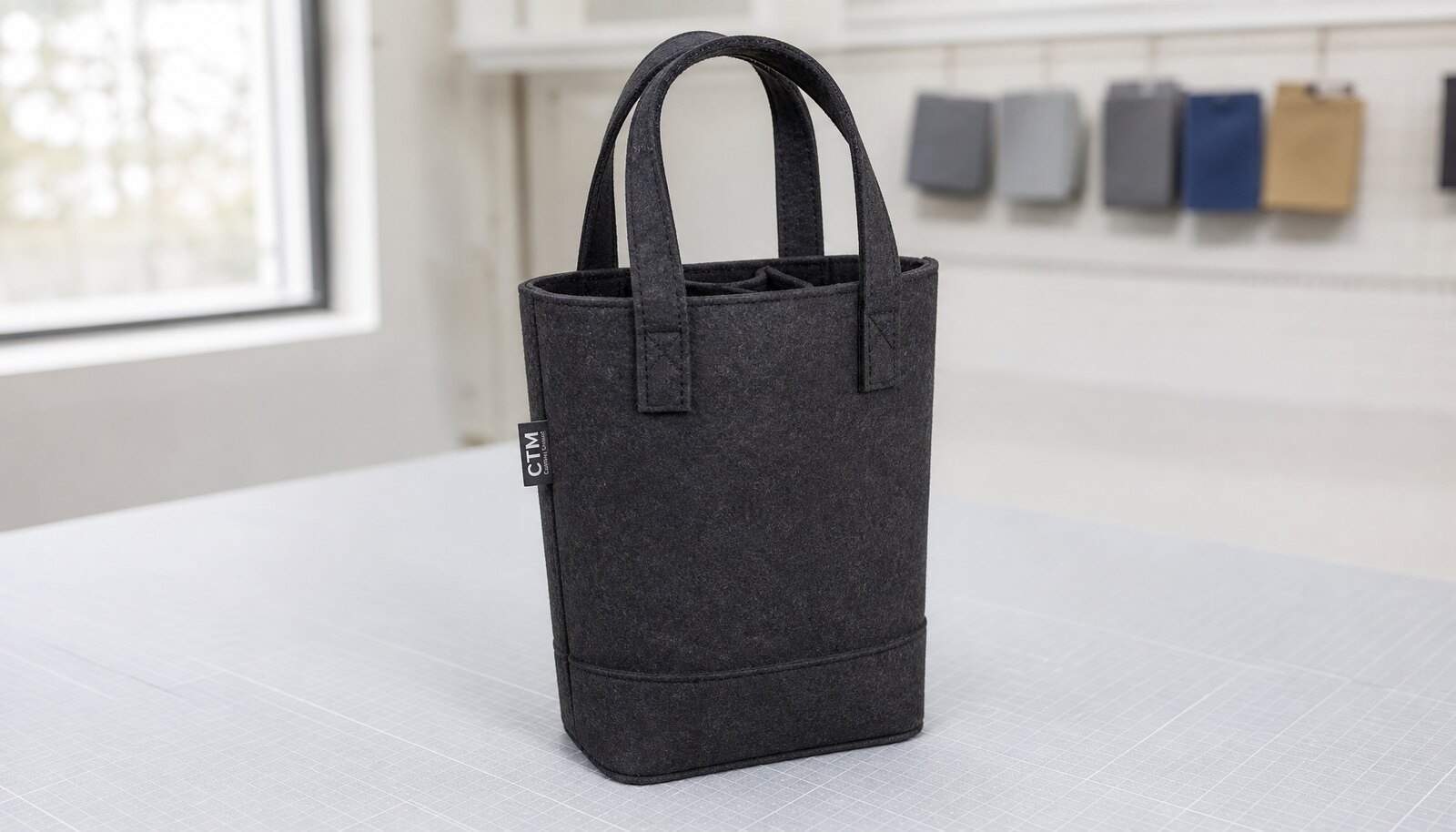
Start With the Minibar Use Case
A felt wine tote for a hotel minibar is not a generic retail wine bag. It sits in a guest-facing space, gets handled by housekeeping, and often has to hold a bottle upright in a narrow drawer or on a small tray. The common failure modes are not subtle: the bag collapses, the handle stretches, the bottle neck pushes through the top edge, the logo rubs off, or the tote looks tired after only a few placements. If the buyer does not define the use case, the factory will quote a nice-looking accessory that cannot survive the room setup.
Start by naming the actual service model. Is the bag for minibar presentation, in-room retail, turndown gifting, or chilled bottle delivery? Those use cases change the structure, lining, handle strength, and pack-out. A bag that only needs to frame a bottle on a shelf can be lighter than one that will be carried through corridors and placed back into service. The bottle profile matters as much as the tote itself, because Bordeaux, Burgundy, and champagne all create different shoulder and neck clearances. The quote should begin with the bottle drawing, not with the artwork.
Measure the hotel environment too. Confirm the drawer depth, shelf height, cart footprint, and whether the tote must stand upright without leaning. If the item must fit beside a room card, note, or other minibar accessory, the usable space changes quickly. That is the first reason procurement gets disappointed: the bag was sized to an idealized mockup, not to the actual property layout.
- Define the exact bottle profile before discussing artwork.
- Measure the drawer, shelf, or tray where the tote will sit.
- State whether the bag must stand on its own or only hold the bottle briefly.
Lock the Product Spec Before You Ask for Pricing
For felt tote bags, the material description needs to be more exact than a generic label like "premium felt." Recycled PET felt around 700-900 GSM and 2.5-3.0 mm thickness is a practical default for hotel minibar use because it balances structure, durability, and reorder consistency. Lower weights can be fine for soft gifting, but they tend to sag, pill, and look cheap when the tote sits in a guest room under direct light. If the hotel wants a premium shelf presence, structure matters more than softness.
The construction details should be written into the RFQ. Ask for sidewall reinforcement, bartacks at the load points, and a base insert if the bottle needs to stand upright. If the design carries a logo, the branding method should be chosen for abrasion, not just visual effect. A small woven label or sewn patch often survives better than a heavy ink flood, especially when the tote will be moved in and out of drawers, carts, or luggage. If screen print is selected, define the approved color, placement tolerance, and the maximum print area so the bag stays flexible.
It also helps to lock what the product is not. If the tote is for dry minibar use only, say so in the spec. If the hotel expects chilled bottles or condensation, that changes the interior finish, moisture behavior, and inspection criteria. Buyers lose time when the factory assumes one service condition and the property uses another.
- Specify felt composition, GSM, thickness, and color reference.
- Set handle drop and internal width from the actual bottle drawing.
- Choose the branding method based on wear, not just appearance.
Build a Quote That Is Actually Comparable
A clean quote for felt wine tote bags should separate the variables that move the unit price. Those usually include felt weight, cutting waste, seam complexity, handle type, reinforcement, print method, label attachment, packing format, and sample charges. If the supplier gives you one lump sum without breaking out the line items, you do not really have a quote; you have a headline. Buyers should ask for pricing at 500, 1000, 3000, and 5000 pieces using the same artwork so the MOQ logic becomes visible.
The quote also needs to show what is excluded. Tooling, print plates, embroidery digitizing, packing inserts, custom carton marks, compliance checks, and inland delivery often appear later if they were not stated up front. Ask the factory to list the assumptions beside the unit price: which felt lot is used, whether the handle is woven or felt, how many print colors are included, whether the sample fee is credited back, and whether the carton spec is fixed. When those assumptions are missing, the cheapest bid is often the one with the most hidden cost.
A useful procurement habit is to compare the quote, the sample, and the draft spec sheet side by side. If those three documents do not match, the supplier has not actually priced the product you think you are buying.
- Separate ex-works price from sample fee, tooling, and packing upgrades.
- Ask for price breaks by quantity, not one summary number.
- Make the factory state whether tissue, dividers, sleeves, and outer marks are included.
Compare Supplier Routes, Geography, and Incoterms
Direct factory sourcing is usually the best route when the tote needs custom dimensions, a specific felt density, or repeatable reorders. You get tighter control over cutting, stitching, packing, and QC records, and the sample room can usually turn around revisions faster once the factory understands the spec. The downside is that the buyer has to manage the details carefully, because there is less buffer between the purchase order and the line. That is manageable if the buying team is disciplined about samples and sign-off.
Trading companies and local converters still have a place, but the comparison should be explicit. A trader can be useful if the hotel program is part of a broader sourcing basket and you want one point of contact. A local converter can help with smaller replenishment orders or urgent regional launches. The risk is that the production source may be less visible and the quote may include multiple margin layers. If the factory cannot show a similar cut-and-sew reference, do not treat the route as equivalent just because the sample looks acceptable.
Geography also changes the risk profile. For China-based sourcing, the key checks are export documentation quality, carton control, and sample discipline. For Vietnam or India, the buyer should watch material lead times, print consistency, and transport handoffs between subcontractors. For Turkey, Eastern Europe, or Mexico, labor availability and peak-season capacity can affect schedule reliability. On the logistics side, ask which Incoterm is quoted and which port or airport is the actual export point. EXW and FOB are easier to benchmark; CIF and DDP need more scrutiny because freight, duty, and inland costs can blur the real landed price.
- Ask for sample room photos and one similar product reference, not just sales language.
- Confirm who owns cutting, printing, sewing, packing, and final inspection.
- Benchmark the same Incoterm across vendors before comparing unit prices.
Decide the Construction Details That Drive Durability
The details that most often separate a good tote from a weak one are not obvious on a quick sample photo. The handle needs a load path that transfers force into reinforced stitch zones rather than into a thin top edge. The base needs enough support to prevent the bottle from rocking in transit. The sidewalls need enough stiffness that the tote does not buckle when it sits half empty in a minibar drawer. Those details should be specified before sampling, because they are expensive to adjust later.
A single-bottle tote is usually the cleanest choice for hotel minibar programs. It is easier to size, easier to pack, and easier to keep consistent across reorders. A twin-bottle format can work when the property wants a gift set or wine pair presentation, but the unit becomes wider, heavier, and more sensitive to seam alignment. The buyer should ask the supplier to show the internal bottle clearance on the sample, not just the external dimensions. If the bottle shoulder is tight against the top edge, the design is too small even if the measurement sheet looks correct.
Branding should also be treated as a construction decision. A woven label or sewn patch usually protects the visual identity better than a large print field, especially in a guest-facing application where the bag will be handled repeatedly. If the logo must be printed, define the placement tolerance, the allowed fade level, and the rub expectation. A premium bag that cannot survive contact with a minibar drawer is a packaging problem, not a design success.
- Specify handle reinforcement, base support, and sidewall stiffness together.
- Use the real bottle clearance as the pass/fail reference, not only the outer size.
- Limit print coverage when abrasion is likely to be high.
Use a QC Matrix, Not a Loose Inspection Note
The QC plan should read like a production control document, not a vague promise to "check quality." For this product, a practical default is ISO 2859-1 single sampling at General Inspection Level II, with Critical defects at zero acceptance, Major defects at AQL 2.5, and Minor defects at AQL 4.0. That gives both sides a clear release standard and prevents arguments after the shipment is packed. If the hotel brand has its own acceptance rules, those should override the generic plan.
Define the defect classes in writing. A Critical defect is one that makes the tote unsafe or unusable: wrong bottle fit, missing handle, sharp edge, strong odor, wrong logo artwork, or visible structural failure. A Major defect reduces function or guest presentation: open seam, crooked label, missing reinforcement, handle distortion, or obvious base collapse. A Minor defect is cosmetic, but still measurable: loose thread, light shade variance, slight fuzz, or a small print shift within tolerance. The key is not just the name of the defect but the threshold at which a lot is held.
The inspection report should include more than pass/fail. Require a measurement sheet with sample count, actual dimensions, handle drop, GSM, thickness, print position, defect code, and photos of any out-of-spec points. For felt wine tote bags for hotel minibars quality inspection checklist work, the fastest way to avoid disputes is to make the factory measure the same points you will check at receiving.
- Set Critical = 0, Major = AQL 2.5, Minor = AQL 4.0 unless your brand is stricter.
- Require a measurement sheet with actual numbers, not just comments.
- Hold any lot that misses bottle fit, logo accuracy, or structural reinforcement.
Approve Samples Against the Real Hotel Setup
A sample should be judged in the same conditions the final bags will face. Insert the actual bottle, close the tote, and check whether the bottle sits upright without leaning or rubbing the upper edge. If the hotel will use chilled bottles, test the sample after condensation forms so you can see whether the felt darkens, stains, or changes shape. If the minibar presentation includes a room card, note, or key sleeve, place those items in the tote too, because usable space shrinks quickly once accessories are added.
The sample sequence should be structured. The prototype proves size and construction. The pre-production sample should use the final felt, final print method, and final packing format. The golden sample then becomes the reference for QC, warehouse receiving, and reorders. If the factory changes the felt lot, handle supplier, or label attachment method, that is not a minor note; it is a new approval point. Procurement should not allow silent substitutions just because the first sample looked acceptable.
It is also worth checking the bag under different lighting. Guest rooms do not all use the same color temperature, and a shade that looks clean in the sample room may read dull or off-brand under warmer lighting. The sample needs to pass both the technical check and the visual check, because minibar products are sold by their appearance as much as by their function.
- Test insertion, removal, and upright stability on a flat surface.
- Check logo alignment under daylight and warm indoor light.
- Treat any material or construction change as a new approval point.
Packing, Cartons, and Receiving at Property
Packing matters more for felt than many buyers expect. Felt can hold a crease if it is folded too sharply, and a compressed carton can leave the tote looking tired before it reaches the hotel. Flat packing is usually the most efficient option, but the fold direction, tissue insert, and carton fill ratio should be specified. If the tote has a formed base or stiffener, the corners need protection so the bottom edge does not arrive crushed. The package should protect both appearance and dimensional recovery.
For hotel programs, the outer carton should be easy to count and receive. Agree the quantity per carton, the net and gross weight limits, and the outer marks before bulk production starts. If the buyer uses a central warehouse, pallet dimensions and carton stacking limits should be written into the spec as well. If the bags are branded, the carton labels should match the hotel SKU system exactly. That reduces receiving disputes and makes replenishment easier because the warehouse team can verify the shipment without opening every box.
When freight is involved, packing density becomes part of the product design. A tote that packs efficiently can lower cube, reduce damage risk, and make the landed cost more predictable. A poorly packed tote may look inexpensive on paper but cost more once handling and freight are added.
- Specify whether the bag ships flat, semi-formed, or with a base insert in place.
- Keep carton weights manageable for hotel warehouse handling.
- Match carton marks, SKU labels, and pallet notes to the purchase order.
Measure Landed Cost, Not Just the Unit Price
A unit price is only useful if it is tied to the same spec, the same packing, and the same shipping assumption. Felt wine totes can become expensive after freight if the cartons are oversized, the packing is loose, or the supplier has to rush materials because the spec was not frozen early enough. For hotel minibar programs, the cube matters because the item is often distributed through a central warehouse or property-level receiving point. A slightly cheaper tote that packs badly can end up costing more than a better-structured version that ships efficiently.
Procurement should also factor in duty, inland trucking, warehousing, and the cost of quality failure. If a lot is rejected for logo error or fit failure, the savings from the lower quote disappear quickly. That is why the quote and the QC standard should be reviewed together. If the cheapest supplier cannot explain the same sample, the same carton count, and the same shipment documents, the landing cost is not really lower; it is just less visible.
The right commercial question is whether the supplier can produce the approved spec at a stable cost across reorders. That means asking where the price changes if you alter GSM, handle type, print method, or carton size. If the supplier cannot explain the cost drivers, they are probably not managing them tightly enough.
- Compare freight cube, carton count, and damage risk, not only ex-works price.
- Use the same approved sample and QC standard across every supplier.
- Ask how the price changes if GSM, handle type, or carton size changes.
Freeze Reorder Rules and Change Control
Hotel programs usually fail on the second order, not the first one. The first shipment is often protected by close attention, but the reorder can drift if the factory changes a material, swaps a carton size, or uses a different label lot without notice. Buyers should establish a simple change-control rule: any change to felt, handle, print method, base support, packing, or export documents requires written approval before production starts. That keeps the golden sample meaningful.
It also helps to set a reordering file that contains the approved spec sheet, the signed sample photo set, the measurement sheet, the QC defect matrix, and the carton layout. When a new buyer or hotel property asks for the same item later, the sourcing team can quote from the real record instead of recreating the spec from memory. That is especially important when the design is close to a standard product but still has hotel-specific dimensions or branding.
If the program will expand across properties, keep a record of the approved bottle profile and any regional variation in minibar setup. A tote that works in one room type may not fit another because the drawer, bottle choice, or accessory set is different. Reorder control should prevent that drift before it becomes a receiving issue.
- Freeze any change to material, label, handle, or packing in writing.
- Keep a reorder file with the signed spec, sample photos, and inspection report.
- Track room-type or property differences before extending the program.
Specification comparison for buyers
| Spec decision | Best default for hotel minibars | Why it wins | Watchout |
|---|---|---|---|
| Felt construction | Recycled PET felt at 700-900 GSM and 2.5-3.0 mm thickness | Gives enough body for a minibar drawer, holds shape after handling, and is easier to reorder consistently than decorative thin felt | Too-light felt looks soft in photos but collapses under a bottle and shows wear quickly |
| Body structure | Single-bottle tote with reinforced sidewalls and a base insert when the bottle must stand upright | Keeps the bottle centered and improves presentation in tight guest-facing spaces | A soft bag without a base can lean, tip, or rub the bottle neck against the top edge |
| Handle build | Double-layer felt handles or woven webbing handles bartacked into the load points | Handles survive housekeeping handling and repeated guest use better than simple stitched tabs | Single-layer handle tabs stretch, twist, or tear at the seam if the bag carries a full glass bottle |
| Branding method | One-color screen print plus a small woven label or sewn patch | Balances durability, readability, and procurement cost without overloading the felt surface | Heavy ink coverage can crack, especially if the bag is folded, rubbed, or stored in drawers |
| Interior finish | Unlined for dry minibar use; wipe-clean lining for chilled bottles or condensation risk | Keeps the program aligned with actual room service and cleaning practices | Unlined felt can retain moisture, odor, or staining when wet service is frequent |
| Supplier route | Direct factory with cut-and-sew control and a sample room | Best for repeatable dimensions, reorder stability, and tighter control over QC records | A trader may bundle fees or obscure the real production source if the line is not transparent |
| Incoterm | FOB or EXW for experienced buyers; CIF only when freight is clearly benchmarked | Helps compare manufacturing cost separately from logistics and customs risk | DDP can hide weak documentation or unclear duty assumptions unless the supplier is highly disciplined |
| Pack-out | Flat pack with tissue, carton dividers, and clear SKU labeling | Protects shape, speeds warehouse receiving, and reduces damage during transport | Over-compressed packing can crease the felt and slow property-level distribution |
Buyer checklist before sampling
- Confirm the bottle profile first: 750 ml Bordeaux, Burgundy, or champagne, and whether the tote must also hold a note card, room key sleeve, or gift insert.
- Measure the final use space in the hotel drawer, tray, minibar shelf, or cart before approving the size.
- Lock the finished dimensions, seam allowance, and handle drop in the RFQ; do not rely on a loose catalog size.
- Approve the felt composition, GSM, thickness, and color reference before sampling starts.
- Choose the branding method, artwork size, and allowable print shift, then record the approved logo file version.
- Specify the handle construction, load-point reinforcement, and whether the bag needs a base insert or side gusset support.
- Decide whether the interior must be wipe-clean, stain-resistant, or left unlined for dry service only.
- Ask for a prototype, a pre-production sample, and a golden sample signed against the final spec sheet.
- Require an ISO 2859-1 sampling plan, a defect grading matrix, and a measurement sheet with actual results before bulk release.
- Define packing per carton, carton count, carton marks, and palletization rules so the receiving team can verify the shipment fast.
Factory quote questions to send
- What felt composition, GSM, thickness, and color standard are you quoting, and is the material recycled PET, virgin PET, or a wool blend?
- What are the finished dimensions, flat pattern dimensions, seam allowance, and handle drop in the quoted price?
- Is the handle part of the felt body, a separate webbing component, or a mixed construction with reinforcement at the stress points?
- Which branding method is included, how many colors or passes are covered, and what is the approved artwork size?
- What reinforcement is included at the base and handle anchors, and is that reinforcement already included in the unit price?
- What is your MOQ by color and by artwork, and what price breaks apply at 500, 1000, 3000, and 5000 pieces?
- What are the sample fee, sample lead time, and number of revision rounds included before bulk production starts?
- Which Incoterm are you quoting, from which city or port, and what freight or export charges are excluded from the price?
- What packing format are you quoting per bag and per carton, including tissue, polybag or sleeve, divider, and carton mark requirements?
- What inspection standard do you use before shipment, can you share a measurement sheet and pre-shipment QC report, and which defects trigger a hold?
Quality-control points to confirm
- Use ISO 2859-1 single sampling at General Inspection Level II unless the buyer has a stricter corporate standard; set Critical defects at zero acceptance, Major defects at AQL 2.5, and Minor defects at AQL 4.0.
- Define a clear defect matrix before production: Critical = wrong bottle fit, unsafe sharp edge, strong odor, missing handle, severe structural failure, or wrong logo artwork; Major = seam opening, off-center branding, missing reinforcement, bent base, or handle distortion; Minor = loose threads, small shade variance, or light surface fuzz.
- Require a measurement sheet for every pre-shipment sample set with SKU, sample count, width, height, depth, handle drop, base width, GSM, thickness, print placement, seam allowance, and pass/fail result.
- Finished width, height, and depth should stay within plus or minus 3 mm of the signed sample unless the design is intentionally soft; handle drop should stay within plus or minus 5 mm.
- Felt GSM should stay within plus or minus 5 percent of the approved spec and should be checked against the signed reference lot, not against a catalog description.
- Thickness should stay within plus or minus 0.2 mm of the approved sample, with any visible thinning at the base or handle anchor treated as a major defect.
- Stitch density should be even across visible seams, with no skipped stitches, loose loops, broken thread, or thread tension spikes that create puckering.
- Bartacks or equivalent reinforcement at handle joints must be complete, centered, and unbroken; any partial bartack or offset reinforcement should fail inspection.
- Print placement should stay centered within plus or minus 3 mm and should not show smearing, cracking, peeling, or color break after a dry rub test.
- Load testing should pass at no less than 3 times the intended bottle weight, with the test held long enough to expose seam creep and handle stretch rather than just a quick lift.