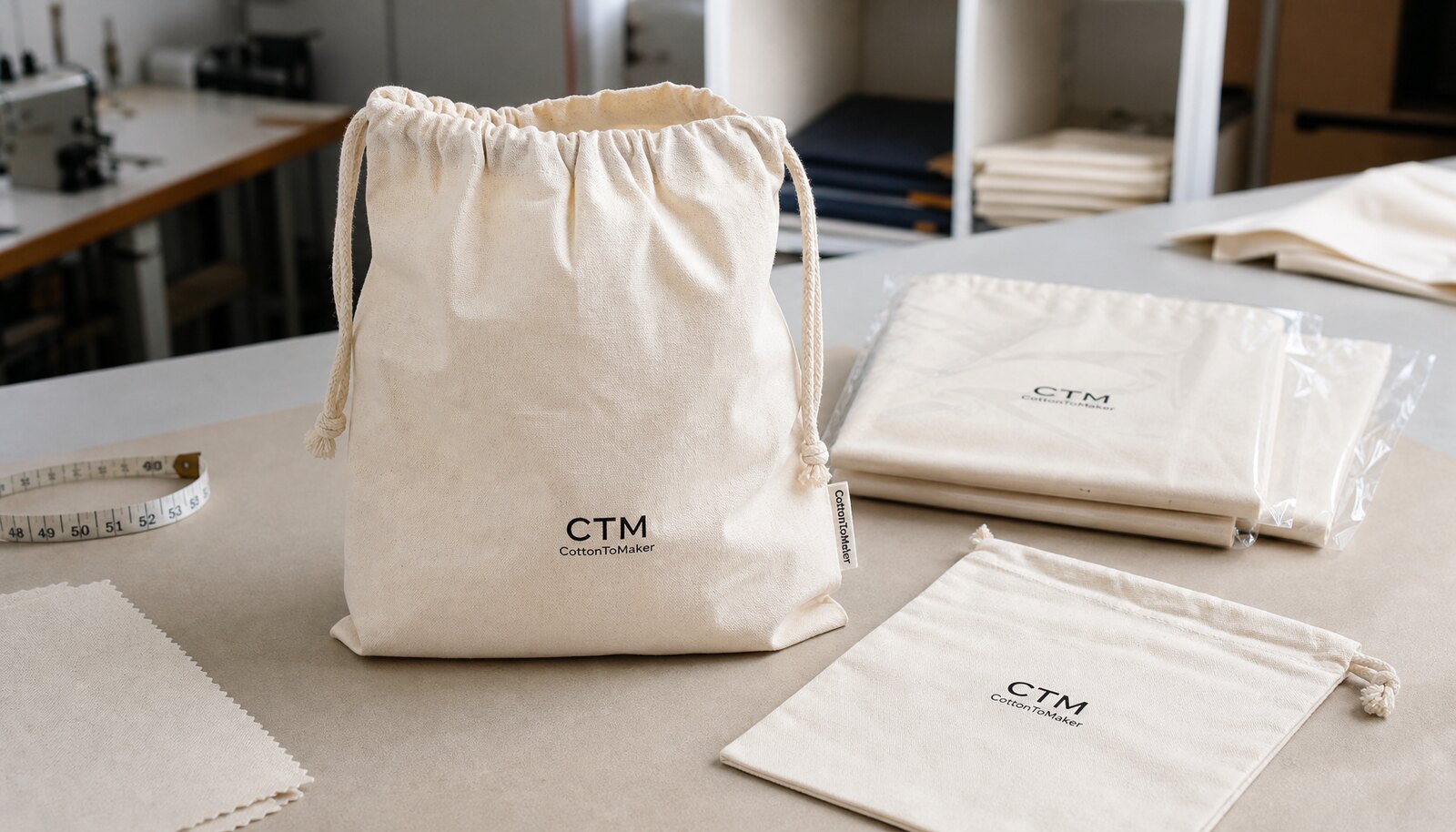
1. The inspection problem event buyers need to solve
A cotton drawstring bag for an event is usually not judged in a showroom. It is judged on the morning of registration, when staff open cartons, insert brochures, T-shirts, bottles, badges, or sponsor gifts, and hand the bag to thousands of attendees. If the cord breaks, the logo is off-center, the fabric feels too thin, or cartons are short-packed, the buyer has almost no recovery time. That is why inspection for event bags must focus on practical use, not only visual appearance.
The main buying problem is simple: many quotations look similar, but the production risk is hidden in fabric weight, cord construction, print curing, packing details, and timing. A low quote may be based on lighter cotton, loose size tolerance, simplified stitching, or bulk packing that does not match the kitting plan. A useful inspection guide helps procurement teams compare supplier offers before ordering and check goods before shipment.
- For deadline-based events, late correction is often more expensive than a better specification from the start.
- For distributor orders, inconsistent quality can damage the buyer relationship even if the bag is a low-cost giveaway.
- For brand owners, the bag carries the campaign logo, so print quality and fabric hand feel affect brand perception.
- For importers, carton size, gross weight, and HS documentation affect landed cost and warehouse handling.
2. Start inspection planning at RFQ stage, not final shipment
The best inspection result is created before production starts. If the RFQ only says "cotton drawstring bag with logo," each factory will quote its own interpretation. One supplier may quote 4 oz cotton with a thin polyester cord, while another quotes 6 oz cotton with cotton cord and stronger top channel sewing. Both may call the product a cotton drawstring bag, but they are not the same product.
For event buyers, the RFQ should define the bag as a functional packing item. State what will go inside, approximate loaded weight, how the bag will be distributed, and whether the bag is intended for reuse. These details influence fabric weight, seam strength, drawcord diameter, and packing method. A factory sales engineer can recommend a safer construction when the actual use is clear.
- State the intended contents, for example: brochure pack, 500 ml bottle, T-shirt, notebook, badge, or product samples.
- Confirm whether the bag is a one-day giveaway, reusable merchandise item, retail add-on, or subscription insert.
- Specify whether the bag must stand a simple pull test when loaded.
- Mention if the event requires organic cotton, plastic-free packing, individual barcode labels, or carton sorting by location.
3. Fabric GSM: how much weight is enough for an event bag?
Fabric weight is one of the fastest ways to compare quotes. Cotton drawstring bags for events are commonly made from 4 oz to 8 oz cotton, roughly around 110 gsm to 230 gsm depending on construction and supplier conversion. For light documents or small giveaways, 5 oz / about 140 gsm can be acceptable. For a better branded feel, 6 oz / about 170 gsm is a common upgrade. If the bag must carry heavier items or be reused, 8 oz / about 230 gsm or canvas construction may be safer.
The risk is not only tearing. Thin fabric can look transparent, wrinkle heavily, and show poor print coverage, especially with dark ink or large solid logos. If the cotton is natural unbleached fabric, small seed flecks are normal; buyers should not treat every speck as a defect unless a cleaner bleached finish was specified. For organic cotton bags, confirm whether the organic claim applies to the fabric only or also to the certified chain of custody required for your market.
- 4 oz / about 110 gsm: very light, useful for low-cost inserts, but not ideal for premium event branding.
- 5 oz / about 140 gsm: common event giveaway level for brochures, badges, and light items.
- 6 oz / about 170 gsm: better hand feel and stronger impression for sponsored events or corporate programs.
- 8 oz / about 230 gsm: stronger bag, higher cost and freight volume, suitable when reuse is expected.
- Inspection tip: cut or weigh a measured fabric piece if GSM disputes are important, instead of judging only by touch.
4. Construction checks: channel, seams, cord, and stress points
A drawstring bag fails most often at the top channel, side seam, or cord exit. Event buyers should ask how the top channel is made. A simple folded channel may be enough for small bags, but a double-fold channel with secure backstitching is more stable. If the channel edge is raw or poorly folded, fraying can start quickly. The side seam should be straight, with consistent seam allowance and no skipped stitches.
Drawcord specification also matters. Cotton cord supports an eco-positioned organic cotton message, while polyester cord may be cheaper and smoother but can conflict with sustainability claims. Cord diameter should match bag size and fabric strength. A very thin cord can cut into the channel, while a very thick cord may not slide smoothly. During inspection, the cord should open and close without excessive force, and the knot or cord end should not slip into the channel.
- Check stitch density, commonly around 8-12 stitches per inch depending on fabric and machine setting.
- Look for backstitching at cord channel ends, side seam starts, and other pull points.
- Pull the drawcord several times on sampled pieces to check smooth operation and channel strength.
- Measure cord length consistency; uneven cords make the bag look poorly controlled.
- Reject serious defects such as broken seams, open channels, loose cord ends, and needle cuts at stress points.
5. Logo printing: choose the method that matches the artwork
For most event cotton drawstring bags, screen printing is the most practical method for one to three solid colors. It gives good coverage, manageable cost at bulk quantity, and a familiar hand feel. Heat transfer can work for gradients, photo effects, or small runs, but buyers should check the edge feel, wash resistance if needed, and whether the transfer film changes the natural look of the cotton. Digital printing may suit complex artwork, but the fabric surface and color still affect final sharpness.
Inspection should compare mass production against an approved print sample, not against a digital file alone. Cotton fabric absorbs ink differently from paper or synthetic fabric. Natural cotton also has texture and seed flecks, so extremely fine text, thin QR codes, or tight sponsor logo details need extra checking. If a QR code is required, scan it from several production samples before shipment. Do not assume it will work because it worked in the artwork file.
- Define print size in centimeters and position from top edge and side edge.
- Use Pantone or another clear color reference, while accepting reasonable tolerance on natural fabric.
- Check ink curing with a rub test after the print is dry and set.
- For multi-color logos, inspect registration and edge alignment.
- For large solid blocks, check pinholes, uneven ink coverage, and fabric show-through.
6. Sampling: what a buyer should approve before mass production
A physical sample is the most useful risk-control tool for an event bag order. The sample should use the same fabric weight, same drawcord, same sewing construction, and same print method as planned production. If the supplier sends only an available stock bag to show shape, that is a reference sample, not a production approval sample. It can help with size discussion, but it should not be used to approve fabric quality or print result.
For tight event schedules, buyers sometimes skip sampling to save one week. This is risky when artwork, fabric color, or packing is customized. A better approach is to approve a plain sewing sample first if timing is urgent, while the print strike-off is prepared in parallel. Keep signed or photographed approval records, including measurements and close-up details. The factory should also keep a sealed sample for production comparison.
- Measure sample width, height, bottom fold if any, channel depth, and cord length.
- Load the sample with expected event contents and pull the cord repeatedly.
- Check whether the logo looks balanced when the bag is flat and when filled.
- Confirm that the fabric color under normal office light is acceptable, not only under studio light.
- Keep the approved sample standard clear: approved as construction only, print only, packing only, or full production standard.
7. MOQ logic: why factories quote different minimums
MOQ for a cotton drawstring bag is not random. It can be driven by fabric purchasing, dyeing minimum, organic cotton availability, cord color, print setup, cutting efficiency, or the sewing line schedule. If the bag uses natural cotton in a common size, the MOQ can be lower because the factory may have regular fabric access. If the buyer requires a custom dyed color, certified organic fabric, unusual cord, or many carton sorting requirements, MOQ may increase.
Procurement teams should ask what controls the MOQ instead of only pushing for a lower number. A factory may accept a small order but charge a higher unit price because fabric waste, print setup, and line changeover are spread over fewer pieces. For event buyers, a slightly higher order quantity can sometimes reduce unit cost and provide spare bags for registration shortages, VIP packs, or last-minute sponsor additions.
- Fabric MOQ: relevant for custom gsm, organic fabric, dyed fabric, or special weave.
- Print MOQ: affected by screen setup, color count, artwork changes, and production efficiency.
- Cord MOQ: important for custom dyed cord, thick cotton cord, or branded cord options.
- Packing MOQ: individual barcode labels or sorted cartons add labor even when the bag itself is simple.
- Buyer action: request price breaks at two or three quantities, such as 1,000, 3,000, and 5,000 pieces.
8. Packing and carton checks for event distribution
Packing is often treated as a small detail, but for event buyers it can decide whether distribution is smooth or chaotic. Bulk packing is usually cost-efficient: bags are folded and packed in master cartons, sometimes with an inner liner. Individual polybag packing protects each bag but adds cost, plastic use, packing time, and carton volume. If the event team will insert items later, bulk packing may be better. If bags are shipped to multiple locations or handed out as retail-style items, individual packing may be justified.
Inspection should confirm quantity per carton, carton marking, carton strength, and whether bags are folded consistently. Wrong carton markings can cause serious trouble when goods are split by city, booth, sponsor, or event date. If cartons are too heavy, warehouse staff may damage them during handling. If cartons are underfilled, freight cost increases. Ask for estimated carton dimensions and gross weight at quote stage so the landed cost estimate is realistic.
- Confirm pieces per inner pack and pieces per master carton.
- Check whether cartons need event name, PO number, SKU, destination, color, or size marking.
- Ask whether individual bags need barcode stickers, suffocation warning, recycled polybag, or paper banding.
- Inspect carton sealing, moisture protection, and whether fabric is dry before packing.
- For container or pallet shipments, request pallet pattern or cubic meter estimate when relevant.
9. Lead time and inspection timing for fixed event dates
Event orders have a hard deadline, so lead time should include more than sewing days. A realistic plan includes artwork confirmation, sample making, sample approval transit, fabric preparation, cutting, printing, sewing, trimming, final inspection, packing, export paperwork, and shipping. If a supplier quotes only production time after sample approval, buyers must still add inspection and logistics buffer.
The most dangerous schedule is one where final inspection happens the day before the vessel cutoff or courier pickup. If defects are found, there is no time to rework. For larger orders, ask for an inline production check after the first finished pieces are available. This catches wrong logo position, incorrect cord, seam problems, or packing misunderstandings before the whole order is completed.
- Build a timeline backward from the event date, not forward from PO date.
- Reserve time for physical sample review if the logo or fabric is new.
- Request production photos at fabric cutting, printing, sewing, and packing stages.
- Plan final inspection before the goods are fully sealed for shipment where possible.
- Avoid last-minute artwork changes after screens, transfers, or cutting patterns are prepared.
10. Acceptance criteria: how to decide pass, rework, or reject
Inspection must separate critical, major, and minor defects. A small natural cotton speck may be acceptable on an unbleached bag, while a broken drawcord channel is not. Slight print shade variation may be acceptable within agreed tolerance, while a misprinted sponsor logo or unreadable QR code can make the bag unusable. Without clear criteria, the buyer and factory may argue after production instead of solving the problem.
For event cotton drawstring bags, acceptance criteria should match the order purpose. A low-cost internal giveaway may accept minor wrinkles or small natural slubs. A sponsor-branded retail-style event bag needs stricter print placement, cleaner trimming, better folding, and more consistent appearance. Buyers should define the inspection level and defect limits in the PO or quality document, especially when third-party inspection is involved.
- Critical defects: mold, sharp objects, wrong logo, unsafe contamination, or unusable bag construction.
- Major defects: open seams, broken cord, severe stains, wrong size beyond tolerance, poor print curing, unreadable QR code.
- Minor defects: small thread ends, light creasing, minor natural cotton specks, slight position variation within tolerance.
- Common size tolerance: agree around +/- 1 cm for width and height unless tighter tolerance is needed.
- Common print placement tolerance: define a measurable range, for example +/- 0.5 cm to +/- 1 cm depending on artwork and bag size.
Specification comparison for buyers
| Spec decision | Recommended option | When it fits | Buyer risk to check |
|---|---|---|---|
| Fabric weight | 5 oz / 140 gsm cotton for light event giveaways; 6 oz / 170 gsm for better hand feel | One-day conferences, race kits, school events, sponsor merchandise | Too-light fabric may look transparent after printing or tear near the cord channel |
| Bag construction | Double-fold top channel with backstitching at both ends | Bulk event use where attendees pull the cord repeatedly | Open channel ends and weak backstitching can fail during packing or first use |
| Drawcord | Cotton cord 4-6 mm, color matched or natural | Eco-positioned events and organic cotton programs | Thin cord may cut into the fabric; polyester cord may conflict with organic cotton messaging |
| Logo print | Screen print for 1-3 solid colors; heat transfer only for gradients or small run artwork | Event logos, sponsor marks, QR codes, simple campaign graphics | Incorrect curing, poor registration, or transfer film hand feel can reduce perceived quality |
| Size tolerance | Agree +/- 1 cm for width and height after sewing | Standard event packing and carton planning | Loose tolerance causes inconsistent appearance and may affect insert fitting |
| Packing method | Bulk pack with inner polybag liner or individual bag only when needed | Distributor stock, conference kitting, retail handout programs | Individual packing adds labor, carton volume, and plastic use if not required |
| Inspection timing | Inline check after sewing start plus final random inspection before shipment | Orders tied to fixed event dates | Only checking at the end leaves no time to correct sewing or print defects |
Buyer checklist before sampling
- Confirm final bag size, measurement point, and tolerance before sample approval.
- State fabric weight in gsm or oz and ask whether it is greige, bleached, dyed, or organic cotton.
- Check whether fabric shrinkage was considered if the bag will be washed or steam finished.
- Approve a physical pre-production sample, not only a digital artwork proof.
- Verify drawcord material, cord diameter, color, knotting method, and channel strength.
- Check print method, print size, placement, color reference, curing standard, and rub resistance.
- Confirm whether quoted MOQ is based on fabric purchase, dyeing lot, printing setup, or sewing line efficiency.
- Request carton dimensions, gross weight, net weight, packing ratio, and pallet information if needed.
- Reserve inspection time in the lead time plan, especially for event-deadline shipments.
- Define acceptable defects and rejection criteria before production starts, not after goods are packed.
Factory quote questions to send
- What fabric weight, composition, weave, and finish are included in this quotation?
- Is the cotton conventional, recycled, organic, or certified organic, and what document can be provided if certification is required?
- What is your quoted bag size tolerance after sewing, and how do you measure the bag?
- Which print method do you recommend for our artwork, and what are the setup charges or limitations?
- Can you provide a physical sample using the same fabric weight, cord, stitching, and print method as mass production?
- What is the MOQ for the exact fabric color, cord color, and print method we request?
- What is the normal production lead time after sample approval, and how much time should be allowed for inspection and shipment booking?
- How many pieces are packed per carton, and what are the estimated carton size, gross weight, and cubic volume?
- What inline and final inspection steps do you perform, and can you share photos or an inspection record before shipment?
- If defects are found during final inspection, what correction options and timing can you realistically support?
Quality-control points to confirm
- Fabric weight test against the approved gsm or oz specification.
- Bag size measurement for width, height, drawcord channel depth, and seam allowance.
- Fabric defects such as oil stains, slubs, holes, weaving lines, color variation, and heavy creasing.
- Seam strength, skipped stitches, loose thread ends, broken needle marks, and backstitching at stress points.
- Drawcord pull test, cord length consistency, knot security, and smooth opening or closing action.
- Logo print position, color matching, registration, curing, ink coverage, cracking, and rubbing resistance.
- Odor, dampness, mold risk, and cleanliness before packing.
- Packing quantity, carton markings, barcode or label accuracy, and carton strength.
- Final AQL inspection result or agreed acceptance criteria before shipment release.