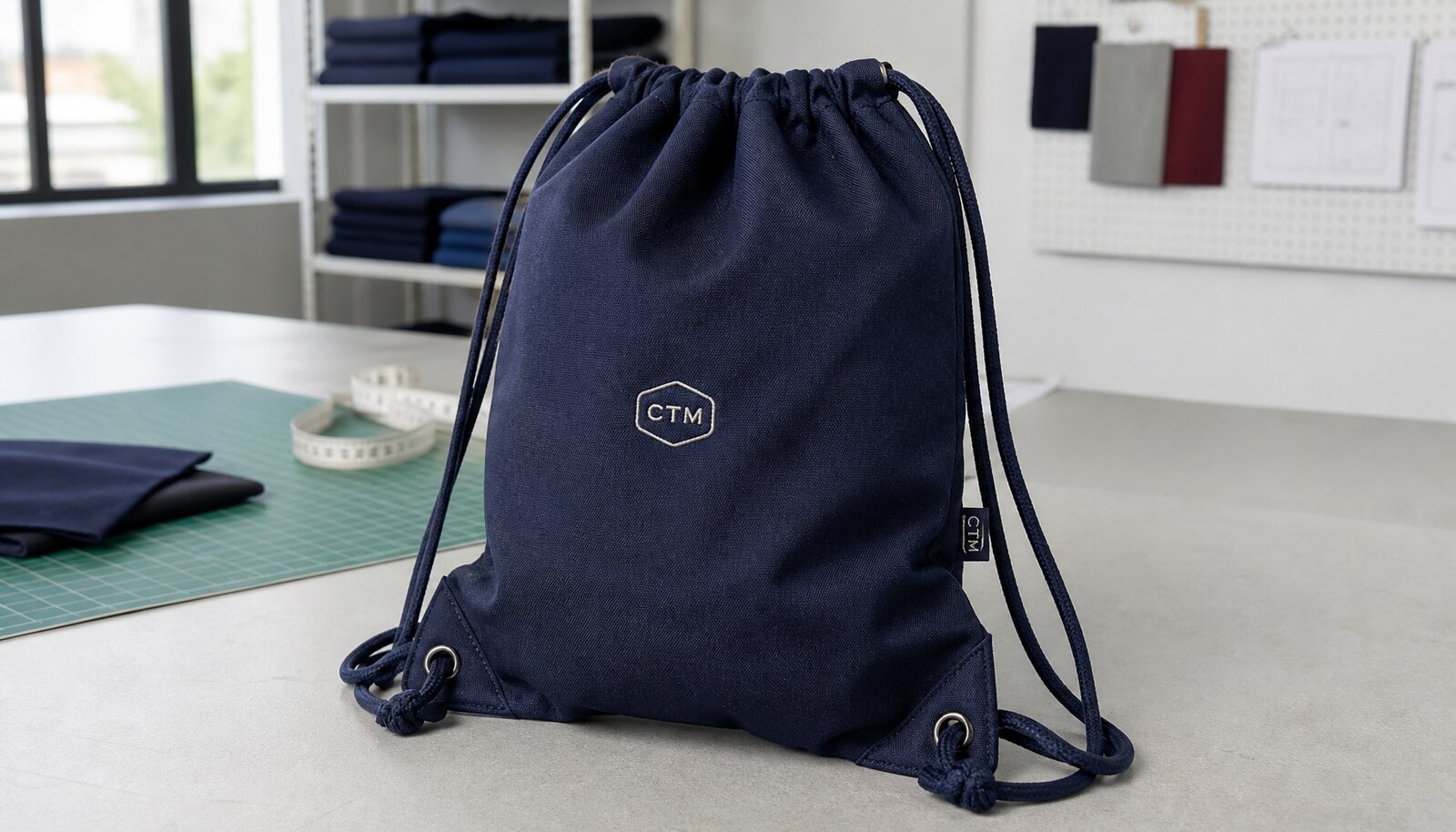
What buyers usually mean when they ask for an embroidered drawstring backpack
An embroidered drawstring backpack is a lightweight cinch bag with a stitched logo, emblem, or monogram applied to the shell fabric. In procurement terms, it sits between a simple giveaway bag and a retail accessory. The embroidery is not just decoration: it changes the fabric behavior, machine time, sample process, and quality standard you need to write into the PO.
Most buyers source this product for event kits, school programs, sports promotions, retail gifting, club merchandise, or brand bundles. Those use cases can look similar on a spec sheet, but they behave differently in production. A campaign bag may prioritize unit cost and fast delivery. A retail or premium program usually needs better fabric handfeel, tighter logo placement, cleaner packing, and more consistent appearance across cartons.
The most useful way to scope the order is to define the end use before you talk about decoration. If the bag is going to a conference floor, a simpler shell and a modest embroidery size may be enough. If it will sit in a retail fixture, buyers should ask for cleaner panel behavior, more consistent folding, and thread colors that hold up under daylight. That distinction helps the factory quote the right level of labor and avoids overbuying features you will not use.
A common mistake is to treat embroidery like an optional add-on. On a drawstring bag, embroidery affects panel stability more than a printed graphic does. Stitch density can pull thin fabric, heavier backing can change drape, and a poorly planned logo location can interfere with the cord channel or seam construction. That is why the quote should start with how the bag will be used, not just what the logo should look like.
For sourcing teams, the practical question is: do you need a promotional bag that simply carries an embroidered brand mark, or a product that can survive retail scrutiny? The answer changes everything from fabric choice to carton loading. If the order is for reorders and repeat seasons, spend more time on the first sample. If it is a one-time campaign, lock the simplest workable spec and avoid extra variants that can slow production.
There is also a difference between a bag that looks good in a photo and a bag that stays consistent across a production run. Buyers who only review one sample sometimes miss small production shifts such as looser thread trim, a slightly stiffer front panel, or a more compressed fold. Those shifts matter most when the product is used for brand gifting, where the bag itself becomes a reflection of the buyer's own standards.
In short, the product category is simple, but the sourcing decision is not. The faster you define use case, decoration level, and presentation standard, the easier it becomes to compare suppliers on the things that actually affect delivery and resale value.
- Common buying use cases: events, sportswear bundles, education programs, retail gifts, club merchandise
- Main sourcing risk: assuming embroidery is a decoration step rather than a construction variable
- Best fit: orders where tactile branding matters more than full-surface print coverage
- First decision: promotional durability or retail presentation
Choose the fabric first, because embroidery behaves differently on each shell
Fabric selection is the foundation of a clean embroidered result. Thin shells can keep the unit cost low, but once the needle pattern becomes dense, the fabric may draw in, ripple, or show the stabilizer behind the stitches. That is why buyers often get better results with 210D or 300D polyester when the goal is a simple branded giveaway, while 6–10 oz cotton canvas is usually better for a softer retail feel or a more premium handfeel.
The spec should state the finished fabric weight, not just the raw fiber type. In supplier conversations, ask whether the weight is measured before or after coating, washing, or finishing. A 210D polyester shell with coating can feel and sew differently from an uncoated shell of the same name. For cotton, ask whether the fabric is plain weave or canvas, whether it is pre-shrunk, and whether the dye lot is consistent across the run. Those details matter because embroidery can expose fabric inconsistency that a plain bag would hide.
If the bag must stand upright in a retail fixture, look for a fabric and reinforcement combination that gives the front panel enough body. If the bag should fold flat for mass distribution, too much stiffness may be unnecessary and could raise cost. Buyers often overlook that this decision affects not only appearance but also carton density, freightable weight, and how the logo sits after folding.
A practical rule is to match fabric weight to logo density. A small monogram on a light shell is usually safe. A large fill-stitch logo on the same shell may need backing, a larger stitch spacing, or a stronger panel construction. If the supplier cannot explain the relationship between fabric and embroidery, ask for a sample stitched on the same base fabric you intend to buy. That is the quickest way to see if the panel will hold shape or start to tunnel around the logo.
For larger orders, also ask where the supplier sources the shell material. If the factory buys from multiple mills, slight differences in handfeel, coating, or dye lot can show up between cartons. That is not always a defect, but it should be controlled. A buyer who needs repeatability should specify a reference sample and a permitted tolerance for shade variation, especially if the bag color is dark and the embroidery thread is bright.
When embroidery is large or dense, the bag usually needs backing or a light stabilizer. This adds a small amount of material and process cost, but it often reduces rework. If a supplier refuses to explain how they stabilize the logo area, ask for a sample from the same fabric before approving the order. The answer will tell you whether they are quoting from real production knowledge or simply guessing at a decoration method.
The best fabric is not the thickest one. It is the one that matches the intended use, embroidery size, and pack format without creating wrinkling, excess weight, or a higher rejection rate during inspection.
When the purchase is for a promotion rather than a long retail run, simplicity wins. One shell color, one logo location, and one fabric construction reduce risk more than chasing the lowest nominal fabric cost. That is especially true when the bag will be handled repeatedly during distribution or kitting, because a more delicate shell may cost less on paper but more in failed packs and returns.
For teams writing an RFQ, it helps to state the fabric goal in plain words: soft, structured, lightweight, or premium. Then translate that into the actual material spec. That way the factory knows whether it should optimize for handfeel, cost, or print-and-stitch stability.
- 210D–300D polyester: lower cost, lighter weight, good for bulk campaign bags, but usually needs stabilizer under embroidery
- 6–10 oz cotton canvas: stronger handfeel and more retail-friendly, but heavier freight and sometimes slower sewing
- Thin fabrics: only suitable for small logos or low stitch density unless reinforced
- State whether the bag must stand upright, fold flat, or sit in a retail shelf pack
Embroidery specs that control cost, appearance, and factory behavior
Embroidery pricing is not driven by logo image alone. It is affected by stitch count, number of colors, digitizing complexity, backing use, machine setup, and whether the factory can run the decoration in the same workflow as cutting and sewing. A simple one-color monogram can be quick to program. A multi-color logo with fine text, small negative spaces, or irregular curves can require more digitizing time and more machine attention, which is where cost and schedule start to rise.
To compare offers properly, define the stitched area in millimeters or inches. Avoid phrases like “medium logo” or “normal size,” because suppliers interpret those differently. If the artwork is being converted into embroidery for the first time, ask whether the digitizing fee is included. Also ask whether a sample run is included, because some suppliers quote thread and machine time separately from setup. That difference can make a low headline price look attractive while hiding the actual landed cost.
There are a few practical thresholds buyers can use when reviewing quotes. A logo that is small enough to stay well away from seams and cord channels is easier to reproduce consistently. A logo that covers a very large part of the front panel may look premium, but it can stiffen the bag and slow sewing. If the artwork uses more than three thread colors, or if the design contains fine text, ask the supplier to show a stitched sample rather than relying on a screen proof.
A useful rule of thumb for quote comparison is to ask what the supplier is actually pricing. Is the price for a stitched logo under a certain stitch count? Does it include a second thread change? Does it assume the artwork is already digitized? Does it include a test run on the same fabric? Those are the details that separate a serious offer from a placeholder quote. When the gap between two suppliers is small, the one that explains the stitch assumptions more clearly is usually the safer choice.
You should also ask how the supplier handles thread shade variation. Not every factory keeps an equally stable thread library. If your brand color is specific, ask for a thread reference card or an approved shade note. Without that, two factories can both say the same color name while producing noticeably different results under normal light.
One more point buyers often miss: dense embroidery can affect the bag's functional opening. If a logo is too close to the cord channel, it can stiffen the upper panel and make the opening less smooth. If the design is too wide, it can pull the fabric and make the bag appear crooked even if the logo itself is correctly stitched. That is why maximum logo size should be tied to a bag dimension, not treated as a standalone design choice.
For procurement, the goal is not just to get a beautiful logo. It is to get a repeatable logo. Repeatability is what protects your future replenishment orders, because a design that only works once is expensive to manage later.
As part of the RFQ, ask suppliers to quote the same artwork at two stitch-count scenarios if you are unsure about density. For example, a light version for campaign use and a fuller version for retail use. Even if you only place one order, the split quote tells you where the real cost sits: digitizing, thread, or machine time.
In supplier terms, the embroidery spec is the difference between a stable repeat order and a one-off project. The cleaner you write it, the less the factory has to guess.
- State logo width and height, plus a maximum stitched area if you have one
- Limit early orders to 1–3 embroidery thread colors if schedule and cost matter
- Ask whether the price includes digitizing, run sample, thread, stabilizer, and machine setup
- Confirm if all color variants can use the same embroidery program
- Request a stitched sample if the logo has small text or dense fill areas
How to compare sourcing routes without missing who really owns the risk
The sourcing route can matter as much as the product itself. A factory that cuts, sews, and embroiders in one site usually has fewer handoffs, which helps when logo placement and panel tension need coordination. If the order goes through a trading company or sourcing office, the quote may still be useful, but the buyer should ask a very direct question: where is the embroidery actually done, and who pays for rework if the first run is off-center or distorted?
Direct factory sourcing is often the better route for repeat programs, especially when the logo must land in the same place across replenishment orders. The upside is stronger control over stitch quality, fabric compatibility, and packing consistency. The tradeoff is that some factories are less flexible on small, highly customized runs, because they prefer to optimize machine time and may require a cleaner artwork package before they commit.
A trading layer can be useful when you are combining multiple SKUs, but it can also hide the real production bottleneck. If the embroidery is subcontracted, ask whether the subcontractor is dedicated to your account or shared across other orders. Shared capacity often means more schedule noise. It also makes sample revision harder to trace because the person quoting the order may not be the person seeing the production unit.
There is a third route that buyers sometimes use: local decoration paired with offshore bag making. That can work for certain markets and urgent jobs, but it introduces another handoff. If you take that route, clarify who confirms the logo alignment, who checks thread color, and who handles a failed first article. Otherwise the final responsibility can become unclear when the order is already late.
The practical threshold is simple: if your order is more about a tight launch date than about the lowest unit price, prioritize fewer handoffs. If your order is more about combining many products into one purchase flow, a trading layer can be acceptable, but only if the quote clearly identifies the embroidery plant and the rework owner. Without that, price comparisons become harder to trust.
For B2B procurement, the main decision is not which route sounds easiest. It is which route gives you the clearest ownership of quality, timing, and corrective action if the logo does not match the approved sample.
When comparing suppliers, ask for one photo from the actual production line or first sample, not just a sales rendering. A real production photo reveals panel tension, machine alignment, and how the embroidery sits relative to seams. It is a simple request, but it often exposes whether the supplier truly controls the process or is only brokering it.
- Direct factory: tighter control, fewer handoffs, clearer corrective action
- Trading layer: easier for mixed-category sourcing, but quote transparency is weaker
- Outsourced embroidery: ask who owns rework if placement or thread shade fails
- For brand programs, request the name of the actual embroidery facility
How to read quotes so the low number does not hide the real cost
A usable quote for an embroidered drawstring backpack should separate the body bag, embroidery, packing, cartons, and any setup charges. If a supplier gives one all-in figure, ask them to break out the assumptions behind it. In particular, check whether digitizing is included, whether thread changes are free, whether the pack spec is standard or retail-style, and whether cartons or inner bundling are extra. A cheaper quote can become the expensive quote once those items are added back.
One practical comparison method is to build the landed cost around the first shipment rather than only the ex-factory unit price. Include sample freight, approval revisions, setup fees, carton upgrades, packing labor, and the freight impact of fabric weight. If one supplier offers a slightly higher unit price but lower defect risk and cleaner packing, that can be the better business decision. The quote should help you see that tradeoff instead of hiding it.
Be careful with quotes that assume very light embroidery without stating stitch count. The supplier may be pricing a small, sparse logo while you are expecting a full, dense fill. Similarly, a quote can look competitive if it assumes loose pack standards or bulk carton packing, but your downstream warehouse may have to spend extra labor repacking the goods. That labor should be part of the comparison if the bag is going into retail, fulfillment, or kitting.
A useful buyer threshold is this: if two offers differ by a small amount, the one with clearer specs and better QC terms is usually the safer one. If the cheaper quote cannot explain its setup, ask whether the difference is fabric weight, stitch count, or packing. The real sourcing risk is not that a quote is high. It is that it is incomplete.
For repeat orders, also ask what remains constant on reorder. Some suppliers will hold the same embroidery file but change thread lot, fabric supplier, or packing subcontractor. That can lead to subtle differences in appearance. The quote should tell you what is locked and what can move.
A good quote comparison also separates one-time charges from recurring charges. Digitizing, sample corrections, and label setup may be one-time costs. Thread, labor, fabric, and packing are recurring. If the supplier blends them together, it becomes hard to know whether the unit price will really hold on reorder. Ask for the line items in writing so your finance team can compare apples to apples.
A practical example of line items to request is: blank body unit price, embroidery setup, digitizing, thread consumption, stabilizer/backing, inner polybag, carton, carton mark, sample courier, and inland transfer if applicable. Even if a factory does not charge every line separately, asking for the breakdown shows where the price is built and where the risk sits.
- Compare ex-factory price, setup fees, sample fees, packing fees, and freightable weight together
- Ask whether embroidery thread color changes are free or charged per change
- Check whether cartons are included in the unit price or billed separately
- Use the same pack count when comparing suppliers, otherwise price comparisons are misleading
- Ask what assumptions the supplier used for stitch count and logo size
MOQ logic: what actually pushes the minimum order up or down
MOQ for an embroidered drawstring backpack is rarely a single fixed number. It moves with fabric availability, embroidery setup, the number of artwork versions, thread color changes, pack format, and whether the supplier can combine your order with other runs on the same machine. A one-color logo on a standard shell may be accepted at a lower quantity, while multiple logo versions, special labels, or retail packaging can push the minimum higher because each variable adds setup and inspection work.
Buyers trying to test demand should simplify the order structure. Keep one shell color, one logo version, and one packing style if possible. If you need several customer segments or campaign variants, split them into later replenishment rounds. That approach reduces the risk of dead stock and makes it easier for the factory to hold a stable embroidery setting across the run. It also helps you learn what the market really wants before you layer on customization.
There are a few procurement thresholds worth watching. If the order is small and the logo is simple, ask for a quote at 300, 500, and 1,000 pieces so you can see where the price curve changes. If the order includes retail labels, hangtags, or barcode stickers, check whether those items have their own MOQ. Some factories will quote the bag MOQ separately and then add a higher MOQ for custom packaging components. That can change the economics more than the bag itself.
A concrete scenario helps here. Suppose Supplier A offers 500 pieces at one price with standard folding and no custom labels, while Supplier B gives you a slightly lower bag price but requires 1,000 pieces to cover a custom hangtag and boxed inner pack. The lower unit price may not matter if you cannot sell or store the extra inventory. That is why MOQ should always be judged against the total order plan, not just the bag line.
Be careful about trying to lower MOQ by accepting a spec that is too loose. Sometimes buyers ask for a very small order and then accept a simplified sample that does not match the final business need. That can create a false approval and a difficult reorder later. The better approach is to simplify the variant structure, not the core quality requirements.
If a supplier says the MOQ is flexible, ask what part is flexible: shell color, embroidery design, packing format, or price. That question usually reveals whether the flexibility is real or only a sales promise.
You can also use a split-order strategy if the supplier allows it. For example, one base color and one logo at the initial MOQ, then a small replenishment order for a second color after sell-through. That is often safer than forcing several variants into the first production run. It lowers the chance of tying up cash in slow-moving stock and keeps the embroidery setup more stable.
The key is to separate a production minimum from a commercial minimum. A factory may technically accept a low quantity, but the cost per piece may only make sense at a much higher volume. Ask for both the minimum they can run and the point where the price becomes commercially reasonable.
- One body color plus one logo version usually gives the lowest practical MOQ
- More embroidery colors often means more setup and higher minimums
- Custom hangtags, barcode labels, or retail inserts can raise packing MOQ
- Ask for tiered quotes at 300 / 500 / 1,000 pcs if you are testing demand
- Clarify whether the MOQ changes if the embroidery is repeated on a reorder
Sample approval: the checks that matter before you commit to mass production
A flat artwork proof is not enough for this product. The sample should show the actual fabric, stitch density, stabilizer, cord length, seam construction, and final packed condition. Under normal room light, check whether the thread tone matches the brand reference and whether the logo sits level on the front panel. A design that looks fine on screen can still show puckering, compression, or a slightly twisted presentation once it is stitched onto a real shell.
Functional checks are just as important as cosmetic checks. Open and close the bag several times, pull the cords through full closure, and inspect whether the top opening closes evenly. If the embroidery is large, fold the bag and see whether the stitched area creases in an ugly way. That matters for retail display, but it also matters when cartons are stored tightly and then reopened later. Compression can make a good-looking logo look tired before the product ever reaches the customer.
If the supplier can provide a first article or PP sample, ask for one that uses the same fabric lot and thread lot intended for bulk production. If that is not possible, at least make sure the sample note explains what is different. A sample from a different lot may still help with logo placement, but it is not a complete approval for color consistency or fabric handfeel. That distinction matters if your buyer team is comparing one supplier against another.
The approval pack should include a physical reference sample and a photo record with measurements. Keep the approved piece labeled with date, version, and supplier name. That makes reorder discussions much easier, especially when the sales team changes or when the next buyer is not the person who signed the first order.
Before approval, ask the supplier to confirm three things in writing: the exact embroidery size, the approved thread shade, and the final pack method. Those three items are the ones most likely to drift between sample and bulk run. If they are locked early, the production team has less room to reinterpret the job.
It is also worth checking the sample under different lighting if the logo color is brand-critical. Some threads look acceptable under office light but shift noticeably under daylight or retail warm lighting. That is not a defect in itself, but it should be known before order release so procurement and marketing are aligned.
In practice, the best sample is not just one that looks good. It is one that gives the factory a clear production standard they can repeat without reinterpretation.
- Require a pre-production sample with final fabric, thread, label placement, and packing style
- Check stitch density, edge smoothness, and logo centering under normal light
- Test cord action and opening symmetry before signing off
- Keep one approved physical sample and one photo record with measurements
- Note any sample differences in lot, thread shade, or stabilizer so production expectations stay realistic
Packing decisions that affect shelf appeal, warehouse handling, and damage risk
Packing is often treated as an afterthought, but for an embroidered bag it can change the customer’s first impression. Overly tight compression can flatten the logo and leave crease lines where the thread has been pressed against the carton or polybag. Flat packing is usually efficient for bulk distribution, but retail buyers may want a cleaner fold, a supporting insert, or a clearer bag presentation so the embroidery faces outward and does not rub.
The pack spec should include the polybag thickness, whether the bag is folded once or twice, carton count, and whether cartons are lined or moisture-protected. If the goods will sit in long-haul freight, humid storage, or cross-docked distribution, simple moisture control can prevent odor and surface marking. Ask the supplier to explain how cords will be arranged inside the pack so they do not tangle or snag the embroidered area.
A retail-ready pack often costs a little more because it needs more labor. The tradeoff is less repacking later and a cleaner presentation at the point of sale. For warehouse or promotional distribution, the cheapest pack is not always the smartest pack. If your downstream team will count and kit the bags, a consistent inner bundle count may save more labor than it costs in supplier packing time.
If you have barcode or SKU labels, define exactly where they should go. A label placed over the logo or across a fold line can create a cosmetic problem or interfere with scanning. The same is true for warning labels or care instructions. Clarify whether the label is on the polybag, the carton, or the bag itself, and tell the supplier if label placement must remain outside the embroidered panel.
A practical packing example: if your warehouse wants 10 pieces per inner bundle and 100 pieces per carton, state that in the RFQ and ask the factory to confirm the gross weight and carton dimensions. If the supplier instead chooses its standard 20-piece bundle, you may save a little packing labor at source but create more handling work at the destination. That is why pack format should be compared alongside unit price.
The safest rule is simple: the pack should protect the embroidery, preserve the fold, and help downstream handling. If it does not do all three, it is probably worth revising.
- Specify fold method and count per polybag to avoid inconsistent packing
- Use carton inner bundling if you need quick warehouse counting
- Protect embroidered surfaces from pressure points and sharp carton edges
- Confirm barcode and SKU label placement before mass packing starts
- Ask whether moisture protection is needed for your shipping route or storage time
Lead time risks: where embroidered orders usually slip
Lead time on an embroidered drawstring backpack is longer than on a plain bag because you are managing both sewing and decoration. The schedule can slip at several points: artwork digitizing, sample revision, thread color approval, fabric cutting, embroidery capacity, and final packing. A delay in any one stage can affect the rest, especially if the factory holds production until the sample is fully approved.
The safest way to manage timing is to split the schedule into visible stages. Ask the supplier for a timeline from artwork approval to sample, sample approval to bulk cutting, bulk embroidery, and packing. If the supplier outsources embroidery, that handoff should be named in the schedule. Buyers should not assume that the sewing line timing is the whole timeline. In many cases, the embroidery queue is the bottleneck, not the sewing queue.
Some suppliers will quote lead time as if all materials are already in stock. That may be true for standard shells, but less true for custom colors, special thread, or branded labels. If your order depends on a specific shade or imported accessory, ask when that item is actually available. Otherwise the factory may quote from optimistic assumptions that only hold if nothing changes after the PO is issued.
For urgent programs, consider what can be frozen early. The more you lock the logo size, thread colors, and pack format before sampling, the less likely the order is to slip after sample approval. On the other hand, if the artwork is still being refined, do not force a production date that leaves no time for revision. That almost always creates a rushed approval and a more expensive correction later.
A realistic lead-time discussion is one that identifies the slow step. Ask the factory, in plain terms, where they lose time most often. That question reveals more than a generic “it depends.” If they say digitizing is the bottleneck, ask whether they can start it before sample approval. If they say embroidery is the bottleneck, ask for the daily capacity and whether your order will be queued behind existing work.
For buyers working to a launch date, ask for a schedule that shows both best case and normal case. The best-case timeline is useful, but the normal-case timeline is the one to build into your internal plan. That helps your team avoid overpromising to sales, marketing, or event operations.
- Digitizing and sample approval are common hidden schedule risks
- Embroidery capacity can be the bottleneck even when sewing capacity is available
- Outsourced decoration adds coordination risk and usually longer rework time
- Confirm what happens if one thread color or logo revision changes after approval
- Ask whether all raw materials are already on hand or still pending
QC thresholds buyers should write into the PO, not leave to memory
If the purchase order does not define acceptance thresholds, quality arguments become subjective. For this product, the most useful controls are logo position tolerance, allowed stitch defects, seam strength at stress points, thread trim quality, pack accuracy, and surface cleanliness. A bag can look acceptable from a distance yet still fail because the embroidery puckered the fabric, the logo tilted slightly, or the cords were cut unevenly.
The QC note should also cover odor, dirt, and carton condition, because embroidered bags are often used for consumer-facing programs. Make sure the factory knows that loose threads, needle marks, visible glue residue, and crooked labels are not acceptable. If the bags are going into retail, a school pack, or a branded giveaway to clients, the cosmetic standard should be higher than a rough event handout. Buyers should be explicit about that difference instead of assuming the supplier knows the end use.
When you set tolerance, write it in measurable language wherever possible. For example, define how far off-center the logo may be, what viewing distance applies to cosmetic defects, and what seam issues count as rejectable. If your team does not have a formal QC manual, even a short PO addendum is better than a vague approval note. The point is to reduce the chance that the factory considers a defect acceptable simply because it is common in their own production flow.
A strong QC plan also includes carton checks. Cartons should remain square, dry, and free from crush marks. If a carton was compressed hard enough to flatten the embroidery, that should be treated as a packing failure, not just a freight issue. This matters because the bag often reaches the buyer or end customer in the same condition it left the carton.
A practical set of acceptance criteria helps both sides. For example: logo placement within the approved tolerance, no visible skipped stitches, no open seam at the cord channel, no loose thread tails longer than a short trim allowance, and no staining or smell that would be noticeable on opening the carton. Those are the details most likely to trigger customer complaints later, so they should be checked before shipment release.
For repeat orders, keep the QC language stable. If you change the acceptance rule every time, the supplier cannot build a reliable production standard. Consistency is what protects reorders.
- Define logo placement tolerance instead of writing only “centered”
- No visible loose thread ends or skipped stitches in the normal viewing distance
- Seams at cord channel and bottom corners must pass load and visual inspection
- Pack count and SKU labeling must match the PO before shipment release
- Set a cleanliness standard for smell, stains, and residue, especially for retail use
Specification comparison for buyers
| Spec decision | Recommended option | When it fits | Supplier-side tradeoff | Buyer risk to check |
|---|---|---|---|---|
| Fabric base | 210D–300D polyester or 6–10 oz cotton canvas | Promotional, retail, school, or event programs where logo clarity matters | Polyester usually gives lower unit cost and easier moisture resistance; canvas can look better but adds weight and can raise freight cost | Too light and the panel collapses; too heavy and the bag may lose drawstring ease or add stitch tension |
| Embroidery placement | Upper front panel or centered chest area with 1–3 logo colors | Brand-led orders where the logo should read first from a short viewing distance | A centered logo is easier to reproduce consistently; edge placements can force extra stabilizer and more machine rework | Large stitched areas can stiffen the bag and slow output; close-to-seam placement raises misalignment risk |
| Thread type | Polyester embroidery thread with colorfast dye | Any program that expects handling, light washing, or outdoor use | Better thread tends to cost a little more but reduces fray, dullness, and shade drift across production lots | Low-grade thread can bleed, fuzz, or show contrast issues under daylight and flash photography |
| Backing/interfacing | Light stabilizer behind the embroidery panel | Thin fabrics and dense stitch counts | Adds material and a small extra handling step, but usually lowers rework from puckering | Without backing, the panel may tunnel, wrinkle, or warp around dense logos |
| Order route | Direct factory with in-house embroidery | Medium to large replenishment orders with repeat artwork | Tighter control, fewer handoffs, easier corrective action; may require cleaner artwork and firmer PO discipline | If the factory outsources decoration, lead time and accountability become less transparent |
| MOQ strategy | One shell color with limited embroidery variants | First-time programs and market tests | Fewer colorways reduce setup, thread changeovers, and dead stock; more variants increase labor and risk | Do not accept a headline MOQ without clarifying MOQ by color, by artwork, and by pack format |
| Packing format | Flat pack with count-based inner bundling | Warehouse distribution and high-volume campaign packs | Flat packing is efficient but can compress embroidery; retail-style folding improves presentation but adds labor | Loose packing can distort cords, wrinkle the logo area, and increase repacking labor |
| Sample approval route | Pre-production sample with exact thread colors, stabilizer, and packing reference | Any order with strict brand color or logo placement requirements | A full PP sample takes more time than a simple proof, but it is the only way to verify panel behavior and logo density | Approving only artwork proofs can miss puckering, seam issues, and pack presentation problems |
| Supplier type | Factory that controls cutting, sewing, and embroidery in one workflow | Orders needing tighter QC and faster corrective action | One-owner process usually reduces blame-shifting and rework delays; may narrow your pool of available suppliers | Trading layers can hide who actually owns stitch accuracy, rework cost, and final inspection |
Buyer checklist before sampling
- Confirm fabric type and finished GSM/oz, then state whether you want a structured bag or a softer foldable bag.
- Specify embroidery size in mm, stitch density expectations, and logo placement on a tech pack or annotated artwork.
- Request MOQ by color, by embroidery design, and by carton pack format, not just one headline MOQ.
- Approve a pre-production sample that shows actual thread colors, seam construction, cord length, and packed condition.
- Set acceptance thresholds for logo registration, puckering, loose threads, seam strength, and odor/cleanliness.
- Ask for packing data: polybag spec, barcode label location, carton count, carton size, and gross weight.
- Compare lead time separately for blank body production, embroidery setup, sample approval, and final inspection.
- Request quote breakdowns for fabric, embroidery, digitizing, packing, cartons, and inland handling.
- Confirm whether embroidery is done in-house or outsourced, and who signs off the final shipment quality.
- Ask for a thread color reference card or Pantone-to-thread match note if your brand standard is strict.
Factory quote questions to send
- What fabric weight do you recommend for this embroidered drawstring backpack, and what is the actual GSM or oz after finishing?
- Is the embroidery done in-house, and what is the maximum logo size you can stitch cleanly without panel distortion?
- How many stitches are included in the quoted embroidery, and how does the price change if the stitch count increases?
- What is the MOQ by color, by logo version, and by carton packing specification?
- Can you provide a pre-production sample with the exact thread colors, stabilizer, cord type, and label placement?
- What is your standard packing method, and can you quote an alternative pack for retail shelf presentation?
- How long is the lead time after sample approval, and what part of the schedule is most likely to slip?
- Which QC points do you inspect before shipment: stitch balance, logo alignment, cord function, and carton drop resistance?
- If the logo color changes, do you treat that as a new setup charge or the same embroidery file?
- Will you share a photo of the first production unit for approval before bulk packing starts?
Quality-control points to confirm
- Embroidery centered within the approved tolerance, with no visible skew or logo compression.
- No puckering, tunneling, or stabilizer shadow around the stitched area.
- Cord runs smoothly through the channel, with both ends cut cleanly and secured.
- Top opening closes evenly and the bag can support the agreed load without seam failure.
- Front and back panels match the approved fabric shade, and thread color matches the reference under normal light.
- Stitching at stress points, especially bottom corners and cord channels, is even and tight with no skipped stitches.
- Packed units count correctly per polybag/carton and labels match the approved SKU structure.
- Cartons remain square and dry, with no crush damage to embroidered surfaces during handling.
- No loose thread tails, needle marks, glue residue, or oil stains visible at normal viewing distance.
- If a hangtag, barcode, or warning label is required, its position should not block the logo or interfere with folding.