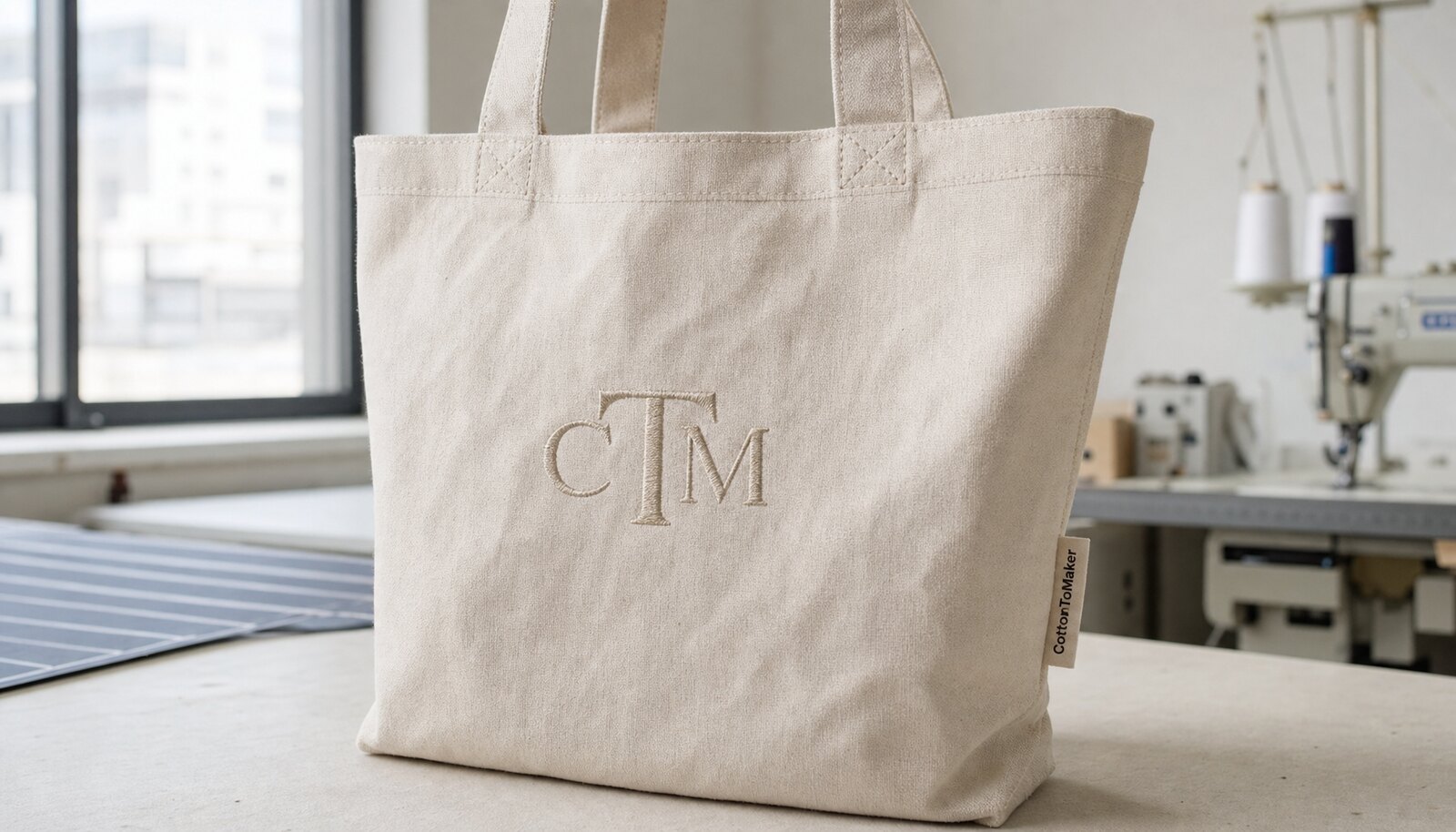
Why embroidery changes the buying brief
An embroidered canvas bag is not just a tote with a logo added at the end. The decoration changes how the fabric behaves, how the factory schedules the job, and what kind of defects you need to police. Buyers often compare quotes as if the bag body is the main cost driver, then discover later that stitch count, logo size, and backing material are what moved the price and the lead time.
The right buying frame depends on use. For retail, a cleaner stitch, a heavier canvas, and tighter packing matter more than the absolute lowest unit cost. For promotions or events, the priority may be shorter lead time and a controlled decoration area. If the artwork has tiny text or fine lines, embroidery may need to be simplified or combined with a woven label or print element so the final bag stays readable.
- Best fit: retail merch, premium giveaways, membership packs, and branded resale.
- Poor fit: very small text, photographic art, gradient-heavy logos, or ultra-low budget campaigns.
- The main buying risk is not the tote body alone, but the way the embroidery changes the sewing process and inspection standard.
Set the base canvas before artwork
Start with the canvas specification before you talk about logo placement. For a light promotional tote, 10 oz canvas is often enough, but for a retail embroidered canvas bag, 12 oz to 14 oz is usually a safer baseline because the fabric holds stitch tension better and hangs with more structure. In metric terms, that puts you around 340 to 475 gsm. If the bag needs a premium feel or repeated carrying, 16 oz or about 545 gsm may be more appropriate, but it will change sewing behavior and cost.
Weave openness matters as much as GSM. A loose weave can distort under dense embroidery, especially around large filled areas. Pre-shrunk or sanforized fabric is useful when size stability matters, because embroidery and pressing can both change the finished dimensions. If the bag will be dyed, bleached, or garment washed, state that early, because shade variation and shrinkage can move outside the normal retail tolerance.
- Practical baseline for many retail programs: 12 oz to 14 oz canvas, reinforced handles, and a clean side seam or gusset.
- If the logo is dense, avoid very soft or open weave fabric because the stitches can pull the face fabric out of shape.
- If you need a structured presentation, ask for bottom board, lining, or heavier reinforcement at the handle anchor points.
Choose the embroidery build
The embroidery method should follow the artwork, not the other way around. Direct embroidery is best for bold logos, simple icons, and short text. Applique works when a large filled area would otherwise need too many stitches and cause stiffness or distortion. A woven patch can solve fine detail problems, while screen print can carry small text or legal copy that embroidery should not attempt. A hybrid bag is often the most commercial answer: embroidery for the brand mark, print or label for the tiny detail.
Thread choice also changes performance. Polyester thread usually gives better wash fastness and color stability than rayon for most bag programs. Backing is not optional when the stitch count rises, because it helps prevent puckering and keeps the front face clean. As a working rule, if the logo is larger than a palm, or if the art has filled areas with high stitch density, ask the factory to show a strike-off on the actual canvas before bulk approval.
- Keep text large enough to read after stitching; very small lettering usually needs a print or woven label instead.
- Ask for the embroidery size in millimeters, not just the logo name, so suppliers quote the same decoration area.
- Use a backing plan for dense fills, dark thread on light canvas, and any design that sits close to a seam.
Compare sourcing routes before you quote
The supplier route affects quality more than many buyers expect. A direct cut-and-sew factory with in-house embroidery usually gives the most control over fabric, placement, and carton packout, but it may not be the cheapest on a small order. A trading company can simplify the process if you need multiple factories or mixed product lines, but then you need stronger spec control because the real maker may change from one order to the next. A local decorator can be useful for short runs, yet the blank tote may not be built for long retail use.
The table above is meant to stop buyers from comparing apples to oranges. For an embroidered canvas bag, the best supplier route is the one that can repeat the same stitch quality, bag body, and packing method without forcing you to rewrite the spec every reorder. If the factory cannot show a sample with your fabric and your artwork scale, the quote is not production-ready, even if the unit price looks clean.
- Choose a direct factory when repeatability and line control matter more than a slightly lower first-order price.
- Choose a dual-source route when decoration quality is critical and you have the capacity to manage incoming QC.
- Choose a local decoration route only when speed or small quantity is more important than long-run retail consistency.
Write an RFQ that gets usable quotes
Most bad quote comparisons start with vague artwork instructions. A workable RFQ for an embroidered canvas bag should include the bag dimensions, canvas GSM, color, handle length, embroidery placement, embroidery size, stitch count target, and thread colors. Add whether the bag needs a lining, top closure, inner pocket, or bottom board. If you want the quote to be usable for finance and logistics, also include the destination port, shipping term, carton count target, and whether you need retail-ready labeling.
A complete quote should split the bag body from the decoration and the packing. That means separate line items for blank bag, embroidery setup or digitizing, sample cost, packing method, and any label or hangtag work. If the supplier only gives one lump sum, you lose the ability to see where a change in artwork, color count, or carton pack is driving the number. That becomes a problem when the second order looks different from the first and nobody can explain why.
- Quote data to request: canvas GSM, bag size, handle length, embroidery size, stitch count band, thread colors, MOQ, sample charge, packing spec, and lead time.
- If the logo has fine text, ask the supplier to propose a simplified stitch version and a print or label alternative for the small detail.
- Use one reference sample or one approved tech pack for all suppliers, or the quotes will not be comparable.
Approve the sample with measurable limits
The sample stage should freeze the parts that can drift in bulk. For embroidery, the important point is not only the look, but the stitch height, thread tension, backing behavior, and placement relative to the seam or gusset. A good pre-production sample tells you how the bag behaves after pressing and folding, not just how it looks flat on a table. If the supplier only sends a digital mockup, you still do not know how the canvas will react under the needle.
Set acceptance limits before bulk release. A practical QC framework includes size tolerance, logo position tolerance, stitch density consistency, color match under daylight, and no visible puckering or oil marks on the front panel. If the bag will be shipped in retail packaging, inspect the fold line too, because a bag that ships flat can still arrive with the embroidery crushed or marked by the polybag.
- Approve a physical strike-off or pre-production sample on the real canvas, not just a render.
- Freeze thread color codes and embroidery size after sample approval so the factory cannot substitute a close match without notice.
- Keep one signed sample as the gold seal for bulk inspection and reorder comparison.
Specify packing and retail readiness
Packing is where many otherwise good embroidered canvas bags are downgraded in the buyer's eyes. An embroidered front panel can flatten if it is folded too sharply or packed against a hard carton wall. If the program is retail-facing, specify the fold direction, whether tissue or insert paper is needed, and how much air should remain in the polybag. A tight pack may save freight, but it can damage the presentation and leave permanent marks on the stitch area.
Do not treat labeling as an afterthought. Carton marks, barcode placement, country of origin labels, and retail hangtags all need to match the agreed pack plan. If you are selling through a distributor or retailer, ask the factory to show the final packed look in the sample stage. That is where problems usually appear: crooked barcode labels, crushed embroidery, inconsistent fold lines, or carton count mismatch.
- For premium retail, use a fold that keeps the embroidery face from pressing into sharp creases.
- For shipping efficiency, confirm carton pack count and outer carton dimensions before approving the final quote.
- If moisture is a risk on the route, ask for clean inner polybags and desiccant only if the market or ship lane needs it.
Protect the schedule from avoidable delays
Lead time is usually longer for embroidered bags than for plain canvas bags because the schedule has more gates. Art digitizing, thread sourcing, strike-off approval, canvas cutting, embroidery production, sewing, packing, and pre-shipment inspection all create separate timing risks. If the logo is new or the size is unusually large, digitizing and strike-off approval can take longer than the sewing itself. Buyers who only quote a bulk date without sample gates usually lose control of the calendar early.
Peak season risk is real. Thread color substitutions, canvas shade changes, and embroidery machine bottlenecks tend to appear when the factory is full. The safer move is to lock artwork and materials before booking the production slot. If you need a launch date, leave room for one revision cycle on the sample and one short delay on packing labels. That is still better than forcing a late change into bulk and accepting a weaker result.
- Separate sample lead time from bulk lead time in your project plan.
- Confirm whether the supplier can hold yarn, thread, and canvas color once the sample is approved.
- If the order is seasonal, ask the factory what part of the process is most likely to bottleneck and plan around that step.
Read landed cost, not unit price
A low unit price can be misleading if the quote hides decoration setup, special packing, or a weak MOQ structure. For embroidered canvas bags, the real cost picture includes the blank bag, digitizing or setup, sample fees, embroidery run time, backing material, packing, domestic handling, and the shipping term. A direct factory may look higher on paper, but if the quote includes cleaner packing and fewer handoffs, the landed cost can still be better than a split supplier route.
The most useful quote comparison uses the same bag size, same canvas GSM, same embroidery area, same stitch count range, same packing count, and same Incoterm. If one supplier quotes EXW and another quotes FOB, the numbers do not mean the same thing. Ask for a separate note on what changes if the stitch count goes up, the thread colors increase, or the packout changes from bulk to retail polybag. That is where hidden cost usually lives.
- Compare quotes on the same trade term, the same carton count, and the same embroidery size.
- Look for separate charges on digitizing, applique, patches, extra thread colors, and special packing.
- If one supplier refuses to split the quote into components, assume you will have less leverage later.
Avoid the usual buying mistakes
The common errors are predictable. Buyers approve artwork that is too small for embroidery, compare supplier quotes without fixing the canvas GSM, and forget that a strong logo on screen does not always stitch well on loose canvas. Another frequent mistake is assuming the first sample is the final production standard when the factory has not yet tested bulk sewing at full speed. That is how you end up with clean samples and noisy bulk output.
The safer workflow is straightforward: choose the base canvas, freeze the artwork scale, request a strike-off or sample on the actual material, approve the packing method, then release bulk only after the quote and sample match. When a supplier pushes for a faster yes without showing the real fabric and stitch behavior, treat that as a process risk, not a convenience. It usually means the supplier is not yet quoting the job you actually want.
- Do not approve embroidery size from a screen mockup alone.
- Do not let fabric shade, thread shade, or packing method drift between sample and bulk.
- Do not compare quotes until every supplier is using the same logo size, GSM, and packing count.
Specification comparison for buyers
| Spec decision | Recommended option | When it fits | Buyer risk to check |
|---|---|---|---|
| Direct cut-and-sew factory with in-house embroidery | Use one supplier that makes the bag body and runs embroidery in the same plant | Best for consistent placement, fewer handoffs, and private-label programs that need repeat orders | Confirm actual in-house machine capacity, stitch quality control, and whether embroidery slows the sewing line |
| Bag factory with subcontracted embroidery | Use a bag maker that outsources decoration to a nearby specialist | Works when the base bag is complex but the logo is standard and repeatable | Watch schedule slip, mixed quality standards, and unclear responsibility if the logo shifts or puckers |
| Trading company sourcing multiple factories | Use a sourcing partner that can assemble bag, decoration, and packing across suppliers | Useful when you need multiple options, mixed materials, or a wide SKU range | Compare hidden margin, verify the real factory, and demand the same spec across all quotes |
| Stock blank tote plus local embroidery | Buy blank bags and add embroidery close to your market | Fits short runs, event programs, test launches, and fast reorder needs | Check bag shade, seam strength, and whether the blank bag handles needle penetration cleanly |
| Small embroidery shop sourcing blanks | Have a decoration shop source the bag body for you | Can work for simple merch and very small orders | Confirm the bag is suitable for retail use, not just decoration, and inspect handle reinforcement |
| Full-package exporter with packing service | Use one exporter to handle bag, embroidery, labels, and carton packout | Good for retail buyers who want one PO and standard ship-ready packing | Make sure setup fees, packing fees, and labeling fees are separated in the quote |
| Domestic sample-first route | Make samples locally before moving bulk offshore | Useful when artwork is still moving or the market test is limited | Do not assume the local sample spec can be copied 1:1 without rechecking fabric and thread sources |
| Dual-source route with bag maker and embroidery specialist | Split the body and decoration across two suppliers with one owner managing QC | Best when decoration quality matters more than lowest unit price | Control incoming inspection, carton flow, and responsibility if either supplier misses tolerance |
Buyer checklist before sampling
- Freeze bag size, canvas GSM, color, and handle length before sending artwork.
- Send vector artwork with the target embroidery size, placement, and thread color count.
- State whether the decoration is direct embroidery, applique, patch, or a print-plus-embroidery hybrid.
- Request sample cost, digitizing cost, MOQ, bulk lead time, and packing method on one quote sheet.
- Approve a physical sample or strike-off before bulk release, not only a PDF proof.
- Specify carton pack count, polybag use, barcode placement, and any retail hangtag or insert card.
- Confirm the acceptable tolerance for logo position, stitch density, and bag measurements.
- Align the quote on the same trade term and shipping point so landed cost is comparable.
Factory quote questions to send
- What canvas weight, weave, and pre-shrink treatment will you use for this bag?
- Is embroidery done in-house or subcontracted, and who signs off the strike-off?
- What is the exact embroidery area, stitch count band, and number of thread colors?
- What are the separate charges for digitizing, sample making, and any special backing or applique?
- What is the MOQ per colorway and per artwork version?
- What packing method is included, and what are the carton size and pack quantity?
- What are the lead times for sample, pre-production confirmation, and bulk production?
- What QC standard do you use for puckering, thread breaks, color matching, and logo placement?
Quality-control points to confirm
- Bag dimensions and handle length stay within the agreed tolerance after sewing and pressing.
- Canvas weight matches the approved swatch and does not feel thin, loose, or uneven across the batch.
- Embroidery lies flat without puckering, tunneling, loose loops, or needle oil marks.
- Logo placement matches the approved sample in height, left-right position, and angle.
- Thread color matches the approved reference under daylight, not only under factory lighting.
- Stitch density covers the fabric cleanly and does not leave open gaps in filled areas.
- Handle reinforcement, bar tacks, and top stitching hold under normal carry load.
- Carton count, polybag spec, barcode, and outer mark all match the approved packing plan.