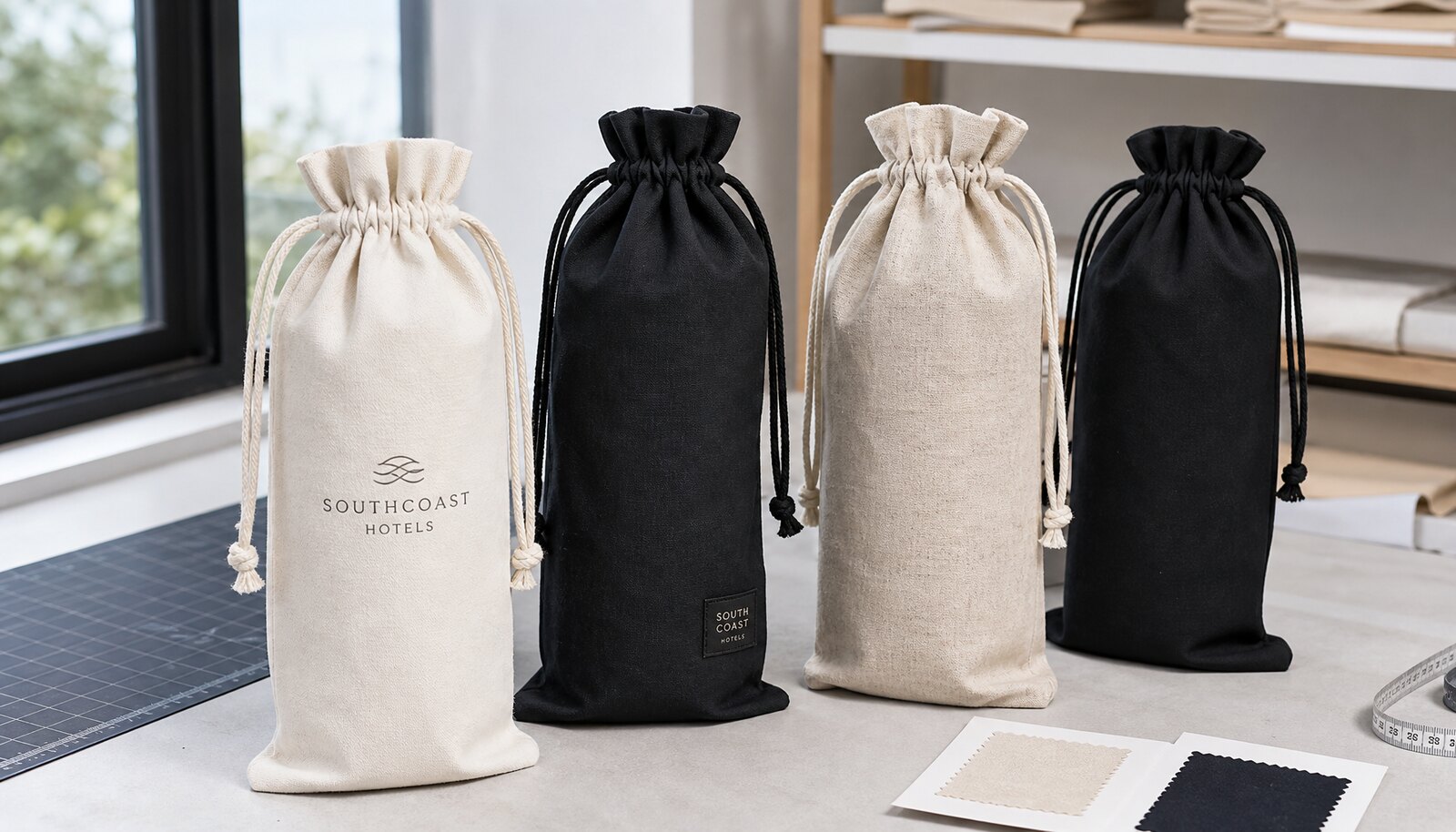
Why hotels buy drawstring wine bags instead of loose bottle packing
Hotels do not buy drawstring wine bags for packaging alone. The bag becomes part of the guest experience, part of the property brand, and in some cases part of the revenue model. A bottle placed in a well-made bag can move through welcome gifting, minibar retail, loyalty redemption, banqueting, and room-service delivery without looking improvised. For procurement teams, that means the bag needs to perform in presentation, protection, and packing efficiency at the same time.
The commercial problem is that many suppliers treat wine bags as a generic textile item. Hotel buyers usually need more than that. A bottle may be handed over at reception, displayed in a shop, stored in housekeeping stock, or moved through a distributor. Each use case changes the decision on fabric weight, seam strength, closure style, and decoration. If the spec starts with the bottle and use case, the sourcing process becomes far more predictable.
- Typical hotel use cases include welcome gifts, minibar retail, anniversary or VIP packs, banquet gifting, and in-room upsell bundles.
- The bag should protect the bottle from scuffs while still packing flat enough to control freight and storage costs.
- A good specification prevents the supplier from substituting lighter fabric or a weaker cord that looks acceptable in a photo but fails in use.
Start with bottle fit, not with decoration
The fastest way to get the wrong bag is to start with branding. The correct sequence is bottle first, then structure, then decoration. A standard 750 ml wine bottle may fit a bag around 16 x 36 cm or 17 x 38 cm, but that is only a base range. Sparkling bottles, tall-neck bottles, magnums, and house-bottle formats often need a wider body, extra height, or a reinforced base. If the bottle strains the seams, the presentation looks tight and the bag wears out faster.
For drawstring wine bags for hotels, fit should be approved against the actual bottle, not a guessed size. If a hotel group uses multiple labels, test the largest and heaviest bottle first. That prevents a bag from being approved for a slim bottle and then failing when used for a wider or heavier one. Where the bottle must stand on retail shelves, ask the supplier whether the base can be slightly flattened or gusseted so the bag sits upright without collapsing.
- Standard 750 ml bottle: a useful starting point is 16 x 36 cm or 17 x 38 cm.
- Sparkling wine and thicker glass: allow more width, and verify that the closure still closes evenly.
- Magnum or special-edition bottle: require a dedicated pattern instead of stretching a standard size.
- If the property uses multiple bottle families, write the fit range into the spec and sample against the largest bottle.
Choose fabric by hand feel, print performance, and hotel positioning
Fabric choice affects both perception and cost. Around 140-160 GSM cotton is often the most practical middle ground for hotel programs: it feels substantial, takes simple printing well, and usually keeps a manageable unit cost. If the property wants a more premium presentation, 180-200 GSM cotton or 10 oz canvas gives the bag more body and helps hide the bottle silhouette. That matters when the bag is intended to feel like a reusable retail item rather than a one-time wrap.
Jute blend can work well for rustic, eco-themed, or seasonal hospitality concepts, but it comes with tradeoffs. The texture is rougher, the fibers are more variable, and print edges are usually less crisp than on cotton. In a hotel lobby with bright lighting, that texture can read as intentionally natural or simply unfinished, so approval should happen under the same lighting the guest will see. The buyer should not accept a fabric description alone. Ask for the weave, the weight, the finish, and a real sample before quoting.
- 140-160 GSM cotton: balanced for most hotel gifting and light retail use.
- 180-200 GSM cotton or 10 oz canvas: better for premium presentation and repeat handling.
- Jute blend: appropriate for rustic concepts, but expect a coarser hand and more variation in appearance.
- If the bag must lie flat in storage, confirm that the chosen fabric will not crease excessively or distort the logo after folding.
Compare sourcing routes before comparing the unit price
The right supplier route depends on what the hotel is optimizing for. Factory-direct sourcing is usually the best path when the buyer needs control over fabric, cut, print, and repeat consistency. It is also the cleanest route for a spec-heavy program because the people pricing the item are closest to the production line. Trading companies or sourcing agents can be useful when the buyer needs coordination across several products, countries, or destinations, but the extra layer can make it harder to see where responsibility sits if a quality issue appears. Local decorators or domestic converters are usually fastest, and they can be the right answer for rush replenishment or very small quantities, but they often have less control over textile consistency and may price the same item more aggressively.
For procurement, the critical point is that unit price alone is not a decision. A low quote can hide setup charges, expensive packing, or a higher defect risk that increases the real cost per usable bag. A slightly higher quote may be cheaper in practice if it includes preproduction support, stable packaging, and a cleaner inspection process. Buyers should compare not only the item price but also sample cost, freight cube, carton configuration, and the chance of rework.
- Factory direct: best when you need exact specs, repeat orders, and stronger QC visibility.
- Trading route: useful for program coordination, but require clarity on who owns the factory and inspection.
- Local converter: useful for speed, but verify fabric consistency and ask for a production-matched sample.
- Always compare the landed cost, not only the ex-works price.
Use a true comparison table to separate fit, cost, and risk
The table below turns the most common sourcing decisions into practical procurement tradeoffs. It is more useful than a plain spec matrix because it compares what the buyer actually has to decide: route, material, decoration, and packing. The goal is not to find the cheapest option in isolation. It is to find the option that matches the hotel's brand level, lead time, and reorder pattern without creating avoidable risk.
If a property group is rolling out multiple hotels, keep the spec as stable as possible and vary only the allowed branding elements. If the order is for a one-off event or a seasonal campaign, the buyer can tolerate more creative variation, but the QC standard still needs to be explicit. A quote is easier to evaluate when the supplier sees the same decision structure the buyer uses internally.
- Use one comparison framework for route, material, decoration, and packing.
- Lock the critical dimensions before discussing minor aesthetic preferences.
- Require the supplier to state assumptions in the quote so hidden changes are visible.
Decoration should match the artwork, not force the artwork to match the bag
Decoration affects cost, lead time, and visual quality more than most buyers expect. For simple hotel marks, one-color screen print is usually the most economical and repeatable choice. It works well on cotton and canvas and gives the buyer a stable result across reorders. If the hotel logo includes thin strokes, multiple colors, or small text, the artwork may need to be simplified so it prints cleanly on a woven textile surface. That simplification should be approved during sampling, not after production has started.
Heat transfer or digital transfer can be useful for shorter runs, seasonal motifs, or more detailed artwork, but buyers should treat it as a different quality profile, not a like-for-like substitute for screen printing. Woven labels and sewn side labels are often the best choice when the hotel wants a more understated brand cue and does not want a large printed face on the bag. Embroidery can look premium, but it adds cost and can distort lighter fabrics, so it should be reserved for cases where the texture is part of the design intent.
- Screen print: best for volume, simple logos, and stable repeat orders.
- Heat transfer: useful for smaller runs, but request durability evidence and a production-like sample.
- Woven or sewn label: a good option for premium, quiet branding.
- Embroidery: use only when the fabric can support it without puckering or distortion.
Make MOQ a commercial decision, not just a factory number
MOQ changes because the factory is balancing material yield, color setup, print setup, and labor efficiency. A blank stock bag or a simple one-color print on standard cotton usually has the lowest MOQ. Once the program asks for custom dyeing, special cord, custom size, label sewing, or unusual packing, the supplier has to commit more raw material and line time. That increases both MOQ and risk for the supplier, which is why the unit price often rises too.
Hotel buyers should decide whether they are buying a pilot, a seasonal campaign, or a replenishment item. A pilot may justify a higher unit price if the MOQ is low enough to reduce inventory risk. A chain-wide roll-out usually benefits from a more standardized spec and a higher MOQ because that stabilizes cost and simplifies replenishment. The key is to compare the inventory cost of excess stock against the unit savings from a larger run. A cheap bag that never gets used is not a good procurement result.
- Blank or stock-color bags usually allow lower MOQ and faster sampling.
- Custom size plus print is the most common middle path for branded hotel programs.
- Custom-dyed fabric, special cord, or premium label work usually push MOQ higher.
- Treat MOQ as part of total cost, including warehousing, obsolescence, and reorder flexibility.
Supplier qualification should cover documents, compliance, and control
A serious RFQ for drawstring wine bags for hotels should ask the supplier to prove they can repeat the product, not just quote it once. Start by identifying who actually makes the bag, where the fabric comes from, and whether the supplier can show a production line or a factory audit summary. Ask for the material content declaration, the proposed ink or transfer method, and any market-specific compliance documents that apply to your destination. Depending on the market, that may include chemical-restriction declarations, azo-free statements, REACH-related documentation, or other destination-specific requirements. If the buyer has an internal supplier code of conduct, the supplier should confirm they can sign it before sampling.
Procurement teams should also ask how the supplier handles change control. A good factory will not silently swap the fabric weight, cord type, or packing format after the sample is approved. There should be a named contact who owns sample signoff, a versioned spec sheet, and a process for notifying the buyer when a component changes. For multi-property hotel programs, that control matters because a small difference in weave or color can become visible when bags are reordered across several properties.
- Confirm the actual manufacturer, not only the sales office or trading entity.
- Request material declarations and destination-market compliance documents as part of quoting.
- Ask for a change-control process so post-approval substitutions cannot happen quietly.
- If the program is brand-sensitive, require a signed preproduction sample and a versioned spec sheet.
Packing, freight, and margin assumptions need to be in the quote
Landed cost can move materially depending on how the bags are packed. Flat packing is usually the most economical choice because it reduces carton volume and freight cube. Individual polybags add protection and help with retail presentation, but they also add labor, plastic, and more volume. For hotel retail or property shops, that extra packing may be worth the cost. For housekeeping stock or bulk gifting, it often is not. The buyer should tell the supplier which packing route is required so the quote reflects the real end use.
To evaluate margin and freight risk, ask for carton dimensions, units per carton, gross weight, and estimated cubic volume. These details matter if the shipment is going by air, consolidated sea freight, or domestic distribution. They also help compare a low ex-works quote from one supplier with a slightly higher but better packed quote from another. A bag that is cheap at the factory gate but expensive to move can erode the margin of a hotel retail program very quickly.
- Flat pack lowers freight volume and is often best for bulk gifting.
- Polybagging supports retail presentation and dust protection but raises cost and cube.
- Carton data should be part of the quote: dimensions, units, weight, and barcode labeling.
- If the bags will be resold, ask whether the supplier can support shelf-ready packing or barcode stickers.
Sample approval should test fit, finish, and repeat handling
A sample is only useful if it is tested like a real production item. The buyer should place the actual bottle into the bag, close the cord several times, and inspect the finished shape under the same lighting the property uses. The top should close evenly without twisting. The seams should stay flat. The bottle should not pull the opening out of alignment when lifted. If the bag is intended for retail display, it should still look clean when filled and standing on a counter or shelf.
For hotel programs, sample approval should include more than a visual review. Check the print against the approved artwork file, confirm the label placement, and test whether the cord slides smoothly without snagging. If the bag will be reused by guests, ask whether the fabric and print can tolerate reasonable handling without obvious wear. The sample should be held as a golden reference, because most production disputes come from vague approvals rather than bad sewing.
- Test with the real bottle, not a cardboard shape or a generic placeholder.
- Verify closure feel, seam alignment, and logo placement after the bag is filled.
- Keep the signed sample, artwork file, and spec sheet together so production cannot drift.
- If the hotel plans to reorder, record the approved sample date and version number.
Specification comparison for buyers
| Option | Typical cost effect | Best fit | Main risk | Buyer note |
|---|---|---|---|---|
| Factory-direct custom bag | Usually lowest landed cost at medium and high volume; setup fees are clearer when specs are stable | Hotel groups, brand programs, repeat seasonal orders, and exact bottle-fit requirements | You need tighter spec control and better supplier qualification because responsibility sits close to the factory | Ask for raw material source, sample lead time, carton data, and a named QC process before you compare price |
| Trading company / sourcing agent | Often higher unit price, but can reduce coordination cost across multiple SKUs or destinations | Multi-property programs, mixed decorative packs, or buyers who need consolidated sourcing | Quality accountability can become less transparent if the trading layer does not own the factory | Require the actual factory name, inspection ownership, and which party signs off preproduction samples |
| Local decorator / domestic converter | Highest unit price in many cases, but fastest turnaround and lower import complexity | Rush replenishment, event gifting, and very small runs for nearby properties | Fabric choice, construction consistency, and stock availability may be narrower than with offshore custom sourcing | Use this route when speed matters more than broad material control |
| 140-160 GSM cotton | Balanced unit price and good print performance; usually efficient for standard hotel gifting | Everyday branded wine bags, welcome amenities, and guest retail with moderate premium positioning | Can look thin if bottle dimensions are too large or if the weave is loose | Request an actual GSM tolerance and a physical sample, not just a fabric description |
| 180-200 GSM cotton or 10 oz canvas | Higher fabric cost and heavier freight, but a stronger premium feel | Upscale hotel presentation, repeated guest handling, and retail-style resale | Heavier material can increase sewing time and freight cost | Best when the bag should hide bottle silhouette and hold structure on shelf |
| Jute blend | Can be cost-effective at the right design, with a distinctive rustic appearance | Eco-themed properties, rustic hospitality concepts, and seasonal gifting | Surface is rougher, print detail is less crisp, and fiber variation is more visible | Approve color and texture against the actual bottle and lighting used by the property |
| 1-color screen print | Usually the most economical decoration at volume and the easiest to repeat | Simple hotel logos, monograms, and property marks | Fine lines, small text, and exact registration need tighter control | Specify print placement tolerance and cure resistance in the quote |
| Woven label or sewn side label | Adds cost per unit but can look more premium and reduce ink coverage on fabric | Luxury positioning, subtle branding, and multi-use gift bags | Too much label bulk can affect drape and folding | Ask whether label sewing is included in the quoted price and where it will be placed |
| Heat transfer / digital transfer | Useful for short runs or artwork with more detail | Pilot orders, seasonal artwork, and low-volume launches | Durability and edge stability can vary by substrate and wash/handling expectations | Require a rub test and a sample that matches the actual production process |
Buyer checklist before sampling
- Confirm the bottle profile first: 750 ml still wine, sparkling bottle, tall neck, magnum, or a nonstandard house bottle.
- Specify the bag by measured dimensions, fabric weight, and closure style, not by words such as 'premium' or 'eco'.
- Tie the artwork approval to one actual bottle sample so the supplier cannot size the bag only to a flat drawing.
- Decide whether the bag is for one-time gifting, guest-room amenity use, minibar retail, or repeated reuse, because each use case changes fabric and QC.
- Define the print method, number of colors, placement centerline, and maximum allowed shift before quoting.
- State the packing format up front: flat pack or individual polybag, carton count, barcode or size label, and pallet requirements if applicable.
- Ask the supplier to quote sample cost, tooling or setup charge, standard production lead time, and any surcharge for rush or split shipment.
- Request compliance documents for the destination market, including material content declarations and any required chemical-restriction or social-compliance documents.
- Ask for a preproduction sample or golden sample that uses the exact fabric, cord, label, and print method intended for mass production.
- Write QC acceptance rules into the RFQ: AQL level, stitch tolerance, print tolerance, pull-test target, and visible-defect limits.
Factory quote questions to send
- What is the exact fabric specification, including GSM or oz weight, weave type, and finishing treatment?
- Is the quoted price for a blank bag, printed bag, or fully finished item with label and packing included?
- What are the setup charges for printing, labels, or special packaging, and are they one-time or recurring?
- What MOQ applies to this exact construction, and what changes the MOQ if we alter color, size, or cord style?
- Can you provide carton dimensions, units per carton, net and gross weight, and estimated cube for landed-cost planning?
- Which inspection standard do you use before shipment, and what AQL level will you accept for major and minor defects?
- What is your pull-test criterion for the cord, and what seam or stitch failures are treated as automatic rejects?
- Can you share the actual compliance documents for the proposed fabric, ink, cord, and label materials?
- Who owns final approval of the preproduction sample, and how are later spec changes controlled?
- What is the lead time after sample approval, and how does it change during peak season or for repeat orders?
Quality-control points to confirm
- Use a clear acceptance standard in the PO: AQL 2.5 for major defects and AQL 4.0 for minor defects is a practical starting point for hotel retail and gifting programs, unless your internal standard is stricter.
- Fabric weight should stay within an agreed tolerance band, commonly +/- 5% of the approved GSM or oz weight, unless the material is intentionally irregular such as jute.
- Finished size should match the approved spec within +/- 0.5 cm for smaller dimensions and +/- 1.0 cm for longer dimensions, with consistent symmetry between left and right panels.
- Top opening, drawstring channel, and cord exit points should be even; visible puckering, twisting, or skew that affects appearance or function is a major defect.
- Stitch density should be defined in the sample approval, commonly 8-12 stitches per inch depending on construction; broken stitches, skipped stitches, and loose back-tacks longer than 1 cm should fail.
- Cord pull test should be written into the QC plan, for example 10 full pull cycles without tearing, channel opening, or cord breakage; if the bag is for heavier bottles, require a higher threshold.
- Print should match the signed sample for placement, color, and edge clarity; a practical tolerance is no more than 3 mm shift from the approved centerline unless the artwork intentionally uses a free-position design.
- Print defects such as pinholes, bleeding, smudging, ghosting, or cure failure should be treated as major defects if they are visible at normal viewing distance of about 50-60 cm.
- Loose threads, oil stains, discoloration, fabric holes, and broken cords should be rejected without debate when they affect the visible face or function.
- Cartons should be dry, intact, and labeled by PO, color, size, and quantity; mixed sizes or mislabeled cartons should be treated as a packing error and corrected before release.