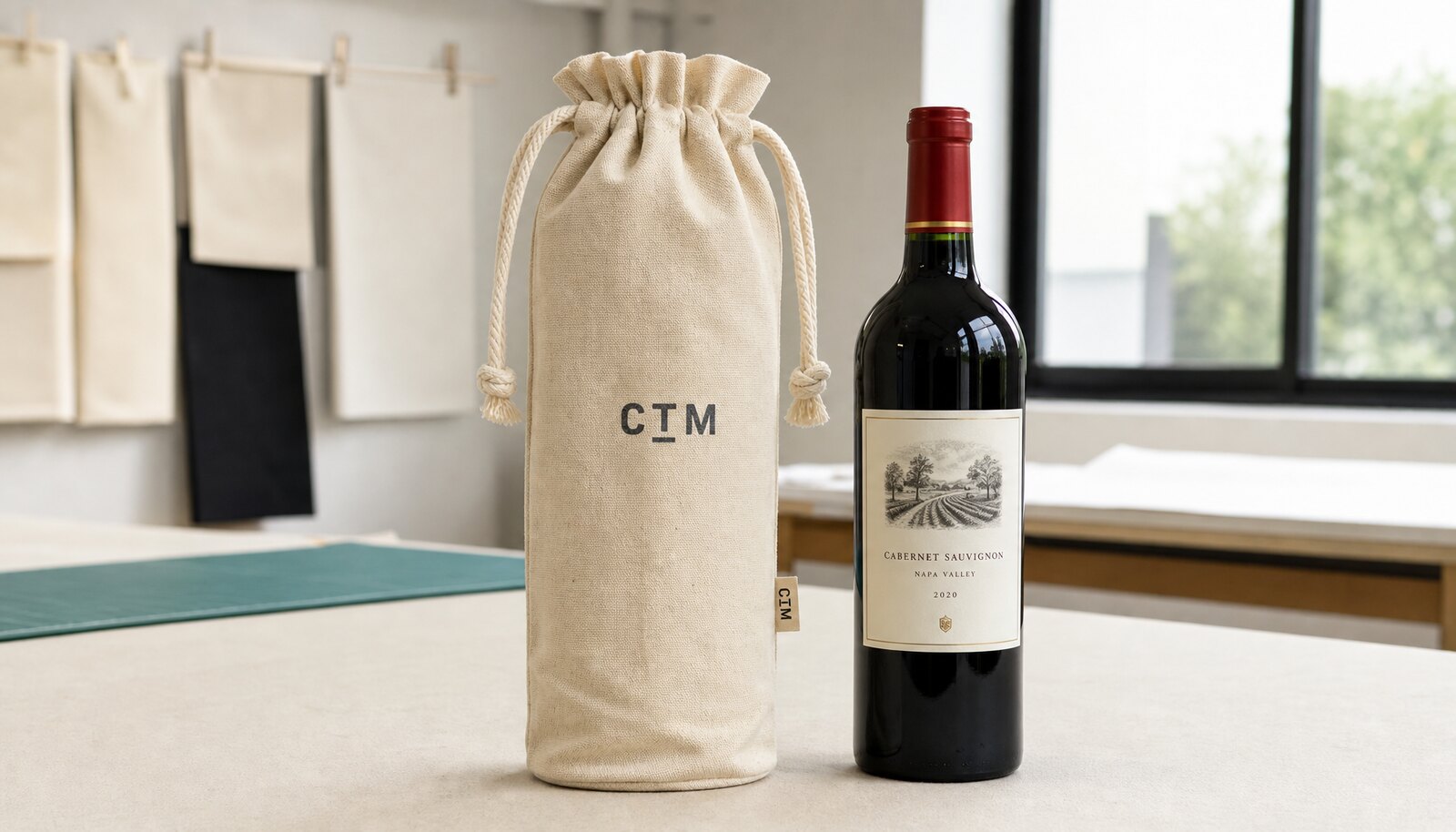
What Ecommerce Buyers Really Need From a Wine Bag
Drawstring wine bags for ecommerce are not just a softer version of a gift pouch. They have to protect the bottle, present the brand cleanly in photos, survive warehouse handling, and still look acceptable when the customer opens the parcel. That means the spec has to balance hand-feel, dimensional fit, and print durability instead of chasing the lowest fabric price. If the bag is too thin, the bottle silhouette shows through and the product looks cheap. If it is too heavy, the unit cost goes up fast and the bag may feel stiff in a bundle pack.
For most ecommerce programs, the real buying question is not whether the bag can hold a bottle. It is whether the bag creates the right retail impression at the lowest landed cost that still gives you low complaint risk. That is why a buyer should define the bottle size, brand position, and packing method before asking for quotes. A supplier can usually make almost any bag; the difference is whether it arrives with a stable finish, reliable cord function, and a presentation that matches the product page.
- State the bottle type first, then the bag size around it.
- Treat appearance, fit, and fulfillment handling as one spec, not three separate decisions.
- If the bag is for ecommerce, the packed unit matters as much as the empty bag.
Start With Fabric Weight, Size, and Structure
Fabric choice drives the entire quote. A natural cotton bag in the 120-140 GSM range works for most standard bottle sleeves and entry-level ecommerce packs. It is light enough to keep freight down, but still thick enough to hide the bottle better than a cheap muslin. If the program is more premium, move to 160-200 GSM canvas or a dense cotton twill. That gives a firmer hand, better opacity, and a more controlled drape around the bottle shoulder and neck. For a single 750ml bottle, common finished sizes often land near 13-15 cm wide by 34-36 cm high, but the right number depends on how much of the bottle neck you want visible.
Do not let a supplier quote only by generic size category. Ask for finished size, seam allowance, and opening width, because a bag that is nominally correct can still be awkward if the cord channel steals too much opening height. For retail wine gifts, a slightly taller bag usually looks better than one that is too short, because the bottle neck and top closure are more visually balanced. If you plan to use the same bag for multiple bottle formats, set a range and test the largest bottle first. That avoids discovering at carton stage that the magnum spec needs a different gusset or extra height.
- 120-140 GSM: good for standard bottle sleeves and cost control.
- 160-200 GSM: better for premium gifting, opacity, and a firmer look.
- Always test the tallest bottle or widest shoulder in the line, not just the standard 750ml bottle.
Choose Closures and Print Methods That Survive Fulfillment
The top closure sounds minor until it starts failing in packing. A simple cotton drawcord is usually the safest route because it is easy to source, easy to tie, and less likely to create assembly issues. A cord that is too thin can cut into the hem and feel cheap, while a thick rope can make the top bulky and reduce the opening. A clean hem with reinforced stitching and a stable cord channel matters more than decorative complexity. If the bag will be packed and re-packed by a warehouse team, the closure needs to glide smoothly and return to shape after several cycles.
For branding, screen print is still the most practical choice for most ecommerce wine bags. It handles one- or two-color logos well and is usually more durable on cotton than a transfer that sits on top of the weave. Use transfer only when the artwork truly needs fine detail or color gradients. Woven labels and side labels work well if the brand wants a quieter look and the bag body should stay simple. The key is to keep the logo away from the cord channel and seam intersections, because those areas distort first when the bag is pulled tight or folded.
- Use screen print for most logo-led programs with one or two colors.
- Use woven or sewn labels when you want a more premium, low-risk brand mark.
- Avoid putting critical artwork near the drawcord channel or side seam.
How Supplier Type Changes MOQ and Control
The same bag can come from very different sourcing routes, and each route changes MOQ logic. An integrated factory that cuts, sews, prints, and packs in one place usually gives the best control over color consistency and sample turnaround. It is the better choice when you have a branded program, several colorways, or repeat replenishment. A trading company can work if you need a broad search or a low-commitment start, but it adds another layer between you and the line that actually makes the bag. That often means more back-and-forth on size, print placement, and packing details.
MOQ is usually driven by fabric stock, print setup, and label type. A plain natural cotton bag can often start at a lower MOQ because the material is easier to buy and the color does not need dye-house coordination. Custom dyed fabric, custom woven labels, and multiple print colors move the MOQ up because the factory has to book more upstream materials and setup time. For a first order, the cleanest way to compare suppliers is to ask them to quote three volume breaks and explain what changes at each break. If a supplier gives only one price, you cannot see where the real cost curve starts.
- Lower MOQ usually means stock fabric, one-color print, and bulk packing.
- Higher MOQ usually comes from custom dyeing, woven labels, or multiple SKUs.
- Ask the factory what part of the quote is tied to fabric, printing, or finishing.
Read the Quote Like a Procurement Document
A usable quote is more than a unit price. It should show what is included and what will be added later. For drawstring wine bags, the most important quote data points are fabric GSM, finished size, print method, number of colors, MOQ by color, sample fee, setup fee, packing format, and lead time after approval. If those items are hidden, the factory can make the price look attractive and then add charges later for artwork setup, cord choice, or carton labeling. That is how buyers end up comparing numbers that are not actually comparable.
The landed cost picture matters more than ex-works price once the order gets beyond a small test run. A low factory price can lose as soon as freight, carton cube, inspection, and rework are included. Ask for a quote at 1,000, 3,000, 5,000, and 10,000 pieces so you can see where the step-downs actually happen. If you need e-commerce fulfillment, add the cost of inner packing, labels, and any folding or pre-insertion labor. A supplier that can separate those costs clearly is usually easier to work with through replenishment.
- Request unit price by volume break, not a single headline number.
- Separate sample fee, setup fee, packing fee, and freight term.
- Compare landed cost, not just factory price.
Sampling and Approval Should Be Physical, Not Casual
For branded wine bags, a physical pre-production sample is not optional. A photo can show print placement, but it will not tell you how the cotton drapes, whether the cord moves smoothly, or whether the seam line is clean after the bag is turned. Use the sample to verify bottle fit, neck clearance, label visibility, and the feel of the fabric in hand. If the product will appear in ecommerce photos, hold the sample under the same lighting conditions your studio or content team will use. A fabric that looks neutral in a factory room can photograph warmer or duller than expected.
The approval process should end with a signed and dated reference sample that both sides can reproduce. Keep one sample for your internal team and one with the supplier, then reference the same version on the purchase order. If you change the artwork after approval, treat it as a revision and not a casual tweak. That matters because even a small change in logo size can move the print setup, alter the placement against the drawcord, or expose a seam issue that was not visible on the first sample.
- Approve the sample against the actual bottle, not a dummy cylinder.
- Keep a signed reference sample tied to the PO.
- Treat logo changes as a revision, not a minor edit.
Packing Rules for Ecommerce and Retail Programs
Packing can quietly erase margin if it is not defined early. For pure ecommerce replenishment, bulk carton packing is usually the right default because the buyer or fulfillment partner can do the final insertion and labeling in-house. If the bags are sold as retail accessories or bundled with bottles before shipment, you may need pre-folded, polybagged units with barcode stickers and clear carton marks. Each of those steps adds labor, and each step should be in the quote before you approve the order. Otherwise you will only discover the real packing cost after the supplier starts treating it as an extra service.
Ask the factory to state how many bags go into an inner pack, how the packs are oriented, and whether the carton will be lined for dust or moisture control. Wine accessory programs often sit in warehouse inventory for weeks, so sloppy folding or inconsistent carton fill can create creasing and presentation issues before the product ever reaches the customer. If your ecommerce model uses kitting or subscription packs, the bag should be easy to fold flat and open cleanly without permanent shape memory. That is a small detail with real fulfillment impact.
- Bulk pack works best when your team will do final fulfillment.
- Retail-ready pack-out needs a separate labor and material quote.
- Define carton counts and label format before production starts.
QC Thresholds That Catch Real Production Problems
The most useful quality checks are practical, not abstract. Measure bag width, height, and opening against the approved sample. Inspect the stitching at the top hem, side seam, and cord channel, because those are the failure points when the bag is pulled tight around a bottle. Check whether the printed logo is centered relative to the body, not just on the fabric panel before sewing. A logo that looks fine on a flat piece can shift once the bag is assembled. Also test the drawcord through several open-close cycles to make sure it does not snag or bunch.
Do not ignore visual consistency across the shipment. Cotton lot variation, ink variation, and different sewing operators can create enough difference to make a batch look uneven on a retail shelf or in product photography. Set a clear standard for thread trimming, loose fiber removal, and print registration. If your brand is selling a premium bottle bag, the acceptable cosmetic threshold should be tighter than a plain promotional pouch. The goal is not perfection at laboratory level; it is repeatable production that looks controlled in the customer hand and on camera.
- Check size, seam integrity, logo placement, and cord function on every approval lot.
- Set a clear cosmetic standard for loose threads and print alignment.
- Test the bag after full assembly, not as a flat cut panel.
Lead Time, Freight, and Seasonal Risk
Lead time for drawstring wine bags is usually shaped by four steps: fabric booking, sample approval, sewing and printing, and packing. If the fabric is stock and the print is simple, the project can move quickly. If you need custom dye, woven labels, or multiple artwork versions, the schedule stretches because each upstream step needs approval before sewing begins. Buyers often lose time by approving the bag concept before they approve the fabric and logo spec. That creates avoidable loops during mass production. If you are buying for a seasonal wine-gifting window, those loops become expensive very quickly.
Freight should be part of the sourcing decision from day one because textile bags are lightweight but bulky. A cheap per-piece quote can still land badly if the carton cube is inefficient. Ask the factory how they pack the bags to preserve carton density and whether the quote assumes sea freight, air freight, or domestic delivery to port or warehouse. For repeat programs, the best schedule protection is a clean repeat order spec with locked size, locked fabric, locked print, and locked carton count. If the spec keeps changing, the factory will treat every order like a new sample round and the schedule will drift.
- Separate fabric booking, sample approval, production, and packing in the schedule.
- Remember that textile bags are light but bulky, so cube affects freight.
- Lock the repeat spec once the first run is approved.
Common Buying Mistakes and How to Avoid Them
The most common mistake is over-specifying the bag in ways that do not improve the customer experience. A heavy fabric, oversized cord, or complex print can make the unit look more premium on paper while adding cost and slowing production. Another frequent issue is fitting the bag to one bottle sample and forgetting the rest of the line. If the bottle shoulder, neck height, or closure cap changes, the same bag may no longer work cleanly. That is especially risky for ecommerce assortments where packaging has to work across multiple SKUs and content images.
The second mistake is assuming that a supplier quote includes every step. If the quote does not explicitly mention sample fee, print setup, packing labor, and carton marks, it is not complete. Buyers should also avoid approving from images alone when the bag is branded. Fabric hand, cord behavior, and seam finish are all hidden by flat artwork proofs. Keep the procurement process practical: define the bottle, define the look, define the pack format, and then compare suppliers on the same basis. That is the simplest way to avoid paying for spec confusion later.
- Do not let premium-looking details hide unnecessary cost.
- Do not approve from artwork images alone on a branded bag.
- Use one locked spec sheet for every supplier quote.
Specification comparison for buyers
| Spec decision | Recommended option | When it fits | Buyer risk to check |
|---|---|---|---|
| Integrated factory with sewing and printing in one plant | Best when you need stable color matching, faster approvals, and one owner for stitching, print, and packing | Use for branded ecommerce launches, repeat replenishment, or multiple colorways | Confirm the factory controls the print step in-house; outsourcing often adds color drift, longer lead time, and weaker accountability |
| 120-140 GSM cotton vs 160-200 GSM canvas | 120-140 GSM for standard bottle sleeves and gift bags; 160-200 GSM for premium positioning or heavier bottle protection | Use lighter fabric for low-cost ecommerce kits and heavier fabric for premium wine gifting | Heavier GSM raises unit cost and carton weight; lighter fabric may show the bottle outline or feel too thin |
| 1-2 color screen print vs full-color transfer | Screen print for clean logos and better wash/rub durability; transfer only when artwork truly needs gradients or photos | Use screen print for most ecommerce wine bags because the artwork is usually simple | Check registration tolerance and rub resistance; transfer can crack, and fine details can blur on textured cotton |
| Standard size vs custom size | Custom size when you need a precise fit for 750ml, magnum, or boxed bottle programs; standard size for fast launch and lower MOQ | Use custom sizing when the bottle neck height, closure style, or retail pack needs consistency | A standard bag may fit the bottle body but leave the neck exposed or too much loose fabric at the top |
| Natural cotton cord vs dyed cord with stopper | Natural cord for the simplest spec and lower risk; dyed cord or stopper only if brand presentation needs it | Use natural cord for basic ecommerce packs and dyed cord for premium branded programs | Cord friction, knot security, and stopper fit need testing; a weak cord turns into a returns issue in fulfillment |
| Bulk carton pack vs retail-ready pack-out | Bulk carton pack for direct fulfillment and low labor; retail-ready pack-out if bags will be shelf displayed or bundled with bottles | Use bulk pack when the buyer will do final labeling or kitting in-house | Retail-ready pack-out adds labor, polybagging, inserts, and carton cube, which can erase margin if it is not quoted separately |
| Low-MOQ domestic supplier vs offshore OEM factory | Domestic source for urgent launches and small trial runs; offshore OEM for repeat volume and better piece cost | Use domestic when speed matters more than margin; use offshore when your specs are settled | Compare unit price against freight, duties, and sample rounds, not factory price alone |
| Physical pre-production sample approval vs photo-only approval | Physical sample approval for any branded program; photo-only approval only for plain stock bags | Use physical approval when logo placement, shade, or hand-feel affects the customer experience | Photo approval misses fabric thickness, seam quality, and cord behavior; that is where many production failures start |
Buyer checklist before sampling
- Define the bottle format first: 750ml standard, slim bottle, magnum, or boxed bottle, then state the finished bag size and any target clearance around the neck.
- Specify fabric weight in GSM, fabric type, and color: for example 120-140 GSM cotton for standard use or 160-200 GSM canvas for premium positioning.
- State the print method, number of colors, and logo placement, and include artwork dimensions so the factory does not resize the graphic blindly.
- Request a physical pre-production sample and a production reference sample, then approve both against the same bottle size you plan to ship.
- Set acceptable tolerances for width, height, seam position, print placement, and drawcord length before mass production starts.
- Define packing format: bulk carton count, inner polybag count if any, barcode labeling, and whether the product ships flat or pre-folded.
- Ask for the quote by volume breaks, sample fee, setup fee, packing fee, and freight term so you can compare suppliers on the same basis.
- Confirm lead time by stage: fabric booking, sample approval, production, packing, and export booking, not just one total number.
Factory quote questions to send
- What is the exact fabric spec in GSM, weave, and shrinkage allowance, and is the fabric stock item or custom-ordered?
- What finished size do you quote, and what dimensional tolerance do you guarantee on width, height, and opening?
- How many print colors are included, what setup charges apply, and is the logo printed in-house or sent to a subcontractor?
- What is the MOQ per color and per artwork version, and does MOQ change if we switch from natural to dyed fabric?
- Can you quote pricing at 1,000, 3,000, 5,000, and 10,000 pieces, including sample fee, tooling, and packing?
- What packing format is included in the quote, and are inner bags, barcode stickers, and master carton marks extra?
- What is the lead time from sample approval to shipment, and what pushes it longer, such as custom dyeing or label production?
- Can you provide production photos, stitch close-ups, and a pre-production sample before mass run approval?
Quality-control points to confirm
- Measure finished bag size against the approved sample and keep width and height within the agreed tolerance, usually no more than plus or minus 1 cm for this type of bag.
- Check the bottle fit with the actual product, including neck clearance, top closure volume, and whether the bag body hangs straight without twisting.
- Inspect seam quality for skipped stitches, loose thread ends, and weak side or bottom joins, especially where the cord channel meets the top hem.
- Rub-test the print by hand on a sample piece to see whether pigment smears, cracks, or transfers onto paper or skin.
- Pull-test the drawcord and knot area to make sure the cord runs smoothly and does not cut into the hem after repeated use.
- Review color consistency across cartons, because cotton dye lots and print ink batches can vary between production lots.
- Inspect packing count and carton labeling so the shipment matches the purchase order, inner pack count, and SKU coding.
- Verify that the approved sample, the bulk production lot, and the final packed unit all match on logo placement and overall appearance.