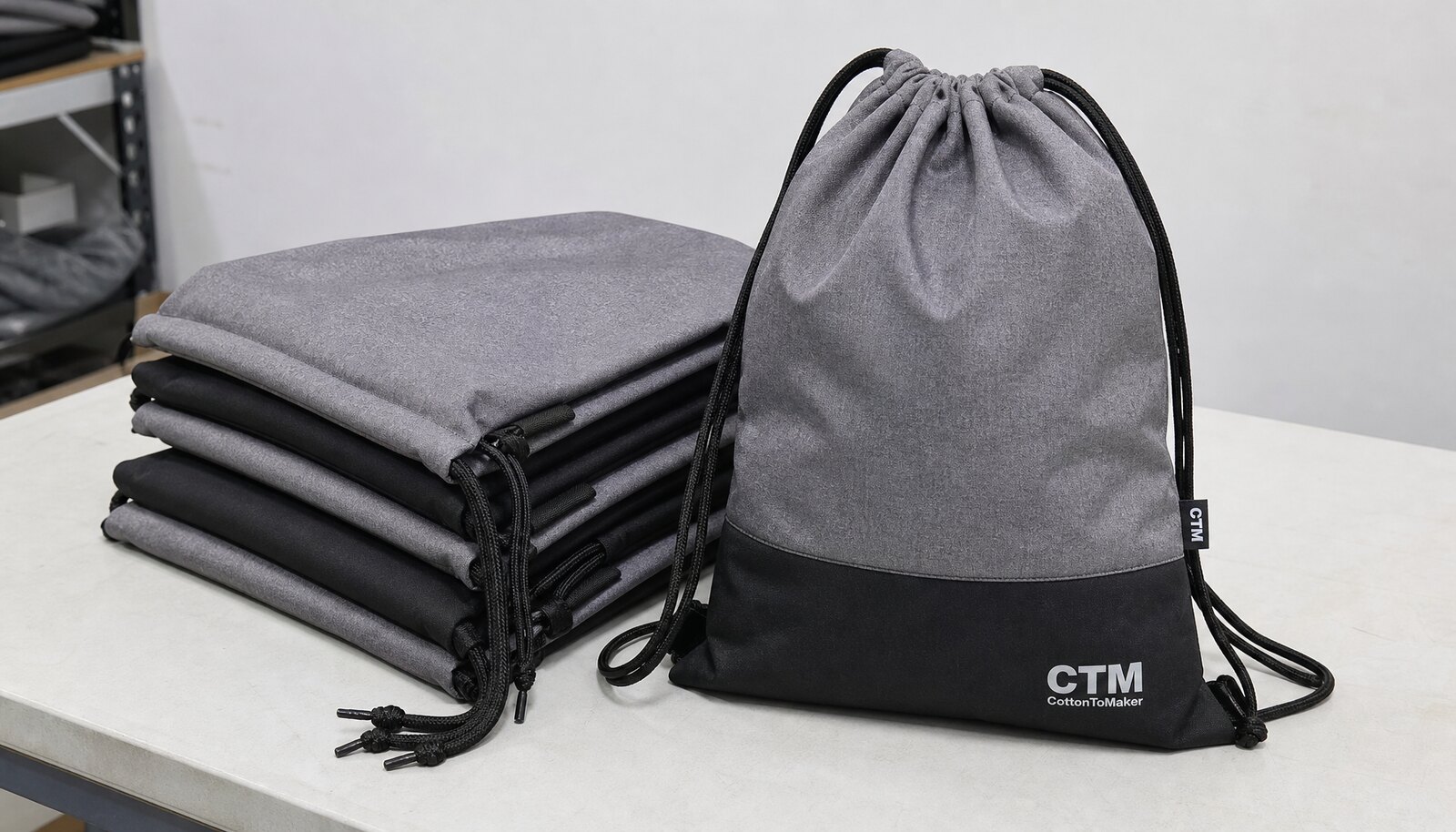
Why wellness program buyers should treat sport packs as a working supply item, not a generic giveaway
Drawstring sport packs for corporate wellness programs are rarely just swag. In many programs they become a working item: a bag for a T-shirt, towel, bottle, shoe cover, or a small health-kit insert that people carry home and then reuse. That changes the commercial decision. A bag that looks acceptable in a mockup can still be a poor buy if it twists under load, arrives with uneven cords, or requires repacking before it can be distributed.
The best procurement brief starts with the event reality. Is this for onboarding, a wellness challenge, a company health fair, a step-count campaign, or a partner incentive? Is the bag being handed out at a single event, mailed to employees, or bundled into a larger kit? These details determine the right fabric body, the level of reinforcement, the print method, and whether presentation quality matters enough to justify a cleaner finish. The more operational the brief is, the less chance the factory has to fill in the blanks with a generic spec.
- Typical wellness priorities: low unit cost, easy distribution, readable logo, and decent reuse.
- Typical failure points: weak cords, thin fabric, off-center print, and carton count issues.
- Useful procurement language: “bag must carry a folded T-shirt and bottle without seam failure during normal use.”
Start with the bag construction before you compare logo pricing
Fabric is the biggest driver of both cost and perceived quality. A 210D polyester bag is usually the right starting point when the goal is a large-volume wellness giveaway with a decent print surface and manageable freight. It is common because it balances price, weight, and appearance. If the bag should feel more substantial or is likely to be reused after the event, 300D polyester is often the better middle ground. It can give the bag more body and reduce the “paper-thin” feel that sometimes undermines a branded program.
If you expect heavier contents, a more structured material such as 600D or a reinforced build can make sense, but buyers should not assume higher denier is automatically better. It raises unit cost, may increase freight by weight, and can change the drape in a way that makes the bag less compact. Ripstop polyester sits in another lane: it is useful when tear resistance matters and the buyer wants a more technical or durable impression. The right question is not “What material is strongest?” but “What construction gives us enough durability without paying for strength the user will never need?”
Do not let suppliers describe the bag only by material family. Ask for denier, weave, coating, and any additional finish. Two polyester bags can look similar on a spec sheet and still perform differently if one is coated and one is not, or if the weave is tighter. That matters for print behavior, hand feel, and how the bag folds in cartons. If you are comparing multiple factories, require them to quote the same construction so the unit price actually means something.
- 210D: economical, light, and common for high-volume events.
- 300D: more body, better opacity, and a more polished feel.
- Ripstop: useful when tear spread is a concern.
- 600D: more structured, but usually a higher-cost choice for wellness giveaways.
- Ask for an actual swatch or sewn production-like sample, not only a data sheet.
Write the spec around what people will put inside the bag
A sport pack spec gets clearer when it describes the contents. A bag meant to carry a folded T-shirt and a bottle is not the same as a bag for shoes and a towel. This sounds obvious, but many RFQs only say “drawstring bag” and leave the factory to guess the real use case. That guess often creates problems: too-narrow openings, cords that dig into the shoulder, or a bag that looks fine empty but becomes distorted as soon as it is loaded.
For corporate wellness, usability is part of brand performance. At a live event, a bag needs to open fast, hold the kit without fighting the user, and still look neat on the table or in photos. For internal distribution, the bag should pack efficiently and avoid excess dust, odor, or loose thread that makes the kit look rushed. Include the usable dimensions, not just the flat size. If the bag must hold a standard bottle, ask the supplier to confirm the fit with a practical sample load rather than relying on a theoretical capacity claim.
It also helps to specify finish level. Some programs need only a simple promotional build; others need cleaner edge binding, tighter thread trimming, and a more consistent fold because the bag will sit next to branded apparel or a premium wellness kit. The more the bag is part of the gift, rather than only a carrier, the more you should care about its finish.
- State the intended contents: shirt, towel, bottle, shoes, or mixed kit items.
- Ask for flat dimensions and a tolerance band.
- If presentation matters, specify fold style, thread trimming, and packing standard.
- Do not accept a catalog size as proof the bag will fit your kit items.
Choose the decoration method by artwork, surface, and reorder plans
Print is where procurement teams often overfocus on color count and underfocus on fabric behavior. On a drawstring sport pack, the logo area is not a flat poster board. It moves, gathers, and sits near seams and cord exits. For that reason, a simple one-color silkscreen is still the most dependable option for many wellness programs. It is especially effective when the logo is bold, the text is large enough to read cleanly, and the order volume is high enough to justify setup.
Transfer methods can be the right answer when the art is more complex. If the brand mark includes multiple colors, a gradient, or fine type that would be lost on coarse fabric, heat transfer or digital transfer may protect detail better than a screen print. The tradeoff is control: transfer methods may be more sensitive to fabric texture, heat, press pressure, and the consistency of operator setup. That means the sample approval needs to be tighter. If you know you will reorder the same design, ask which method is more repeatable for the factory. The cheapest first run is not always the cheapest program over time if the decoration cannot be reproduced cleanly.
The most important line in the artwork brief is not the logo file type; it is the placement specification. Give the imprint area in millimeters or centimeters, and identify what it must avoid: seams, drawcord holes, top corners, and edge binding. That keeps the factory from interpreting “front logo” too loosely.
- Screen print: best for bold, simple logos and repeat orders.
- Transfer: better for multi-color or detail-heavy artwork.
- Set print clearance from seams and cord exits in exact measurements.
- If the logo includes small type, request a proof on actual production fabric.
Use the comparison matrix to evaluate tradeoffs, not just specs
Procurement teams often compare bags by quote line items and miss the product-level tradeoff. A better matrix asks: which bag is most suitable for the event, the handout experience, and the likely reuse pattern? The point is not to create a longer spreadsheet. The point is to make the buying decision visible. That is especially useful when a low-cost supplier wins on price but loses on packaging, reinforcement, or print clarity.
When you review options, look at where the extra spend goes. Paying a little more for a stronger fabric may be cheaper than handling damaged units or replacing a poor batch. Paying for cleaner packing may save warehouse labor. Paying for a more controlled print method may protect brand quality on a bag that will be photographed, reused, or seen by employees beyond the initial event. A real commercial comparison should show not only what the spec is, but what it means in use.
- Compare on use case, not just line price.
- Treat packing, labeling, and carton count as part of the product.
- If a quote is much lower, ask which cost element was reduced: fabric, print, packing, or reinforcement.
Pressure-test MOQ before you commit to a campaign plan
MOQ should not be treated as a single number. It is usually a set of thresholds: per color, per artwork version, per fabric option, and sometimes per packing method. That is why a quote can look workable on paper and still fail once you split the campaign across locations or employee groups. If your wellness program needs several colorways or different logo versions for divisions, the real minimum matters more than the headline number.
In many wholesale programs, a standard range of 500 to 1,000 pieces per color or artwork version is a practical place to start for custom polyester drawstring sport packs. But this is not a rule; it is a negotiation point. Some factories will accept lower volumes but tighten fabric choice, limit decoration complexity, or add setup charges. Others will allow mixed colors but charge for sorting and separate packing. Buyers should ask the supplier to show the MOQ by variant and identify where extra charges begin. If the answer is vague, the final order is likely to be vague too.
The useful procurement question is simple: what is the smallest unit the factory can make without changing the spec? If the campaign needs several versions, compare the cost of one larger standard run against several smaller variant runs. In some wellness programs, consolidating artwork and simplifying colors saves more money than pushing for the lowest single-piece price.
- Ask for MOQ by color, artwork, and packing format.
- Check whether mixed-color runs are allowed in one production batch.
- Verify setup charges separately from unit price.
- If multiple departments want custom versions, compare the cost of standardizing artwork first.
Sample approval should prove function, not just appearance
A mockup is useful, but it cannot approve a bag. For a drawstring sport pack, the physical sample tells you whether the fabric feels too thin, whether the cords sit evenly, whether the opening is usable, and whether the print survives real handling. Buyers should ask for a pre-production sample made from the actual fabric, with the actual cord, the actual hardware, and the actual print method. If the supplier cannot provide that, ask for a sewn blank sample first so you can at least verify construction before decoration is applied.
The most common sample mistake is approving what looks good in a flat photo. The bag should be checked in motion. Open and close it. Load it with the items you expect people to carry. Look at how the print behaves when the bag is gathered. Check whether the corners pull evenly and whether one cord is noticeably longer than the other. If the sample is acceptable visually but awkward in use, the production run will probably feel the same way.
Tie the sample sign-off to a specific revision. That means the artwork version, fabric description, color reference, and packing format should all be documented. If the factory changes one of those elements later, the sample approval no longer covers the shipment.
- Approve the real print process, not only a digital proof.
- Check cord symmetry, opening ease, and loaded behavior.
- Document the sample revision so the factory cannot substitute materials later.
- Ask for photos of the exact approved sample from several angles.
Verify the factory in a way that matches the size of the order
A polished quote does not prove manufacturing control. Procurement teams should verify that the supplier can make the bag at the quoted standard and that the order will not be pushed to an unknown subcontractor without disclosure. Start with the basics: business registration, production address, and current workshop photos. The useful photos are not marketing images; they are pictures of the sample room, sewing area, print area, and packing station. If the supplier will not share current production images, ask why.
For larger or repeat orders, request whatever verification documents your company policy requires, such as audit reports or social compliance paperwork. You do not need to overcomplicate a small promotional run, but you do need enough evidence to know the factory is real, active, and capable of controlled output. If the quote comes from a trading company, ask for the actual manufacturing site and who will own the sewing, printing, and packing steps. That is the difference between a clean quote and an accountable supply chain.
One practical buyer habit is to ask for a short live video or timestamped walk-through of the production area when the order is time-sensitive. It is a low-friction way to confirm that the shop exists and that the equipment shown in the quote is actually available.
- Request current workshop photos, not stock graphics.
- Confirm the actual production site and who does each step.
- Ask for audit documents only as far as your procurement policy needs.
- If a third party is quoting, identify the real factory before placing the PO.
Set QC thresholds that a warehouse team can actually use
QC for drawstring sport packs should focus on failures that create receiving work, complaints, or replacements. Visual perfection matters, but it should not crowd out function. A buyer can usually tolerate a small shade shift on a promotional bag if the product is otherwise clean and serviceable; a torn seam, crooked print, or bad cord attachment is a different matter. The best QC sheet uses pass/fail language that a factory inspector can apply quickly.
The inspection list should include stitching, top channel reinforcement, cord performance, eyelet or cord-hole condition, print alignment, color consistency, odor, and carton count accuracy. For instance, the seam around the top channel should be even and free of skipped stitches. The cord should move smoothly without fraying where it enters the channel. If metal eyelets are used, they should not have burrs, rust, or sharp edges that could damage the fabric or a user’s hand. For an internal wellness mailing, the carton should arrive clean enough that the team can send it out without repacking.
It is also helpful to separate cosmetic deviations from functional failures. A loose thread that can be trimmed may be acceptable if it is isolated and not near a load point. A loose thread running from the top channel is not acceptable if it suggests the seam is starting to open. That distinction makes the QC standard more realistic and avoids both over-rejection and sloppy acceptance.
- Define what is cosmetic and what is functional failure.
- Check the top channel, corners, and cord entry points first.
- Use carton count and SKU labeling as receiving checkpoints.
- If bags are handout-ready, include cleanliness and presentation in the release standard.
Treat packing and carton planning as part of the landed cost
Packing affects more than appearance. It changes labor, freight volume, warehouse handling, and how quickly the bags can be distributed when they arrive. Bulk packing is usually the most efficient choice when the bags will be kitted later or distributed from a central warehouse. Individual polybagging makes sense when the bags will be handed out directly, placed in consumer-style kits, or shown in a retail-like setting. Neither choice is universally better; the right answer depends on the downstream workflow.
Ask for carton dimensions, gross weight, and carton count before final approval. A quote that seems slightly cheaper on a unit basis can become more expensive if the cartons are oversized or the bags are folded inefficiently. Also ask how the cords are managed in the pack: tucked, banded, or loose. Loose cords can create a messy receiving experience and make cartons look less professional. If the order is large, even small packing inefficiencies can add real labor at the warehouse dock.
Packaging labels should be part of the order spec. At minimum, the carton should identify product name, color, quantity, and PO number. If your operation uses barcodes or inner pack labels, specify those up front rather than asking for them after the quote is approved.
- Bulk pack for warehouse distribution and kitting.
- Individual polybag for direct handout or presentation-heavy programs.
- Ask for carton size, gross weight, and count before approval.
- Specify inner packs, barcode labels, or master carton rules early.
Specification comparison for buyers
| Decision area | Lower-cost option | More durable / premium option | Commercial tradeoff and buyer note |
|---|---|---|---|
| Fabric | 210D polyester | 300D polyester | 210D is usually the economical choice for mass wellness handouts. 300D gives a fuller body, less see-through appearance, and a more premium feel. If the bag must be reused after the event, 300D often reduces complaints even when the unit price is higher. |
| Tear resistance | Standard polyester | Ripstop polyester | Ripstop helps the bag resist small tears spreading, which can matter if employees carry shoes or heavier kit items. It can look less “basic promotional” than thin polyester, but confirm the weave does not complicate print clarity or make the bag feel too technical for your program. |
| Structure | Soft unlined build | Heavier 600D-style build or reinforced paneling | Soft bags pack flat and cost less to ship. Structured bags hold their shape better on-site and on camera, but they add weight, freight volume, and cost. For employee wellness campaigns, a middle ground often wins unless the bag is intended to be reused many times. |
| Closure and comfort | Single cord with basic top channel | Double drawcord with reinforced corners and smoother shoulder carry | Single cord construction can work for lighter loads and very large quantities. Double cord options are more comfortable and usually feel more stable on the shoulder. Ask whether the top corners are bartacked or otherwise reinforced, because that is where failure tends to start. |
| Decoration method | 1-color silkscreen | Multi-color transfer or more controlled print system | Silkscreen is the simplest and usually most repeatable for a bold logo. Transfer methods help when artwork has gradients, multiple colors, or small text, but they are more sensitive to fabric texture, temperature, and press setup. The right method depends on the art, not just price. |
| Logo placement | Front lower panel or centered area with wide clearance | Placed with exact seam and cord clearance, potentially with back branding too | A simple front placement is easier to control and less likely to collide with seams or cords. If brand visibility matters on photos or event counters, confirm the logo zone in millimeters and request a placement proof before production. |
| Packing format | Bulk packed by color and SKU | Individual polybag with barcode sticker or kit-ready packing | Bulk packing lowers labor and freight volume. Individual polybagging is better when the bags are handed out as retail-style gifts or inserted into pre-packed wellness kits. The quote should show which format is included and what it does to carton count. |
| MOQ structure | One headline MOQ for the whole order | MOQ broken down by color, artwork, packing format, or fabric | A single order minimum can look attractive until you learn each color or artwork variant carries its own threshold. The useful procurement question is not “What is your MOQ?” but “What is the MOQ per variant, and where do setup charges begin?” |
Buyer checklist before sampling
- Define the wellness use case in one sentence before you request quotes: employee onboarding, fitness challenge reward, event handout, health fair giveaway, or kit insert. The intended use determines the acceptable fabric, load tolerance, print durability, and packing format.
- Write the bag specification in measurable terms instead of catalog language. Include approximate size, fabric denier, weave type, closure style, cord type, print method, print area, and whether the bag must fit a towel, shoes, a T-shirt, or a bottle.
- Decide the expected load before you price the order. A bag that only carries light paper collateral can be built differently from one that must hold gym shoes and a reusable bottle. Tell suppliers the real contents so they do not quote a bag that fails in use.
- Ask for the exact fabric construction, not just “polyester.” Request denier, weave, coating if any, and whether the same material will be used in bulk production. If the factory proposes a coated surface, ask how that coating affects sewing, hand feel, and print adhesion.
- Set the decoration scope before the first quote lands. Specify number of print colors, logo size, artwork placement, and whether there is small text or reversed-out detail. If the art is delicate, ask the supplier what line thickness they can reproduce cleanly on that fabric.
- Require a physical pre-production sample or a sewn production-like sample. A digital proof is useful for layout, but it does not show how the bag behaves when the fabric is sewn, pulled, folded, or printed.
- Ask for sample images from multiple angles: front, back, side seam, top channel, cord exit, and close-ups of the print and stitching. If brand color matters, request daylight and neutral indoor lighting photos so you can judge shade more realistically.
- Confirm MOQ separately by color, artwork version, fabric option, and packing format. A low total number can hide separate minimums for each variant, which is where many budgets get stretched.
- Request a quote breakdown that isolates fabric, sewing, print setup, print unit price, cords, eyelets or reinforcement parts, packing, carton labeling, and any special handling. This is the fastest way to compare suppliers on the same basis.
- Set pass/fail QC criteria before bulk production begins. Include stitch quality, cord symmetry, print alignment, shade tolerance, odor, count accuracy, carton labeling, and any packaging expectations your receiving team needs.
Factory quote questions to send
- What exact fabric are you quoting, including denier, weave, and any coating, and is that the same material that will be used in bulk production?
- What is the price at 500, 1,000, 3,000, and 5,000 pieces, and what changes at each tier? Please separate fabric, print, sewing, setup, and packing charges.
- What is the MOQ per color and per artwork version, and are mixed-color runs allowed without extra setup or carton charges?
- What decoration method is included in the quote, and what exactly is covered: screen setup, print area, number of colors, and any second-location print?
- Can you provide a pre-production sample made with the actual production fabric, cord, and print method rather than only a blank or digital proof?
- What is the standard lead time after sample approval, and where are the likely delay points: fabric sourcing, printing, sewing, packing, or freight booking?
- How are the bags packed: bulk, inner packs, individual polybag, or kitted format? Please state carton count, carton dimensions, and gross weight.
- What inspection checks do you perform before shipment, and can you share the tolerance list or QC sheet used for release?
- Which supplier verification documents can you provide: business registration, factory address, recent audit report if available, and workshop photos of the sewing, print, and packing areas?
- If we reorder, what parts of the spec can remain unchanged and what would trigger a new setup charge or new sample approval?
Quality-control points to confirm
- Stitching: check for even seams, no broken thread runs, no skipped stitches, and no open seam at stress points. For a wholesale promotional bag, buyers often use a practical benchmark of 7–9 stitches per inch on load-bearing seams, but the more important rule is that the seam must stay flat and intact when the bag is loaded and pulled.
- Top channel and reinforcement: confirm the cord channel does not collapse when the bag is opened and closed repeatedly. Reinforced corners or bartacks should be visible if the bag is intended for regular reuse. Ask the supplier to identify where reinforcement is placed, rather than assuming it is built in.
- Cord performance: verify the cord slides smoothly, does not fray at entry points, and does not twist excessively under normal handling. Left and right cord lengths should match within a practical tolerance, typically about ±1 cm on the finished sample unless the design is intentionally asymmetric.
- Load behavior: do a simple in-hand pull test on a loaded sample. For lighter wellness kits, the bag should hold together under a short steady pull without obvious seam distortion. If the bag is meant to carry shoes or a heavier bottle, state a higher pull requirement in writing and test to that standard.
- Eyelets or cord openings: edges should be smooth, properly set, and free of burrs, cracking, or rust. If metal hardware is used, ask whether the finish is anti-rust or otherwise protected for transit and storage in humid conditions.
- Print quality: inspect for clear edges, correct placement, no visible misregistration, and no cracking when the fabric is gathered. For a simple logo, placement should not wander far from the approved position; a small shift may be acceptable, but the logo should not collide with seams, folds, or cord exits.
- Color consistency: compare bulk goods with the approved sample under neutral light. Bulk shade should not drift enough to make cartons look mismatched or make the decoration appear different from one batch to another.
- Odor and cleanliness: open cartons should not smell strongly of oil, mildew, glue, or heavy chemical residue. For direct employee handout, this matters almost as much as visual appearance because the bag is part of the brand experience.
- Packaging accuracy: confirm carton count by SKU, color, and artwork version. A practical standard is no count shortage and no unexplained overfill. If your warehouse needs exact receiving, specify over/under tolerance in the PO.
- Carton condition and labeling: cartons should arrive dry, intact, and labeled on at least two sides with product name, color, quantity, and PO reference. If the bags are polybagged, the bags should be clean and not torn or heavily wrinkled in a way that degrades presentation.