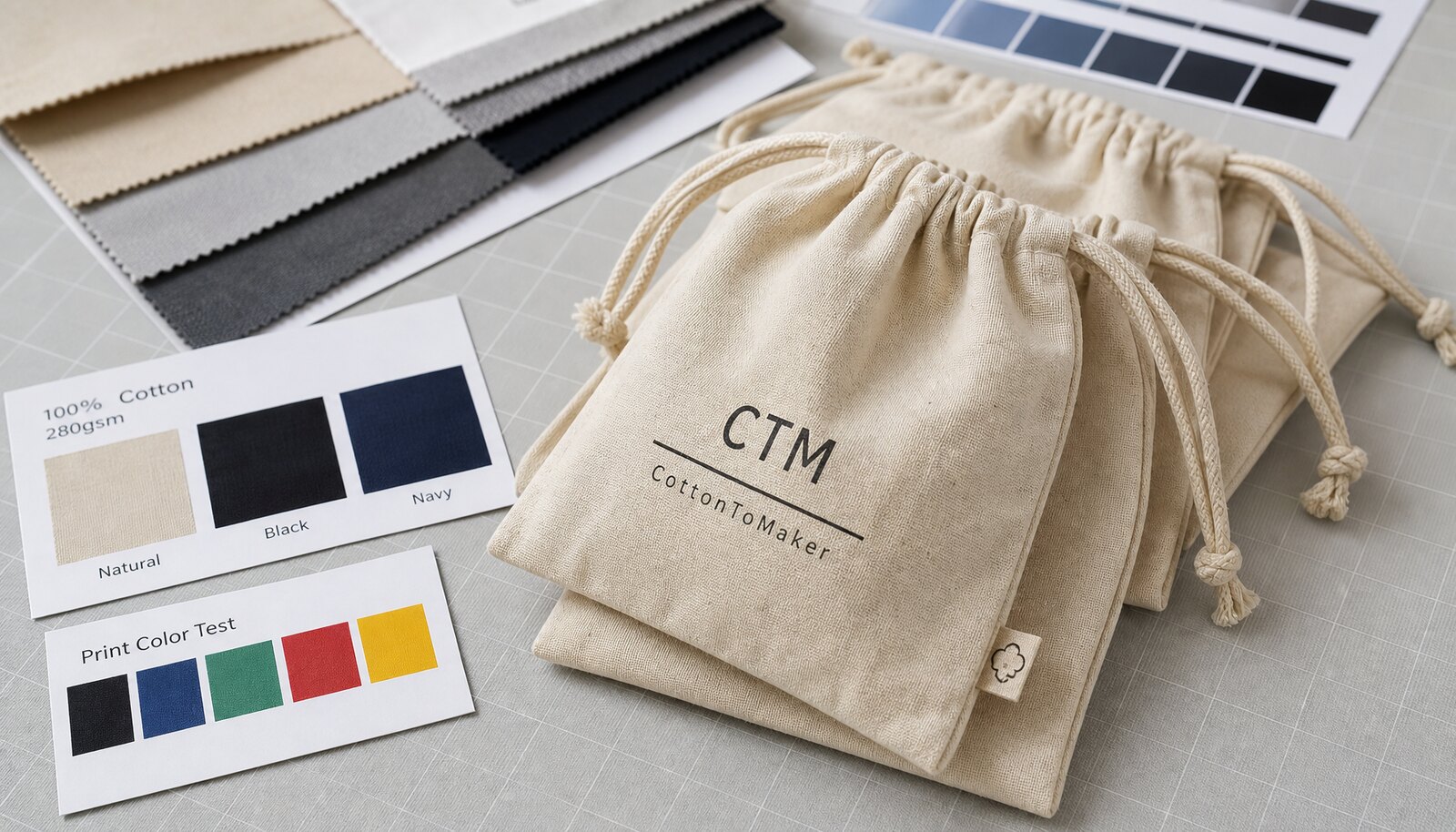
1. Start with the job the pouch has to do
A drawstring pouch with logo is not one standardized item. It can be a retail accessory, a kit component, a jewelry pouch, an electronics sleeve, or branded packaging that has to perform in front of the end customer. That distinction matters because the buying criteria change with the use case. A pouch that sits inside a box can tolerate a simpler finish than one that is sold on a shelf or handed to a customer as part of the product experience.
Procurement teams usually get better results when they define the pouch by function before they define it by decoration. If the pouch must protect an item, fabric weight, seam construction, and cord durability matter more than the print method. If the pouch is part of a premium presentation, the way it folds, closes, and holds shape can matter more than saving a small amount on cloth. If it is a high-volume giveaway, repeatability, carton efficiency, and reorder stability may be the main commercial issues.
The safest RFQ starts with the intended load, the handling pattern, and the final destination. Ask whether the pouch will be filled once and never reopened, reused many times, or opened and closed repeatedly during storage or travel. Then state whether the pouch is inserted by hand or machine, because that affects opening size, distortion tolerance, and pack-out speed. Those details change the right fabric, cord choice, reinforcement, and packing format.
If the pouch is part of a larger bundle or product kit, note what else will touch it. Sharp corners, metal edges, printed inserts, or oily components can change the fabric and print requirements. A pouch for a soft apparel item is a different sourcing decision from a pouch that will contain hardware or fragile goods.
For a drawstring pouch with logo, the most common early mistake is treating appearance as the only requirement. The second is assuming the supplier can infer the end use from a photo. If you want a quote that is actually comparable, spell out what the pouch needs to do after it leaves the factory, not just how it should look in a mockup.
- State whether the pouch is for packaging, retail resale, promo distribution, or protective storage.
- Describe the item it must hold, including weight, sharp edges, and whether it will be inserted by machine or by hand.
- Define whether the customer sees the pouch before or after the product is opened, because that changes the quality standard.
- Note whether the pouch must stack cleanly, compress flat, or stand upright in a display box.
2. Fabric and construction drive the real cost
Fabric choice changes the quote more than many buyers expect. Cotton is the common starting point, but cotton is not a single spec. The supplier is pricing GSM, weave density, dye process, finishing, shrinkage behavior, and sometimes whether the cloth comes from a stable mill source or a spot purchase. A pouch made from lighter cloth may look similar in a photo, but it can behave very differently in sewing, print registration, and carton packing.
For many branded programs, 120-140 GSM cotton is a practical baseline because it offers a reasonable balance between hand feel, print stability, and cost. If the pouch needs a more structured retail presence, a heavier canvas can be more appropriate. Heavier fabric usually improves shelf appearance and durability, but it also changes folding, packing volume, print sharpness, and sewing effort. If the pouch is meant to feel premium, the construction should support that impression rather than fight it.
Construction details matter just as much as the fabric. A cord channel that is too narrow can create friction and wear. A seam with too little allowance may look fine on day one and fail when the pouch is overfilled or pulled repeatedly. Reinforcement at the stress points is a small cost compared with a bulk rejection or customer complaint. Ask specifically how the corner, channel, and drawcord exit points are finished, and whether the same thread and stitch pattern will be used in bulk.
The buyer should also ask about shrinkage and finishing. If the cloth is not prewashed or pre-shrunk, the factory should tell you the expected dimensional change after production or first use. That matters when the pouch has to fit inserts or when logo placement is measured from a seam reference. For reorders, ask whether the supplier can hold the same cloth source, or at least document the fabric basis well enough to match the prior lot.
If you plan repeat orders, traceability is not only a compliance topic. It is also the simplest way to avoid version drift across seasons or programs. The quote should tell you what fabric the factory is assuming, what construction it will use, and what it will do if a later batch requires a substitution.
- Use a lighter cloth only if the end use tolerates softness, slight wrinkling, and lower structure.
- Use heavier canvas when the pouch must hold shape, protect contents, or signal a more premium finish.
- Ask for seam allowance, stitch density, thread color, and reinforcement details instead of accepting a generic construction description.
- If repeatability matters, request the same cloth source or mill lot for reorder planning.
3. Match the branding method to the artwork, not the habit
Many RFQs stop at the phrase "print logo," which leaves too much room for the factory to choose the easiest method. That may produce a quote, but it does not always produce the right result. The decoration method should be selected based on logo detail, color count, placement size, surface texture, and how the pouch will be used after production. A bold one-color logo and a small multi-color mark do not belong in the same sourcing logic.
Screen printing is usually the most economical option for simple artwork with solid coverage. It works well when the logo has clean edges, a limited palette, and enough space to avoid seam interference. Ask the supplier what mesh or ink system it plans to use and how it cures the print, because those choices affect rub resistance and long-term appearance. Heat transfer can support more complex art or smaller marks, but it should not be selected without testing durability, especially if the pouch will be folded, handled often, or packed tightly.
Embroidery and sewn patches can create a more premium feel, but they change cost, lead time, and the risk profile because they introduce thread density, alignment, and fabric distortion concerns. A woven label is often a good middle ground when the brand wants a refined look without relying on direct print detail. None of these methods is universally better. The right choice depends on the artwork and the use case.
A useful procurement rule is to avoid asking the supplier to "make it look nice" without defining the print logic. Instead, define the artwork file, approved size, placement reference, maximum color count, and acceptable variation in color or registration. If the pouch is intended as branded packaging, the logo still needs to survive handling, carton pressure, and customer unpacking. A decoration method that looks good in a sample photo but flakes, cracks, or bleeds in use is not acceptable for a commercial order, even if the upfront quote is low.
- Use screen print for simple, high-volume artwork with limited colors and strong lines.
- Use heat transfer when the design is too detailed for screen print, but test rub and fold resistance.
- Use embroidery, woven labels, or sewn patches when the brand wants texture or a premium finish.
- Define minimum text size and line thickness so the supplier cannot quietly simplify the art.
4. Size, opening, and tolerance need a written standard
Size is one of the most common sources of quote confusion because a nominal pouch size is not the same as a finished usable size. Once seams and the cord channel are added, the interior dimensions may be smaller than the number written in the RFQ. Buyers should specify the finished measurement, the opening width, and, if relevant, the usable internal space after construction. If the pouch must fit a product insert, it is better to test with the actual item than to rely on assumed clearance.
The measurement method also needs to be agreed in advance. Some teams measure flat after light pressing. Others measure from stitch to stitch or from external edge to external edge. That sounds minor, but it is the difference between a clean approval process and a dispute over whether the supplier met the spec. The same logic applies to logo placement. If the artwork must sit a fixed distance from the top seam or centerline, write that into the spec and reference the signed proof.
Good tolerancing is about predictability, not perfection. The buyer does not need every pouch to be identical to the millimeter, but the supplier does need to know the acceptance window before production starts. Tighter control matters most on small pouches, visible retail formats, and orders that need a consistent presentation across lots. A loose tolerance can save production effort, but it increases the chance that a pouch looks acceptable on paper and awkward in hand.
If the pouch is part of a kit, use the actual packed item as the reference for size approval. A pouch that is technically within nominal dimensions can still be too small if the opening is awkward or the product catches on the seam. The commercial risk is not only a dimensional miss. It is a pouch that fails in use or creates extra pack-out labor at the factory or DC.
- Write the nominal size and the finished measurement you will inspect, not just one number on the RFQ.
- State whether the sample will be approved flat, filled, or lightly pressed.
- Use one placement reference for the logo, such as center front or a fixed distance below the top seam.
- If the pouch must fit a product, ask the supplier to test with the actual item before bulk approval.
5. Build the RFQ so suppliers can price the same thing
A strong RFQ for a drawstring pouch with logo should make it difficult for suppliers to quote the wrong product. The goal is not to overwhelm them with information. The goal is to remove ambiguity so every quote reflects the same construction, decoration, and packing assumptions. Without that, one supplier may quote a light cloth pouch with a simple screen print while another prices a heavier construction with more labor and a different finishing step.
The cleanest RFQ structure is a single spec version per line item. If you need multiple colors, multiple logo versions, or different pack formats, separate them. It is better to compare three clear quotes than one blended quote that hides variation. Add any commercial assumptions that affect cost, such as whether cartons need shipping marks, whether polybags are required, whether inserts are included, whether the pouch will be folded in a specific way, and whether the supplier must apply barcode labels or retail stickers.
Procurement teams should also ask the supplier to identify which parts of the order are one-time setup and which parts repeat on reorder. Print screens, plates, labels, cutting dies, special packing, and custom carton marks can all affect the first order differently from the second order. If those items are not separated, the unit price can look attractive while the total cost stays opaque. A supplier should be able to show the cost logic behind the quote without turning it into a long commercial explanation.
The best RFQ is specific enough to price, but still flexible enough to allow the supplier to recommend a better process if it can justify it. That is where useful supplier input belongs: inside a defined spec, not instead of one. If a supplier proposes a better fabric basis, print method, or pack format, ask it to explain the change in terms of durability, lead time, or landed cost rather than just saying it is easier to make.
- Keep one size, one fabric, one artwork version, and one pack format per quote line.
- Separate sample, setup, bulk, packing, and carton costs so the quote is readable.
- Ask suppliers to flag any assumed substitutions before they submit pricing.
- Use the same spec version number in the RFQ, sample approval, and purchase order.
6. Compare suppliers by control, not just by price
A lower unit price does not always mean lower sourcing risk. In pouch programs, the cheapest quote may simply reflect a lighter cloth, less thread, a smaller print area, or weaker packing assumptions. A more reliable supplier often costs a little more on paper because the quote includes the controls that keep production stable. Procurement value comes from knowing which controls are present and which ones are missing.
Direct factories usually offer more visibility into fabric source, sewing construction, and print setup. That matters when the order is large, repeatable, or brand-sensitive. Trading companies can still be useful, especially when the order combines multiple products or the buyer needs a responsive commercial layer. The point is not that one route is always better. The point is that you should know where the accountability sits if the sample differs from bulk, or if a correction is needed after production starts.
Ask specific control questions. Who approves the color standard? Who owns the screens or artwork files? Who signs the pre-production sample? Who handles an in-line defect if stitching begins to drift? What happens if the supplier needs a fabric substitute because the original cloth is unavailable? If the supplier cannot answer those questions cleanly, the commercial risk often sits with the buyer even if the quote looks simple.
For a drawstring pouch with logo, the most useful supplier comparison is usually a matrix of control, lead time, repeatability, packing efficiency, and response to change. That is more actionable than a basic price sheet because it tells you whether the supplier is set up for a one-time order or a repeat program. It also helps separate a genuinely efficient offer from a quote that is simply incomplete.
- Prefer the source that can show how it will control fabric, print, sewing, and packing across the run.
- Verify the actual production site and not only the sales contact or trading office.
- Ask whether the factory keeps approved sample records and reorder references.
- Treat late-stage changes as a supplier capability test, because the response tells you how the order will be handled later.
7. Use the comparison table to spot hidden differences
Spec decisions do not just change the product. They change production outcome. The table below is meant to expose the differences that matter to a procurement buyer: what the quote really includes, where risk is likely to sit, and which choices tend to produce stable output. This is more useful than a narrow feature chart because it forces the buyer to think about supplier behavior, not only product features.
Apply the table to the exact pouch size, logo, and pack format you are buying. A supplier can be the lowest bidder and still be the wrong choice if the quote relies on a different construction standard, a different packing method, or a looser interpretation of the artwork proof. The goal is to compare like with like before the PO is issued. If one quote includes a pre-production sample and another does not, or one includes individual packaging and another assumes bulk packing, the numbers are not directly comparable.
- Use the same approval sample and the same reference photo across all suppliers.
- Write down which assumptions are included in each quote, especially packing and setup.
- If a supplier changes fabric, print method, or cord type, ask for a revised sample before accepting the price.
8. Sampling should validate construction, not only appearance
A sample is useful only if it tests the things that are hard to see in a flat product photo. The pouch may look acceptable on screen and still fail when the cord is pulled, the logo is stretched, or the seam is stressed by an overfilled item. For that reason, sample approval should cover more than visual placement. It should test whether the pouch behaves correctly in use and whether it matches the promised construction.
The most practical approval process has three steps. First, review the art proof and sample photos so placement and branding are aligned. Second, inspect the physical sample for size, feel, closure function, and construction quality. Third, retain a signed golden sample or a clearly labeled reference sample so the bulk run can be checked against something real. Without that reference point, disputes tend to rely on memory instead of evidence.
Sampling is also the place to check whether the factory is honest about process. If the sample is made with a different cloth, different print method, or cleaner sewing than the bulk quote implies, that is a warning sign. The most important thing to learn from sampling is not whether one piece looks good. It is whether the supplier can repeat the same result at scale.
When the order is brand-sensitive, document the sample with measurements, photos, and written sign-off notes. That gives procurement a defensible record if there is a mismatch later. It also helps reorders move faster because the next buyer or sourcing manager can see exactly what was approved. If you expect multiple reorders, ask the factory to keep the reference sample and the approved art file tied to the item code.
- Check the sample empty, partially filled, and closed so you can see how it performs under real use.
- Do a simple rub or fold check on the logo before approving the bulk run.
- Compare the sample to the approved file for seam placement, cord symmetry, and print position.
- Keep one physical reference sample and one photo record tied to the PO.
9. QC should be written in factory language
Quality control works best when it tells the factory exactly what to check and how to record it. Generic statements like "good workmanship" are too vague to be useful. A buyer should define the checkpoints that can actually fail in production: fabric consistency, finished dimensions, logo placement, print durability, cord function, seam integrity, pack count, and carton condition. That makes inspection more repeatable and the results easier to dispute if needed.
Do not rely on a single final inspection to catch every problem. The better approach is to inspect the pre-production sample, the first article or first output, and the final packed goods. If the order is large enough, ask where in-line checks will happen for print registration and seam quality. The most expensive defects are usually the ones caught too late, after the goods are already packed or labeled.
For a drawstring pouch with logo, print durability deserves more attention than it often gets. Buyers should ask how the supplier will test the mark for rubbing, folding, or abrasion during handling. If the pouch is going into a kit or retail package, the logo may rub against inserts, cartons, or neighboring pouches before the customer even sees it. That is a practical failure mode, not a theoretical one.
It is also worth defining rejection handling in advance. If the supplier finds a defect, who approves rework? If a carton is short, what is the replacement timing? If an artwork mismatch is detected after packing, is reprint required or can the lot be sorted? These terms belong in the sourcing conversation before production begins, not after the problem has already cost time. Add acceptance limits for shade variation, print placement, and measurement drift so there is no ambiguity at shipment.
- Use one agreed measurement method for all inspection samples and bulk cartons.
- Check the logo against the approved proof for placement, size, and overall visual match.
- Inspect the cord channel, seam ends, and stress points for fraying, skipping, or open stitches.
- Record carton count, labels, and shipping marks against the packing list before goods leave the factory.
10. Packing, landed cost, and quote questions decide the real total
The unit price on a quote is only part of the cost. A drawstring pouch with logo can become expensive once packing, labels, export cartons, freight volume, and reject handling are added. That is why procurement should ask for the quote in a way that separates product cost from logistics and setup cost. A clean landed-cost comparison is more useful than a single line number because it shows how the order will behave in the warehouse and on the invoice.
Packing format has a real cost impact. Bulk packing is usually the most efficient for kit insertion and warehouse handling. Individual polybags or retail-ready inserts make sense when the pouch is a shelf item or when dust and crease control matter. The wrong packing choice can add labor, increase freight volume, or create receiving problems at the distribution center. Ask for carton dimensions, gross weight, and count per carton early because those details affect freight and pallet planning as much as the factory price does.
If you want a quote that is easy to evaluate, ask for the same level of detail on every supplier response. The useful questions are the ones that expose where cost comes from and where quality can fail. A vague quote may look faster, but it usually costs more time in follow-up, sample churn, and late-stage corrections.
In practice, the best procurement outcome is a pouch that arrives on time, matches the approved sample, and can be reordered without re-litigating the spec. That comes from structured quoting, controlled sampling, and written QC expectations rather than from asking for the lowest number first.
- Compare ex-works price, setup, packing, and freight volume together instead of in isolation.
- Ask whether a reorder will reuse the same screens, labels, and carton marks.
- Confirm who pays for rework, reprint, or replacement if the bulk run misses the approved sample.
- Request carton size and pack count before approving the final commercial offer.
Specification comparison for buyers
| Decision area | Procurement-safe choice | Why it usually wins | Risk to check before order |
|---|---|---|---|
| Fabric and hand feel | 100% cotton in the 120-140 GSM range for standard branded pouches | Balances printability, cost, hand feel, and carton efficiency for many programs | Confirm lot consistency, shrinkage behavior, and whether the cloth is prewashed or expected to relax after finishing |
| Construction | Side seams with reinforced cord channel and double stitching at stress points | Improves closure performance and lowers failure risk during packing and end use | Ask for seam allowance, stitch density, thread type, and whether the same construction will be used on the bulk run |
| Branding method | Screen print for simple logos; woven label, patch, or embroidery for premium or detailed art | Matches the decoration method to the artwork complexity instead of forcing one method onto every logo | Verify minimum text size, number of colors, cure method, and expected rub resistance |
| Supplier route | Direct factory with named sample owner, production owner, and in-line QC contact | Clearer accountability for material source, approvals, and corrective action | Verify the actual production site, not just the sales office, and confirm who owns the screens or plates |
| Packing format | Bulk pack for kit insertion; individual polybag or insert only when the channel requires it | Keeps labor, freight volume, and warehouse handling aligned with the real use case | Define exact carton count, master carton marks, and any retail labeling before production starts |
| Commercial structure | One spec version per line item with setup charges called out separately | Makes unit prices comparable and avoids hidden costs in color, art, or packing changes | Check whether sample fees, print setup, and carton labeling repeat on reorders |
| Change control | Written approval for sample, artwork placement, and material substitution | Prevents silent spec drift when the supplier swaps cloth, ink, or cord to protect margin | Require notice and approval before any change to fabric source, print method, or sewing construction |
Buyer checklist before sampling
- Define the pouch's actual job first: product packaging, retail accessory, event giveaway, kit component, or protective sleeve.
- Lock the finished size, usable opening, and what must fit inside after seam allowance and cord channel are added.
- Specify fabric composition, GSM, weave, color reference, and whether the cloth must be natural, dyed, bleached, or prewashed.
- Attach vector artwork and state print method, print size, placement reference, and acceptable color matching approach.
- Require the same material and print process for the pre-production sample and the bulk run unless you approve a change.
- Ask for seam construction details: side seam type, cord channel width, reinforcement points, and thread color.
- Separate one-time costs from repeat costs in the quote, including setup, screens, plates, labels, and special packing.
- Request carton dimensions, gross weight, count per carton, and whether the order will be packed bulk or retail-ready.
- Ask for lead time broken into sampling, material procurement, production, inspection, and packing so delays are easier to track.
- Agree in writing on how rejects, overage, shortage, rework, and reprint are handled before you place the PO.
Factory quote questions to send
- What exact fabric composition, GSM, weave, finish, and dye process are you quoting for this drawstring pouch with logo?
- Can you identify the fabric source or mill, and can that source be held stable for a reorder program?
- Which sewing construction will you use, including seam type, seam allowance, stitch density, and reinforcement at stress points?
- Which decoration method will you use for my artwork, and what is the maximum printable or embroidable area on this pouch size?
- What is the smallest readable text size or line thickness you will accept for this logo method?
- What are the one-time setup fees, and which of them repeat if I change artwork, color, or placement on the next order?
- Can you quote sample, bulk, packing, label application, and export carton costs as separate line items?
- What is the MOQ by size, color, fabric, and logo version, and where does the next price break start?
- What inspection standard do you use, and can you show the QC checkpoints before shipment?
- How do you handle short shipment, print defects, seam failures, or color mismatch if production falls outside the approved sample?
Quality-control points to confirm
- Finished size matches the approved spec sheet using one agreed measurement method for all samples and bulk cartons.
- Logo placement matches the signed artwork proof, including the distance from top seam, side seam, or centerline reference.
- Fabric lot, color, weave, and surface hand feel match the approved sample; any intentional substitution is approved in writing.
- Print coverage is even, with no obvious pinholes, bleeding, mis-registration, or weak coverage at the edges of the mark.
- A simple rub, fold, or abrasion check does not show unacceptable ink transfer, cracking, or peeling for the intended use.
- Cord runs smoothly through the channel, closes evenly, and does not snag, bind, or pull loose at the seam.
- Seams are intact with no skipped stitches, open ends, loose threads, broken needle marks, or weak stress points.
- Cartons are clean, dry, and odor-controlled, with pack counts, labels, and shipping marks matching the PO and packing list.
- If the pouch is part of a retail program, the fold, insert, and presentation condition match the agreed pack-out standard.
- Any acceptance limits for shade variation, print placement, and measurement drift are written into the spec before bulk production starts.