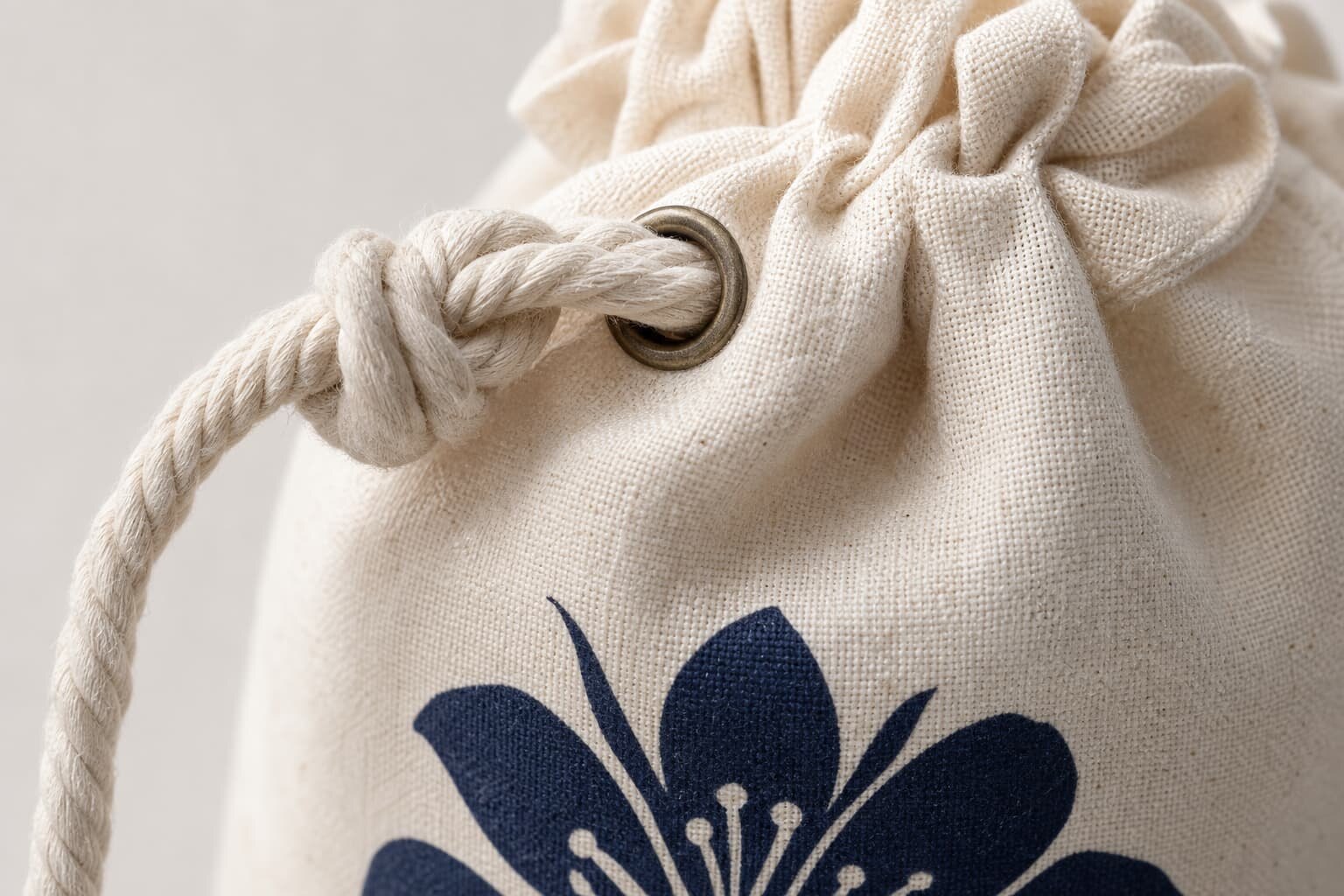
Why Unit Cost Is Hard To Read
A drawstring pouch quote only looks simple until you compare two suppliers line by line. One factory may give you a clean unit number and another may split fabric, sewing, print, packing, and carton charges into separate lines. Both can be correct, but they are not always comparable. The unit cost is really the result of a spec decision, a labor decision, and a packing decision. If any of those are missing from the RFQ, the quote can look cheaper only because the supplier assumed a thinner fabric, fewer print colors, or a looser packing standard.
For procurement teams, the real risk is not overpaying by a few cents; it is buying the wrong construction and discovering it only after approval. A pouch that seems affordable at first may become expensive when the buyer adds the missing pieces: a heavier GSM, a better cord, a label, a compliant carton mark, or a sample revision. The safest way to read a quote is to ask what was assumed, not just what total number was offered. Once you know the assumptions, you can compare suppliers on the same basis and avoid false savings.
- Compare quotes only after normalizing fabric, size, print, packing, and lead time.
- Treat a single all-in number as incomplete until the factory states the assumptions behind it.
- Ask for separate sample, setup, and packing lines so hidden work is visible.
- Use the approved sample as the reference, not the sales promise.
Fabric Weight Sets The Cost Floor
Fabric is usually the first place where unit cost changes. For drawstring pouches, buyers often choose cotton sheeting, muslin, or light canvas. A lighter fabric can reduce cost, but only to a point. Around 100-120 GSM, the pouch feels soft and economical, but it may show the contents and look weak under retail lighting. Around 140-180 GSM, the pouch usually has better body, better print definition, and less chance of distortion after sewing. Above that, the look moves toward a premium or gift-ready pouch, but material and sewing time usually rise with it.
The buyer question is not simply which GSM is cheapest. It is which weight matches the use case. A promo pouch that holds accessories for a short campaign may not need the same body as a retail pouch that sits on shelf or is reused by customers. If the pouch carries sharp or heavy contents, a thin fabric can become a return problem. Ask the factory to state the base fabric, GSM tolerance, shrinkage allowance, and whether the quote assumes bleached, natural, or dyed cloth. Those details tell you more about the real unit cost than the headline number does.
- 100-120 GSM: lower-cost promo use, but higher risk of transparency and weaker hand feel.
- 140-180 GSM: common middle ground for better structure and better print appearance.
- 200 GSM and above: stronger presence, but usually higher material and sewing cost.
- Ask whether the fabric is pre-shrunk, because shrinkage can change the final size and fit.
Cord, Sewing, And Construction Choices
The cord looks minor on paper, but it changes both cost and user experience. Cotton cord gives a natural look and fits eco-minded branding, while polyester cord can hold up better to abrasion and repeated opening. Cord diameter also matters. A thicker cord often feels better in hand, but it may require a wider channel and cleaner stitching to prevent jams. If the pouch uses a simple draw channel, the sewing line must stay even, because a crooked channel creates friction and weakens the closure. When the factory quotes a low price, check whether the cord length, cord ends, and knot finish are already included.
Construction details are another hidden cost lever. A top hem that is too narrow may save material but increases the risk of seam failure. Loose stitch density can speed production, yet it creates a weak channel and more repairs. Reinforcement at the side seam, the bottom seam, and the cord exit points matters when the pouch is used repeatedly or carries items with corners. Buyers should ask for the exact seam allowance, stitch count, and whether the factory inserts an internal lock stitch or bartack at stress points. Those details help you understand why one quote is stable and another may only be cheap because it is underbuilt.
- Choose cord material based on brand feel and abrasion needs, not only on unit price.
- Confirm cord diameter and channel width together, because they work as a system.
- Ask for seam allowance and stitch count so the supplier cannot silently reduce construction quality.
- Check whether cord ends need knots, heat sealing, or tips, because each finish changes labor time.
Print Method Changes More Than Artwork
Decoration can move the unit cost more than many buyers expect. A single-color screen print is often the most efficient choice for simple logos and repeat runs, because the setup is manageable and the result is clear on cotton. Once the artwork adds more colors, finer text, or a larger print area, the factory may need more screens, more alignment work, and more inspection time. If the logo is small and the brand wants a premium look, a woven label or embroidered mark may make more sense, but those choices often change sewing time and material cost in different ways.
The key is to match the method to the logo and the customer channel. A trade-show pouch with a bold one-color mark can be priced very differently from a retail pouch with layered artwork, a side label, and care information. Buyers should ask how many print colors are included, whether the artwork is on one side or both, how the print is cured, and what registration tolerance the factory will hold. A quote that does not define the print method is not a true comparison quote. It is only a rough estimate waiting for a correction later.
- Screen print is usually efficient for simple logos and larger runs.
- Embroidery and woven labels add a premium look, but they also add sewing or labeling time.
- Multi-color art can increase setup and inspection cost even when the pouch size stays the same.
- Ask for print placement tolerance so the logo does not drift between samples and bulk.
MOQ, Sampling, And Lead Time
MOQ logic is where many first-time RFQs go wrong. A factory does not price only by piece count; it prices by setup effort, fabric usage, color change, and the chance of leftover material. A pouch in one size and one color with one simple logo may have a much cleaner MOQ than a pouch with multiple colors, special labels, or custom dyed cloth. If you plan to order several versions, ask whether the factory can combine them under one run or whether each color and artwork version counts as a separate production lot. That answer changes the real unit cost more than a small change in fabric weight sometimes does.
Sampling is also part of the cost structure, even when it is credited later. A first sample may show the basic shape, but a buyer should still check print placement, cord movement, seam finish, label position, and the final measured size before approving bulk. Lead time should be split into sample approval, material booking, production, and packing. If a supplier says one lead time without explaining those steps, the number is hard to trust. Custom fabric, dyed cord, and special labels can extend the schedule even when the pouch itself is simple.
- MOQ often changes by size, color, print version, and label type, not just by total quantity.
- Ask whether samples are credited against bulk or treated as separate non-recurring cost.
- Confirm how many sample revisions are included before the factory starts charging again.
- Request a lead time breakdown so you can see where delays are likely to happen.
Packing, Cartons, And Finished-Case Costs
Packing is a cost line that buyers often ignore until freight or warehouse work becomes expensive. A pouch packed flat in bulk can be very efficient for shipping, but only if the buyer accepts the way it arrives and has a receiving process ready. Once individual polybags, barcode stickers, hang tags, moisture protection, or folded insert cards are added, labor increases and the carton count can change. That means the unit cost should be read together with the packing specification, not apart from it. Even a small pack change can move the final landed cost more than a minor fabric adjustment.
Carton planning matters too. A factory may quote to a carton count that looks acceptable on paper but is inefficient for palletization or warehouse handling. Ask for carton dimensions, gross weight, and how many pouches go into each inner and master carton. If the buyer needs retail-ready packing, define it early and do not let the factory assume a generic bulk pack. For importers, this is where quote confusion happens most often: the sewing cost is stable, but the pack-out cost shifts because the assumption was different. That is why the RFQ should define packing before the price conversation starts.
- Define bulk pack or retail-ready pack before asking for a final quote.
- Ask for carton count, carton dimensions, and gross weight to support freight planning.
- Check whether labels, inserts, stickers, or inner polybags are included or extra.
- Use the same packing spec across all suppliers when you compare unit cost.
How To Read A Supplier Quote
A clean supplier quote should tell you what is included and what is excluded. At minimum, it should state fabric type and GSM, finished size, print method, cord material, packing format, MOQ, sample terms, production lead time, and quotation validity. If the quote only gives a unit number, it is not enough to support a sourcing decision. You need the assumptions because the cheapest quote may rely on a thinner cloth, a simpler print, a looser tolerance, or a packing method that your team cannot actually use. A real quote lets you understand where the supplier is being efficient and where they are quietly reducing scope.
When two quotes differ, compare them in layers. First compare the base pouch construction. Then compare decoration. Then compare packing and carton assumptions. Finally compare the commercial terms, including sample charge, payment timing, and whether the price changes at the next volume break. If one supplier includes woven labels and the other does not, that is not an equal comparison. If one supplier assumes 120 GSM and the other assumes 160 GSM, the lower price is only a lower spec. The goal is not to force every factory to quote the same way. The goal is to force every factory to define its assumptions so the buyer can compare them honestly.
- Normalize every quote to the same fabric, size, print method, and pack format.
- Flag any quote that does not list exclusions or quote validity.
- Compare price breaks at the same quantity, not at different lot sizes.
- Ask for a revised quote when a spec line is missing, not after approval.
RFQ Data Buyers Should Send Up Front
The easiest way to lower quote noise is to send a better RFQ. A factory cannot price accurately if the buyer only sends a logo and a rough size. Send the finished dimensions, target fabric weight, fabric color, cord type, print method, print size, artwork file, label position, packing format, and destination market. If the pouch must meet a retail program, include what matters to the downstream team: barcode position, carton labeling, master pack count, and any unit handling requirement. That lets the factory build the quote around the real job, not around assumptions that may be wrong.
Good RFQs also show what is flexible and what is fixed. If GSM can move within a range, say so. If the print method can change from screen print to woven label, say whether that changes the brand standard or only the cost target. This matters because a factory will often optimize around the only thing it can see. If the buyer does not state the priority, the quote may save money in the wrong place. A clear RFQ does not just ask for a price. It creates a shared production brief that reduces revisions, protects timing, and gives procurement a real apples-to-apples comparison.
- Send a measured sketch or spec sheet, not just a logo file.
- State the must-have items first: size, GSM, print method, pack format, and market.
- Separate what can vary from what cannot vary so the factory can quote intelligently.
- Ask for a re-quote if any of the core spec lines change after submission.
Sample Approval And QC Points That Protect Margin
Sample approval is the point where a future cost problem can still be fixed cheaply. Before bulk, check the finished size, the feel of the fabric, the seam straightness, the drawstring movement, the logo placement, and the overall look under normal light. If a sample is slightly off, do not assume bulk will naturally improve. It usually means the factory has not locked the process yet. Ask for a corrected pre-production sample if the label shifts, the print sits too low, or the cord jams in the channel. Those are not cosmetic details; they are signals that the bulk run can drift.
For quality control, the buyer should set measurable acceptance criteria, not vague opinions. Define what counts as acceptable print placement, what amount of shade variation is allowed, and whether cord pull performance must be checked on random pieces. Inspect the first bulk output for stitch density, carton count, and packing consistency before the full shipment is cleared. This protects margin because it avoids rework, repacking, and delayed delivery. The cheapest unit cost is not the winner if it creates sorting, claim handling, or replacement orders later. A pouch that is built correctly on the first pass is usually the most economical pouch in the real ledger.
- Approve the pre-production sample only after size, print, and cord movement are checked.
- Use measurable tolerances for placement, shade, and finished dimensions.
- Inspect the first bulk pieces before authorizing the whole shipment.
- Treat rework risk as part of unit cost, not as a separate problem.
Specification comparison for buyers
| Spec decision | Recommended option | When it fits | Buyer risk to check |
|---|---|---|---|
| Fabric weight | 120-140 GSM cotton for promo; 160-180 GSM for retail; 200 GSM+ for premium feel | When the pouch needs more body, less transparency, or better print appearance | Too thin can show contents, shrink more, or feel unstable after washing |
| Print method | Single-color screen print for simple logos; woven label or embroidery for premium branding | When artwork is limited, run size is stable, or the pouch will be reused | More colors and fine details can raise setup cost and blur edges if the method is wrong |
| Cord material | Cotton cord for natural positioning; polyester cord for lower friction and stronger abrasion resistance | When the pouch must match a natural brand look or handle repeated opening and closing | Cord thickness changes closure feel, and weak knots can slip in transit |
| Construction | Turned hem with clean channel stitching and reinforced stress points | When buyers want a clean retail finish and less seam failure | Loose stitch density or uneven channel width can cause cord jams and returns |
| Packing format | Flat bulk pack with carton counts defined before approval | When import freight efficiency matters and buyers can handle repacking locally | Individual polybags, inserts, or barcode labels can add labor and carton volume quickly |
Buyer checklist before sampling
- Confirm finished size, fabric weight in GSM, and whether the fabric is bleached, natural, dyed, or printed.
- State the exact print method, number of colors, print size, and artwork placement tolerance.
- Specify cord material, cord diameter, channel construction, and whether cord ends need knots, heat sealing, or metal tips.
- Ask for separate line items for sample cost, setup cost, decoration cost, packing cost, and carton cost.
- Give target MOQ by size, color, and print version so the factory can price the real production lot.
- Request a clear lead time split between sample approval, material booking, production, and packing.
- Define carton count, master carton dimensions, and whether inner polybags or inserts are required.
- Ask for production photos, inspection checkpoints, and the tolerance standard before bulk approval.
Factory quote questions to send
- What fabric type and GSM are included in this quote, and is the price based on greige, dyed, or finished material?
- Does the quote include screen setup, plate charges, woven labels, sewing labor, and packing, or are any of those extra?
- What is the MOQ by color and print version, and how does the unit price change at the next price break?
- What sample stage is included, what is charged separately, and how many revision rounds are allowed?
- What is the standard production lead time after sample approval, and what can extend it?
- What carton count, carton size, and inner pack assumption were used to calculate the quote?
- What quality checks will be done on stitching, cord performance, print placement, and size tolerance?
- If we change fabric weight, print method, or packing, which cost line changes first?
Quality-control points to confirm
- Measure finished pouch size after sewing, not just cut size, and confirm it matches the approved spec.
- Check fabric GSM, hand feel, and opacity against the approved sample so thinner substitution is not hidden.
- Inspect stitch density, seam straightness, channel width, and stress points where the cord exits the pouch.
- Verify print alignment, ink coverage, curing, and rub resistance on both the sample and the first bulk pieces.
- Pull the cord repeatedly to confirm smooth closure, no fraying, and no slippage at the knot or stopper if used.
- Review packing count, carton markings, and inner pack condition before shipment release.
- Confirm that the approved label position, logo color, and artwork version match the bulk pre-production sample.