Why Compliance Starts Before the First Quote
A drawstring pouch looks simple, but it is still an imported textile product with material, labeling, chemical, print, packing, and retail receiving risks. Most compliance problems start when the RFQ asks only for size, quantity, and logo. A supplier can answer that request with many different fabric grades, cord types, and packing assumptions, and every version may look acceptable in a small photo.
For procurement teams, the goal is not to turn a pouch RFQ into a legal document. The goal is to remove unclear decisions before suppliers quote. A useful compliance guide helps you define what must be controlled, what can be flexible, and what evidence is needed before production. This makes price comparison cleaner and reduces the chance of a shipment being delayed by failed inspection, missing labels, odor, color bleeding, or incorrect carton marking.
- Confirm the destination market before quoting because labeling and testing expectations may differ.
- Separate product safety compliance from buyer quality requirements; both matter but they are not the same.
- Ask for written confirmation of the material and print system instead of relying on catalog photos.
- Treat the approved sample as the production standard, but support it with measurable tolerances.
Define the Pouch Use Case Before Choosing Fabric
The same drawstring pouch can be used as a jewelry pouch, cosmetic gift bag, bottle accessory pouch, hotel amenity bag, candle dust bag, toy part bag, or promotional packaging. Each use case changes the compliance and quality focus. A pouch used only to hold a lightweight card set does not need the same seam strength as a pouch used for a glass jar. A pouch used next to skincare products may require closer attention to odor, fabric dust, and dye transfer.
Your RFQ should describe the product going inside the pouch, estimated product weight, retail channel, and whether the consumer will reuse it. This information helps the supplier recommend fabric weight, cord strength, and seam construction. It also prevents the common mistake of selecting the cheapest muslin pouch for a product that needs a heavier canvas feel or better print coverage.
- Light contents under about 100 g often fit 4-5 oz cotton or muslin if the buyer accepts a soft handfeel.
- Mid-weight contents such as cosmetics, small jars, candles, and accessories usually need 6-8 oz cotton or canvas.
- Premium retail packaging often benefits from 8-10 oz canvas, thicker cord, cleaner stitching, and controlled logo placement.
- Dust bag use requires attention to lint, seam softness, and fabric color transfer rather than only tensile strength.
- Food-adjacent or cosmetic-adjacent use may require stricter material declarations and odor control.
Fabric Weight, GSM, and Color Are Compliance Inputs
Buyers often ask for cotton drawstring pouches without specifying GSM. This leaves too much room for interpretation. Cotton pouch fabric may be quoted in ounces or GSM, and the conversion is not always exact because weave, finishing, and shrinkage affect handfeel. A 4 oz fabric may be acceptable for a lightweight giveaway, while an 8 oz canvas provides more structure and better durability. If the product is sold as reusable packaging, fabric weight becomes part of the customer experience.
Color also affects compliance. Natural cotton can include seed flecks, shade variation, and small slubs. Bleached white fabric may show dirt more easily. Dyed fabric raises questions about dye lot control, colorfastness, and transfer onto the product inside. If your brand color is strict, provide a Pantone reference but also ask for a lab dip or fabric swatch before bulk fabric production. For natural or undyed cotton, define whether black specks and weave irregularity are acceptable.
- Request fabric weight in GSM or oz with tolerance, such as plus or minus 5 percent if the supplier can support it.
- Ask whether the fabric is greige, bleached, dyed, washed, or pre-shrunk.
- Set color approval by physical swatch, not only a screen image.
- For dyed pouches, request colorfastness expectations for rubbing, moisture, and contact with the packed product.
- For natural cotton, agree on acceptable seed flecks so they are not rejected later as stains.
Cord, Channel, and Seam Construction Need Written Specs
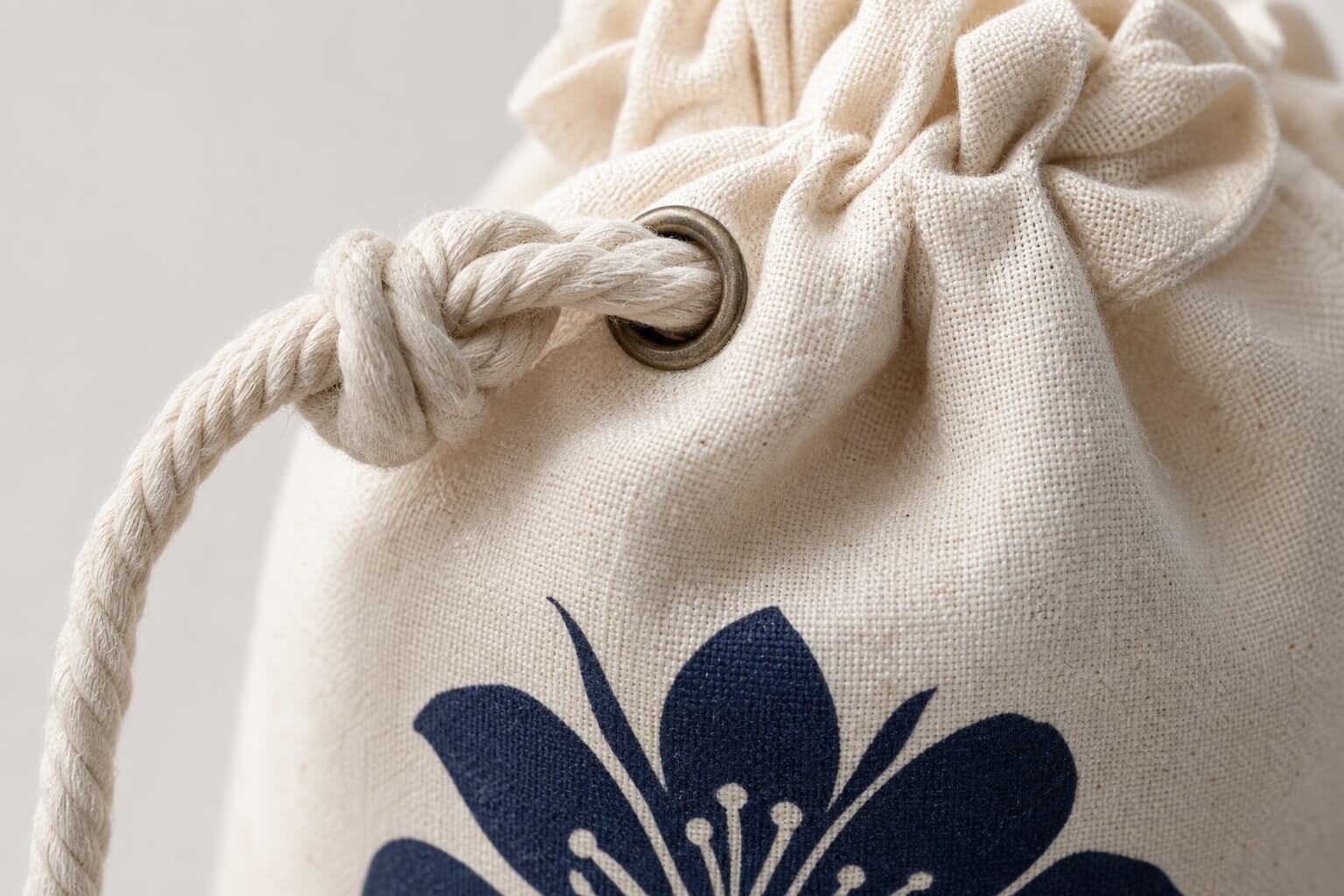
The drawstring system is one of the most common hidden differences between supplier quotes. A single drawstring is cheaper and faster, but a double drawstring feels better and closes more evenly. Cotton cord supports a natural brand look, while polyester cord can offer stronger color and smoother movement. Ribbon may look decorative, but it is not always suitable for repeated use or heavier contents. Cord diameter, knot finish, and end treatment should be part of the quote.
The channel and seam construction control how the pouch performs during filling, retail handling, and consumer use. If the channel is too narrow, the cord drags and the pouch feels low quality. If seam allowance is too small, side seams may open during use. For heavier items, buyers should ask about seam type, stitch density, bar tack options, and bottom reinforcement. These are low-cost decisions compared with the cost of rejected goods.
- State single or double drawstring clearly in the RFQ.
- Define cord material, diameter, color, and whether knots or sealed ends are required.
- Ask for stitch density or a sample photo of the seam construction if the pouch carries weight.
- Check whether the cord color is stock or custom dyed because this affects MOQ and lead time.
- Confirm the drawstring channel width after sewing, not only the flat fabric fold width.
Print Method Compliance: Ink, Placement, and Durability
Logo printing is not only an artwork decision. It affects ink selection, curing, odor, handfeel, rub resistance, and final inspection. Screen printing is usually the practical choice for solid logos and one to three colors. Heat transfer can handle gradients and fine detail but may feel less natural on coarse cotton or canvas. Embroidery can look premium but is not ideal for very small pouches or detailed small text. Woven labels and side labels are good options when the pouch fabric texture makes direct printing less sharp.
A compliant print specification should include artwork file format, print size, print color reference, placement distance from top and side seams, and acceptance criteria. On drawstring pouches, the print area is affected by the top channel, side seams, and the way the fabric puckers when closed. A logo that looks centered on a flat pouch may appear too high once the pouch is filled. Ask for a printed pre-production sample using the same fabric and ink system planned for bulk.
- Use screen print for solid brand marks, simple icons, and larger quantity orders.
- Use heat transfer only after checking edge adhesion and handfeel on the actual pouch fabric.
- Use woven label or side seam label when small logo details must stay readable.
- Define logo placement from finished pouch edges, not from cutting panels.
- Check print rub resistance, cracking, odor, and color match during sample approval.
MOQ Logic: What Really Drives the Minimum Order
The quoted MOQ for drawstring pouches is rarely only about sewing. It can be driven by fabric purchase minimums, dyeing minimums, cord color minimums, print setup, label production, and packing labor. A supplier may accept a small MOQ for natural cotton stock fabric but require a higher quantity for custom dyed fabric or special cord. If you compare quotes without understanding the MOQ driver, a low price may depend on switching to a stock material later.
Procurement teams should ask suppliers to split MOQ by component. This is especially useful when launching multiple pouch sizes or multiple logo versions. Sometimes the best commercial route is to keep one fabric color and cord color across several SKUs, then vary the print. In other cases, a buyer can reduce risk by starting with stock natural cotton and moving to custom dyed fabric after sales volume is proven.
- Fabric MOQ may change by weight, weave, color, and finishing.
- Cord MOQ may apply separately when the color is custom dyed.
- Print MOQ is affected by screen setup, color count, and changeover time.
- Label MOQ can be higher than pouch MOQ, especially for woven labels.
- Packing MOQ matters when retail sleeves, barcode stickers, or custom cartons are required.
Sample Approval Should Test the Production Route
A sample made from leftover fabric is useful for shape discussion, but it is not enough for compliance approval. For bulk orders, the pre-production sample should match the quoted fabric weight, fabric color, cord, seam construction, logo method, label, and packing. If any component is substituted, the supplier should mark it clearly. Otherwise, the buyer may approve a sample that the factory cannot reproduce at the quoted price.
Sample checking should be practical and measurable. Measure finished width and height, check the drawstring opening, compare logo placement, inspect seam consistency, and place the actual product inside if possible. If the pouch will touch a product surface, leave it in contact for a short internal check to see whether lint, dye, or odor transfers. This is not a substitute for lab testing when required, but it catches many sourcing mistakes early.
- Measure at least three sample points because soft fabric can stretch or compress.
- Close and open the pouch repeatedly to check cord movement and channel tension.
- Pack the real product or a weight equivalent to test shape and seam stress.
- Rub the print with a dry white cloth and, if relevant, a slightly damp cloth.
- Check whether the sample packing method matches the quotation and warehouse needs.
Packing, Labeling, and Carton Details Affect Import Receiving
Packing is often treated as an afterthought for pouches because the product is soft and not fragile. That is risky for distributors and retail buyers. Incorrect counts, mixed SKUs, missing carton marks, weak cartons, or unclear inner packing can create receiving delays and chargebacks. If pouches are used as part of a kitting program, packing accuracy may be more important than the pouch itself.
Ask the supplier to quote the exact packing method: pieces per polybag or paper band, pieces per inner carton if used, pieces per export carton, carton dimensions, gross weight, net weight, and carton marks. If the buyer wants plastic-free packing, state it early because paper bands, kraft sleeves, or bulk packing may change labor time and carton utilization. For humid routes, consider moisture control and avoid packing goods before print ink or fabric is fully dry.
- Define whether pouches are bulk packed, individually packed, bundled, or retail packed.
- Confirm barcode sticker location and whether stickers go on pouch, polybag, hangtag, or carton.
- Use separate carton marks for size, color, logo version, PO number, and carton count.
- Ask for carton drop strength suitable for export handling if cartons are large or heavy.
- Request final packing photos before shipment, especially for first orders or multi-SKU shipments.
Lead Time Risks: Fabric, Printing, and Inspection Bottlenecks
A supplier's lead time should be tied to the production route, not stated as a vague number. Stock fabric with one-color screen print can move faster than custom dyed canvas with woven labels and retail packing. Lead time usually starts after sample approval, deposit, artwork confirmation, and receipt of all packaging files. If one of those items is missing, production may not truly be in progress.
The main bottlenecks for drawstring pouches are fabric procurement, dyeing, print setup, drying or curing, sewing line capacity, label arrival, and final packing. Inspection booking can also add time if the buyer uses a third-party inspector. For seasonal promotions, ask for a production schedule showing material arrival, cutting, printing, sewing, QC, packing, and shipment readiness. This schedule is more useful than a simple promise date.
- Ask what material is in stock and what must be ordered or dyed.
- Confirm whether printing happens before or after sewing because it affects timing and logo placement.
- Build time for sample revisions if logo size, cord color, or fabric weight is not approved first round.
- Book inspection early when the order has a fixed retail launch date.
- Do not approve shipment until final carton count, packing photos, and inspection status are clear.
Quote Data Needed for Clean Supplier Comparison
A compliant quotation should let you compare suppliers on the same basis. A quote that says cotton pouch, logo print, FOB price is not enough. You need to know the fabric weight, finished size, tolerance, cord type, print method, color count, packing, sample route, testing support, lead time, and payment term. Without those details, the cheapest quote may simply be missing important cost elements.
For internal sourcing review, build a quote comparison sheet that separates unit price from setup charges and risk items. Include screen charge, sample fee, custom dye charge, label cost, packing cost, testing cost if applicable, and estimated carton volume. This helps procurement explain why a slightly higher unit price may still be the better landed-cost decision if it includes stronger fabric, clearer packing, and fewer compliance gaps.
- Compare finished size and GSM first; do not compare prices for different fabric weights.
- Separate one-time setup charges from repeat order unit costs.
- Ask whether the supplier quoted FOB, EXW, CIF, DDP, or another trade term.
- Request carton dimensions so logistics can estimate freight impact.
- Record quote validity because cotton, dyeing, and freight-related costs can change.
Specification comparison for buyers
| Spec decision | Recommended option | When it fits | Buyer risk to check |
|---|---|---|---|
| Fabric weight | 4-6 oz cotton for light retail gifts; 8-10 oz canvas for heavier contents | Jewelry, cosmetics, candles, promotional kits, reusable packaging | Under-specified GSM can cause weak handfeel, print show-through, and lower perceived retail value |
| Fabric construction | Plain weave cotton for soft pouches; canvas for structure; muslin for low-cost natural look | Natural brand packaging, dust bags, reusable gift packs | Ask whether fabric is pre-shrunk, bleached, dyed, or natural because this affects size tolerance and color consistency |
| Cord type | Cotton cord for natural look; polyester cord for bright color and strength; ribbon only for decorative light use | Fashion, skincare, hospitality, gifting, accessory packaging | Cord diameter and colorfastness are often missed in quotes and can change the final pouch appearance |
| Print method | Screen print for solid logos; heat transfer for gradients; woven label for small premium branding | Bulk logos, detailed artwork, brand compliance programs | Ink adhesion, curing, and artwork size must be checked on the exact fabric, not only on digital artwork |
| Closure construction | Double drawstring for retail handling; single drawstring for low-cost inserts | Products opened repeatedly or used as reusable packaging | Single cords reduce cost but may feel weak and can fail if the pouch carries weight |
| Testing level | AQL inspection plus buyer-specific tests for colorfastness, seam strength, and print adhesion | Import programs, chain retail, regulated promotional channels | Do not assume a supplier's general factory audit replaces product-specific checks |
| Packing method | Inner polybag or paper band by SKU, export carton with clear carton marks and gross/net weight | Multi-SKU orders, distributor replenishment, retail warehouse receiving | Mixed sizes or unmarked cartons slow receiving and increase chargeback risk |
| Documentation | Quote sheet with material, size tolerance, print method, packing, lead time, sample approval, and compliance declarations | Any order requiring importer approval or retailer onboarding | A low unit price without spec detail is not comparable and may hide fabric, cord, or packing changes |
Buyer checklist before sampling
- Define pouch use case: retail packaging, dust bag, gift pouch, promotional giveaway, or product protection.
- State exact finished size with tolerance, not only fabric cutting size.
- Specify fabric type, weight in GSM or oz, color, dye method, and whether natural flecks are acceptable.
- Confirm cord material, diameter, color, draw direction, knot finish, and whether double drawstring is required.
- Attach logo artwork with size, color reference, placement distance from seams, and print method preference.
- Ask the supplier to confirm compliance requirements based on destination market and product contact risk.
- Request pre-production samples using the correct fabric, cord, print, label, and packing method.
- Set measurable acceptance criteria for size, seam strength, color, print adhesion, stains, odor, and packing count.
- Require carton packing details including pieces per inner pack, carton size, gross weight, and carton marks.
- Compare quotes only after every supplier confirms the same specification, sample route, testing scope, and lead time.
Factory quote questions to send
- What exact fabric construction and weight are included in this quote, and can you provide GSM tolerance?
- Is the pouch size quoted as finished size after sewing, washing, or ironing, and what production tolerance applies?
- What cord material, diameter, color, and closure style are included in the unit price?
- Which print method is quoted, how many print colors are included, and what is the maximum printable area?
- Are setup charges, screen charges, sample fees, lab testing, inner packing, and export carton costs included or separate?
- What MOQ applies to the fabric color, pouch size, cord color, and logo print method separately?
- Can you produce a pre-production sample from bulk fabric before mass production starts?
- What compliance documents can you provide for the fabric, dyes, inks, or finished pouches if requested?
- What is your normal lead time after sample approval, and what can delay it during fabric dyeing, printing, or packing?
- What inspection standard do you use before shipment, and can we add buyer-defined AQL checkpoints?
Quality-control points to confirm
- Measure finished pouch width and height after sewing and pressing against the approved tolerance.
- Check fabric weight, handfeel, shrinkage tendency, dye lot consistency, odor, stains, and weaving defects.
- Pull-test side seams, bottom seam, and drawstring channel to confirm the pouch can handle intended product weight.
- Test drawstring smoothness by opening and closing samples repeatedly from different cartons.
- Check logo position, print color, ink coverage, edge sharpness, curing, rub resistance, and wash or wipe behavior if relevant.
- Verify label wording, country of origin, barcode, warning text, and retail packaging against the buyer's approved artwork.
- Count pieces per polybag, inner carton, and export carton; confirm mixed SKU cartons are clearly marked if allowed.
- Inspect cartons for correct dimensions, gross weight, carton marks, carton strength, and moisture protection.
- Review random production samples from early, middle, and final output instead of only the supplier's best retained sample.
- Photograph defects and classify them as critical, major, or minor before deciding rework, sorting, or acceptance.