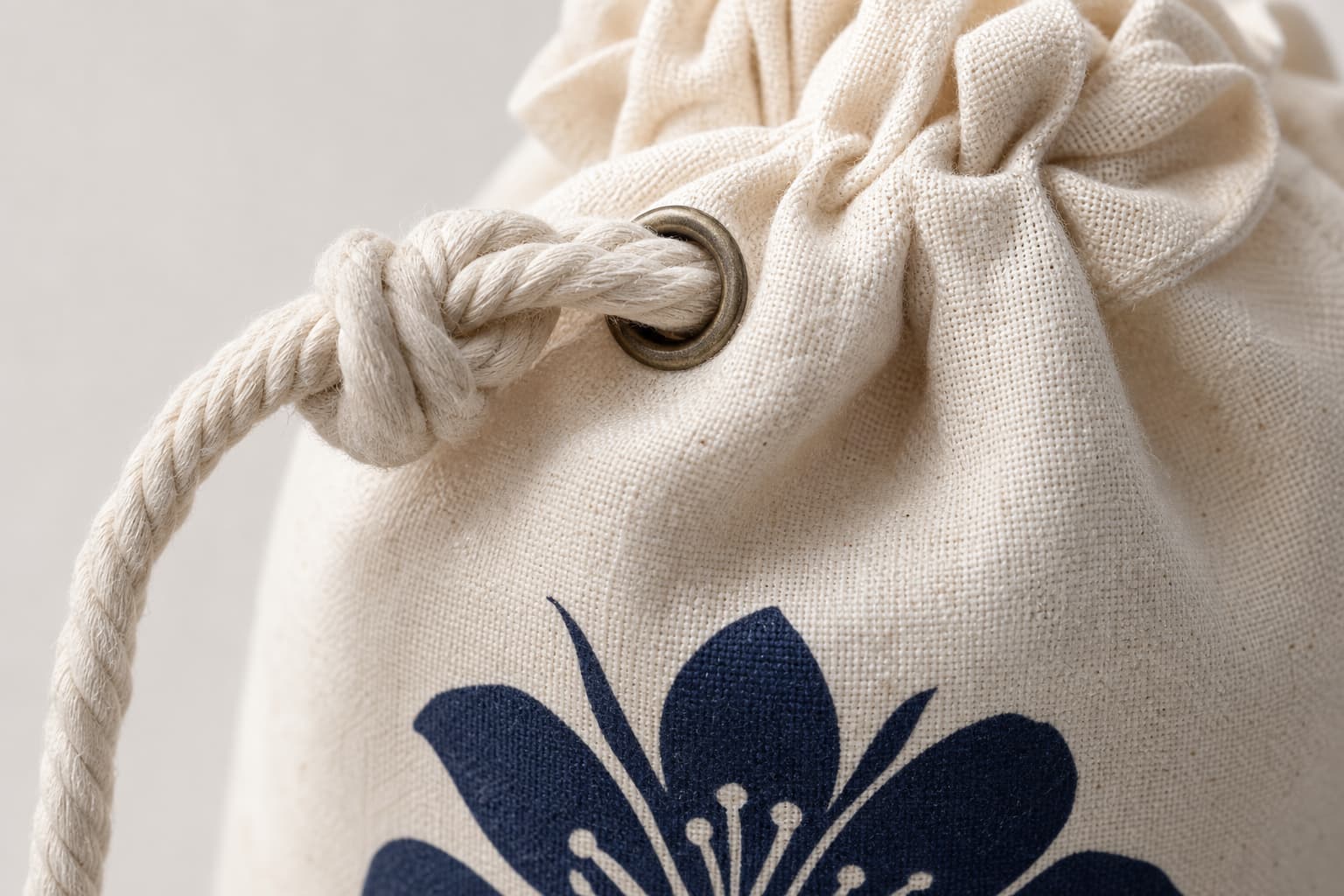
Start With Usable Size, Not Only Flat Size
The most common RFQ mistake is asking for a drawstring pouch size based only on the product's outside dimensions. A pouch is not a rigid box. It loses space at the side seams, bottom seam, and drawcord channel. If the buyer requests 10 x 15 cm and the product is also close to 10 x 15 cm, the pouch may technically match the purchase order but still be difficult to fill.
For RFQs, give the factory both the desired finished flat size and the product size that must fit inside. If the item is thick, round, or irregular, include product thickness and packed weight. A candle, watch box, soap bar, and jewelry card can all need different pouch allowances even if their front dimensions look similar.
- For thin flat items, add about 1-2 cm to width and 2-3 cm to height as a starting allowance.
- For thick items, add more width because the fabric wraps around the side depth.
- Keep the logo below the drawcord channel so the print is visible when the pouch is closed.
- Ask for the usable internal height below the cord channel, especially on small pouches.
- If the pouch must stand or look full in retail photos, test with the real product before approving bulk size.
Common Drawstring Pouch Sizes and What They Actually Fit
Size ranges are useful for early budgeting, but final approval should be based on a sample with the actual product inserted. Small pouches often fail because the top channel takes too much space. Large pouches often fail because the buyer selected fabric that is too light for the product weight.
Factories usually quote more accurately when the RFQ states the use case: jewelry pouch, cosmetics pouch, dust bag, candle pouch, apparel pouch, event giveaway pouch, or retail gift pouch. This helps the merchandiser recommend fabric, seam strength, cord diameter, and packing method.
- 7 x 9 cm to 10 x 12 cm: rings, small jewelry, coins, USB drives, small samples.
- 12 x 15 cm to 15 x 20 cm: cosmetics, soap bars, candles, tea packs, small gift sets.
- 18 x 24 cm to 25 x 30 cm: scarves, socks, travel items, promotional kits.
- 30 x 40 cm to 40 x 50 cm: apparel, shoe accessories, larger dust bags, home textile packaging.
- Custom tall sizes work well for bottles or tools, but the cord channel and logo location must be planned together.
Fabric Weight Changes Both Cost and Fit
Drawstring pouch fabric is usually quoted by GSM or by ounce weight. Lightweight muslin may be enough for low-cost packaging, while cotton canvas is better for reusable retail pouches. A heavier pouch feels more premium, but it can cost more, pack bulkier, and close less smoothly if the cord channel is too tight.
For cotton and canvas pouches, the buyer should request the fabric specification in writing. Do not accept only descriptions such as natural cotton, thick cotton, or eco fabric. These words are not precise enough for comparing supplier quotes.
- 120-150 GSM cotton: economical dust bags or light gift packaging, but may be more transparent.
- 160-200 GSM cotton: common for retail gift pouches and promotional packaging.
- 5 oz to 6 oz cotton: balanced handfeel for many branded pouches.
- 8 oz canvas: stronger and more structured for reusable packaging or heavier products.
- 10 oz canvas and above: premium feel, but check closing performance and carton volume.
Print Area Must Be Planned Around the Cord Channel
A logo that looks correct on a flat art file may sit too high after sewing. The drawstring channel folds and stitches across the top area, so the printable space is smaller than the full pouch height. On small pouches, this difference is significant.
Screen printing is usually the most practical method for simple logos on cotton pouches. Heat transfer can handle more detail but may feel less natural on cotton. Embroidery gives texture, but it is not ideal for very small pouches or fine lettering. Woven labels are useful when the pouch size is small and the brand mark does not need a large front print.
- Keep the logo at least 2-3 cm below the top channel on small and medium pouches.
- Avoid printing too close to side seams because fabric tension can distort the artwork.
- Use one-color screen print for simple logos and better cost control at bulk quantity.
- Request a print strike-off on the same fabric color and GSM as bulk production.
- For dark fabric, confirm whether underbase ink is needed to keep the logo color accurate.
MOQ Logic: Size, Fabric Color, Cord, and Print All Matter
A supplier's MOQ is not only about the pouch quantity. MOQ can be driven by fabric dyeing, cord color, printing setup, cutting efficiency, and the number of sizes in the order. A mixed-size order may look large in total quantity but still be inefficient if each size has a small quantity.
To compare quotes, ask suppliers to separate the main cost drivers. For example, natural cotton in a standard fabric may have a lower MOQ than custom dyed cotton. A one-color logo normally has a lower setup burden than multi-color print. Standard white or natural cotton cord is easier than a custom Pantone cord.
- Standard natural fabric usually supports lower MOQ than custom dyed fabric.
- Multiple sizes should be quoted by size, not only as one combined quantity.
- Custom cord color may have its own MOQ even if the pouch fabric is standard.
- Multi-color print adds setup cost and can increase sample time.
- If the first order is small, keep fabric, cord, and print simple to improve factory feasibility.
Sample Approval Should Test Size, Closure, and Branding Together
A blank size sample is useful, but it does not prove that the printed pouch will work in bulk. Printing can change handfeel, placement accuracy, and visible balance. For branded retail packaging, approve a full pre-production sample before bulk cutting where possible.
The buyer should physically insert the actual product, close the pouch, pull the cords, and check whether the logo remains visible. For pouches used by store staff or fulfillment teams, filling speed matters. A pouch that is technically correct but slow to pack can create extra labor cost.
- Check flat finished size with a ruler and compare it to the RFQ tolerance.
- Insert the actual product and confirm it fits without forcing the seams.
- Close the pouch fully and check whether the cord slides smoothly.
- Confirm the logo is not hidden by folds, knots, or product shape.
- Take sample photos filled and unfilled so both buyer and factory agree on appearance.
Packing Method Affects Freight, Creasing, and Warehouse Handling
Drawstring pouches are soft goods, so packing can change the buyer's landed cost and receiving process. Flat packing saves space and is usually efficient. Individual polybags protect the pouch but add material, packing labor, and unpacking work. Folded packing can reduce carton size but may create creases on printed areas.
For retail or distribution orders, carton data should be part of the quote. Procurement teams need estimated pieces per carton, carton dimensions, gross weight, and carton marking details. This information helps compare suppliers beyond unit price.
- Flat bulk packing is practical for many unfilled pouches and reduces unnecessary handling.
- Individual packing may be needed for retail cleanliness, kitting, or barcode control.
- Avoid tight folding across a printed logo if the ink is thick or the fabric is dark.
- Request carton dimensions and gross weight before confirming freight estimates.
- Specify carton marks, SKU separation, and size labels if the order includes multiple pouch sizes.
Lead Time Depends on More Than Sewing Capacity
Drawstring pouches look simple, but lead time can be affected by fabric availability, dyeing, print approval, sample revisions, cord sourcing, and packing requirements. A quote that gives only one bulk production time without conditions is not enough for a purchase plan.
Buyers should separate sample lead time, sample transit time, bulk production time, inspection time, and shipment booking. If the order has a fixed launch date, the RFQ should state the required ex-factory date and the latest acceptable sample approval date.
- Stock natural fabric is usually faster than custom dyed fabric.
- Printed samples take longer than blank size samples because artwork setup is required.
- Peak season can affect fabric mills, printing workshops, and carton supply.
- Inspection should be scheduled after packing but before final shipment release.
- Late artwork approval is a common reason for missing the requested ship date.
Specification comparison for buyers
| Spec decision | Recommended option | When it fits | Buyer risk to check |
|---|---|---|---|
| Small jewelry or accessory pouch | 8 x 10 cm to 10 x 12 cm, 4 oz to 5 oz cotton | Rings, bracelets, small cosmetics, USB items, sampling kits | Opening may be too tight after drawcord channel is sewn; confirm usable internal height, not only flat cut size |
| Medium retail gift pouch | 13 x 18 cm to 15 x 20 cm, 5 oz to 6 oz cotton or 140-180 GSM muslin | Candles, skincare sets, socks, tea packs, small promotional gifts | Logo can distort near curved contents; test print placement with the actual product inside |
| Large apparel or shoe accessory pouch | 25 x 30 cm to 35 x 45 cm, 6 oz to 8 oz cotton canvas | T-shirts, scarves, slippers, kids shoes, travel organizers | Thin fabric may look transparent and collapse in photos; check opacity and handfeel before approval |
| Premium reusable pouch | 8 oz to 10 oz cotton canvas with reinforced side seams | Retail packaging intended for repeated storage use | Higher GSM increases drawcord resistance; confirm the pouch closes smoothly when filled |
| Low-cost dust bag | Non-printed 120-150 GSM cotton or blended fabric | Protective packaging where branding is secondary | Loose weave and shrinkage can change finished size after washing or steam pressing |
| Logo method for most cotton pouches | One-color screen print with 2-3 cm clearance from seam and cord channel | Simple brand marks, text, icons, event packaging | Fine lines may fill in on coarse fabric; request strike-off on production fabric |
| Drawcord choice | Cotton rope for natural look; polyester cord for smoother sliding | Cotton for eco-style retail; polyester for frequent opening and closing | Cord diameter must match channel width; thick cord can jam and slow packing |
Buyer checklist before sampling
- Confirm finished size in width x height, not fabric cutting size.
- State whether size is measured flat, empty, and before or after ironing.
- Send the actual product dimensions and weight the pouch must hold.
- Allow top channel loss, seam allowance, and drawcord clearance when calculating internal space.
- Specify fabric type, GSM or oz, color, shrinkage tolerance, and whether pre-shrunk fabric is required.
- Define logo size, print method, Pantone reference, print position, and seam clearance.
- Confirm cord material, cord diameter, cord color, knot style, and single-side or double-side pull.
- Request pre-production sample photos and physical sample approval before bulk cutting.
- Specify packing method: flat, folded, individual polybag, carton quantity, and carton marks.
- Ask suppliers to quote MOQ, sample fee, bulk lead time, packing volume, and over/under shipment tolerance.
Factory quote questions to send
- Is the quoted size the finished pouch size after sewing and pressing, or the cut fabric size?
- What usable internal height remains below the drawstring channel?
- What fabric GSM or oz is included in the quote, and can you provide a fabric swatch before sampling?
- What is the recommended print method for our logo size and artwork details on this fabric?
- What is your MOQ by size, fabric color, cord color, and print color count?
- Can you quote the same pouch in two fabric weights so we can compare cost and handfeel?
- What size tolerance do you apply for finished pouches in bulk production?
- How many pieces fit per export carton, and what are the estimated carton dimensions and gross weight?
- What sample type will you provide: blank size sample, printed strike-off, or full pre-production sample?
- What is the bulk lead time after sample approval and deposit, and does it change during peak season?
Quality-control points to confirm
- Measure finished width and height from a random sample of bulk pouches against the approved tolerance.
- Check usable internal height below the drawcord channel with the buyer's actual product inserted.
- Pull the drawcord repeatedly to confirm the channel is not too narrow, twisted, or blocked by stitching.
- Inspect logo position, print sharpness, ink coverage, color consistency, and cracking after light rubbing.
- Check side seams, bottom corners, backstitching, loose threads, and whether knots are secure.
- Compare bulk fabric handfeel, color, opacity, and GSM against the approved sample or swatch.
- Verify packing count per inner pack and carton, carton marks, barcodes if required, and moisture protection.
- Confirm no odor, oil marks, needle stains, fabric holes, or mixed sizes are present before shipment.