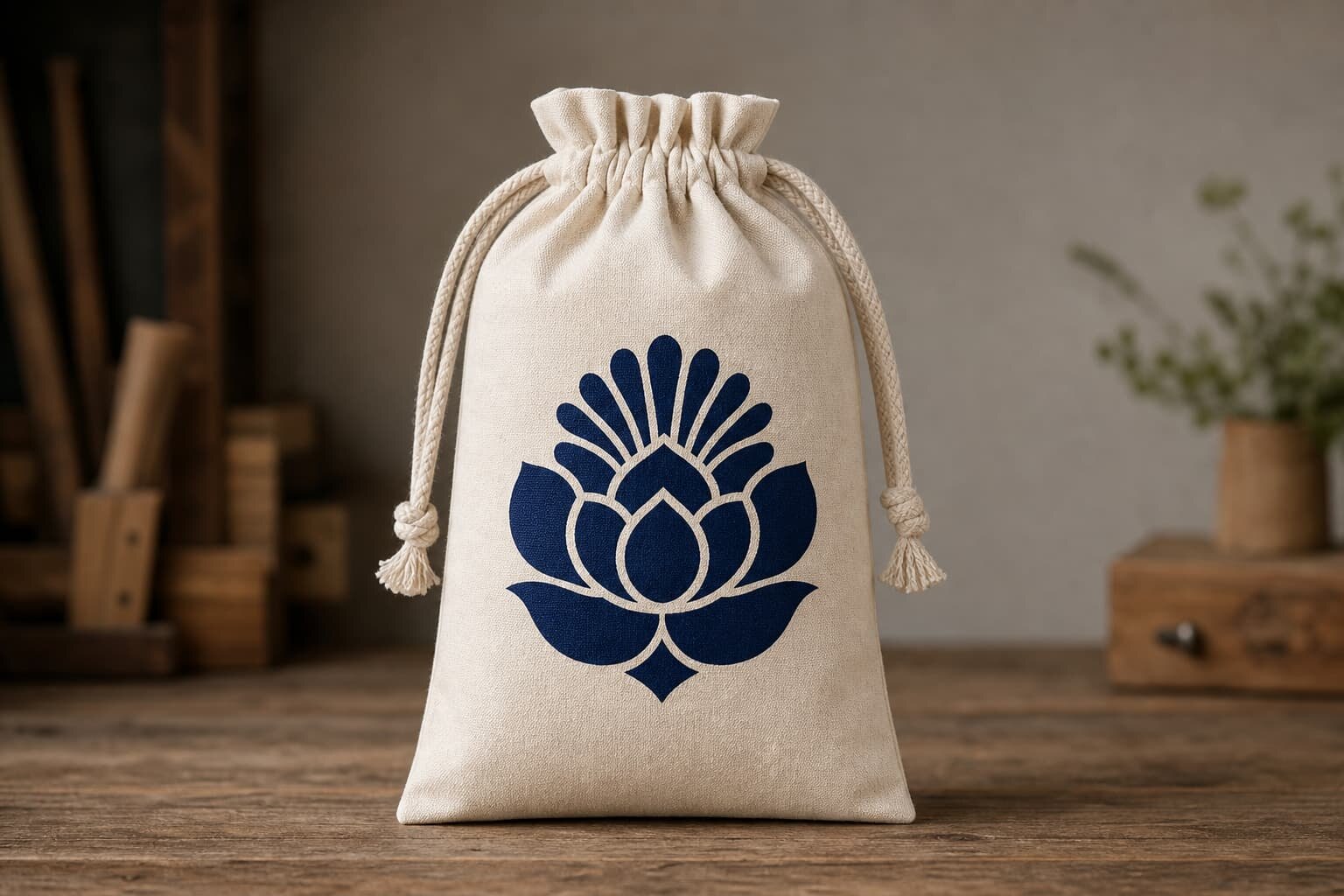
Why the Seam Spec Sheet Matters in a Pouch RFQ
A drawstring pouch looks simple on a product page, but the seam construction decides whether it feels retail-ready or disposable. Many quote gaps start because the buyer asks for cotton drawstring pouches with logo printing, while the factory assumes the lowest-cost side seam, narrow seam allowance, basic overlock, and no reinforcement at the bottom corners. The first sample may still look acceptable from the front. The problem appears when the pouch is filled, pulled closed, packed tightly, or inspected inside out.
A seam spec sheet gives procurement teams a common technical language before prices are compared. It does not need to be a complicated garment tech pack. It should define the finished size, fabric weight, seam type, seam allowance, stitch density, thread, drawcord channel, reinforcement points, print clearance, packing method, and inspection standard. When every supplier quotes against the same seam spec, the buyer can compare real production value instead of comparing one strong pouch against one cheap pouch that only looks similar in photos.
- Use the seam spec sheet before sampling, not after the first production problem.
- Attach photos or simple line drawings showing inside seam construction and channel stitching.
- Separate cosmetic requirements from functional requirements so factories know what cannot be changed.
- Ask each supplier to confirm exceptions in writing instead of assuming the quote matches your standard.
Define the Finished Pouch Before Defining the Seam
The seam spec starts with finished pouch dimensions because seam allowance, hem fold, and channel height all consume fabric. A 10 x 15 cm finished jewelry pouch and a 30 x 40 cm cotton dust bag may both use drawstring closure, but they need different seam decisions. Small pouches require tight control of channel height and cord diameter. Larger pouches need stronger side seams, better bottom reinforcement, and enough print clearance so the logo does not fall into the fold or distort near the seam.
Buyers should state whether dimensions are measured flat, after sewing, after washing, or after final pressing. If the pouch has a bottom gusset, boxed corners, rounded bottom, or side label, these details must be included before the factory calculates cutting consumption. A supplier can quote a lower unit price by using smaller cut panels, narrow hems, and tight seam allowance. That saving may disappear when the finished size fails tolerance or when the pouch cannot hold the intended product.
- Finished size: width x height, measured flat after sewing.
- Tolerance: commonly plus or minus 3-5 mm for small pouches and plus or minus 5-10 mm for larger pouches, depending on fabric and order standard.
- Opening: single drawcord, double drawcord, cotton tape, braided cord, satin ribbon, jute cord, or polyester cord.
- Bottom: flat bottom, gusseted bottom, boxed corner, or rounded corner.
- Use case: gift packaging, cosmetic pouch, wine bottle bag, hardware pouch, retail storage bag, or promotional giveaway.
Match Seam Construction to Fabric Weight
Fabric weight changes how the seam behaves. A lightweight 120 GSM muslin pouch can pucker if the stitch density is too high or the thread is too thick. A 10 oz canvas pouch may look strong, but thick seam intersections at the channel and side seam can create uneven stitching if the factory uses the wrong needle, foot pressure, or folding sequence. Jute and linen-look fabrics need extra attention because loose yarns can fray quickly when the seam allowance is narrow.
For RFQs, avoid writing only cotton pouch or canvas pouch. State the target GSM or ounce weight and ask the factory to confirm the nearest available stock fabric. If color dyeing or custom weaving is required, MOQ and lead time will change. Stock natural cotton may support lower MOQ and faster sampling. Custom dyed fabric usually requires higher MOQ because fabric dye lots, shrinkage testing, and lab dips must be controlled before cutting.
- 120-150 GSM cotton muslin: suitable for lightweight gift, jewelry, or cosmetic sample pouches; check puckering and transparency.
- 180-220 GSM cotton: better for promotional and retail gift pouches; use stable side seams and neat overlock.
- 8 oz canvas: suitable for reusable drawstring storage bags; needs stronger needle control and wider channel.
- 10-12 oz canvas: good for heavier products, but thick seams require careful sampling and may raise sewing cost.
- Jute or burlap blend: requires fray control, odor review, and wider seam allowance than tightly woven cotton.
Set Side Seam and Bottom Seam Acceptance Criteria
The side seam and bottom seam carry most of the load when the pouch is filled. For a low-cost disposable pouch, a simple overlock may be enough. For export retail packaging or product protection, buyers should consider inside overlock plus lockstitch, French seam, bound seam, or another reinforced construction. The right choice depends on product weight, desired inside appearance, and target price. The spec sheet should not only name the seam type; it should show where the seam starts and ends, how corners are reinforced, and whether backstitching is visible.
Bottom corners are a common failure point. The seam may open because the operator turns the corner too fast, the stitch length becomes long at the corner, or the backstitch is skipped to save time. In a sample review, fill the pouch with the intended product weight and pull gently from both sides. This is not a lab test, but it quickly shows whether the seam logic is suitable. If the product is dense, such as candles, metal parts, glass jars, or wine accessories, specify reinforcement instead of relying on normal stitching.
- Side seam: specify overlock only, lockstitch plus overlock, French seam, or binding.
- Bottom seam: specify same construction as side seam or stronger construction if product weight is high.
- Seam allowance: define target after sewing, not only cut allowance.
- Reinforcement: require backstitching or bar tack at bottom corners when load is important.
- Inspection: turn inside out and check skipped stitches, loose thread chains, and uneven trimming.
Control the Drawcord Channel Before It Causes Delays
The drawcord channel is where many approved samples fail in bulk production. If the channel is too narrow, the cord does not slide smoothly and buyers receive complaints that the pouch is hard to close. If the channel is too loose, the top looks bulky and the pouch may not close tightly. If the stitch line is wavy, the defect is very visible on natural cotton and canvas. A practical spec sheet states finished channel height, fold construction, cord diameter, cord length, and exit point finish.
The cord type also affects MOQ and sewing. Cotton rope has a natural look but can shrink, shed fibers, or vary in shade. Polyester cord slides well and offers stable color, but may not match a natural eco-positioning. Satin ribbon works for gift packaging but can twist inside the channel. Jute cord matches rustic pouches but can be rough and may shed. For every option, the sample should be checked after printing and packing because a beautiful cord can still crease the logo or make the pouch difficult to stack.
- Channel height: commonly 25-35 mm finished, adjusted to cord diameter and pouch size.
- Cord exit: side opening, two-side pull, front center, or channel opening at seam.
- Cord length: define total length and tolerance after knotting.
- Cord end: knot, metal aglet, heat sealed polyester end, wooden bead, or no stopper.
- Channel seam: check straightness, stitch tension, and whether cord is caught by stitching.
Print Placement Must Respect the Seam Plan
Printing cannot be treated as a separate decision from seam construction. Screen print, heat transfer, digital print, embroidery patch, woven label, and debossed leather patch all need clearance from seams and folds. If artwork sits too close to the side seam, the print edge may distort during sewing or disappear when the pouch is filled. If the logo is too close to the drawcord channel, it can crease each time the pouch is closed. For brand owners, this creates a bigger problem than a small size tolerance because the defect is visible to the final customer.
For screen printing on cotton or canvas drawstring pouches, a practical rule is to keep artwork at least 15 mm away from side seams and 20 mm away from the drawcord channel, with more clearance for thick canvas or large logos. Heat transfer can show edge lifting if it crosses seam bulk or folded fabric. Embroidery is usually not ideal on very small or lightweight pouches because backing and stitch tension can distort the panel. A seam spec sheet should include the printable area, placement tolerance, print color count, and whether printing is done before or after sewing.
- Screen print: good for solid logos and medium to large runs; check ink handfeel and curing.
- Heat transfer: useful for detailed artwork; keep away from folds and high-friction seam areas.
- Digital print: suitable for multicolor artwork on selected fabrics; confirm color fastness and fabric compatibility.
- Woven label: good for premium branding; specify label size, fold type, and insertion seam.
- Embroidery patch: better than direct embroidery for many pouch fabrics if distortion risk is high.
Use MOQ Logic That Reflects Real Factory Setup
MOQ is often misunderstood in pouch sourcing. A factory may accept 500 pieces for a stock natural cotton pouch with one-color print, but the same factory may need 1,000 to 3,000 pieces for custom dyed fabric, special cord color, custom woven label, or reinforced seam construction. MOQ is not only a sales rule. It comes from fabric procurement, dye lot minimums, printing setup, sewing line setup, packing material purchase, and the amount of sampling work required.
Buyers should ask MOQ by variable, not only total quantity. If an order includes three pouch sizes, four fabric colors, and two logo versions, the real production split may be too small for stable cutting and printing. A better RFQ states the forecast quantity and asks the supplier to quote practical breakpoints. This helps procurement compare whether a higher MOQ gives a meaningful unit cost reduction or only increases inventory risk.
- Lowest MOQ usually applies to stock fabric, stock cord, standard seam, and simple print.
- Custom fabric color may require lab dip, dye lot control, and higher minimum cutting quantity.
- Multiple print artworks increase setup cost even when the pouch size is the same.
- Reinforced seams may raise labor cost more than material cost.
- Packing changes, such as individual polybags or barcode labels, can create separate MOQ for packaging supplies.
Quote Data Buyers Should Require
A low unit price is not useful if it hides the construction assumptions. For drawstring pouches, the quote should identify fabric weight, size, seam construction, print method, print area, cord type, label details, packing, sample cost, production lead time, and any excluded items. Without these details, procurement may approve the cheapest quote and later discover that the supplier did not include reinforced seams, inside overlock, retail packing, or color matching.
Ask suppliers to state the quote basis clearly. For example, the price may be based on natural 8 oz cotton canvas, finished size 20 x 30 cm, lockstitch plus overlock side seams, 30 mm drawcord channel, 5 mm cotton cord, one-color screen print on one side, bulk pack 100 pieces per inner polybag, and 500 pieces per master carton. This level of detail makes quote comparison faster and reduces commercial arguments after sampling.
- Fabric: composition, GSM or ounce weight, color, shrinkage expectation, and stock or custom status.
- Sewing: seam type, seam allowance, stitch density, reinforcement, and label insertion.
- Branding: print method, color count, print size, placement, label, tag, or patch.
- Packing: unit pack, inner quantity, carton quantity, carton dimensions, gross weight estimate, and carton marks.
- Timing: sample lead time, PP sample approval point, bulk production lead time, and shipment booking requirement.
- Commercial terms: MOQ by size or color, tooling or screen charge, sample charge, payment term, and quote validity.
Sample Approval Should Include Inside-Out Review
Many pouch samples are approved only from the front, which is not enough. The buyer should request at least one sample turned inside out or ask for inside seam photos before approving the pre-production sample. This is especially important for retail buyers and distributors because loose threads, raw edges, and weak corner stitching may not be visible during normal photo review. If the pouch will be used to pack a premium product, the inside appearance becomes part of the customer experience.
Sample approval should also test the drawcord function after the pouch is filled. Pull the cord several times, open and close the pouch, and check whether the channel twists, the cord sheds, the knots loosen, or the top hem puckers. If the pouch is printed, check whether the print cracks or creases after closure. Any changes made after PP sample approval should be recorded in the action log and reflected in the seam spec sheet so the sewing line and inspector follow the same updated standard.
- Request one normal sample and one inside-out sample when seam quality is important.
- Measure finished size at top, middle, and bottom to catch sewing distortion.
- Compare seam allowance on both sides; uneven allowance may affect strength and appearance.
- Check thread color under natural light and indoor light.
- Photograph approved seam details and include them in the inspection reference file.
Packing and Lead Time Affect Seam Quality Too
Packing is not separate from seam quality. Tight compression can crease screen prints, deform cord knots, and make side seams look twisted when the buyer opens cartons. If the factory packs pouches randomly, inspectors may not notice that a percentage of seams are misaligned. For retail programs, specify whether pouches are flat packed, folded once, tied, untied, individually bagged, grouped by inner polybag, or packed with hangtags and barcode labels.
Lead time should be counted from the correct approval milestone. For a standard stock fabric pouch, production may start after artwork and sample approval. For custom dyed fabric, the clock should start after lab dip approval and fabric availability. For complex pouch programs with multiple sizes, prints, and labels, add time for material matching and line setup. Rushing sewing after late artwork approval increases the risk of skipped reinforcement, poor trimming, and inconsistent channel stitching.
- Flat packing protects print appearance better than tight random folding.
- Cord alignment should be checked before carton sealing if the pouch is retail-facing.
- Carton quantity should balance freight efficiency with pressure on seams and prints.
- Barcode stickers and hangtags need placement instructions so they do not cover the logo.
- Production lead time should list dependencies: deposit, artwork, lab dip, PP sample, packaging file, and final inspection booking.
Specification comparison for buyers
| Spec decision | Recommended option | When it fits | Buyer risk to check |
|---|---|---|---|
| Main seam construction | Inside overlock plus lockstitch safety seam | Medium to heavy cotton, canvas, and gift pouches that need better seam strength | Confirm whether quote includes both operations or only simple overlock |
| Seam allowance | 8-10 mm after sewing for cotton and canvas | Most reusable retail and promotional pouches | Too narrow allowance can fray after washing or when pouch is filled |
| Bottom corner reinforcement | Backstitch or bar tack at both bottom corners | Pouches carrying bottles, cosmetics, hardware, or dense items | Factories may omit reinforcement unless shown in the spec sheet |
| Drawcord channel height | 25-35 mm finished channel depending on cord diameter | Cotton tape, twisted cotton cord, braided polyester cord, or jute cord | Narrow channels make cord pulling stiff and cause puckering |
| Stitch density | 8-10 stitches per inch for woven cotton and canvas | Balanced strength and neat appearance on most pouch fabrics | Very high density can perforate lightweight fabric; very low density looks cheap |
| Raw edge control | Overlock, French seam, or binding based on target quality | Export orders where loose threads and fraying are common rejection points | Ask whether inside seam appearance is included in AQL inspection |
| Print-to-seam clearance | Minimum 15 mm from seam and 20 mm from drawcord channel | Screen print, heat transfer, embroidery patch, or woven label placement | Artwork too close to seam may distort, crack, or be partly hidden |
| Top opening finish | Double-fold hem before drawcord channel stitching | Retail-ready cotton, muslin, canvas, and linen-look pouches | Single fold may expose frayed edge inside the channel |
| Packing method | Flat pack with cords aligned and seam side consistent | Orders requiring barcode labels, retail cartons, or distributor repacking | Random folding can crease prints and hide seam defects during inspection |
Buyer checklist before sampling
- Confirm pouch size is listed as finished size, not cut panel size, and include tolerance for width, height, and drawcord length.
- Specify fabric composition and weight, such as 5 oz cotton, 8 oz canvas, 10 oz canvas, 120 GSM muslin, or jute blend, because seam strength depends on fabric behavior.
- Define seam type for side seam, bottom seam, drawcord channel, top hem, label insertion, and any gusset or boxed corner.
- Mark the seam allowance and required inside finishing method so factories cannot quote a cheaper raw-edge construction by mistake.
- Set print-to-seam clearance and print placement tolerance before approving artwork, especially for screen print and heat transfer orders.
- Ask for a pre-production sample turned inside out, with close-up photos of both side seams, bottom corners, channel stitching, and cord exit points.
- Include minimum stitch density, thread color, thread material, and whether backstitching or bar tacks are required at stress points.
- List packing requirements by unit, inner polybag, master carton quantity, carton marks, barcode position, and whether cords must be tied or untied.
- Check that MOQ is quoted by fabric color, pouch size, print color count, and seam construction, not only by total order quantity.
- Require factory quote data to separate fabric, sewing, printing, label, packing, sampling, and testing or inspection costs where possible.
Factory quote questions to send
- What seam construction are you quoting for the side seam, bottom seam, top hem, and drawcord channel?
- What is the finished seam allowance after sewing, and can you keep it consistent across bulk production?
- Is the inside seam overlocked, French seamed, bound, or left with a raw edge?
- What fabric GSM or ounce weight is included in this quote, and what shrinkage should we expect after washing or steaming?
- What stitch density and thread type will be used for cotton, canvas, jute, or polyester-blend pouch fabric?
- Are bottom corners and cord exit points reinforced with backstitching, bar tacks, or extra stitching?
- What is the minimum print clearance from seams, drawcord channel, and pouch bottom for the selected print method?
- How many pieces are included in the pre-production sample approval, and will one sample be supplied inside out for seam review?
- What MOQ applies if we split the order by size, fabric color, cord color, or artwork?
- What packing method is included in the unit price, and what is the carton quantity and estimated carton size for freight planning?
Quality-control points to confirm
- Measure finished pouch width and height after sewing and pressing, not before drawcord insertion.
- Turn samples inside out and check that seam allowance is wide enough and not trimmed too close to the stitch line.
- Pull side seams and bottom corners with moderate hand force to identify skipped stitches, weak backstitching, or thread breakage.
- Check that the drawcord channel is straight, wide enough, and free from caught fabric that blocks cord movement.
- Compare stitch density against the approved sample and inspect for long stitches around corners and thick seam intersections.
- Confirm print placement stays clear of seam bulk, drawcord channel stitching, and folded edges.
- Inspect cord length, cord diameter, knot security, and whether both sides pull evenly after packing.
- Review inside loose threads, raw edge fraying, needle holes, oil marks, and fabric puckering before shipment approval.
- Check carton packing orientation to prevent print creasing, pouch twisting, or heavy compression on cord knots.
- Record acceptance criteria in the inspection file so the factory, buyer, and third-party inspector judge the same seam details.