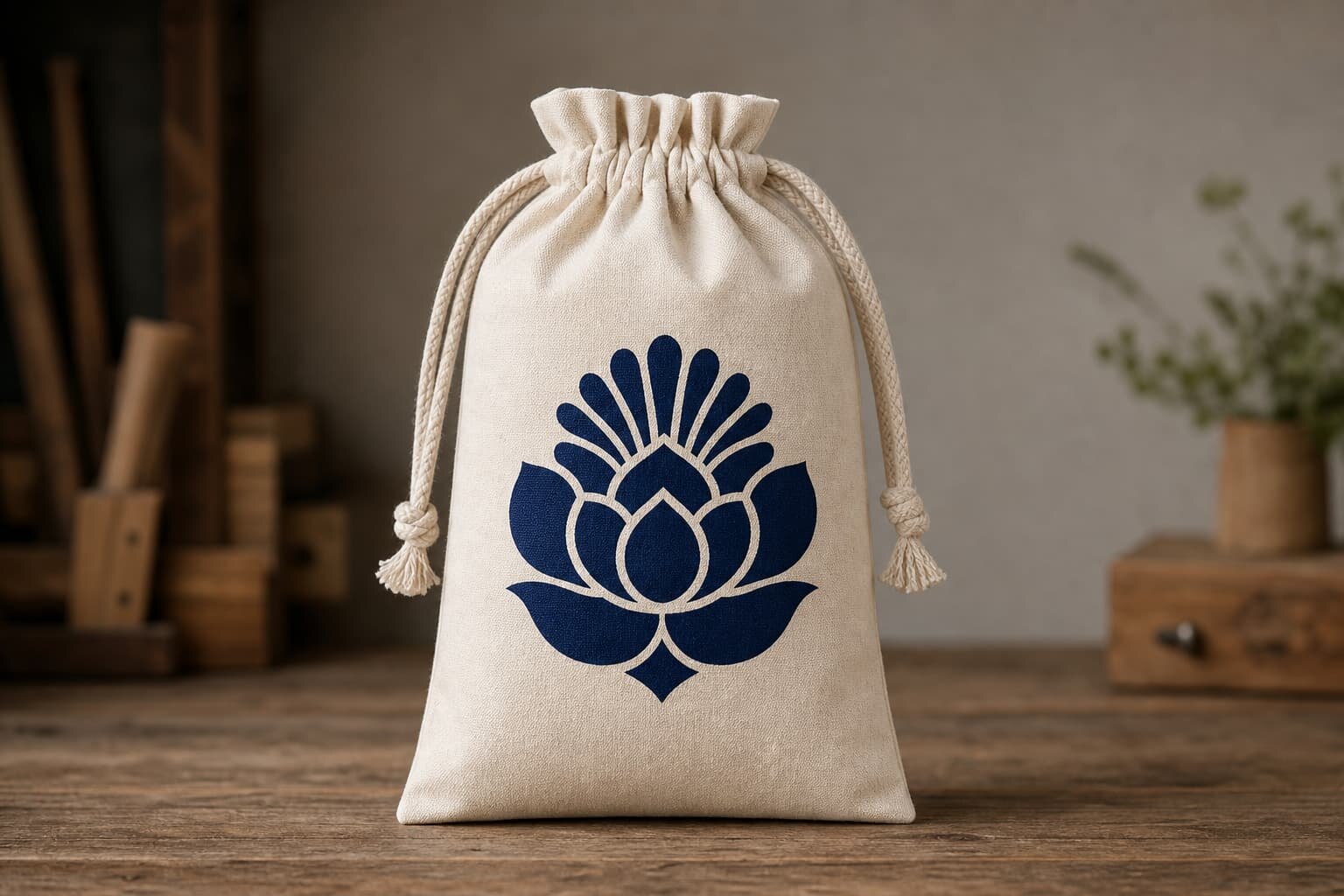
Why artwork setup changes the real pouch quote
A drawstring pouch looks simple on a buyer sheet, but screen printing cost and risk can change quickly once the factory sees the artwork. A one-color logo printed on natural 5 oz cotton is a different production job from a three-color design on black 8 oz canvas with small type under the logo. If the RFQ only says cotton pouch with logo, suppliers will make assumptions, and those assumptions will not be the same across factories.
The main buying problem is not only getting a low unit price. It is making sure every supplier quotes the same print method, color count, fabric weight, logo size, and approval process. When this information is missing, one supplier may quote a simple one-color water-based print while another includes underbase printing, screen setup, sample charge, and heavier fabric. The quote comparison then becomes misleading.
- For accurate quotes, give pouch size, fabric GSM, artwork file, print size, print color count, and print position together.
- Ask whether screen setup, sample cost, and bulk printing are included or shown as separate lines.
- Do not approve a bulk order from a digital layout only when color, fine text, or retail appearance is important.
- Use the approved printed sample as the physical standard for production, not only the PDF proof.
Start with the pouch fabric before adjusting the artwork
Screen printing performance depends heavily on the pouch fabric. Light cotton around 120-180 GSM is common for promotional and packaging pouches, but it absorbs ink differently from heavier 220-320 GSM cotton canvas. A loose weave can make thin lines look rough. A dark dyed fabric may require a white underbase or a heavier ink deposit to make the logo visible. Jute and jute-blend pouches are more textured, so fine artwork usually needs simplification.
Buyers should not finalize the artwork size before confirming the finished pouch size and fabric. A logo that looks balanced on a 20 x 30 cm pouch may look crowded on a 10 x 15 cm jewelry pouch. The drawcord channel also reduces usable print space near the top. If the artwork is too close to the channel, the print can look distorted once the pouch is filled and pulled closed.
- 120-140 GSM cotton: suitable for lightweight packaging, but avoid large heavy ink blocks.
- 150-180 GSM cotton: common balance for promotional pouches and cleaner one-color prints.
- 220-320 GSM canvas: better for retail or reusable pouches, with stronger print appearance and higher material cost.
- Jute or coarse fabric: use bolder artwork, fewer small details, and larger spacing between elements.
Prepare vector artwork that a screen room can actually use
For screen printing, the factory needs clean vector artwork. AI, EPS, or editable PDF files are preferred because the screen room can separate spot colors, scale the logo without losing edge quality, and check line thickness. A JPG copied from a website may look acceptable in an email, but once enlarged for a pouch screen, the edges can become jagged and small text may fill in during printing.
All fonts should be outlined before sending artwork. If the factory opens the file without the same font installed, the text can change shape or spacing. Buyers should also remove unused artwork, hidden layers, and unclear color effects. Gradients, shadows, transparent overlays, and photographic images are normally not good candidates for basic pouch screen printing unless the supplier specifically confirms a halftone process.
- Send vector files with fonts outlined and strokes expanded where possible.
- State the final print width and height, such as 80 mm wide, not only scale to fit.
- Provide Pantone Solid Coated or Uncoated references for each spot color.
- Avoid tiny legal text unless the factory confirms minimum readable height on the actual fabric.
- Keep a separate approved PDF proof so purchasing, design, and factory teams review the same version.
Set print size and placement from finished pouch edges
A useful artwork setup should show the logo position from the finished pouch edges, not from a rough photo. For example, specify that the logo is centered horizontally and positioned 70 mm below the top finished edge, with a print width of 90 mm. This gives the factory a measurable target. It also helps the QC team inspect bulk goods against the same standard.
Drawstring pouches have special placement limits. The top channel, side seams, bottom fold, and corner stitching can interfere with the print board or make the surface uneven. On small pouches, the printable area can be much smaller than the total pouch size. If the logo must sit near the top, confirm whether the factory prints before or after sewing and whether that changes position tolerance.
- Keep artwork below the drawcord channel unless the supplier confirms enough flat print area.
- Leave safe distance from side seams to avoid broken edges or uneven pressure.
- Use a centerline measurement for simple logos and edge measurements for strict retail placement.
- For two-sided printing, confirm whether the back print aligns with the front print or has its own position.
- For assorted sizes, prepare a separate layout for each size instead of shrinking one file without review.
Choose the right screen print method for the pouch order
Most cotton drawstring pouches use water-based or pigment screen printing because the result suits natural fabric and has a relatively soft hand feel. For a simple one-color CTM-style logo on natural cotton, this is usually the most practical option. On darker pouches, bright logo colors may need an underbase, double pass, or different ink system. That changes cost and can also change the feel of the print.
Buyers should be careful when artwork has gradients, many colors, or photographic detail. Screen printing can handle more complex designs, but each color requires setup and registration control. For small MOQ orders, heat transfer or digital printing may be more economical, but those methods create a different surface feel and different durability profile. If the purchase order specifically requires screen printing, make sure the supplier does not silently switch methods to solve artwork complexity.
- One-color water-based print: economical, clean, and suitable for many cotton pouch RFQs.
- Two-color spot print: still practical, but registration tolerance must be checked on the sample.
- Dark fabric with light logo: ask whether a white underbase is included in the quote.
- Large solid print area: check hand feel, drying, cracking, and fabric show-through.
- Fine lines and small type: require a printed sample before bulk approval.
Understand MOQ logic, setup charges, and cost drivers
Screen printing has fixed preparation work. The factory must check artwork, output film or make a digital screen process, prepare the screen, mix ink, set the print position, test the fabric, and clean down after printing. This is why a 200 piece pouch order can carry a high setup cost per unit, while a 3000 piece order spreads that cost more efficiently. A very low MOQ may still be possible, but the price structure will not behave like a simple material-only calculation.
When comparing quotes, ask suppliers to separate the pouch sewing cost, print cost, screen setup, sample fee, packing, and inland handling if possible. Some factories include setup charges inside the unit price; others list them separately. Neither method is wrong, but buyers need to normalize the comparison. A quote that looks cheaper at 500 pieces may not be cheaper at 5000 pieces if setup and print running cost are hidden.
- Main cost drivers: fabric GSM, pouch size, drawcord type, print color count, print area, packing, and order quantity.
- Low MOQ orders carry higher setup cost per unit because screens and sampling are fixed work.
- Repeat orders may reduce setup work if artwork, size, ink color, and screen condition remain unchanged.
- Assorted artwork increases handling time even when pouch size and fabric are the same.
- Two-sided printing should be quoted separately because it adds setup, handling, and curing time.
Use sampling to catch print problems before mass production
A digital proof confirms layout, but it cannot confirm ink absorption, edge sharpness, hand feel, or color appearance on the selected fabric. For new pouch artwork, a printed sample on actual production fabric is the safest approval route. This is especially important for dark pouches, small text, large solid print areas, strict brand colors, and retail packaging programs where appearance matters at shelf level.
The sample should be checked like a production item, not like a design concept. Measure the finished pouch size, logo size, logo position, drawcord function, seam strength, and packing style. If the print is slightly too high on the sample, do not simply say approved with changes unless the factory clearly updates the production layout. Ambiguous sample comments are a common reason for bulk disputes.
- Check whether the printed sample uses actual bulk fabric or a substitute stock fabric.
- Measure logo width and height with a ruler, not only by visual judgment.
- Rub the print surface after curing to check transfer, tackiness, or weak adhesion.
- Fill and close the pouch to see whether the logo remains visually centered in real use.
- Keep one signed or clearly marked approved sample for factory reference and one for incoming QC.
Set realistic acceptance criteria for bulk inspection
Bulk screen printing always has production tolerance. The goal is to define tolerances that protect the brand without creating impossible inspection standards. For many drawstring pouch orders, buyers set measurable limits for logo size, placement, major smudging, color deviation, and print defects. The tolerance should reflect the pouch size and fabric. A 3 mm position shift may be visible on a small jewelry pouch but less critical on a large shoe bag.
Inspection should cover both pouch construction and print quality. A clean logo on a weak seam is still a failed product. Likewise, a strong pouch with off-center printing may not meet retail requirements. Check pieces from different cartons because print settings can drift during production, and operators may adjust pressure or ink during the run.
- Logo position: define allowable movement from approved sample, such as plus or minus 3-5 mm depending on pouch size.
- Logo size: confirm printed width and height against the approved proof or physical sample.
- Ink coverage: reject obvious pinholes, missing strokes, heavy smears, or double-image printing.
- Color: compare to approved sample under consistent light, not only to a phone photo.
- Construction: inspect seam lock, drawcord channel, cord length, bottom corners, and loose threads.
Plan packing and curing so the print arrives clean
Packing is often treated as an afterthought, but it can damage printed pouches if the ink is not fully cured or if the goods are packed too tightly. Freshly printed cotton pouches need proper drying or curing time before stacking and carton packing. If packed too early, ink can transfer to the back of another pouch, create blocking marks, or trap odor and moisture.
The RFQ should state the packing requirement clearly. Some buyers want bulk packed without individual polybags for sustainability reasons. Others need individual bags, SKU labels, retail inserts, or carton separation by artwork. Each choice affects labor, carton size, inspection time, and shipping documents. If pouches are natural cotton, moisture control and clean carton packing are also important to reduce mildew risk during ocean transit.
- Confirm whether pouches are bulk packed, inner bundled, individually polybagged, or retail packed.
- Ask the factory how long printed pouches are dried or cured before final packing.
- Use carton liners or moisture protection when shipping natural cotton goods in humid seasons.
- Separate different artworks or SKUs clearly to avoid distributor receiving errors.
- Confirm carton quantity, gross weight, carton size, and carton marks before shipment booking.
Build a complete RFQ package suppliers can quote accurately
A strong RFQ reduces back-and-forth and prevents quote gaps. For drawstring pouch screen printing, the buyer should send finished pouch size, fabric material and GSM, drawcord material, color, logo file, print size, print position, print method preference, quantity breaks, packing method, destination terms, and target approval schedule. If there are compliance or retail packaging requirements, include them before the supplier quotes.
The best RFQ format is specific enough for the factory to price correctly but still leaves room for manufacturing advice. For example, you can state preferred 5 oz natural cotton and one-color black water-based screen print, then ask the factory to advise if the logo line thickness needs adjustment. This lets the supplier act like a production partner instead of only a price taker.
- Include quantity breaks such as 500, 1000, 3000, and 5000 pieces to see MOQ and scale pricing.
- Attach the artwork file and a placement sketch in the same email or RFQ folder.
- Ask the supplier to confirm any artwork changes before sampling, not after bulk production starts.
- Request sample lead time and mass production lead time as separate items.
- Ask for quote validity period, payment terms, export carton details, and shipping handover point.
Specification comparison for buyers
| Spec decision | Recommended option | When it fits | Buyer risk to check |
|---|---|---|---|
| Fabric weight for promotional pouch | 4-6 oz cotton, around 120-180 GSM | Lightweight packaging for cosmetics, jewelry, samples, amenity kits, or event giveaways | Thin fabric can show print-through, puckering, or uneven ink coverage if artwork has large solid areas |
| Fabric weight for retail or reusable pouch | 7-10 oz cotton or canvas, around 220-320 GSM | Higher perceived value, gift sets, retail packaging, and heavier product contents | Higher GSM increases unit cost, carton weight, and may need longer drying or curing control |
| Artwork color count | One to two spot colors for most bulk screen print orders | Best balance of cost, registration control, and repeatable production | Each extra color usually needs another screen and can raise setup cost and registration risk |
| Logo file type | Vector AI, EPS, or editable PDF with outlined fonts | Clean edges, scalable logo, accurate separation for screen making | Low-resolution PNG or JPG files can produce jagged edges and unclear small text |
| Print position | Centered on front panel, kept away from side seams and drawcord channel | Most brand packaging and distributor programs | Printing too close to the top hem, seam allowance, or cord channel can distort the logo |
| Ink choice | Water-based or pigment ink for cotton and cotton canvas | Soft hand feel, natural packaging look, and most cotton pouch programs | Dark fabric or bright logo colors may need underbase or ink testing before bulk approval |
| Sample approval | Printed pre-production sample on actual fabric and pouch size | Orders with retail branding, strict Pantone colors, or repeat replenishment | Digital proof alone cannot verify ink absorption, print hand feel, or logo position tolerance |
Buyer checklist before sampling
- Confirm pouch size after sewing, not only fabric cutting size, and state the accepted tolerance in the RFQ.
- Send vector artwork with outlined fonts, separated colors, Pantone references, and final print dimensions in millimeters.
- Specify fabric type and GSM, such as 5 oz cotton, 8 oz canvas, jute-cotton blend, or recycled cotton if required.
- Mark the print position from finished pouch edges, including distance from bottom, side seam, and drawcord channel.
- State whether the print is one side, two sides, same artwork, different artwork, or rotated orientation.
- Ask the factory to quote screen setup separately from unit print cost when comparing low and high quantities.
- Request a printed sample on production fabric before mass production for new artwork, dark fabric, or tight color control.
- Define sample acceptance criteria for logo size, position tolerance, ink coverage, color match, and rubbing resistance.
- Confirm packing method, inner polybag or no polybag, carton quantity, carton markings, and moisture protection.
- Check whether lead time includes artwork checking, screen making, sample approval, bulk sewing, printing, curing, QC, and packing.
Factory quote questions to send
- What fabric composition, fabric weight in GSM or oz, and shrinkage allowance are included in this drawstring pouch quote?
- Is the quoted pouch size the finished size after sewing, and what size tolerance do you apply for bulk production?
- How many print colors did you count from the artwork, and are screen setup charges listed separately?
- Which ink system will you use for this fabric: water-based, pigment, plastisol, discharge, or another option?
- What is the minimum line thickness and minimum text height you recommend for this pouch fabric and GSM?
- Can you print the logo in the requested position without crossing the seam, bottom fold, or drawcord channel?
- Will the sample be printed on actual production fabric and actual pouch size, or on substitute material?
- What color tolerance do you use against Pantone references, and can you provide a wet and dry rub check?
- What is the MOQ for this pouch size and print method, and how does the price change at 500, 1000, 3000, and 5000 pieces?
- What is the estimated lead time for artwork review, sample making, bulk production, inspection, packing, and handover?
Quality-control points to confirm
- Check finished pouch size, drawcord length, seam strength, and top channel opening before reviewing print quality.
- Measure logo width, logo height, and distance from finished pouch edges against the approved sample.
- Inspect screen print edges for sawtooth lines, pinholes, smudging, double image, and broken fine text.
- Compare ink color under consistent lighting against approved sample or Pantone target, especially on dyed cotton.
- Rub printed area after curing to check whether ink transfers, cracks, flakes, or feels tacky.
- Open several packed cartons and compare print position across the top, middle, and bottom of the carton.
- Check that pouches are fully dry before packing to avoid blocking, odor, mold risk, or ink transfer.
- Confirm carton labels, SKU separation, inner packing, and any retail barcode or insert placement match the purchase order.