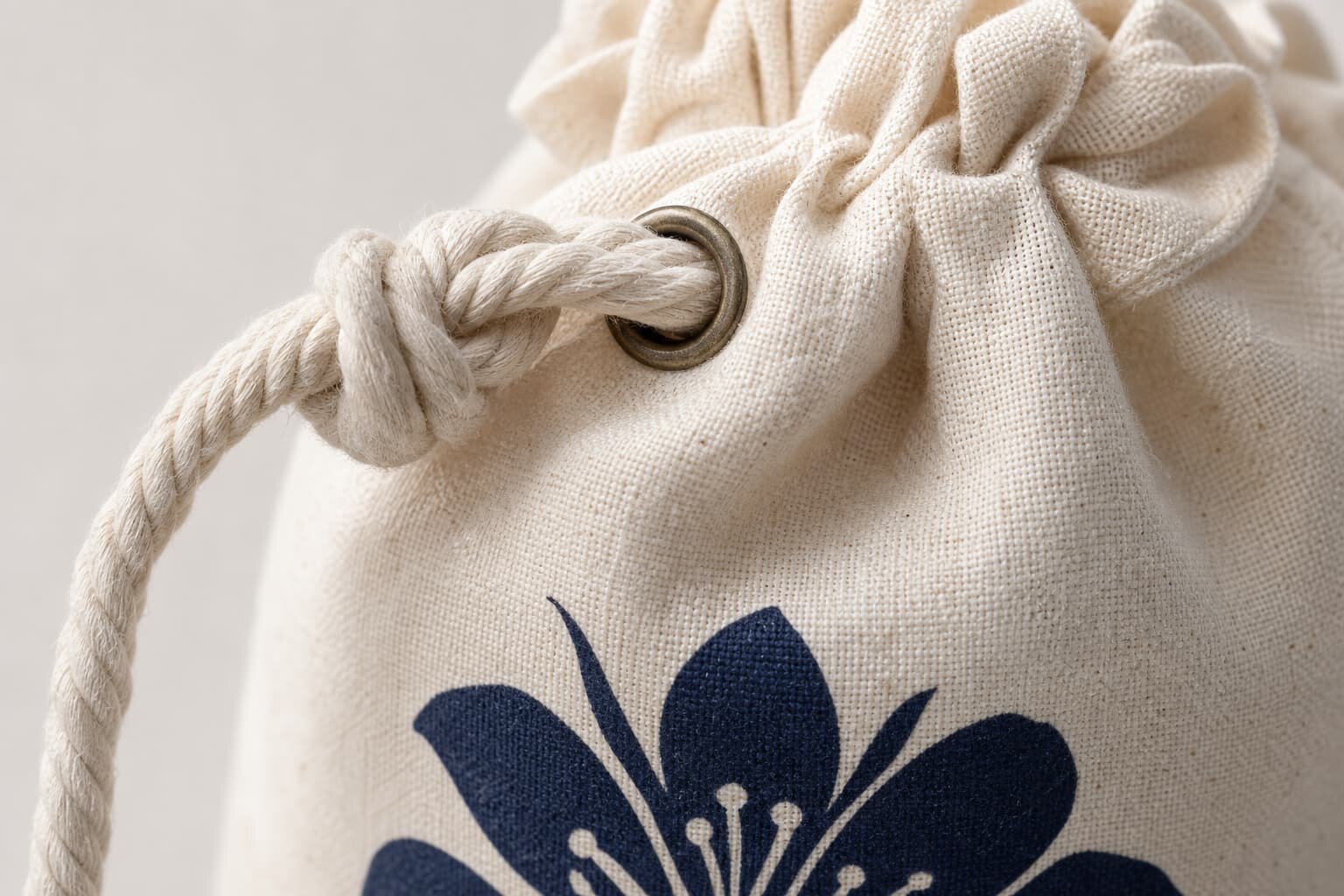
Why a Retail Handover Packet Matters
A drawstring pouch retail handover packet is the working file that tells buying, design, QA, warehouse, and store operations exactly what was approved. It is not just a pretty product sheet. For a small pouch, the problems usually come from small missing details: whether the size is finished size or cut size, whether the cord is cotton or polyester, whether the print is centered from the seam or the pouch panel, and whether warehouse teams receive cartons that match the retail allocation plan.
The buying problem is simple: a pouch can look acceptable in one sample photo but fail during retail handling. Store staff may need to place jewelry, cosmetics, samples, repair parts, membership gifts, or small accessories into the pouch at speed. If the pouch opening is tight, the cord sheds fiber, the logo cracks, or carton counts are wrong, the cost lands with the buyer even if the unit price looked good.
- Use the handover packet to connect the RFQ, supplier quote, approved sample, production standard, and receiving checklist.
- Keep one controlled version so design changes do not travel by email screenshots only.
- Include practical tolerances because pouches are sewn textile goods, not molded plastic parts.
- Treat packing as part of the product spec, not as a warehouse afterthought.
Start with Use Case Before You Set the Spec
A retail handover pouch used at a checkout counter has different requirements from a pouch shipped inside an ecommerce carton or used as premium gift packaging. The first question is not only size. It is how many times the pouch will be opened, who handles it, what goes inside, and whether the consumer is expected to reuse it. These points affect fabric weight, cord type, seam strength, print durability, and packing format.
For example, a 120 GSM cotton pouch may be enough for a lightweight promotional insert, but it may feel too thin for a premium skincare handover packet. A 200 GSM canvas pouch can feel more substantial, but on a very small size it may become stiff around the drawstring channel. Buyers should define the use case in the RFQ so suppliers do not quote the cheapest construction while assuming the pouch is disposable.
- For jewelry or small accessories, prioritize clean seams, low lint, smooth cord movement, and accurate small-size sewing.
- For cosmetics or fragrance samples, check fabric opacity, odor control, print rub resistance, and inner packing cleanliness.
- For retail gift-with-purchase programs, balance handfeel, brand print quality, and quick store handling.
- For reusable storage, increase GSM, improve cord quality, and consider reinforced channel stitching.
Fabric Weight and Construction Decisions
Most cotton drawstring pouches for retail handover packets fall between 120 and 240 GSM. The lower end is economical and packs flat, but it wrinkles more and can show contents. The mid-range, around 140-200 GSM, is often the safer choice for brand presentation because it still folds cleanly while giving better opacity and handfeel. Heavier canvas above 220 GSM can work for premium positioning, but it changes the way the top channel gathers and may increase carton volume.
Do not approve fabric by GSM alone. A loose weave at higher GSM may still feel less stable than a tighter weave at slightly lower GSM. Ask whether the factory is using plain cotton, cotton canvas, recycled cotton blend, organic cotton, polyester-cotton blend, or jute-cotton blend. Each option affects shrinkage, color consistency, print edge sharpness, lint, and cost. If the pouch is dyed, request a color standard and tolerance method before bulk cutting.
- State fabric as composition plus GSM plus weave, such as 100% cotton plain weave 160 GSM or cotton canvas 10 oz.
- Ask for GSM tolerance, commonly quoted as a practical production range rather than one exact number.
- Confirm whether fabric is stock natural, bleached, dyed to order, or printed from greige fabric.
- Check shrinkage if the pouch will be washed, steamed, or exposed to humid warehouse conditions.
Size, Cord, and Closure Details Buyers Often Miss
Finished pouch size should be measured after sewing with the pouch laid flat. If your RFQ only says 15 x 20 cm, one supplier may quote finished size while another may quote fabric cut size. That difference can remove usable space, especially after the drawstring channel and seam allowance. For retail handover, also define the usable opening width, because staff need to insert products quickly without fighting the channel.
Cord quality is another common quote gap. Cotton cord gives a natural look and matches cotton fabric, but it can shed more than polyester and may vary in shade. Polyester cord can run smoother and resist moisture better, but may look less natural. Cord diameter, color, length, knot style, and whether the pouch uses one drawstring or two should be written into the packet. If the pouch will be reused, ask for cord pull testing rather than only a visual sample.
- Define finished width, finished height, channel height, seam allowance expectation, and size tolerance.
- Specify single drawstring or double drawstring, including draw direction and final cord length.
- Confirm whether cord ends are knotted, heat sealed, metal tipped, wooden tipped, or left raw.
- Check that the drawcord does not pull into the channel during repeated opening and closing.
Print Method Selection for Retail Presentation
For most drawstring pouch orders, screen printing is the practical choice for solid logos, simple icons, and one to three spot colors. It gives good coverage on cotton and keeps unit cost controlled at moderate quantities. The buyer should still check whether the ink sits too heavily on the fabric, especially on soft lightweight pouches, because thick ink can stiffen the panel and crack if the pouch is folded through the print.
Heat transfer can handle fine details, gradients, and small artwork, but it may feel more like a film on the fabric. Digital print can be useful for low MOQ or full-color designs, but the supplier must explain color fastness and handfeel. Embroidery is usually better for premium reusable pouches, not small cost-sensitive handover packets, because it can pucker light fabric. Woven labels or sewn side labels can be a clean alternative when the brand wants subtle identification without large surface printing.
- Include artwork file format, print size, placement, Pantone references, and whether print is one side or two sides.
- Set print position tolerance, such as acceptable movement from top edge, side seam, and center line.
- Ask for a print strike-off on actual fabric before approving a large order.
- Avoid placing detailed artwork too close to side seams, bottom corners, or the gathered top channel.
MOQ Logic Behind Supplier Quotes
MOQ for drawstring pouches is not only a sewing line number. It may come from fabric dyeing minimums, stock fabric availability, printing setup, cord color MOQ, label MOQ, or packing material MOQ. A supplier may accept a small order using stock natural cotton and one-color screen print, but the same quantity may not work for a custom dyed fabric, matching dyed cord, and printed retail carton allocation.
When comparing quotes, ask what assumption drives the MOQ. A low unit price may be based on stock fabric, shared printing setup, and loose bulk packing. A higher price may include custom dyeing, final artwork proofing, inner packs by store quantity, and stronger export cartons. Both quotes can be technically valid, but they are not the same product or service level. Your handover packet should make these assumptions visible before the PO is issued.
- Separate MOQ for fabric, print, cord, woven label, individual packing, and carton marking.
- Ask whether sample cost is credited back after bulk order or charged separately.
- Check if below-MOQ orders use substitute materials that must be approved in writing.
- Request price breaks at realistic quantities so buyers can see where efficiency improves.
Sample Approval and Acceptance Criteria
A retail handover packet should include the approved sample record, not only a photo. The safest sample is a pre-production sample made with actual bulk fabric, actual cord, actual print method, and proposed packing. If the first sample is made from substitute stock material, label it clearly as a construction sample only. Do not allow a construction sample to become the final standard for color, handfeel, or print performance.
Acceptance criteria should be simple enough for both factory QC and buyer inspection teams to use. Define size tolerance, print tolerance, seam quality, cord function, stain level, odor, loose threads, carton counts, and folding method. For small pouches, a few millimeters of variation may be acceptable, but a consistent lean seam or off-center print will be visible when displayed in a retail environment.
- Keep one sealed sample or signed sample photo set with measurement notes.
- Measure at least width, height, channel height, cord length, and print placement.
- Test opening and closing for repeated cycles, not only one pull.
- Record whether the sample is approved, approved with comments, or rejected for correction.
Packing and Warehouse Handover Data
Packing is where many small pouch programs lose control. If the warehouse expects 100 pieces per inner pack and receives loose cartons of 800 pieces, receiving becomes slow and error-prone. If a retail team needs 25 pouches per store kit, carton configuration should support that allocation. Your handover packet should state inner count, master carton count, carton size, gross weight, net weight, carton mark content, and whether pouches are folded, flat, bundled, banded, or individually packed.
There is also a sustainability and handling trade-off. Individual polybags protect light-colored pouches from moisture and handling marks, but they add labor and packaging waste. Paper bands or bulk inner bags may be enough for natural cotton pouches, but only if cartons are clean, dry, and not overfilled. For retail handover pouches that sit near a counter, ask how the pouches will look after unpacking. A low-cost packing method that crushes cords and wrinkles the front panel may create extra labor at store level.
- Define whether units are packed flat, folded once, bundled, paper banded, or individually bagged.
- Require carton labels with PO, SKU, color, size, quantity, carton number, and destination if needed.
- Ask for packing photos before shipment, including open carton, inner pack, and carton mark.
- Confirm moisture protection for sea freight, especially for natural cotton and light-colored fabric.
Lead Time Planning and Risk Points
Lead time should be broken into stages: artwork confirmation, material sourcing, sample making, sample approval, fabric dyeing or preparation, printing, sewing, trimming, packing, inspection, and shipment booking. A single statement such as 30 days production is not enough if the artwork is not final or the fabric must be dyed. For a retail launch, late sample approval can push every later step, so the handover packet should show decision deadlines.
The highest-risk stages are usually custom dyeing, print approval, and packing confirmation. Sewing simple pouches is normally not the longest step, but reworking print placement or replacing a wrong cord color can cost days. If the pouch must arrive before a promotion date, ask the factory which materials should be locked first and which decisions can remain flexible. This helps avoid paying rush costs for issues that could have been settled in the RFQ.
- Request separate timing for lab dip, print strike-off, pre-production sample, bulk production, and packing.
- Ask when the factory needs final artwork to hold the planned ship date.
- Confirm whether public holidays, peak season, or fabric mill schedules affect the plan.
- Use inspection booking dates based on real packing completion, not estimated sewing completion.
How to Compare Quotes Without Buying the Wrong Pouch
When three suppliers quote the same pouch, the lowest price may be missing important details. Compare GSM, fabric type, cord specification, print method, sample inclusion, packing method, carton strength, inspection readiness, and whether the quote includes export documentation support. A retail handover pouch is usually low unit value, so one missing packing or print assumption can erase the savings quickly.
Build a quote comparison sheet with one line for each major cost driver. Ask suppliers to restate your spec in their quotation instead of only saying yes. If a supplier changes the fabric from 180 GSM cotton canvas to 140 GSM cotton to hit a target price, that may be acceptable for some programs, but it should be a conscious decision. The goal is not to force every supplier into the highest spec. The goal is to know exactly what you are buying.
- Compare quoted fabric by composition, GSM, weave, color source, and tolerance.
- Compare printing by method, color count, setup charge, strike-off process, and durability checks.
- Compare packing by inner count, master carton count, carton mark, and protection method.
- Compare lead time by stage, not just final shipment week.
Specification comparison for buyers
| Spec decision | Recommended option | When it fits | Buyer risk to check |
|---|---|---|---|
| Fabric weight | 140-200 GSM cotton or canvas for most retail handover pouches | Gift-with-purchase, accessory packaging, small cosmetics, jewelry, stationery, or event kits | Too light may show contents and wrinkle badly; too heavy may increase freight and make small pouches bulky |
| Cord structure | Double cotton drawcord, 3-5 mm, with secure top channel allowance | Retail staff need quick opening and closing without cord pull-out complaints | Confirm cord color, shrinkage, end finishing, and whether knots are allowed in your retail presentation |
| Print method | Screen print for solid logos; heat transfer for fine gradients; woven label for premium small runs | Brand logo, store campaign mark, care icon, or limited retail program | Print cracking, dye migration, logo distortion near seams, and approval mismatch between artwork and bulk fabric |
| Closure style | Single drawstring for low-cost packaging; double drawstring for better retail handling | Single-use handover packet versus reusable pouch kept by the consumer | Single cord may look less balanced and can be slower for store staff to cinch neatly |
| Packing method | Flat packed in inner polybags or paper bands, then export carton by fixed count | Store replenishment, retail counter allocation, and warehouse receiving | Mixed counts, loose cords tangling, carton labels missing PO, SKU, color, and pouch size |
| Sample approval | Pre-production sample using bulk fabric, actual cord, actual print, and final packing fold | Before deposit release or before cutting fabric for time-sensitive programs | Approving a salesman sample made from substitute fabric leads to GSM, shade, and handfeel disputes |
Buyer checklist before sampling
- Define final pouch size as finished size after sewing, not fabric cut size.
- Confirm fabric composition, GSM tolerance, weave type, color standard, and shrinkage expectation.
- State whether the pouch is for retail handover, product packaging, reusable storage, or promotional giveaway.
- Attach final artwork with print size, placement from pouch edges, Pantone references, and acceptable color tolerance.
- Specify cord material, cord diameter, color, draw direction, knot requirement, and cord pull strength expectation.
- Require one approved pre-production sample made with bulk fabric, final cord, final print method, and proposed packing.
- List packing counts by inner pack and master carton so retail allocation teams can receive without recounting every unit.
- Ask the factory to quote tooling, sample, printing, packing, and freight assumptions separately where possible.
- Confirm carton marks include PO number, SKU, pouch size, color, quantity, gross weight, net weight, and carton number.
- Set acceptance criteria for size tolerance, print position tolerance, seam strength, stains, loose threads, cord pull-out, and packing count errors.
Factory quote questions to send
- What fabric GSM and weave are you quoting, and what is your normal tolerance for this fabric in bulk production?
- Is the quoted pouch size the finished size after sewing, and what tolerance do you recommend for this size?
- Which print method are you quoting for the artwork, and why is it suitable for the logo detail and fabric surface?
- Does the quote include bulk fabric dyeing, stock fabric, or greige fabric printing, and how does that affect MOQ?
- What cord material, diameter, color, and construction are included in the quote?
- Can you make the pre-production sample with actual bulk fabric, cord, print, and packing before mass production?
- What is the estimated lead time for sampling, material preparation, printing, sewing, packing, and export carton completion?
- What packing method is included: loose bulk, inner polybag, paper band, individual bag, or retail-ready carton allocation?
- What quality checks do you perform for pouch size, seam strength, cord pull-out, print adhesion, stains, and carton counts?
- Which quote items change if the order quantity is below the fabric dyeing MOQ, printing setup MOQ, or efficient sewing line quantity?
Quality-control points to confirm
- Measure finished pouch width and height on a flat pouch after sewing and before packing.
- Check fabric GSM against the approved swatch and confirm the handfeel is not a lighter substitute.
- Inspect side seams, bottom seams, channel stitching, and bartack or reinforcement points where applicable.
- Pull the drawcord repeatedly to check slipping, channel tearing, knot security, and cord length consistency.
- Rub test the printed logo dry and lightly damp, especially on dark fabric or dense ink coverage.
- Check print placement from the top opening, side seam, and bottom edge, not only by visual centering.
- Open random inner packs and confirm exact unit count, color mix, SKU label, and carton marking.
- Review stains, oil marks, loose threads, odor, fabric slubs, broken stitches, and inconsistent folding before shipment.