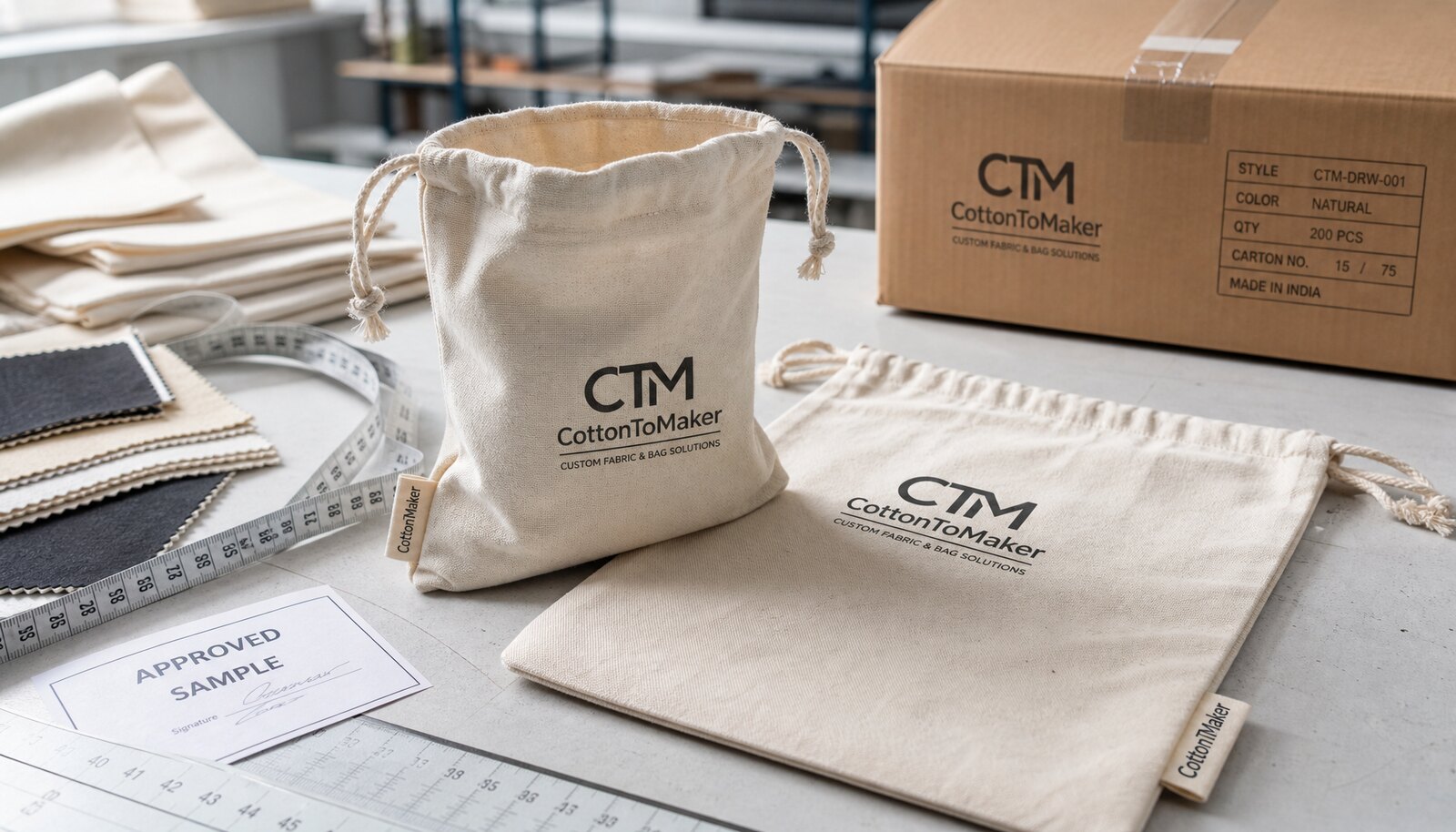
What a Production Hold Release Actually Controls
A drawstring pouch production hold release is the buyer's formal instruction that the factory may continue after a blocked point in the order. The hold may sit before material purchase, before printing, before cutting, before sewing, before packing, or before shipment. The commercial risk is different at each stage. A fabric hold protects color, GSM, and hand feel. A print hold protects logo color and placement. A packing hold protects retail presentation, carton data, and warehouse receiving.
Many pouch disputes happen because the buyer says, "approved," while the factory understands only one part of the order is approved. For example, a buyer may approve the logo artwork, but the factory treats that as permission to print all panels. If the fabric absorbs ink differently from the PDF proof, the buyer may reject the goods even though the factory followed the file. A good hold release names the exact item released, the reference sample used, and the next process allowed.
- Use separate release points for fabric, print, pre-production sample, bulk production, packing, and shipment.
- Do not release mass production based only on a digital mockup when the logo is printed on cotton, jute, canvas, or dyed fabric.
- State whether the factory may purchase materials, cut fabric, print panels, sew bulk, or pack finished goods.
- Ask for a revised production calendar after each hold release so the delivery date is not assumed.
Common Hold Reasons in Drawstring Pouch Orders
Drawstring pouches look simple, but several small decisions can stop production. The most common holds are fabric shade mismatch, unconfirmed GSM, logo color not matching the brand guide, unclear pouch size, cord not approved, and missing packing data. These are not administrative details. They determine the usable pouch size, print result, sewing efficiency, carton volume, and final cost.
A hold is useful only if it prevents the right mistake. If the pouch is for cosmetics, the buyer may care more about print sharpness, dust protection, and clean packing. If the pouch is for hardware or accessories, the buyer may care more about seam strength, cord pull, and abrasion. If the pouch is part of a retail gift set, the packing sequence may be more important than the pouch alone.
- Fabric hold: GSM, composition, color, shrinkage, weave, and whether the fabric is washed or unwashed.
- Print hold: artwork size, ink color, print method, curing, logo placement, and tolerance from edges.
- Cord hold: material, diameter, color, length, knot method, metal tip, plastic tip, or no tip.
- Size hold: flat size, usable inner size, seam allowance, channel depth, and product fit test.
- Packing hold: individual polybag, set pack, master carton quantity, carton mark, barcode, and insert card.
Fabric GSM and Construction Before Release
The fabric decision should be released before cutting because it affects the full pouch. For common cotton drawstring pouches, 120-160 GSM is often used for lightweight retail packaging, jewelry pouches, dust bags, and promotional sets. For a more premium feel or repeated reuse, buyers often move to 180-240 GSM canvas or twill. Heavier fabric is not automatically better. It can create bulky seams, reduce drawstring closure flexibility, increase carton volume, and raise sewing time.
When comparing supplier quotes, do not accept "cotton pouch" as a fabric specification. Ask for GSM, composition, weave, color standard, washing status, and whether the quoted fabric is in stock or custom dyed. A quote based on stock natural cotton may not be comparable to a quote using custom PMS-dyed canvas. If the pouch must fit inside another retail box, request a folded sample or packing simulation before release.
- For light gift packaging: check if 120 GSM is opaque enough for the product inside.
- For cosmetics or accessories: consider 140-180 GSM if print quality and hand feel matter.
- For premium reusable pouches: check 200-240 GSM seam bulk at the bottom corners and cord channel.
- For dyed cotton: approve shade under consistent light and confirm whether color fastness testing is required.
- For natural cotton: agree how much cotton seed speckling is acceptable before bulk cutting.
Print Method Release: Do Not Approve Artwork Alone
Logo printing is one of the highest-risk release points. A PDF or AI file confirms design intent, but it does not confirm how ink behaves on cotton, canvas, jute, or polyester blend fabric. Screen print is common for solid logos and larger quantities. Heat transfer can work for complex graphics or smaller batches, but the hand feel and edge durability should be checked. Digital print may suit multi-color artwork, but the buyer should review sharpness, color saturation, and wash or rub performance if the pouch is reusable.
The release evidence should show the logo on production-equivalent fabric, not only on white paper or a studio mockup. Check logo size, position, color, ink coverage, curing, hand feel, and any distortion after sewing. If the pouch is printed before sewing, the factory needs accurate panel placement. If printed after sewing, the print area may be limited by seams and pouch thickness.
- Screen print: confirm screen charge, ink type, curing method, and minimum line thickness.
- Heat transfer: check edge bonding, stretch behavior, and whether the transfer film changes the fabric hand feel.
- Digital print: check color sharpness on natural cotton and whether pretreatment affects fabric shade.
- Embroidery: check puckering risk on light GSM fabric and whether backing is visible inside the pouch.
- Woven label or side label: approve label size, fold type, stitch position, and scratchy edges.
MOQ Logic When a Hold Changes the Specification
Production holds often create MOQ changes. If the buyer changes from stock natural cotton to custom dyed cotton, the fabric MOQ may become the main driver. If the cord changes to a custom color, the cord supplier may have a separate MOQ. If the print changes from one color to four colors, setup time and rejection risk increase. The pouch MOQ is not only a sewing number; it is the highest MOQ among fabric, cord, label, print, packing, and factory line efficiency.
Procurement teams should ask the factory to break down which component controls the MOQ. This prevents confusion when two suppliers quote the same pouch size but very different minimums. One may be quoting stock fabric and stock cord. Another may be including custom dyed fabric, custom woven label, individual polybag, and export carton marks. Both quotes may be technically correct, but they are not comparable.
- Ask whether the quoted MOQ is controlled by fabric purchase, printing setup, cord dyeing, label weaving, or packing materials.
- If order quantity is below the fabric MOQ, ask whether leftover fabric cost is included in the unit price.
- If the logo has several colors, confirm whether each color requires a separate screen or setup.
- If retail packing is custom, confirm the MOQ for polybags, insert cards, stickers, and barcodes.
- If you need reorder consistency, ask whether the same fabric batch can be reserved or documented.
Sample Checks Before Releasing Bulk Production
A pre-production sample should represent the order that will be made, not just the factory's ability to sew a pouch. The best PP sample uses the same fabric type, same GSM range, same cord, same thread, same print method, same label, and same packing direction as the bulk order. If any part is substituted, mark it clearly in the approval record and decide whether another sample is required before release.
Sample checking should include function, not only appearance. Put the buyer's product inside the pouch if possible. Close the drawstring repeatedly. Check whether the product catches on the seam allowance or cord channel. Measure the pouch flat and also confirm usable inner height after the channel is sewn. A pouch that meets flat dimensions may still be too small if the product needs full-height clearance.
- Measure width and height at three points if the pouch is large or uses heavy fabric.
- Check channel height and cord movement after the pouch is filled, not only when empty.
- Pull both cords ten to twenty times to see if the channel twists, jams, or frays.
- Compare print placement from top edge and side seam using a ruler, not only by eye.
- Confirm the approved sample is sealed, dated, and referenced in the purchase order.
Lead Time Impact of a Hold Release
A hold release does not automatically restart the original lead time. If the hold lasted several days, the factory may have moved sewing lines, printing capacity, or material booking to another order. Buyers should request a refreshed schedule after release. The schedule should separate material purchase, fabric arrival, printing, cutting, sewing, trimming, packing, final inspection, and shipment handover.
The lead time impact is larger when the hold concerns custom materials. Stock natural cotton can usually move faster than custom dyed cotton, custom cord, or woven labels. Printing can also become a bottleneck during peak seasons. If the order has a fixed retail launch date, the buyer should not release production without confirming whether air freight, split shipment, or partial delivery is being considered and who pays if the delay was caused by late approval.
- Ask which process was waiting during the hold and which processes can still run in parallel.
- Confirm whether fabric was already purchased or still pending buyer approval.
- Request a new estimated ready date after release, not only the old promised delivery date.
- If inspection is required, reserve the inspection date after the factory confirms the packing schedule.
- If the order is seasonal, discuss partial shipment before the full order is completed.
Packing and Carton Data Must Be Released Separately
Packing is often treated as the final step, but it can become the reason an order misses shipment. Drawstring pouches may be packed loose, bundled, individually polybagged, set packed with different colors, inserted into retail cartons, or matched with product kits. Each method changes labor time, carton size, carton weight, barcode control, and warehouse receiving.
Before releasing packing, confirm the count per inner polybag, count per export carton, folding method, moisture protection, carton mark, SKU separation, and whether mixed colors are allowed in one carton. If the pouch is made from natural cotton or jute, the buyer should also consider odor, dust protection, and moisture during sea freight. Over-tight packing can crease printed logos or deform cord knots.
- Approve one clear packing photo showing fold direction, cord position, label visibility, and unit count.
- Confirm whether each pouch needs an individual polybag or only bulk carton packing.
- State whether cartons can contain mixed sizes, mixed colors, or only one SKU per carton.
- Check carton gross weight if pouches are heavy canvas or packed with accessories.
- Approve carton mark content before cartons are printed or labelled.
Quote Data Buyers Should Lock Before Release
A production hold is a good moment to clean up the quote. The final approved quote should state pouch size, fabric GSM, fabric composition, color, print method, number of print colors, logo size, cord material, label details, packing method, carton quantity, sample cost, setup charges, payment terms, Incoterm, and validity. Without this information, two quotes may look close in price while carrying very different production assumptions.
Buyers should also check what is excluded. Some factories quote only the pouch unit price and add screen charges, sample courier fees, inspection rework, special carton marks, or barcode labelling later. Others include more in the unit price. The goal is not always the lowest quote; it is a quote that matches the released specification and can be inspected.
- Confirm whether the unit price includes fabric, cutting, sewing, printing, cord, trimming, normal packing, and export carton.
- List setup fees separately so they are not confused with repeat-order unit cost.
- Ask for the quoted tolerance for size, GSM, print placement, and color difference.
- Confirm the Incoterm and port because FOB, EXW, and DDP quotes are not comparable.
- Request a quote revision if the hold release changes any material, print, packing, or lead time assumption.
Acceptance Criteria for Releasing the Hold
The buyer should release the hold only when the factory has provided enough evidence for the next production step. For low-risk stock pouches with one-color print, photos and a print strike-off may be enough. For premium retail packaging, the buyer may need a physical PP sample, packing sample, and signed approval sheet. The acceptance standard should be practical, measurable, and understood by both sides.
Do not use vague approval comments such as "looks good" or "OK for production" without conditions. A stronger release says, "Approved to proceed with bulk cutting and printing based on PP sample dated X, natural cotton 160 GSM, logo screen print 70 mm wide, centered 60 mm below top edge, size tolerance plus/minus 5 mm, packing 100 pcs per export carton." This type of release reduces argument during inspection.
- Fabric: approved GSM range, color reference, weave, and hand feel compared with the reference sample.
- Size: approved flat dimensions, usable inner size, channel height, and tolerance.
- Print: approved method, logo size, color, position, curing, and acceptable variation.
- Cord: approved material, color, length, diameter, knot, and draw function.
- Packing: approved folding, polybag count, carton quantity, carton mark, and SKU separation.
- Schedule: approved revised production calendar and inspection timing after release.
Specification comparison for buyers
| Spec decision | Recommended option | When it fits | Buyer risk to check |
|---|---|---|---|
| Fabric weight for standard cotton pouch | 120-160 GSM cotton or cotton canvas | Small retail packaging, dust bags, jewelry, cosmetics, gift sets | Too light can show contents, distort after printing, or feel cheaper than the approved sample |
| Fabric weight for premium pouch | 180-240 GSM canvas or twill | Reusable packaging, heavier product inserts, brand gift programs | Higher GSM increases sewing bulk at the cord channel and may change carton volume |
| Print approval before production release | Pre-production print strike-off on bulk fabric | Logo color, position, and ink hand feel are commercially important | Digital artwork approval alone does not confirm ink absorption or fabric shrinkage |
| Cord and drawstring construction | Cotton cord, polyester cord, or self-fabric tape confirmed by sample | Buyer needs a specific pull feel, natural look, or cost target | Cord diameter can affect closing function, knot size, and metal detector sensitivity if tipped |
| Packing release condition | Approved folding, polybag count, carton mark, and carton size | Retail sets, ecommerce kits, or distributor warehouse sorting | Late packing changes can delay shipment more than sewing changes |
| Production hold release timing | Release only after PP sample, print sample, and material cards are signed off | Orders with logo print, custom fabric, retail packing, or strict delivery window | Releasing before all approvals may save days but can create rework, air freight, or rejected cartons |
Buyer checklist before sampling
- Confirm the hold reason in writing: fabric, color, print, size, cord, packing, carton mark, labelling, or payment document.
- Compare the production hold sample against the approved reference sample, not only against artwork files.
- Check pouch dimensions after sewing and after drawstring closure, including usable inner size.
- Verify fabric GSM, weave, color, shrinkage risk, and whether the fabric is greige, dyed, bleached, or washed.
- Approve the actual print method and print location on bulk fabric or production-equivalent fabric.
- Confirm cord material, cord diameter, cord length, knot style, channel width, and closure function.
- Review MOQ impact if any component is custom dyed, custom woven, or purchased from a nominated supplier.
- Approve packing method, set quantity per polybag, carton quantity, carton size, gross weight, and carton marks.
- Lock the inspection standard, AQL level, critical defects, and acceptable tolerance before production resumes.
- Ask the factory to update the lead time calendar after hold release, including material booking and shipment date.
Factory quote questions to send
- What exact item is on production hold, and what buyer approval is needed to release it?
- Is the hold stopping material purchase, cutting, printing, sewing, packing, or shipment booking?
- Which fabric GSM, composition, weave, and color standard are included in the quoted price?
- Will the pre-production sample use the same bulk fabric, same cord, same thread, and same printing process as mass production?
- What pouch size tolerance do you apply after sewing, and is the quoted size flat size or usable inner size?
- Which print method is quoted: screen print, heat transfer, digital print, embroidery, woven label, or embossing on patch?
- Are setup charges, screen charges, plate charges, sample charges, and courier charges included or separate?
- What is the MOQ for the pouch body, cord, printed logo, dyed fabric, and custom packing materials?
- How many days are required after hold release for material purchase, printing, sewing, packing, inspection, and export documents?
- What evidence will you send before production release: fabric photo, GSM test, print strike-off, PP sample photos, packing photo, or video?
Quality-control points to confirm
- Fabric GSM must match the approved range and should be checked from bulk fabric, not only from a sample remnant.
- Finished pouch dimensions should be measured flat before closure, with tolerance stated in the purchase order.
- Cord channel width must allow smooth drawing without fabric bunching, skipped stitches, or blocked ends.
- Print position should be checked from the pouch top edge and side seam, not by visual centering only.
- Print adhesion, ink bleeding, cracking, and color difference should be checked before cutting all panels when possible.
- Side seams, bottom seam, and channel seams should be checked for stitch density, loose threads, backtacking, and seam slippage.
- Cord length and knot security should be tested by repeated opening and closing, especially for retail reusable pouches.
- Packing quantity per polybag and carton should match the approved packing instruction and export carton mark.
- Carton compression risk should be reviewed when using heavy canvas, bulky cords, or individually polybagged units.
- Final inspection should include mixed-carton risk, shade variation, odor, stains, needle marks, and wrong logo orientation.