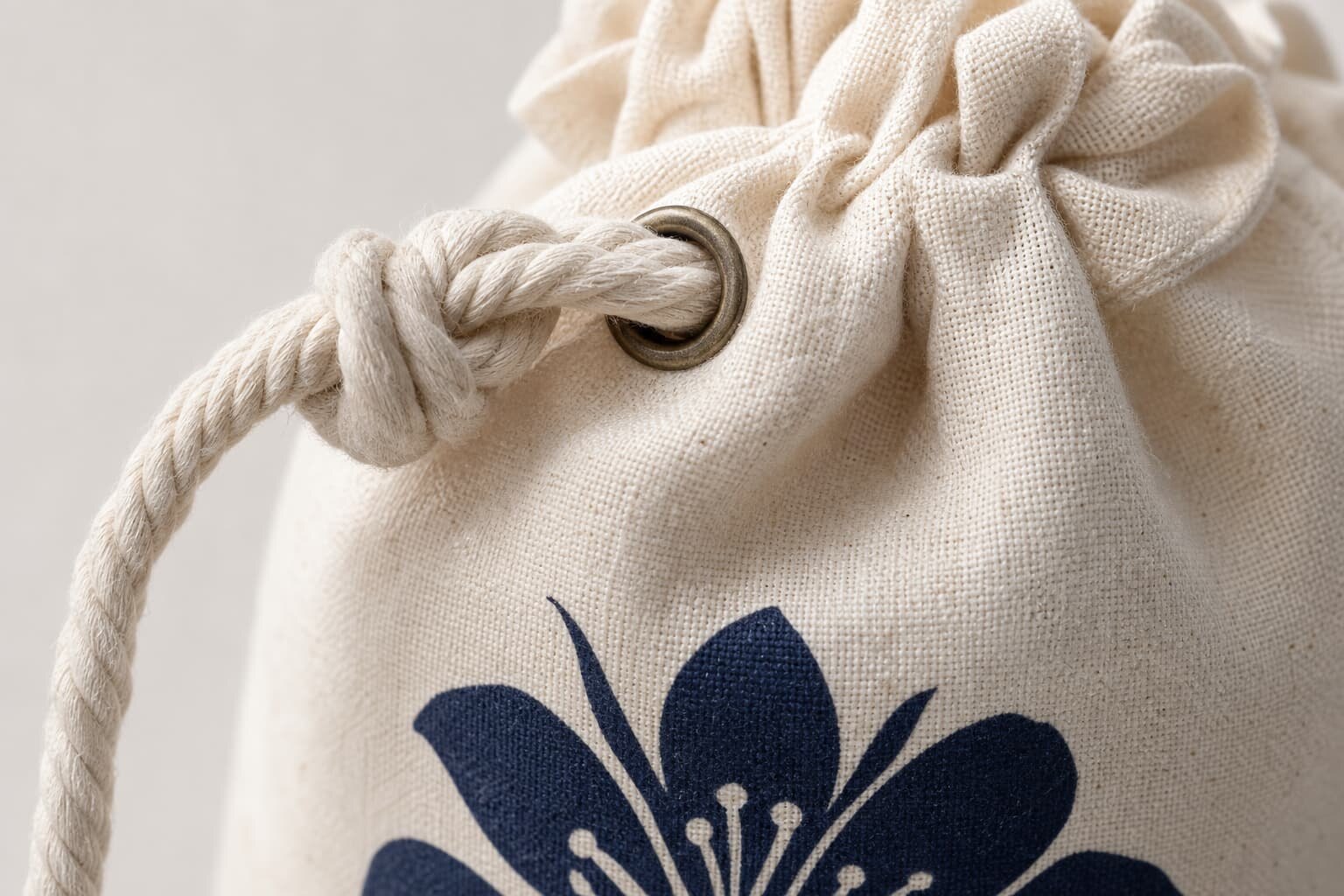
Why Artwork Becomes a Purchasing Problem
A drawstring pouch looks simple until the private label artwork is placed on real fabric, sewn into a channel, pulled by cords, folded into cartons, and checked by a retailer. Many quote problems start because the RFQ only says natural cotton pouch with logo. That is not enough for a factory to choose fabric, calculate print cost, reserve label material, or judge whether the logo can sit where the buyer wants it.
For procurement teams, the goal is not to make the artwork file prettier. The goal is to remove quote assumptions before money is spent on samples and bulk production. A clear artwork guide helps you compare supplier offers on the same basis, avoid unexpected setup charges, and reduce the risk that a beautiful brand mark looks uneven, distorted, or too low on the finished pouch.
- Treat artwork as a production specification, not only a brand asset.
- Decide fabric, pouch size, print method, label method, and packing before asking for final price.
- Ask suppliers to confirm limitations in writing instead of accepting a quote with unclear artwork conditions.
- Use the approved pre-production sample as the control standard for bulk inspection.
Start With the Product That Must Fit Inside
Before discussing logo size, confirm the object the pouch must hold. A jewelry pouch, candle pouch, charger pouch, hotel amenity pouch, and footwear dust pouch need different allowances. If the pouch is too tight, the buyer may blame sewing accuracy even when the true issue was a missing product dimension. Send the packed product dimensions, weight, sharp edges, and whether the user needs to remove and replace the item many times.
For rigid product boxes, add enough width and height allowance for insertion, drawstring closure, and fabric thickness. For soft goods, the pouch can be closer to the product size but still needs seam and channel clearance. If the logo must remain visible after closing, mark the printable safe area below the drawstring channel and above the bottom fold.
- For small jewelry or cosmetic pouches, confirm whether the pouch is measured inside or outside the seam.
- For bottles or jars, check bottom width and closure height, not only total height.
- For shoe or handbag dust bags, check whether the product enters horizontally or vertically.
- For retail sets, test all components together because cords and tags can catch during packing.
Choose Fabric GSM Before Choosing Print Method
Fabric weight controls both appearance and print behavior. A 90-120 GSM cotton or muslin pouch is light and economical, but the weave is often more open. Fine logo details can look less sharp, and dark ink may show through slightly on the reverse side. A 140-180 GSM cotton pouch is a common balance for retail packaging because it gives better opacity and hand feel without becoming too bulky in cartons.
Premium canvas pouches often use 200-280 GSM fabric. This feels more substantial and supports higher-value products, but it can also make the drawstring channel stiffer. Heavy canvas may need a wider channel and thicker cord to pull smoothly. If the logo sits over a thick seam or near a bulky folded edge, print pressure can become uneven. Ask the factory to confirm whether printing happens before or after sewing, because that changes logo placement tolerance.
- 90-120 GSM: suitable for light inserts, giveaways, and cost-sensitive packaging.
- 140-180 GSM: suitable for many private label retail pouches with screen printed logos.
- 200-280 GSM: suitable for premium dust bags, gift sets, candles, and heavier accessories.
- Request fabric swatches if the same GSM from two suppliers feels different due to weave and finishing.
Match Artwork Complexity to the Print Method
Screen printing is usually the most practical option for solid private label logos, short slogans, and one or two spot colors. It gives good opacity on cotton and canvas, and cost becomes efficient when quantities increase. The buyer should provide Pantone references and accept that textured cotton is not coated paper. Very thin lines, tiny registered symbols, and small reversed text may fill in or lose sharpness on heavier weaves.
Digital printing and heat transfer can support more colors, gradients, and detailed graphics, but they introduce other risks. Transfers may change hand feel, show edge outlines, or crack if the application is not suitable for the fabric and usage. Digital print color can shift on natural or dyed cotton because the base fabric affects the final tone. If the pouch is intended as premium reusable packaging, approve a physical printed sample instead of relying on a screen PDF.
- Use screen print for simple logos, solid shapes, and repeat private label orders.
- Use heat transfer only after checking hand feel, edge durability, and color match on the actual fabric.
- Use digital print when multi-color artwork is important and minor color variation is acceptable.
- Avoid tiny text below practical print size unless the factory proves it on the chosen fabric.
Set a Realistic Logo Placement Rule
Logo placement should be defined from finished pouch edges, not from a rough photo or a flat fabric panel sketch. The drawstring channel, seam allowance, bottom fold, and side seams all reduce the usable area. If the pouch is printed before sewing, the factory must allow for sewing and folding variation. If it is printed after sewing, the printable area may be limited by the platen size and seam thickness.
A good artwork sheet shows pouch width, pouch height, channel height, logo width, logo height, distance from top finished edge, distance from bottom edge, and whether placement is centered to the pouch body or the visible front panel. This matters especially for small pouches where a 5 mm shift is obvious. For double-sided printing, confirm whether both sides are identical or if one side carries legal text, care symbols, or product information.
- Keep the main logo below the drawstring channel so it does not wrinkle when the pouch closes.
- Leave safety space from side seams to prevent distorted or partly hidden artwork.
- Confirm whether the logo is centered before or after the pouch is pulled closed.
- For side labels, mark the exact seam, height, fold direction, and visible label size.
Understand MOQ Logic for Private Label Details
MOQ is not only the number of pouches. A supplier may accept a low pouch quantity if using stock fabric and a one-color screen print, but the MOQ can rise when you request custom dyed fabric, dyed cotton cord, woven labels, metal tips, special bead stoppers, or retail barcode packing. Buyers often compare unit prices without asking which components are stock and which require separate minimums.
For new private label programs, separate the base pouch MOQ from decoration MOQ. A factory might have stock natural cotton fabric suitable for 500 or 1000 pieces, but a custom woven label supplier may require a larger label order. In that case, the quote should state whether extra labels remain in factory stock for future reorders, whether they are charged upfront, and how long they can be stored.
- Ask for MOQ by pouch body, print color, label type, drawcord color, and packing method.
- Check whether setup charges apply per artwork, per color, per size, or per print position.
- For multiple pouch sizes using the same logo, ask whether one screen can be shared or not.
- For retail launches, consider extra label or cord inventory only if reorder timing is realistic.
Build the Artwork File Package Correctly
A factory-ready artwork package is more than a logo image pasted into an email. Send vector files such as AI, EPS, SVG, or editable PDF, with fonts outlined and colors specified. Include a JPEG or PDF visual reference so the merchandiser can see how the final pouch should look. If the artwork includes a brand color, provide Pantone Solid Coated or Uncoated reference and clarify whether exact matching is required or approximate matching is acceptable on fabric.
If artwork contains legal marks, recycling icons, SKU codes, website addresses, or QR codes, give the factory the final version before sampling. Changing these after the screen or transfer film is prepared may cause extra cost and delay. QR codes need special attention because cotton texture and ink spread can reduce scan performance. Test the printed code on the actual pouch sample using normal phone cameras before approving bulk.
- Name files clearly by pouch size, artwork version, print color, and date.
- Outline fonts so text does not change when opened on another computer.
- Convert linked images into embedded artwork if the file depends on placed graphics.
- Provide a placement drawing with real dimensions, not only a lifestyle reference image.
Use Samples to Prevent Expensive Rework
For a new drawstring pouch private label order, the safest workflow is a blank fitting sample followed by a printed pre-production sample. The blank sample confirms size, fabric, channel, cord, seam, and product fit. The printed sample confirms artwork position, ink color, opacity, curing, label position, and packing behavior. Skipping the blank sample can waste time if the printed sample looks good but the product does not fit smoothly.
Pre-production sample approval should be tied to measurable criteria. Do not approve with vague comments such as logo looks okay. Record the final pouch size, fabric GSM, logo dimensions, Pantone color, cord style, stitch color, label type, and packing format. Keep one signed or sealed sample with the factory and one with the buyer or inspection company. If the order is repeated later, this record prevents arguments when a new merchandiser handles the reorder.
- Check product insertion and removal at least several times, not only once.
- Pull the drawstring fully closed and confirm the logo still presents correctly.
- Rub the print lightly after curing to check obvious transfer or poor adhesion.
- Place the sample in the planned packing method to check creasing and ink contact.
Compare Quotes by Cost Drivers, Not Only Unit Price
A low unit price can hide missing specifications. One supplier may quote 120 GSM fabric while another quotes 180 GSM. One may include only one print color while another includes a woven label and individual packing. One may calculate bulk cartons only, while another includes inner bags, desiccants, carton marks, and barcode labels. If the RFQ does not separate these items, the lowest quote may become expensive after sample approval.
Ask each factory to show the quote structure in practical terms: fabric, sewing, printing or label, drawcord, sampling, packing, carton data, and lead time. You do not need the factory's full internal cost sheet, but you do need to know which specifications are included. This makes negotiation more professional because you can adjust GSM, print method, or packing without forcing the supplier to guess.
- Compare fabric GSM and composition before comparing unit price.
- Confirm whether print setup, screen charge, or transfer film charge is separate.
- Ask whether sample cost is refundable, credited, or independent of bulk price.
- Request carton size and gross weight because freight cost can change the landed cost.
Control Packing, Lead Time, and Final Approval
Private label pouches are often used as product packaging, so packing cannot be an afterthought. A printed pouch packed too soon after printing can stick, mark, or transfer ink. A natural cotton pouch packed in a damp environment can develop odor or mildew risk during ocean transit. A premium pouch folded sharply through the logo can arrive with visible creases that the retailer sees before the product is even touched.
Lead time should be counted from a clear approval point. For example, bulk production may start after deposit, final artwork, fabric approval, and pre-production sample approval are all complete. If one item is missing, the factory cannot safely cut fabric or prepare screens. Build your timeline backward from required delivery date, including artwork correction, sample transit, buyer approval, production, inspection, packing, and shipping handover.
- State whether pouches are packed flat, folded, rolled, banded, or individually bagged.
- Confirm inner quantity per bag and master carton quantity for warehouse receiving.
- Use moisture protection where natural cotton, jute, or canvas will ship by sea.
- Do not release bulk packing until print curing and final inspection checks are complete.
Specification comparison for buyers
| Spec decision | Recommended option | When it fits | Buyer risk to check |
|---|---|---|---|
| Fabric for general retail pouch | 140-180 GSM cotton or cotton canvas | Cosmetics, jewelry, accessories, small gift packaging where the pouch must feel reusable but not too stiff | Confirm shrinkage allowance and whether quoted size is before or after washing, printing, and sewing |
| Fabric for premium dust bag | 200-280 GSM canvas or brushed cotton | Footwear, handbags, candles, glassware, or higher-value private label packaging | Thicker fabric may reduce drawstring closure softness and increase carton volume |
| Low-cost event or insert pouch | 90-120 GSM cotton, muslin, or polyester-cotton | Giveaways, inserts, lightweight product protection, or one-time retail promotions | Light fabric can show print strike-through, loose weave, and weaker seam strength |
| Logo print method for simple artwork | Screen print, 1-2 spot colors | Clear logos, solid marks, repeat orders, and cost-sensitive bulk production | Require Pantone reference, print size, and tolerance for minor ink spread on textured cotton |
| Artwork with gradients or many colors | Heat transfer or digital print after lab dip review | Illustrations, photographic artwork, small runs, or multi-color branding | Check hand feel, wash resistance, edge cracking, and color shift on natural fabric |
| Premium brand label detail | Woven side label or sewn cotton label | Retail brands that want visible private label identity without large front print | Confirm label fold type, stitch position, and whether label MOQ differs from pouch MOQ |
| Drawcord choice | Cotton rope or flat cotton tape | Natural brand presentation, reusable packaging, gift sets, and apparel accessories | Cord thickness must match channel width; tight cords slow packing and frustrate consumers |
| Sample approval workflow | Blank size sample plus printed pre-production sample | New artwork, new fabric, new supplier, or retail launch with packaging sign-off | Skipping PPS can cause logo placement, size, or color disputes after mass production |
| Bulk packing method | Flat bulk pack with inner polybag or paper banding by set quantity | Most importer cartons, distributor stock, and retail backroom handling | Confirm creasing, moisture control, barcode needs, and carton mark format before packing |
Buyer checklist before sampling
- Send finished pouch size as width x height in centimeters or inches, and state whether tolerance is measured flat after sewing.
- Specify fabric composition, construction, color, and target GSM instead of only writing cotton pouch or canvas pouch.
- Attach vector artwork in AI, PDF, EPS, or SVG format with fonts outlined and Pantone colors listed.
- Mark exact print or label placement from the finished pouch edge, not from an estimated fabric panel.
- Define drawstring material, color, diameter or width, knot style, and whether a bead stopper is required.
- Request a blank size sample first if the pouch must fit a product box, bottle, cosmetic jar, jewelry card, or accessory set.
- Approve a printed pre-production sample before bulk cutting when artwork, fabric color, or print method is new.
- State packing method, carton quantity, carton marks, barcode label needs, moisture protection, and whether individual polybags are allowed.
- Ask the factory to quote setup cost, sample cost, unit price, packing cost, and lead time separately.
- Keep approved sample, artwork file name, Pantone code, and measurement sheet in the PO record for reorder control.
Factory quote questions to send
- What fabric GSM, composition, weave, and color standard are included in this price?
- Is the quoted pouch size the finished size after sewing, and what size tolerance will you accept in production?
- Which print method are you quoting for this artwork, and how many print colors or print positions are included?
- Do you need vector artwork, Pantone references, a physical color swatch, or a printed reference sample from our side?
- What is the MOQ for the pouch body, printed logo, woven label, dyed drawcord, and special packing if each has a different minimum?
- Can you make a blank fitting sample before the printed sample, and what is the sample lead time for each stage?
- What production lead time starts after which approval: deposit, artwork confirmation, fabric approval, or pre-production sample approval?
- How will you control logo placement during bulk sewing and printing, especially if the pouch has side labels or double drawcords?
- What packing method, carton quantity, carton size, gross weight, and moisture protection are included in the quote?
- What charge or delay applies if the buyer changes artwork size, color, label position, or packing after sample approval?
Quality-control points to confirm
- Finished pouch width, height, and drawstring channel height match the approved measurement sheet within agreed tolerance.
- Fabric GSM, hand feel, color, shrinkage behavior, and surface cleanliness match the approved sample.
- Logo size, placement, color, edge sharpness, opacity, and curing are checked against approved artwork and PPS.
- Side label or woven label position, fold direction, stitching, and logo orientation are correct.
- Drawcord pulls smoothly, knots are secure, cord ends are clean, and channel opening is not too tight.
- Seams, bartacks, bottom corners, and overlock or internal finishing are strong enough for intended product weight.
- Printed areas show no sticking, cracking, obvious pinholes, heavy ink bleeding, or transfer marks after packing simulation.
- Bulk packing quantity, inner packing, carton marks, moisture control, and barcode labels match the purchase order.