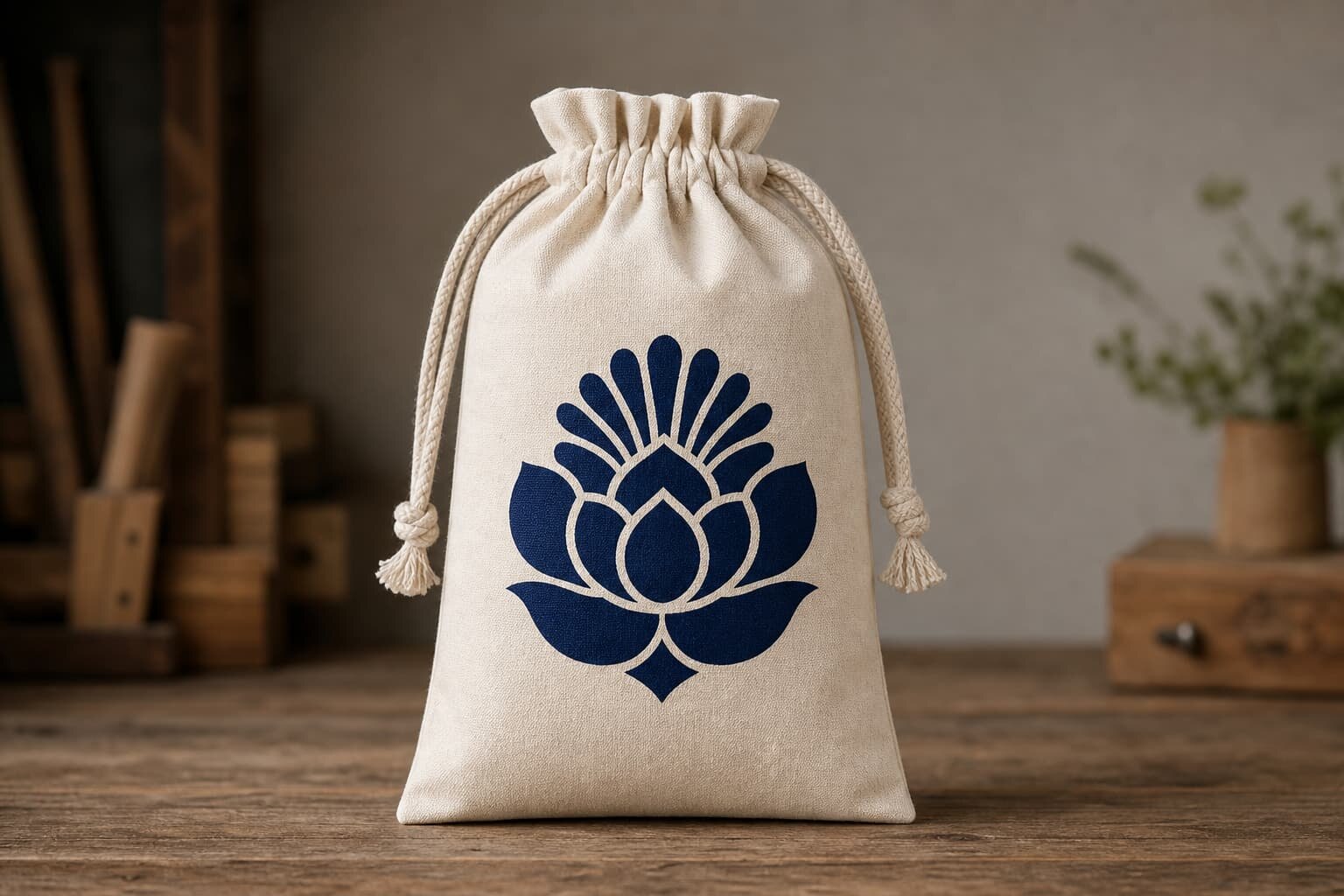
Why Printing Cost Changes So Much on Drawstring Pouches
A drawstring pouch looks simple, but the print cost can change sharply when the buyer changes fabric, size, artwork coverage, color count, or packing. Many RFQs ask only for a unit price on a cotton pouch with logo. That is not enough for a reliable quote. A factory has to calculate fabric consumption, printing setup, printing speed, curing or drying time, sewing labor, drawcord material, packing labor, reject allowance, and export carton details.
For procurement teams, the main risk is comparing quotes that are not built on the same assumptions. One supplier may quote a 120 gsm cotton pouch with a small one-color screen print and bulk packing. Another may quote 8 oz canvas, two-side print, individual polybag, barcode, and stricter inspection. The cheaper offer may not be cheaper after the specification is corrected.
- Ask for the pouch body cost and print cost to be shown separately.
- Confirm whether the quoted size is finished size after sewing.
- Compare fabric GSM, print method, color count, packing, and sample terms before choosing a supplier.
- Do not approve a price based only on a product photo; request a technical specification.
Start With Pouch Size, Fabric GSM, and Intended Use
Printing cost is connected to pouch construction because the fabric must hold the ink, resist distortion, and support the drawstring channel. A 10 x 15 cm jewelry pouch in 120 gsm cotton is a different product from a 30 x 40 cm retail laundry pouch in 240 gsm canvas. The larger pouch uses more fabric, more sewing time, a longer cord, and often a larger logo area. Larger print areas slow production and can increase the reject rate.
For light packaging, 4-5 oz cotton or around 120-140 gsm fabric may be acceptable. For a reusable retail pouch, many buyers move to 6-8 oz cotton canvas, roughly 180-240 gsm depending on the weave. Heavier fabric gives better structure and print opacity, but it does not automatically solve every printing issue. A rough canvas surface can affect fine text, while a very thin fabric can show uneven ink absorption or print-through.
- Small jewelry or cosmetic pouch: often 8 x 10 cm, 10 x 15 cm, or 15 x 20 cm.
- Gift set pouch: often 20 x 30 cm or 25 x 35 cm, depending on product depth.
- Footwear, apparel, or laundry pouch: often 30 x 40 cm or larger, with stronger cord and seams.
- Natural cotton saves dyeing cost but may vary in shade; dyed fabric needs color tolerance and lead time.
Print Method Is the Largest Cost Variable After Fabric
Silkscreen printing is usually the most practical method for bulk drawstring pouch orders with simple logos, solid text, and one to three colors. It has setup cost for screens, but the unit print cost becomes efficient as quantity increases. Buyers should ask whether the screen charge is included, whether it applies per color, and whether it is reusable for repeat orders. A one-color logo on one side is not the same cost as a two-color logo printed on both sides.
Heat transfer, digital print, embroidery, woven labels, and patches each have a different cost logic. Heat transfer can handle detailed graphics and smaller runs but may create a different handfeel on cotton. Digital print can be useful for multi-color artwork, but fabric type and pretreatment matter. Embroidery adds premium texture but can distort thin fabric and is not ideal for very small text. A woven label or sewn patch may be better when the brand wants a clean premium detail without printing a large area.
- Use silkscreen for simple logos, repeat orders, and strong unit cost control.
- Use heat transfer for complex color artwork when handfeel is acceptable after sample approval.
- Use embroidery only when the fabric weight can support needlework without puckering.
- Use woven labels when consistent logo detail is more important than a large printed graphic.
How MOQ Logic Affects the Printed Pouch Unit Price
MOQ is not one number. A printed drawstring pouch can have a pouch sewing MOQ, fabric dyeing MOQ, print setup MOQ, cord color MOQ, label MOQ, and packing material MOQ. If a supplier gives one MOQ without explaining the cost drivers, the buyer may face a price increase after artwork review. For example, a natural cotton pouch with stock cord and one-color screen print can support a lower MOQ than a custom dyed pouch with matched cord, woven label, and individual printed packaging.
Small orders carry a higher unit print cost because setup labor is spread across fewer pieces. This is why a 500-piece trial order may look expensive compared with 3,000 or 5,000 pieces. Buyers should request price breaks instead of asking only for one quantity. A good RFQ asks for the same specification at several quantities so the purchasing team can see where the cost curve becomes reasonable.
- Request price breaks at realistic levels such as 500, 1,000, 3,000, 5,000, and 10,000 pieces.
- Ask which MOQ is caused by fabric, which is caused by printing, and which is caused by accessories.
- Separate sample MOQ from bulk MOQ; a sample can be made by a different process if not controlled carefully.
- For repeat programs, ask the factory how screen storage and repeat setup charges are handled.
Artwork Details That Increase or Reduce Printing Cost
Artwork is not just a design file. It determines color count, screen count, print size, registration difficulty, ink consumption, drying time, and defect risk. A small one-color logo printed in the center of a flat pouch panel is efficient. A large solid print near the drawstring channel, seam, or bottom corner can create alignment issues and uneven pressure. If the logo crosses a seam or sits too close to the cord channel, the print may not look clean after sewing.
Send vector artwork whenever possible, such as AI, EPS, or PDF with outlined fonts. If the artwork includes Pantone references, make clear whether exact color matching is required or whether close commercial matching is acceptable. Exact matching on natural cotton is harder than on coated paper because the fabric base shade affects the ink result. Buyers should approve a physical strike-off rather than relying only on a digital proof.
- State the print size in centimeters, not only the logo file size.
- Define placement from the top edge, side edge, or center line of the finished pouch.
- Confirm whether the print is one side, two sides, or repeated on multiple colorways.
- Avoid small reversed text, very thin lines, and large ink blocks unless tested on the selected fabric.
- Ask for tolerance, such as plus or minus 5 mm, when placement accuracy matters.
Sample Approval Should Check More Than the Logo
A printed drawstring pouch sample should confirm fabric, size, sewing, cord, print quality, packing, and label details. Many production problems happen because the buyer approves a logo strike-off but does not approve the complete pouch construction. The factory then prints correctly but uses a cord that is too thin, a channel that is tight, or packing that creases the logo. Sample approval should reflect the actual bulk specification as closely as possible.
For cost control, ask the factory to identify which parts of the sample are made by bulk process and which are handmade for approval. A hand-cut sample may look acceptable but not represent mass production tolerance. If the order uses custom dyed fabric, a pre-production sample after dyeing is more useful than a sample made from stock natural cotton. If the order uses heat transfer or digital print, approve handfeel and edge behavior after the pouch has been folded and packed.
- Measure finished size after sewing and compare it with the RFQ tolerance.
- Rub the printed area with a dry and slightly damp white cloth to check obvious transfer.
- Pull the drawcord several times to check channel smoothness and seam strength.
- Fold the pouch as it will be packed and check whether the print cracks, sticks, or creases badly.
- Keep one approved sample at the factory and one with the buyer for final inspection reference.
Packing Choices Can Change Both Cost and Defect Rate
Packing is often treated as a minor line item, but it affects labor, materials, carton size, inspection time, and final presentation. Bulk packing is economical for distributors that will repack locally. Individual polybags are useful for retail, marketplace fulfillment, and kitting, but they add bag cost, labor, label handling, and a higher chance of barcode or assortment errors. If a buyer needs plastic-free packing, the factory needs to know early because paper bands, glassine bags, or carton dividers may need testing.
Drawstring pouches also create packing issues because cords can tangle, knots can loosen, and printed panels can pick up dirt if handled carelessly. Natural cotton and light-colored fabrics show marks easily. If the pouch is printed with heavy ink, the packing method should avoid pressure marks before the ink is fully cured. The RFQ should state units per inner pack, carton quantity, carton mark information, and maximum carton weight.
- Bulk pack: lowest cost, but requires clear carton sorting and clean handling.
- Individual polybag: better for retail control, but adds labor, labels, and plastic compliance questions.
- Paper band or FSC-style paper sleeve if required by the buyer: confirm cost, MOQ, and strength in transit.
- Carton liner: useful for light-colored cotton pouches to reduce moisture and dirt risk.
- Barcode label: specify label size, location, scan standard, and who supplies the data.
Lead Time: Where Printed Pouch Orders Usually Slow Down
Lead time is not only sewing time. It includes artwork checking, sample making, buyer approval, fabric preparation, cutting, printing, curing, sewing, trimming, inspection, packing, and export documentation. If the buyer changes artwork after screen making, or changes fabric color after sample approval, the clock can restart. The most realistic quote separates sample lead time from bulk production lead time and states when the timeline begins.
For urgent launches, procurement teams should ask which material is in stock and which components are custom. Natural cotton fabric and standard cords are usually easier to schedule than custom dyed cotton, Pantone-matched cord, custom woven labels, or special retail packaging. Printing can also create a bottleneck if the logo has many colors or if both sides need printing before sewing.
- Ask for a timeline after final artwork approval, not after initial inquiry.
- Confirm whether fabric is greige, stock natural, stock dyed, or custom dyed.
- Check whether print curing time is included before sewing or packing.
- Leave time for inspection and rework before the cargo handover date.
- For seasonal retail orders, freeze artwork and packing data before bulk material purchase.
Quote Data Buyers Should Require Before Comparing Suppliers
A useful quote for printed drawstring pouches should read like a production plan, not just a price. At minimum, it should include finished size, fabric composition, GSM or oz, fabric color, drawcord details, print method, print size, print color count, packing method, MOQ, sample cost, setup cost, production lead time, carton data, and trade terms. Without this data, the buyer cannot know whether two quotes describe the same product.
Ask suppliers to separate cost items when the program may change. For example, show the unit price for the plain pouch, the print charge, the setup charge, and the packing upgrade. This helps the buyer decide whether to reduce cost by changing artwork size, simplifying color count, switching from individual polybag to bulk packing, or increasing order quantity. It also reduces conflict later when the brand adds a hangtag or second print position.
- Finished pouch size and tolerance.
- Fabric type, GSM, color, and whether shrinkage is considered.
- Drawcord material, color, length, knot, stopper, or tip details.
- Print method, print area, number of colors, setup charge, and repeat charge.
- Packing method, carton quantity, carton dimensions, gross weight, and carton marks.
- Sample lead time, bulk lead time, payment terms, Incoterms, and quote validity.
Common Cost Mistakes and How to Prevent Them
The most common mistake is buying the cheapest printed pouch quote without confirming the specification behind it. A lower GSM fabric, smaller print area, missing setup charge, no individual packing, or lower inspection standard can make a quote look attractive. The issue appears later when the buyer receives thin fabric, weak cords, off-center logos, or cartons that are not ready for the distribution channel.
Another mistake is approving only digital artwork. Screen color on cotton is affected by fabric shade, ink thickness, drying, and surface texture. Heat transfer handfeel and digital print sharpness must also be checked on the actual material. A buyer does not need to overcomplicate the project, but a short approval process prevents most production disputes.
- Do not compare unit prices until fabric GSM and packing are aligned.
- Do not assume one setup charge covers all colors, sides, and artwork versions.
- Do not place fine artwork too close to seams or the drawstring channel.
- Do not skip the print strike-off when brand color and logo sharpness matter.
- Do not ignore carton data; freight cost can change the real landed cost.
Specification comparison for buyers
| Spec decision | Recommended option | When it fits | Buyer risk to check |
|---|---|---|---|
| Fabric for low-cost printed pouch | 4-5 oz cotton or 120-140 gsm cotton | Small gift packaging, cosmetics, jewelry, hotel amenities, low carry weight | Thin fabric can show print-through, cord stress, and less premium handfeel |
| Fabric for retail or reusable pouch | 6-8 oz cotton canvas or 180-240 gsm fabric | Brand packaging, retail sets, accessories, reusable promotion packs | Higher GSM raises material cost and may require adjusted print pressure |
| Print for simple one-color logo | Silkscreen printing | Solid logo, text, simple icon, repeat orders with stable artwork | Setup charge and minimum print run can make small orders look expensive |
| Print for gradients or many colors | Heat transfer or digital print depending on fabric | Photographic artwork, small runs, seasonal campaigns, multi-color graphics | Handfeel, wash resistance, and edge marks must be approved on a real sample |
| Premium branding detail | Woven label, embroidery, or debossed leather/PU patch | Gift pouch, fashion accessory, limited edition packaging | MOQ, label lead time, needle marks, patch placement tolerance |
| Packing cost control | Bulk pack by size and color, inner carton liner | Distributor stock, repacking at destination, lowest unit packing cost | Loose cords can tangle; buyer must define bundle quantity and carton marking |
| Shelf-ready packing | Individual polybag, barcode sticker, warning label if required | Retail buyer, marketplace fulfillment, kitting project | Packing labor and label errors can cost more than expected if not specified early |
Buyer checklist before sampling
- Define pouch size as finished width x height, not fabric cutting size.
- Specify fabric type, GSM or oz, color, shrinkage expectation, and whether fabric is dyed or natural.
- Send logo artwork in vector format and state print size, print position, and number of print colors.
- Ask the factory to quote setup charge, unit print charge, sample charge, and repeat-order screen charge separately.
- Confirm whether printing is done before or after sewing and how the factory controls position tolerance.
- Approve a physical print strike-off on the actual pouch fabric before bulk production.
- Check drawcord material, cord color, cord diameter, knot method, and whether metal tips or stoppers are included.
- Define packing method, polybag requirement, barcode labels, carton marks, and maximum carton weight.
- Request lead time split by fabric preparation, sampling, printing, sewing, packing, and final inspection.
- Include acceptable defect limits for print smearing, off-position logos, loose stitches, color variation, and dirty marks.
Factory quote questions to send
- What fabric GSM or oz is used in your quote, and is the fabric in stock or custom dyed?
- Is the print cost based on silkscreen, heat transfer, digital, embroidery, woven label, or another method?
- How many print colors are included, and what is the extra cost per additional color or screen?
- Is the setup charge one-time, per color, per artwork, or per order repeat?
- What is the MOQ for the pouch body, and what is the MOQ for the selected print method?
- Can you provide a physical print strike-off on the actual fabric before mass production?
- What print size and position tolerance do you normally control for drawstring pouches?
- Are cords, cord color matching, labels, stoppers, hangtags, and individual packing included in the unit price?
- What are the carton dimensions, gross weight, and units per carton for freight estimation?
- What production lead time applies after artwork approval, sample approval, and deposit?
Quality-control points to confirm
- Check fabric GSM, color, handfeel, weave consistency, and shrinkage against the approved sample.
- Measure finished pouch width and height after sewing; do not rely only on cutting panels.
- Inspect print color, registration, curing, edge sharpness, opacity, and rub resistance.
- Check logo placement from pouch edges and drawstring channel, especially on small pouches.
- Pull-test drawcord channel and side seams for loose stitching or skipped stitches.
- Confirm cords are equal length and knots do not slip through the channel.
- Review label, hangtag, barcode, and carton mark accuracy before packing is sealed.
- Open random cartons to check packing quantity, mixed colors, dirty marks, odor, and moisture risk.