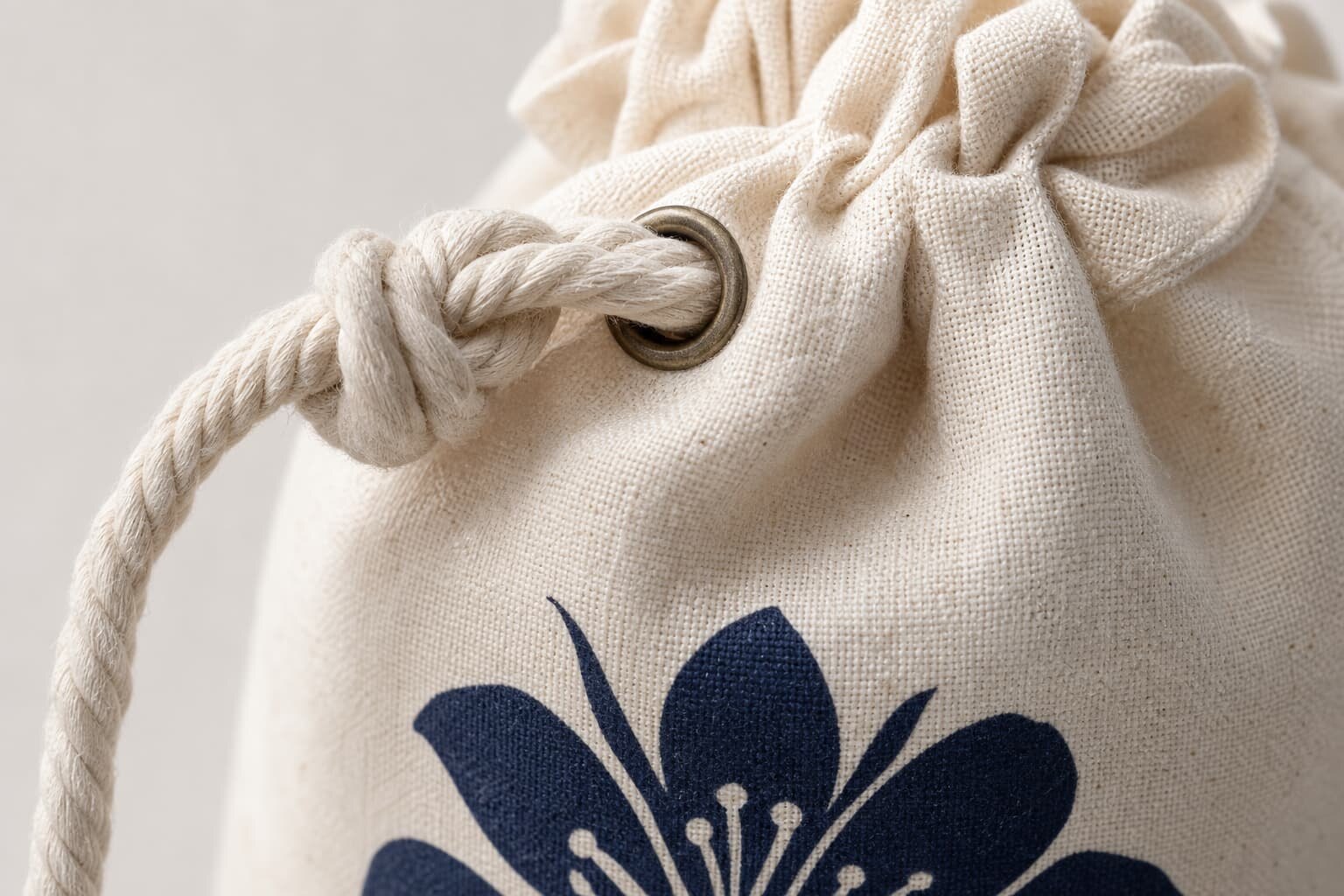
Why this memo matters before bulk release
A drawstring pouch packing table audit approval memo is the point where a buyer stops treating the order as a sample and starts treating it as a controlled production run. It records what was checked at the packing table, what matched the approved sample, and what must not change before bulk cartons leave the factory. For importers and retail buyers, that matters because most pouch disputes are not about the logo alone. They come from small differences in fabric weight, cord length, fold method, pack count, or carton labeling that are easy to miss in a photo but expensive to fix in transit or at destination.
If you buy for promotions, retail, or subscription kits, the memo should sit between the final sample approval and the bulk release. It gives the factory one clear set of acceptance points: measured size, confirmed GSM, print method, seam quality, packing count, and outer carton data. When the order includes multiple colors or sizes, the memo also prevents the factory from mixing specs on the floor. That is the real value: it turns a vague approval into a traceable production gate.
- Use the memo when the order has more than one size, color, or print version.
- Use it when the pouch will ship into retail, gifting, or subscription packing channels.
- Use it when the supplier is changing fabric lot, cord supplier, or packing method.
- Use it when you need a clean approval record for an internal procurement file.
What the approval memo should lock, and what it should not
A useful memo locks objective data, not vague language. It should name the product code, finished dimensions, fabric composition, GSM, color reference, print method, print location, cord type, packing count, carton spec, and the exact sample that governs the order. For example, if the pouch is 100 percent cotton at 120 gsm with one front screen print, the memo should say that directly, along with the acceptable tolerance if you allow one. If the buyer wants a softer hand feel or a thicker retail look, that should be written into the spec, not left as a comment in an email.
What the memo should not contain is language like good quality, normal packing, or same as last time unless those phrases are backed by a sealed sample and a revision number. The factory needs a line-by-line instruction it can measure on the floor. That is especially important for drawstring pouches because the product is simple enough that suppliers may assume the order is flexible. In practice, small changes in GSM, print coverage, or cord construction can change the look, the price, and the return risk.
- Required fields: product code, size, GSM, print method, print position, cord spec, label spec, packing count, carton data.
- If you allow tolerances, write them down as numbers, such as +/- 5 gsm or +/- 3 mm on finished size.
- If the order uses multiple colors, create a separate line for each color and each print version.
- Attach the sealed sample number so the factory knows which version controls production.
How to run the packing table audit on site
The packing table audit should start with the first-off pieces from the line, not with the best-looking pouch in the sample room. Ask the factory to show units from the beginning, middle, and end of the run so you can see whether the line stays stable after setup. On a normal order, many buyers check at least 20 to 30 pcs per size or color, and more if the order is large, the artwork is complex, or the factory has changed fabric lot. The point is not to inspect every pouch by hand. The point is to see whether the production method can hold the approved spec when operators work at speed.
At the table, the buyer should check measured size, cord length, print position, folding method, pack count, and whether the carton sample matches the packing instruction. Watch how the factory handles rejected pieces. If the team has no clear bin for rejects, mixed goods can slip back into the run. A proper audit also checks the work flow itself: are operators using the correct ruler, is the print cured before stacking, and are the pouches flattened the same way in every pack. Those details decide whether the bulk will match the sample when the cartons are opened at destination.
- Pull test units from the top, middle, and bottom of the pile.
- Compare each unit against the sealed reference sample, not against memory.
- Measure size, cord length, and print placement with the same tool every time.
- Check that rejected units are isolated and counted before the line continues.
- Confirm the packing count by re-counting one full inner bag and one carton sample.
Spec choices that change pass or fail outcomes
Drawstring pouches look simple, but the material choice changes everything the buyer will see and feel. A thin 80 to 90 gsm cotton pouch may work for a promotional gift or a lightweight accessory set, while a 120 to 140 gsm pouch gives more body and better shelf presence. If the buyer is comparing quotes, the GSM needs to be on the same basis across suppliers. Some factories quote a lighter cloth and then build the price back up with extras, while others quote a heavier cloth but leave packing details out. The packing table memo is where you stop that drift and force each supplier to quote the same spec.
Print method also affects approval. A one-color screen print is often the most stable for simple logos and larger quantities, while woven labels or sewn patches are better when the brand needs durability and a more premium feel. Heat transfer can be useful for detailed art, but it needs careful cure control and may wear differently in retail use. Cord type matters as well. Cotton cord feels more natural, while braided polyester can be tougher and less prone to fray. The buyer should select the method based on the product's end use, not just on the lowest unit price.
- If the logo is simple and the run is large, screen print is often the easiest to control.
- If the design has fine detail, ask whether the factory can hold registration without blur.
- If the pouch will be handled often, bar tack and cord finish matter more than a small price gap.
- If the order uses natural cotton, ask how the supplier controls slubs, shade variation, and shrinkage.
Use the right sample checks before you approve bulk
Do not approve bulk from artwork alone. The buyer should see a pre-production sample, a line first-off sample, and a sealed reference sample that stays with the order file. The pre-production sample proves the supplier understands the spec. The first-off sample proves the line can make the same result at speed. The sealed sample proves everyone has the same reference when a dispute appears later. If the factory changes fabric lot, print screen, or label supplier after approval, the memo should require a fresh sign-off before the run continues.
A strong sample check for a drawstring pouch is practical, not cosmetic. Confirm the pouch opens and closes smoothly, the cord does not twist inside the channel, the print sits where the buyer requested, and the fabric weight feels like the approved sample. If the pouch has a woven side label, check the edge finish so it does not scratch adjacent products in a retail kit. If the order includes a care label or barcode, test that the label is readable and properly sewn. Sample approval is not just about looks. It is the last chance to catch handling problems before production scale makes them expensive.
- Keep one sealed sample in the buyer file and one at the factory line if the order is large.
- Check front, back, side seam, cord exit, label, and fold finish on each sample.
- If the supplier offers a revised sample, mark the old version as inactive.
- If the pouch will be packed with other products, test whether the print rubs off or transfers.
Packing, carton data, and lead time are part of the product
Many buyers treat packing as a shipping detail, but for drawstring pouches it is part of the finished product. A flat-folded pouch packed in clean inner bags ships differently from a loosely stacked pouch with mixed counts. The memo should state how many pcs go in each inner bag, whether the drawcord is tucked or tied, whether there is tissue or a carton divider, and how the outer carton is marked. For retail programs, carton marks and SKU labels matter because the distribution center may reject a shipment that cannot be matched to the PO. For export, gross weight and carton size also affect freight planning.
Lead time needs the same discipline as the product spec. A simple pouch with stock fabric and one-color print may move faster than a pouch with custom woven label, special packing, or multiple size splits. Rather than accepting a generic delivery promise, ask the supplier to separate sample lead time, material booking time, print setup, line production time, and final packing time. That gives procurement a realistic schedule and makes it easier to spot delays early. If the supplier quotes one number without explaining the steps behind it, there is usually a hidden risk somewhere in the run.
- Ask for carton dimensions, gross weight, and inner count before you approve freight planning.
- Confirm whether the product is bulk packed or retail packed, because the cost structure is different.
- Request a carton sample photo with marks visible, not just a product photo.
- If the shipment is sea freight, ask how the factory protects the pouches from moisture and dust.
How to read quotes without missing hidden cost
A clean factory quote should separate the product cost from the setup and packing cost. For drawstring pouches, the unit price can change with GSM, print area, number of colors, label type, cord material, and packing style. The buyer should ask for price bands at several quantities, such as 500, 1,000, 3,000, and 5,000 pcs, because MOQ logic is often hidden in the step between those numbers. If a quote does not show where the price drops or why it drops, procurement cannot compare suppliers fairly. A low price on paper can become the highest landed cost once artwork fees, label charges, or extra packing are added.
The packing table audit memo helps here too. When the quote is built from the same spec that will be checked on the line, fewer surprises show up later. Ask whether the screen fee is one-time or per color, whether a woven label has its own MOQ, whether individual polybags are extra, and whether the factory has priced carton marks or barcode labels. Also ask whether the quote assumes bulk packing or retail packing, because those are not the same job. The right question is not just what is the price. It is what must be true for that price to hold through approval and shipment.
- Request a quote split into fabric, print, label, packing, carton, and QC if possible.
- Ask for unit price at multiple quantity bands so the MOQ curve is visible.
- Check whether the supplier quoted a lighter GSM or simpler pack to get the headline price down.
- Make sure any artwork revision, color change, or packing change is priced in advance.
Mistakes that trigger rework, claims, and chargebacks
The most common mistake is approving a good-looking sample and assuming the bulk will match automatically. It often does not. A second mistake is leaving the fabric spec loose, which lets one supplier quote 90 gsm and another quote 120 gsm without the buyer noticing the gap. Another frequent issue is ignoring cord consistency. If one end is longer, frayed, or differently knotted, the pouch may still function, but the retail shelf look changes. Buyers also get burned when the packing count on the table does not match the carton instruction, because the destination team receives short cartons, mixed cartons, or cartons that weigh differently from the booked spec.
The memo prevents these mistakes by turning each one into a checkable line item. If the print is not fully cured, the audit should stop before bulk cartons are sealed. If the seam is weak at the cord channel, the order should be held until the factory corrects the stitch method or adds reinforcement. If carton labels do not match the PO, the buyer should require a relabel before release. This is the practical value of the memo: it gives procurement a documented reason to pause production before a minor issue becomes a claim.
- Do not approve by photo alone if the order has multiple lots or a tight retail requirement.
- Do not leave GSM, size tolerance, or print placement as informal notes.
- Do not let the factory mix approved and unapproved units on the same table.
- Do not release cartons until count, mark, and product version match the PO exactly.
Memo language that keeps approval controlled
The approval memo should read like a production instruction, not a sales email. Keep it short, specific, and versioned. A practical line is: approved for bulk only against sealed sample ref no. X, dated Y; any change to fabric GSM, color, print method, size, cord, label, or pack count requires written buyer approval before production. That one sentence closes most of the loopholes suppliers use when they try to swap a material or compress a packing step after sign-off. Add the buyer name, factory contact, sign date, and the revision number so the document can be traced later.
If the audit finds a mismatch, the memo should not become a blame note. It should state what failed, what corrective action was accepted, and whether the buyer will require a fresh first-off sample before bulk continues. The objective is control, not drama. Procurement teams work best when the approval record makes it easy to compare the quote, the sample, and the bulk run side by side. That is the simplest way to avoid disputes over a pouch that looked correct in the showroom but arrived different in the carton.
- Use one revision number for the memo, artwork proof, and approved sample record.
- Name the exact sample that controls production, including date and version if possible.
- Write the rejection trigger in plain language, such as size drift, print shift, or packing mismatch.
- Keep the buyer signature and factory acknowledgment together in the same file.
Release the PO only when the memo and quote match
A good sourcing workflow for drawstring pouches is simple: RFQ, sample, packing table audit, memo, then PO release. If the buyer releases the PO before the memo and quote are aligned, the supplier has room to interpret the order in its own way. That may be fine for commodity packaging, but it is risky when the pouch is going into retail, subscription, or branded gifting. The safest approach is to make the memo a gate that sits between technical approval and commercial release. If the quote says 120 gsm cotton with one-color screen print and flat bulk packing, the memo should say the same thing.
This is also where procurement can protect margin. When the memo captures the actual production method, it becomes easier to compare supplier quotes on equal terms. It also helps the buyer explain why one quote is higher: heavier GSM, better label, better carton plan, or more careful packing. That makes internal approval easier and keeps the factory from cutting corners to stay at the target price. For a simple pouch, that control is often the difference between a clean margin and a batch of avoidable claims.
- Match the RFQ, quote, sealed sample, and memo before the PO goes out.
- Hold the PO if the factory has not confirmed the same pack count and carton data.
- Use the memo to define the final buyer hold point before bulk shipment.
- Archive the quote, sample, and audit record together for future reorder comparisons.
Specification comparison for buyers
| Spec decision | Recommended option | When it fits | Buyer risk to check |
|---|---|---|---|
| Fabric weight/GSM | 80-100 gsm cotton for promo use; 120-140 gsm for retail feel | Light gifts, event kits, and price-sensitive runs vs. pouch programs that need better body and less see-through | Thin cloth, weak seams, and batch-to-batch shade drift |
| Print method | 1-2 color screen print for simple logos; woven label for long-life branding | Straight logos, repeat orders, and larger runs with stable artwork | Registration drift, poor cure, or artwork that is too detailed for the method |
| Cord material | Cotton cord or braided polyester cord with tied or heat-sealed ends | Retail use, repeated opening, or when the buyer wants a softer hand feel | Uneven cord length, slipping knots, or scratchy ends that damage other goods |
| Closure reinforcement | Double hem with bar tack at stress points | Orders that will be packed, reopened, or handled often in the channel | Loose channel stitching and pulled seams at the cord exit |
| Packing format | Flat folded bulk pack with clear inner count and carton marks | Export shipments, warehouse receiving, and mixed-size programs | Mixed counts, crushed pouch shape, and wrong carton labels |
| Label strategy | Sewn woven side label or sewn care label | Retail programs and branded programs that need durable identification | Label misplacement, rough edges, or label content that does not match the PO |
Buyer checklist before sampling
- Confirm the finished pouch size, tolerance, and measured sample code before bulk release.
- Lock the fabric composition and GSM, including any acceptable range and shade standard.
- Approve print method, print area, Pantone reference, and whether the logo is on one side or both sides.
- Verify cord material, cord length, knot finish, and whether the ends are heat-sealed or tied.
- Confirm the seam build, bar-tack points, and stitch density at the cord channel and bottom seam.
- Check the packing count per inner bag and per carton, plus the folding method used on the line.
- Review carton size, gross weight, carton marks, barcode position, and any retail label requirements.
- Ask for a pre-production sample, a first-off sample from the line, and a sealed reference sample.
- Request quote lines for unit price, setup charges, label cost, packing cost, and carton cost.
- Keep the signed approval memo tied to the PO, artwork proof, and final sample record.
Factory quote questions to send
- What is your unit price by quantity band, such as 500, 1,000, 3,000, and 5,000 pcs?
- What fabric GSM is included in the quote, and what tolerance do you allow on bulk production?
- Which print method are you quoting, and does the price include screen setup or color separation?
- What is the minimum order quantity per color, size, and print version?
- Does the quote include woven labels, care labels, or side labels, or are those extra?
- What packing format is included: bulk packed, individual polybag, folded insert, or retail hangtag?
- What carton spec, inner count, and master carton count are you pricing against?
- What is the sample lead time, and what is the bulk lead time after sample approval?
- What extra charges apply for artwork changes, second-side print, barcode labels, or special packing?
- Can you share the packing table audit record or line inspection report for the approved sample run?
Quality-control points to confirm
- Fabric GSM matches the approved range and the hand feel is consistent across the lot.
- Finished size matches the approved measurement within the buyer tolerance.
- Seam allowance, stitch density, and bar-tack strength are consistent at the stress points.
- Cord length, cord type, and knot or tip finish match the approved sample.
- Print position, color, cure, and edge sharpness match the artwork proof.
- Label placement, label content, and label stitching are correct and centered as required.
- No broken stitches, loose threads, oil marks, or needle damage are present on visible faces.
- Pack count per inner bag and carton count match the packing instruction exactly.
- Carton marks, barcode labels, and SKU data match the PO and artwork version.
- Start, middle, and end of run samples are consistent so the buyer can spot drift early.