Drawstring Pouch OEM Product Development Capability for Europe
Byline: Vincent Xi, Editorial Author · Author profile
European B2B buyers should treat drawstring pouch OEM product development capability as a freeze-or-stop gate, not a logo applied to a stock bag. Manufacturing should wait until construction, bill of materials (BOM), decoration process, measurement points, and destination-market documents are locked on a sewn, production-intent prototype. Bulk price and lead time then belong on a re-quote of that frozen pack. Published sample windows and minimum order quantities (MOQs) on OEM websites are comparison context only. They do not replace a pack an importer of record can file for a named destination in Europe.
A drawstring pouch is a small cut-and-sew article, but development still has to resolve the cord channel, exit hardware or bartacks, cinch behaviour, fabric shrinkage, and whether the SKU is a sold textile product or packaging. Those choices change sampling time, bulk yield, and the files required when the article is placed on the market in the European Union (EU), the European Economic Area (EEA), or the United Kingdom (UK). Rules are not uniform across Europe: EU instruments, EEA alignment, UK law, and national packaging extended producer responsibility (EPR) schemes can apply differently to the same construction depending on destination and use.
This page is for European manufacturing RFQs in the drawstring-pouch family. It compares publicly stated OEM process claims. It does not invent CottonToMaker factory metrics, certifications, client results, or first-person production stories, and it does not rank suppliers.
Approval answer. Sign manufacturing only when the OEM has returned a sewn production-intent pouch that matches a locked BOM, the real cord path, the bulk decoration process, and a document list named by EU member state(s), EEA country, and/or UK. Artwork on a stock pouch is fulfilment. It is not product development capability.
Product development capability: what European buyers should freeze
For this product family, product development capability is the OEM’s ability to convert a brief into a repeatable article: geometry, materials, a sewn prototype that includes the real cord path, decoration that matches bulk, and a quality-control (QC) plan that still works at quantity.
Public manufacturer pages describe that stack in different words. Those pages are source contexts for RFQ questions, not factory audits and not CottonToMaker performance.
- One OEM/ODM source, as published on its drawstring bag manufacturer page, combines fabric research and development (R&D), cut-and-sew production, material sourcing, and engineering, and it specifically calls out structural engineering for cord channels and reinforcements plus print and embroidery routes (Szoneier drawstring bag manufacturer page).
- A second source, as published on its custom drawstring bags page, describes custom drawstring bags and pouches with a four-step path from brief and mockup to production and shipment, naming cotton, recycled polyethylene terephthalate (rPET), satin, and velvet, plus screen print or embroidery (Rivta drawstring bags page).
- A third source, as published on its product-development page, lists ideation, material sourcing, 2D/3D technical design, in-house prototyping, bulk production, QC, custom packaging, and logistics for custom bags including drawstring pouches, and it mentions Pantone matching (Jundong product development page).
Translate each published claim into a freeze-pack deliverable on the request for quotation (RFQ):
- Design pack: finished size, gusset, opening width, channel height, volume if relevant, measurement method, and shrinkage allowance.
- BOM: fabric construction and mass per area if known, lining, cord type and diameter, cord-end, grommet or bartack, thread, labels.
- Process match: the decoration method that will actually run in bulk, not a faster stand-in on the first proto.
- Engineering: how the channel is formed, how cord is threaded, where stress bartacks sit, and how the mouth behaves when cinched.
- Control plan: measurement points, defect list, colour standard, and any needle-detection or metal-detection requirement from the buyer’s category.
- Market file list: fibre text, chemical communication, hardware identity, pack-out, and EPR marks named by destination, not by a single “Europe” label.
If the factory can only apply artwork to a stock pouch, stop. That is fulfilment, not OEM product development capability. A digital mock, a stock-pouch overlay, or a decoration method that will not run in bulk hides channel failure, shrinkage, and shade risk until after a European purchase order is already committed.
Construction decisions that belong in the first sewn sample
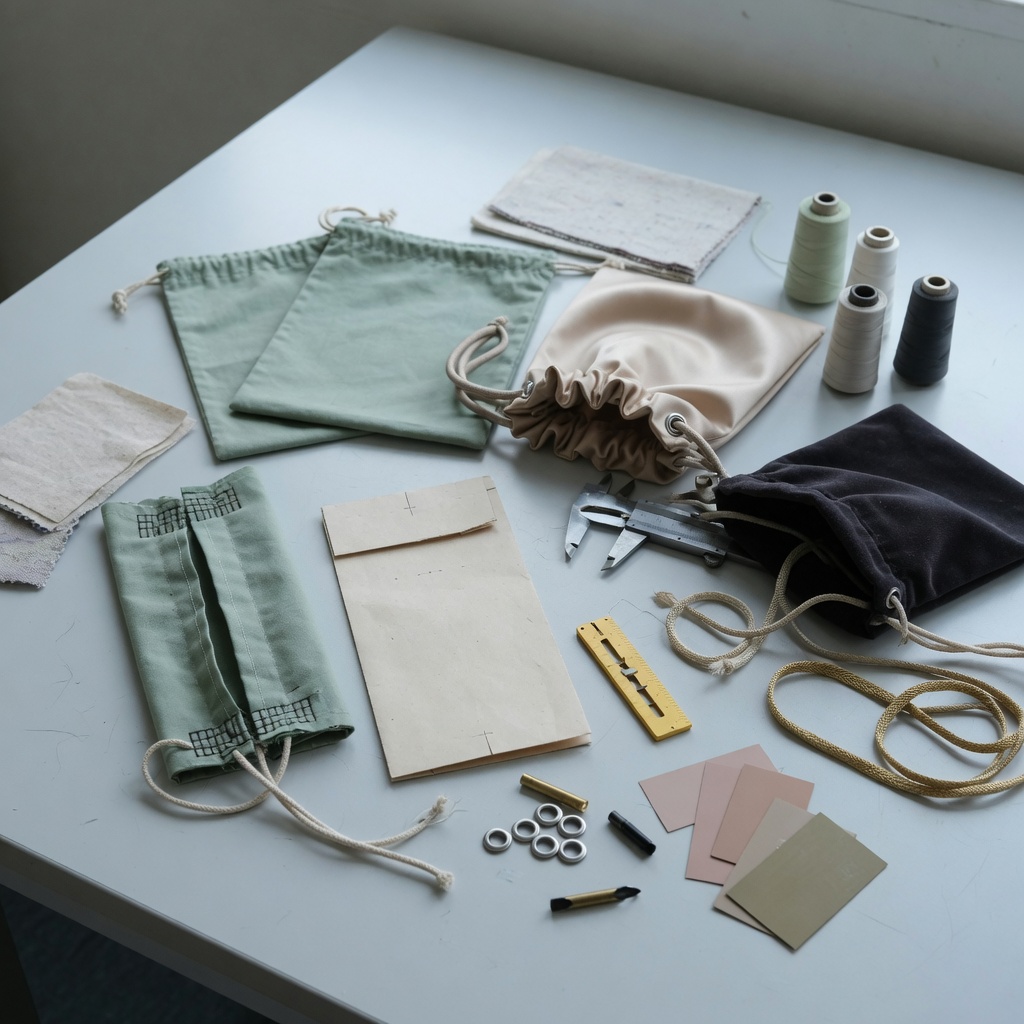
The first sample should be a sewn, production-intent article whenever bulk will be cut-and-sew. Digital mockups are useful for layout, but they do not prove channel strength, cord friction, or shrinkage. Do not approve a freeze until these variables are written and visible on the proto:
- Body: flat pouch versus gusseted; single layer versus lined; open hem versus bound mouth.
- Channel: self-fabric tunnel, applied casing, or metal-eyelet exits. Channel height and stitch type control whether the cord jams or the fabric rolls.
- Reinforcement: bartacks at channel ends, box-X at stress points, or webbing. Structural engineering for cord channels is one of the published capability claims buyers can test against a physical sample (Szoneier drawstring bag manufacturer page).
- Cord: round versus flat; cotton, polyester, polypropylene, or rPET; with or without stopper; heat-cut, aglet, or metal end; length versus opening circumference.
- Hardware chemistry: nickel in grommets or metal cord ends can matter for skin-contact articles under EU chemical restrictions. Do not assume a hardware finish is unrestricted. Confirm the alloy/finish identity and the current official restriction text for the named destination.
- Decoration: screen, embroidery, heat transfer, or woven label. Embroidery on a small pouch changes handfeel and can distort a channel if stitch density is high.
- Labelling: fibre content, care, batch, and any packaging marks if the pouch is sold as packaging rather than as a standalone textile product.
Example geometry to verify in the supplier quote (not a factory standard and not a cited-page specification): a 200 millimetre × 250 millimetre finished pouch, laid-flat width × height, with a 20 millimetre self-fabric channel. Cut height must include channel fold-over, seam allowance, and shrinkage. Cotton and rPET do not take the same steam or wash allowance. Confirm the measurement method (laid flat, uncinched, after press) and the millimetre tolerance on the tech pack.
Example millimetre tolerance to verify in the supplier quote (not a factory standard): ±5 millimetres on laid-flat width and height unless the buyer’s retail specification states a tighter millimetre band.
A sample that skips the real channel, or substitutes digital print for bulk screen or embroidery, understates bulk risk. A slower sewn proto that uses the bulk process is usually the cheaper decision if the European program has multiple colourways or a cosmetic-grade handfeel requirement.
Published sampling, MOQ, and process examples to benchmark
Use published OEM numbers only as comparison ranges. They are marketing claims on supplier pages, not CottonToMaker performance, and they are not harmonised definitions of “sample” or “MOQ.” Re-quote after the freeze; do not treat a homepage band as the RFQ answer.
Concrete data points from the cited pages (published claims, not independently measured for this article):
- Sample window A: 7–10 days for samples, as published for custom drawstring bags and pouches on the Rivta page (unit: days as stated; the page does not specify working versus calendar days; scope: the custom drawstring programs described on that page; as-of: the cited manufacturer page, reconfirm on a dated quotation; source: Rivta drawstring bags page).
- Prototype window B: 5–7 days in-house prototyping, as published on Jundong’s product-development page (unit: days as stated; working versus calendar days not specified on the citation used here; scope: custom bags including drawstring pouches as listed on that page; as-of: the cited page, reconfirm on a dated quotation; source: Jundong product development page).
- MOQ example A: MOQ from 500 pieces, as published by Rivta for the custom drawstring programs on that page (unit: pieces; scope: that manufacturer’s stated custom programs; as-of: the cited page; status: published marketing claim, not a per-colourway RFQ definition; source: Rivta drawstring bags page).
- MOQ example B: bulk production from 100–300 pieces MOQ, as published by Jundong (unit: pieces; scope: the OEM/ODM bag programs described on the product-development page, which include drawstring pouches; as-of: the cited page; status: published marketing claim, not a locked bulk price; source: Jundong product development page).
A 5–7 day proto and a 7–10 day sample can both be true as published and still be incomparable. Ask whether the clock starts at complete artwork, at fabric-in-stock, or at custom-dyed fabric; whether the deliverable is a printed mock, a sewn channel, or a bulk-process decorated article; and whether each colourway needs its own strike-off.
Price these MOQ splits explicitly:
- Lower piece counts (the 100–300 piece published band) often pair with fewer colourways, stock fabrics, or extra setup charges.
- A 500-piece published MOQ may still rise if the buyer adds lining, embroidery, custom-dyed cord, or individual polybags with national packaging marks.
- Split shipments to several EU member states, plus UK if in scope, can create carton-marking and invoice splits that do not appear in a factory’s “from 500 pcs” headline.
Rivta also describes a four-step sequence: brief and mockup, then production and shipment (Rivta drawstring bags page). Jundong describes a longer development stack: ideation, sourcing, 2D/3D design, prototype, bulk, QC, packaging, logistics (Jundong product development page). Szoneier emphasises material engineering plus channel and reinforcement engineering (Szoneier drawstring bag manufacturer page). For an RFQ, those steps only matter if each one produces a file or a physical article the buyer can reject.
The same Rivta page lists GRS, BSCI, and ISO among its claims (Rivta drawstring bags page). Distinguish a standard’s requirement from a company’s published practice. Global Recycled Standard (GRS) is a chain-of-custody standard for recycled content when the certificate scope covers the material and site. BSCI is a social-compliance audit program, not an EU market-access mark. “ISO” on a web page is incomplete until the buyer sees the standard number, site, scope, and expiry. Do not treat a website badge as a shipment document, and do not infer that CottonToMaker or any unnamed factory holds those documents.
Europe RFQ documents: EU, EEA, UK, and national schemes
Keep the product freeze primary. Name destination markets on the RFQ because documentation is not interchangeable across Europe, and a capable OEM still cannot replace the importer of record.
What the OEM should attach to the approved sample. BOM, colour standard, measurement chart with method, construction sheet for the cord channel, material declarations, and artwork locked to the bulk process. Request test reports against named methods only when the SKU’s materials and hardware make those methods relevant. Do not ask for a generic “EU certificate” as if one document covered chemicals, safety, fibre labelling, and EPR.
EU (member states). If the pouch is placed on the Union market as a consumer product, the importer should map obligations under the General Product Safety Regulation (GPSR) against the current official EU text and keep technical documentation proportionate to the risk. Textile fibre composition labelling follows Regulation (EU) No 1007/2011 when the article is a textile product. Chemical communication for substances of very high concern (SVHCs) in articles is commonly handled under REACH Article 33; buyers should verify the current official EU legal text and European Chemicals Agency (ECHA) Candidate List rather than rely on this editorial summary. Metal hardware may also be in scope of REACH Annex XVII restrictions (for example nickel in prolonged skin contact). Confirm the legal text for the specific hardware and use case. Do not treat this section as a complete legal opinion.
EEA. Iceland, Liechtenstein, and Norway often apply EU product-rule alignments through the EEA Agreement, but the importer of record should confirm the applicable instrument for the specific SKU. Do not copy an EU declaration onto an EEA shipment without checking.
UK. UK REACH is a separate chemical regime. Product safety, markings, and fibre labelling should be specified against current UK official guidance, not assumed to match EU files. A pouch program sold in both the EU and the UK needs two document sets even if the sewn article is identical.
Country-specific packaging EPR. If the pouch is packaging (for example a dust bag supplied with another product) rather than a sold textile accessory, national packaging EPR can apply in the individual country of placement. Registration, data reporting, and on-pack marks differ by country. A single “Europe packaging logo” instruction is not a specification. Name each ship-to country on the RFQ and assign importer-of-record responsibility separately from OEM sewing capability.
Buyer decision table: specify, compare, verify, approve
| Decision item | What to specify in the RFQ | Trade-off to compare | What to verify on the sewn proto | Approval gate before bulk |
|---|---|---|---|---|
| Finished size and channel | Laid-flat width × height, channel height, measurement method, millimetre tolerance | Tighter tolerances raise reject risk; loose tolerances fail retail fit | Measure uncinched and cinched opening; check channel roll | Signed measurement chart with method |
| Fabric and lining | Fibre, construction, mass per area if known, colour standard | Cotton vs rPET vs satin vs velvet changes print, drape, and declarations (Rivta drawstring bags page) | Handfeel vs approved swatch; shade under agreed light | Locked BOM and shade band |
| Cord path and reinforcement | Channel type, bartacks, eyelet or open tunnel, cord diameter and length | Hardware adds chemistry and cost; sewn tunnels add stitch engineering (Szoneier drawstring bag manufacturer page) | Pull test at agreed force as a quote assumption to confirm; no skipped bartacks | Photo of construction + stitch spec |
| Decoration process | Bulk process, print size, stitch count, placement from seam | Screen vs embroidery vs transfer changes MOQ, handfeel, and strike-off time | Bulk-process sample, not a faster substitute | Artwork lock + process lock |
| Colourways vs MOQ | Pieces per colour, per size, per ship-to | Published 100–300 pcs vs from 500 pcs bands will move once colourways split (Jundong product development page; Rivta drawstring bags page) | Confirm whether MOQ is per colour or combined | Quotation with MOQ definition in pieces |
| Sample definition | Sewn production-intent proto, days from complete file, working vs calendar | 5–7 day vs 7–10 day published windows are not the same deliverable | Receive the actual construction, not only a mockup | Sample report with pass/fail list |
| Destination market | EU member state(s), EEA, and/or UK; product vs packaging | One sewn SKU can need different marks and EPR files | Labels, fibre text language, packaging marks | Document pack named by market |
| Recycled or social claims | Certificate name, site, scope, expiry if a claim will be printed | GRS/BSCI/ISO website mentions are not shipment files (Rivta drawstring bags page) | Certificate copy matches mill/factory and material | Claims removed if documents are missing |
| Pack-out | Fold, individual bag, carton size, inner qty | Extra polybags and inserts can change EPR and cube | Carton drop and label placement as specified | Pack-out sheet signed |
| QC | Measurement points, defect list, inspection level | Tighter AQL-style plans cost more inspection time | First-article report against the signed proto | Written QC plan attached to PO |
Every row is a buyer action: specify on the RFQ, compare quotes on the same definition, verify on a physical article, then approve a freeze.
RFQ checklist for drawstring pouch OEM manufacturing
Use this list as the body of the RFQ. Each item should produce a file, a measurement, or a yes/no that a purchasing team can file. Do not send a logo and a “Europe” ship-to.
Freeze pack (article, construction, process)
- State the article: drawstring pouch, not a generic bag; include intended use (retail accessory, sports, beauty dust bag, promotional insert).
- Give finished dimensions in millimetres, laid-flat, uncinched, define channel height, and state the millimetre tolerance as a quote assumption to verify.
- Attach a simple 2D drawing or annotated photo with placement datums from seams, not from “centre of pouch” alone.
- Specify fabric fibre and, if known, mass per area; list acceptable substitutes and which substitutes are forbidden.
- Specify lining, if any, and whether the lining must match face shade.
- Specify cord fibre, diameter in millimetres, length in millimetres, and end finish.
- Specify channel construction: self-tunnel, applied casing, or eyelet exits; require bartack or equivalent reinforcement on the proto.
- Specify bulk decoration process and forbid a cheaper stand-in unless labelled “visual mock only.”
- Require Pantone or equivalent colour references for fabric, cord, and print, and state the light source for shade approval (Jundong product development page).
- Define sample type: sewn production-intent prototype including real channel and bulk process.
- Define sample clock: start event, working or calendar days, and how many pieces per colour.
- Ask the OEM to restate its sample window against that definition, rather than pasting a website range of 5–7 or 7–10 days (Jundong product development page; Rivta drawstring bags page).
- Require a BOM with material names, not marketing adjectives.
- Require a construction sheet for the cord channel and reinforcements (Szoneier drawstring bag manufacturer page).
Commercial splits and QC
- Define MOQ in pieces per colourway, per size, and per ship-to; ask whether 100–300 piece or 500 piece published bands still apply after those splits.
- State pack-out, carton marks, and whether inner packaging is in EPR scope in named countries.
- State QC measurement points, visual defect list, and whether third-party inspection will be booked by the buyer.
- State Incoterms, ship-to addresses in the named European markets, and who is importer of record.
- Require lead time from written sample approval to bulk ex-works, in working days, with capacity assumptions labelled as quote assumptions to verify.
- Require that artwork, BOM, and construction freeze be listed as PO attachments so later substitutions are visible.
- Require a change-control rule: any fabric lot, cord, hardware, or process change reopens sample approval.
Destination-market files (name territories; do not write “Europe” as law)
- Name destination markets separately: EU member states, EEA countries, and/or UK.
- State whether the pouch is a sold product, packaging for another product, or both.
- Require fibre-composition text suitable for Regulation (EU) No 1007/2011 if the article is a textile product sold in the EU; require a UK wording check if UK is in scope.
- Require a written position on REACH Article 33 (EU) and UK REACH for SVHC communication; do not accept “REACH compliant” with no scope.
- If metal hardware is used, require the alloy/finish identity so nickel and other restriction questions can be checked against current Annex XVII / UK restriction lists.
- If recycled content will be claimed, require the current certificate, site, material, and expiry (for example GRS if that is the claim); otherwise forbid the claim on artwork.
- If social-compliance evidence is required by the buyer’s policy, request the audit program name, site, and date; do not confuse it with product safety.
Evidence, methodology, and limitations
Author note. This article is written by Vincent Xi, Editorial Author. The approved public profile is https://cottontotemaker.com/authors/vincent-xi/. No factory-visit diary, personal test, client result, or years-of-experience claim is attached to this byline.
How the data was derived. Editorial comparison of three publicly available manufacturer pages that describe drawstring-bag or drawstring-pouch OEM/ODM development (Szoneier, Rivta, Jundong). Process steps, sample-day ranges, MOQ piece counts, material lists, and certificate names are taken from those pages as published claims. They were not re-measured, re-audited, or confirmed on a dated quotation for this article. European regulatory items are framed as buyer verification tasks against official texts, not as a legal opinion and not as a claim that one rule covers all of Europe.
Limitations / what to verify. Website sample days and MOQs omit fabric-in-stock status, working-day definitions, colourway splits, and whether the sample is sewn. Certificate names on a commercial page are not proof of current, in-scope certification. EU, EEA, UK, and national EPR obligations can diverge for the same pouch. Chemical lists update. Any millimetre example in this article, including 200 millimetre × 250 millimetre, 20 millimetre channel, and ±5 millimetre tolerance, is an example calculation/assumption to verify in the supplier quote. Buyers should reconfirm every number on a dated quotation, request current documents, and keep importer-of-record advice separate from OEM sewing capability.
Discuss Your Requirements
Review our manufacturing capabilities, then share your specifications for a supplier-fit review.