Drawstring Pouch OEM Customization Options for Malaysia RFQs
By Vincent Xi, Editorial Author
For Malaysian B2B buyers, drawstring pouch OEM customization options should be priced as a controlled specification, not as a loose menu of fabrics, colors, and logo methods. Suppliers can quote comparable terms only when they receive the same requirements for material, finished dimensions, construction, closure, decoration, order allocation, packaging, and delivery.
Issue a revision-controlled RFQ and ask each supplier to mark every field as confirmed, excepted, or open. Where acceptance depends on size, placement, appearance, strength, or packing, define the measurement method and approval evidence before comparing prices.
The published figures below can help frame supplier questions. They are not current quotations, Malaysia market benchmarks, or evidence that a listed option will suit the final pouch.
Source evidence for RFQ screening
| Evidence context | Attributed data | How to use it |
|---|---|---|
| Undated supplier-published service scope on the Drawstring Pouch Bag customization page | The page states that its MOQ starts at 1,000 pieces, custom samples take 5-7 days, and indicative prices range from US$0.20-US$2.00 per piece. The sample timing basis and quotation inclusions are not stated in the supplied evidence. | Request a dated quote for the final specification. Confirm whether the sample window uses calendar or business days and whether pricing includes decoration, packing, freight, taxes, or import charges. |
| Undated supplier-published option menu on the Drawstring Pouch Bag customization page | The page describes 30 colors, 10 logo methods, and cotton/canvas with a nominal mass range of 100-600 gsm within its own customization scope. | Ask for current swatches, material codes, tolerances, method availability, and a decorated sample. Do not treat menu counts or nominal mass as proof of finished-pouch performance. |
| Undated supplier-published offering on the Jundong custom drawstring bags page | The page states an MOQ of 200-500 pieces and sample timing of 3-7 days for its offering. The supplied evidence does not state whether the timing uses calendar or business days. | Ask whether each threshold applies to the whole order or separately to each material, size, color, artwork, component, or packaging format. Define the sample clock-start event and whether transit is excluded. |
| Undated sourcing-guide context in the Wzbiben custom drawstring bag guide | The guide says MOQs often start at 500 units and that some factories offer 500-1,000 units per design for custom colors or prints. | Treat these as guide-published examples, not a verified market average. Replace them with supplier commitments tied to the final specification and quantity matrix. |
The supplied evidence does not provide publication or access dates for these figures. Do not average the figures or convert them into an industry-wide MOQ, price, sampling period, production lead time, or Malaysia market benchmark.
Malaysia drawstring pouch customization options to lock before pricing
A useful RFQ separates each customization choice from the evidence needed to approve it.
| Customization area | Buyer-defined RFQ requirement | Supplier response and approval evidence |
|---|---|---|
| Product fit | Packed-product description, dimensional envelope, packed mass, contact surfaces, clearance, opening, and presentation condition | Proposed external and usable dimensions, disclosed assumptions, and a fit review using a controlled product sample or approved dimensional envelope |
| Finished dimensions | Width, height, usable opening, cord-channel depth, measurement orientation, units, condition, and tolerances | Confirmed values, production tolerances, measurement method, measured sample, and revision-controlled drawing |
| Material | Fiber composition, construction, nominal mass or thickness basis, color, finish, and prohibited substitutions | Supplier material code, declared values, tolerances, current availability, physical swatch, and requested supporting documents |
| Pouch construction | Seam arrangement, edge finish, cord channel, reinforcement, stitch condition, and workmanship limits | Proposed production construction, disclosed subcontracted steps, exceptions, and a representative sample |
| Drawstring and hardware | Cord or ribbon material, construction, diameter or width, exposed length, color, end finish, pull arrangement, and eyelet specification | Component codes, dimensions, tolerances, attachment method, availability, and closure sample |
| Decoration | Artwork revision, process, finished dimensions, edge-based placement, orientation, colors, restricted areas, and reverse-side requirements | Proposed method, setup and unit charges, process limits, subcontracting disclosure, and decorated sample |
| Color | Controlled target, comparison conditions, proof type, and permitted variation | Swatch or proof reference, production-control method, exceptions, and physical approval evidence |
| Packaging | Packing material, fold, inner pack, carton pack, surface protection, cord placement, and shipping-mark artwork | Pack quantity, carton specification, dimensions, mass, charges, exclusions, and representative pack-out |
| Quantity allocation | Units by material, size, color, artwork, closure, packaging format, and shipment | Variant-level MOQ, price-break basis, permitted surplus or shortage, and separate process or material minimums |
| Malaysia delivery scope | Malaysian consignee, destination or handover point, required window, and responsibility for each transport stage | Production schedule, freight scope, quotation validity, document scope, dependencies, and exclusions |
Keep unresolved values marked as open. A catalog description or generic sample should not replace a measurable acceptance specification.
Material customization options and traceability
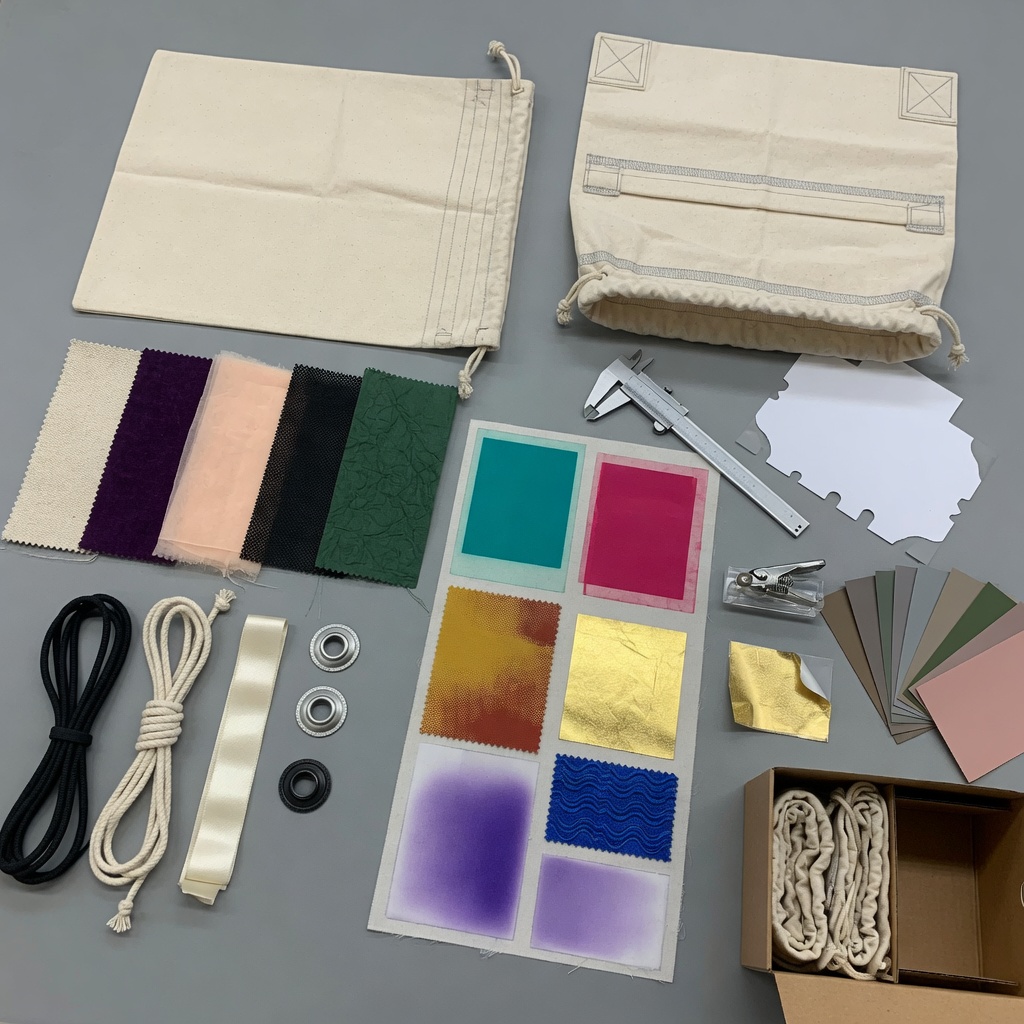
The undated Drawstring Pouch Bag customization page lists velvet, cotton/canvas, organza, mesh, and RPET within its own scope. The undated Jundong custom drawstring bags page lists cotton, canvas, nylon, polyester, RPET, velvet, mesh, and TPU within its offering. These are candidate material categories, not evidence that similarly named grades from different suppliers are equivalent.
For each proposed material, request:
- A supplier material code tied to the quote, swatch, sample, and purchase order.
- Declared fiber composition and the supplier's proposed tolerance.
- Weave, knit, mesh, pile, coating, or lamination details where applicable.
- Nominal mass in
gsmor thickness inmm, including the measurement basis and production tolerance. - Color and finish references with defined comparison conditions.
- External and usable finished dimensions in
mm. - Finished sample mass in
gwhen it affects product comparison or packing. - Buyer-defined criteria for opacity, surface condition, hand feel, packed fit, and presentation.
- Written approval before any change to the material, finish, source, or subcontractor.
Nominal material mass is a specification field. It does not by itself verify seam durability, opacity, hand feel, decoration quality, or suitability for the packed product. Approve those characteristics on a production-representative sample using agreed methods and acceptance rules.
If a supplier proposes an RPET description, request the claimed recycled-content basis and any current supporting document required by the buyer. Do not imply certification unless a current document has been checked for issuer, scope, product coverage, and validity for the order.
Logo and color customization options
The undated Drawstring Pouch Bag customization page names screen printing, hot stamping, digital printing, and heat transfer within its scope. The undated Wzbiben custom drawstring bag guide discusses screen printing, heat transfer, digital printing, embroidery, and sublimation. Neither source establishes that every method is available or appropriate for every material, construction, artwork, quantity, or finish.
For each method under consideration, ask the supplier to return:
- The accepted artwork file format and revision.
- Finished artwork width and height in
mm. - Horizontal and vertical offsets in
mmfrom named finished-pouch edges. - A proposed placement tolerance in
mmfor buyer approval. - The color target and physical comparison reference.
- Restricted areas around seams, folds, reinforcement, eyelets, and the cord channel.
- Setup charges, unit charges, process limits, and any subcontracted work.
- The sample basis and any differences between sampling and production.
Inspect the decorated sample for coverage, edge definition, alignment, distortion, surface condition, reverse-side effects, and color result. Where adhesion or durability matters, define the sample condition, applied action or force, duration or repetition basis, failure definition, and acceptance threshold in the RFQ. The supplied sources do not provide a universal pass threshold.
The Wzbiben guide recommends confirming Pantone color proofs before mass production. That is attributed sourcing guidance, not a legal requirement, achieved tolerance, inspection rule, or certification. State whether approval will use a physical material swatch, printed proof, decorated sample, or another controlled reference, together with the comparison conditions.
Size, closure, eyelet, and packaging customization options
Use a dimensioned drawing to define the finished width and height, usable internal space, opening, cord-channel depth, seam arrangement, closure position, and artwork placement. If packed fit is critical, provide either a controlled product sample or a buyer-approved dimensional envelope with the required clearance left as an RFQ value for confirmation.
The undated Drawstring Pouch Bag customization page lists nylon drawstrings, cotton ropes, satin ribbons, and metal eyelets as options within its scope. Treat them as menu options requiring a component-level specification and current availability check.
For the closure, specify the material, construction, diameter or width in mm, color, finish, exposed length in mm, measurement condition, end treatment, knot arrangement, pull direction, and opening-and-closing acceptance check.
For an eyelet design, define material, finish, location, reinforcement, orientation, attachment condition, and acceptable edge condition. If retention testing is required, leave the force in N, hold time in s, fixture, sample condition, failure definition, and pass threshold as buyer-approved RFQ fields. No universal values are supported by the supplied evidence.
Packaging instructions should define the packing material, folding method, pouch orientation, cord placement, inner-pack quantity, carton quantity, surface protection, carton dimensions in mm, gross and net mass in kg, and controlled shipping-mark artwork. The Wzbiben guide recommends confirming packaging before mass production. Approve a representative pack-out and record anything that remains provisional.
MOQ, sampling, and quotation comparison
The published MOQ and sample figures differ in supplier and guide scope, so use them to prompt questions rather than set an expected market level.
Ask each supplier whether its MOQ applies to the whole order or separately to each material, custom color, size, artwork, decoration process, closure component, packaging format, or shipment. Require separate disclosure of minimums for dyed material, printed fabric, custom hardware, decoration, and packaging where applicable.
The sample record should identify whether the item is an appearance prototype or a production-representative approval sample. It should also state which material, color, decoration, component, tooling, packaging, and process details are final, provisional, or substituted.
Define the event that starts the quoted sample period, such as confirmed specifications, usable artwork, material availability, and required payment. Ask whether timing includes material procurement, manufacture, internal review, and transit. A sample period should not be treated as a production lead time.
For commercial comparison, use a buyer-defined model such as:
Comparable quoted unit cost = pouch unit price + allocated sample and tooling cost + decoration + packaging + freight + buyer-verified import and delivery charges
Record the currency, quantity allocation, delivery point, included charges, and exclusions beside the result. Describe the result as landed cost only after the Malaysian buyer has verified every applicable charge for the actual transaction.
Quality-control fields for customized pouches
The undated Wzbiben custom drawstring bag guide identifies swatches, print adhesion, cord strength, seam durability, color proofs, sample timing, production lead time, and packaging as sourcing checks. Select only the checks relevant to the approved pouch, then convert them into measurable requirements.
| Check | RFQ fields to define | Required evidence |
|---|---|---|
| Finished dimensions | Target and tolerance in mm, pouch condition, orientation, equipment, and measurement locations | Results tied to sample or inspected-unit identifiers |
| Usable opening | Target and tolerance in mm, opening condition, and handling method | Recorded result and image showing the measurement position |
| Decoration placement | Named edge references, offsets and tolerance in mm, orientation, and artwork revision | Measurements and images compared with the approved sample |
| Material identity | Material code, declared composition, construction, nominal mass or thickness, tolerance, and swatch reference | Supplier declaration and buyer-requested supporting record |
| Seams and edges | Inspection locations, prohibited conditions, defect classification, and acceptance rule | Inspection result with location-specific images for failures |
| Closure operation | Pouch condition, opening-and-closing action, cord position, sample-selection rule, and pass threshold | Result tied to each inspected-unit identifier |
| Cord or eyelet retention | Fixture, force in N, hold time in s, sample condition, failure definition, and buyer-approved threshold | Test result, equipment identification, and failure image where applicable |
| Decoration durability | Conditioning, contact material, applied action, repetition basis, failure definition, and buyer-approved threshold | Before-and-after images and recorded result |
| Pack-out | Packing material, fold, orientation, protection, quantities, carton dimensions in mm, and mass in kg | Pack-out images and carton record |
The inspection plan should identify the controlled drawing, artwork, swatch, approved sample, packaging reference, inspection stage, responsible party, sample-selection method, defect-disposition process, and required sign-off. The supplied evidence does not establish universal tolerances, test forces, repetition counts, or acceptance limits, so those values must be agreed for the actual order.
Malaysia manufacturing quotation and delivery controls
A Malaysia-focused drawstring pouch manufacturing RFQ should identify the Malaysian buying entity, consignee, destination or named handover point, quotation currency, required delivery window, and responsibility for each transport stage. These are transaction fields for the buyer to complete, not claims about Malaysian legal requirements.
Ask suppliers to separate pouch unit cost by variant, material and color surcharges, decoration setup and unit charges, sample and courier charges, tooling, custom components, packing, inspection where requested, freight, document charges, and exclusions. The quotation should also state its validity, payment dependencies, production assumptions, inspection point, and handover basis.
The supplied evidence does not establish a Malaysia-specific customs classification, duty, tax, labeling rule, mandatory standard, import-document list, or legal conclusion for a particular pouch or intended use. Verify those matters for the actual material, contents, transaction, and import arrangement with an appropriately qualified Malaysian customs or compliance adviser. Treat a supplier-proposed classification or document list as information to verify, not as a final determination.
The evidence also provides no Malaysia-specific temperature, humidity, storage, or transit threshold. Do not add an undefined tropical-grade claim. Where environmental exposure matters, describe the expected shipping, storage, and use conditions in the RFQ, then agree on a verification method and acceptance limit before approving the sample.
A quote is ready for comparison when it identifies the controlled RFQ revision and makes material exceptions, variant-level MOQ allocation, sample basis, tooling, packaging, freight scope, documentation, schedule dependencies, and delivery exclusions visible. Keep unresolved entries open instead of converting them into buyer assumptions.
Practical RFQ checklist for Malaysia buyers
Use this checklist before issuing the RFQ and again before approving a supplier quotation. Mark each item as confirmed, excepted, or open, and require the supplier to reference the applicable RFQ revision in its response.
- [ ] Identify the Malaysian buying entity, consignee, quotation currency, destination or handover point, and required delivery window.
- [ ] Describe the packed product, contact surfaces, dimensional envelope, packed mass, required clearance, and intended presentation condition.
- [ ] Attach a revision-controlled drawing covering external dimensions, usable dimensions, opening, cord channel, seams, reinforcement, closure, and decoration placement.
- [ ] State every target dimension and tolerance with its unit, measurement orientation, pouch condition, equipment, and reference points.
- [ ] Define each material by supplier code, fiber composition, construction, nominal mass or thickness basis, color, finish, and permitted tolerance.
- [ ] Prohibit unapproved substitutions of material, finish, component source, manufacturing process, or subcontractor.
- [ ] Provide a variant matrix showing quantities by material, size, color, artwork, decoration method, closure, packaging format, and shipment.
- [ ] Require the supplier to disclose whether MOQ applies to the complete order or separately to each variant, process, component, or package.
- [ ] Identify the artwork revision, finished decoration dimensions, edge-based placement, orientation, color reference, restricted areas, and reverse-side requirements.
- [ ] Request decoration setup charges, unit charges, process limitations, subcontracting disclosure, and sample-to-production differences.
- [ ] Specify drawstring or ribbon material, construction, diameter or width, exposed length, color, end treatment, knot arrangement, and pull direction.
- [ ] Specify eyelet material, finish, location, reinforcement, attachment condition, and acceptable edge condition when eyelets are included.
- [ ] Define whether the requested sample is an appearance prototype or a production-representative approval sample.
- [ ] Record all provisional or substituted sample elements, including material, color, decoration, hardware, tooling, and packaging.
- [ ] Define the event that starts sample timing and require the supplier to state whether material procurement, internal review, and transit are included.
- [ ] List each inspection check with its method, equipment, sample condition, measurement unit, failure definition, acceptance threshold, and evidence format.
- [ ] Identify the approved swatch, artwork, drawing, sample, and packaging reference that production and inspection must follow.
- [ ] Define packing material, folding method, pouch orientation, cord placement, protection, inner-pack quantity, carton quantity, carton dimensions, and carton mass.
- [ ] Request an itemized quotation covering pouch variants, decoration, samples, tooling, custom components, packing, inspection, freight, documents, and exclusions.
- [ ] Require quotation validity, schedule assumptions, payment dependencies, production timing, inspection point, freight scope, and delivery responsibilities.
- [ ] Ask for the supplier's proposed document list while keeping Malaysian customs, import, tax, labeling, and compliance determinations subject to buyer verification.
- [ ] Keep every unresolved requirement marked as open and obtain written approval before releasing production or accepting a specification change.
A completed checklist supports comparison only when suppliers answer against the same controlled requirements. It does not replace review of the physical approval sample, current quotation, supporting documents, or transaction-specific Malaysian import and compliance requirements.
Evidence method, author basis, and limitations
Supplier-published context: The Drawstring Pouch Bag and Jundong pages were used only for attributed examples of materials, accessories, decoration methods, MOQ, sample timing, and indicative pricing within their respective stated scopes. Current availability, equivalent specifications, quotation inclusions, and production capability were not demonstrated by the supplied evidence.
Sourcing-guide context: The Wzbiben page was used only for attributed guidance concerning swatches, decoration checks, cord strength, seam durability, color proofs, timing, packaging, and MOQ discussion. It is not presented as an independently verified market dataset.
Method: The supplied evidence was mapped to RFQ decisions covering specification, quotation, sample approval, quality control, packaging, and delivery. Numerical claims were retained only with their units, source scope, and undated status. They were not averaged, projected, or converted into market benchmarks. Missing timing definitions, test methods, quotation inclusions, and Malaysia-specific requirements remain explicit verification points.
Author basis: The approved CottonToMaker author profile for Vincent Xi identifies him as Editorial Author. That source does not document first-hand factory visits, physical pouch testing, customer outcomes, manufacturing credentials, awards, or certifications, so no such experience claim is made.
Limitations and verification: The supplied pages do not provide dated quotations, audited capability records, complete technical data sheets, independently observed test results, or Malaysia-specific legal conclusions. Before ordering, verify material identity, construction, dimensions, tolerances, color, decoration, components, variant allocation, sample fidelity, tooling, production schedule, inspection methods, packaging, quotation validity, delivery scope, and required import or compliance documents for the actual transaction.
Discuss Your Requirements
Review our manufacturing capabilities, then share your specifications for a supplier-fit review.