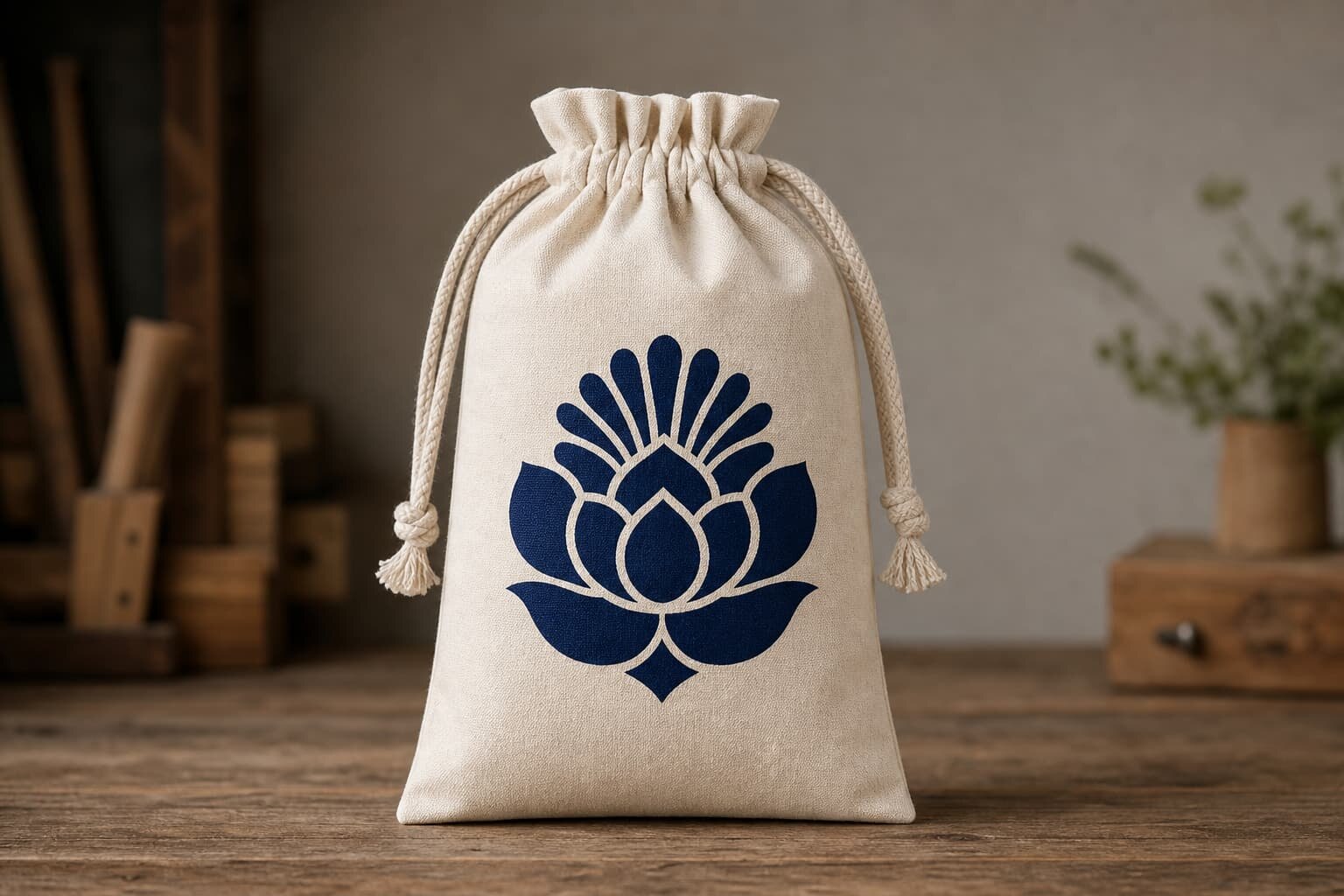
Why logo placement fails on drawstring pouches
Logo placement on a drawstring pouch looks simple on a flat artwork file, but the finished product is not a flat poster. The upper channel gathers when the cord is pulled, the side seams take fabric away from the printable area, and the bottom seam or boxed corner changes how the pouch stands when filled. A logo that looks centered on the cut panel can look too high, too low, or crooked after sewing.
For procurement teams, the main buying problem is not only whether the logo can be printed. The problem is whether every pouch in the shipment presents the brand correctly in real use. If the logo sits too close to the channel, it may wrinkle when closed. If it sits too low, it may be hidden by the product or distorted by the bottom seam. If the supplier quotes without a placement drawing, each factory may interpret the same artwork differently.
- Ask for finished pouch dimensions, not only cut fabric size.
- Require a logo placement drawing with distances in millimeters.
- Check visibility with the pouch filled and pulled closed.
- Treat placement tolerance as a commercial requirement, not a decoration detail.
Set the logo reference points before quoting
A useful RFQ should tell the factory where to measure from. For drawstring pouches, the safest reference points are the finished top edge, the lower stitch line of the drawstring channel, the finished side seams, and the finished bottom seam. Do not write only "logo centered on front" unless the design is flexible. Centered can mean centered on the cut panel, centered between seams, centered below the cord channel, or visually centered after filling.
For small pouches, such as jewelry or accessory sizes, a 2-3 mm shift may already look obvious. For larger cotton laundry-style pouches or bottle pouches, plus or minus 5 mm may be acceptable if the logo remains level and visually centered. The tolerance should match the product use, pouch size, print method, and brand expectation. A luxury retail pouch normally needs tighter control than a low-cost giveaway pouch.
- Specify distance from the top finished edge to the top of the logo.
- Specify distance from the lower channel stitch line to the top of the logo when the channel affects visibility.
- Specify left and right margin from finished side seams.
- Specify minimum clearance from bottom seam, gusset, boxed corner, or fold line.
- State acceptable tolerance separately for placement, angle, and print quality.
Choose a placement that works after filling
A drawstring pouch is often inspected flat, but buyers usually sell or use it filled. Cosmetics, candles, jewelry boxes, tea packs, wine bottles, soap sets, and electronic accessories all change the pouch shape. A centered logo on an empty pouch may ride upward or bend when the product pushes against the fabric. Before approving placement, put a product or dummy insert inside the sample and close the cord.
For tall pouches, avoid placing the logo too close to the bottom because product weight can form a rounded base. For shallow pouches, avoid placing the logo too close to the top because the drawstring channel creates wrinkles. For pouches with a gusset or boxed bottom, check whether the front panel remains flat enough for the decoration method. A logo crossing into a curved or folded area will be harder to control in bulk production.
- For jewelry pouches, keep the logo small and clearly below the cord wrinkle zone.
- For cosmetic pouches, test with the heaviest expected item inside.
- For bottle pouches, check front visibility when the bottle neck pulls the fabric upward.
- For retail gift pouches, confirm how the pouch will sit in shelf display or gift box packing.
Match fabric GSM to decoration accuracy
Fabric weight affects both logo appearance and placement stability. Lightweight cotton around 120-150 GSM is common for low-cost drawstring pouches, but it can shift more during sewing and printing. Medium cotton around 180-220 GSM gives a cleaner surface for many screen prints and heat transfers. Heavier cotton canvas around 280-340 GSM or 8-12 oz is more stable, but the thicker seam areas reduce the safe decoration area near edges.
Natural cotton, bleached cotton, dyed cotton, canvas, jute, and blended fabrics all behave differently. Ink may sink into open weaves, embroidery may pucker thin fabrics, and heat transfer may show a different edge feel on rough canvas. The inspection checklist should connect logo placement with the fabric actually quoted. A supplier sample on 220 GSM cotton does not prove that the same placement will look good on a cheaper 140 GSM fabric.
- 120-150 GSM cotton: economical, but confirm print sharpness and fabric movement.
- 180-220 GSM cotton: common balance for branded retail and promotional pouches.
- 280-340 GSM canvas: stronger hand feel, but check thick seams and folding marks.
- Jute or coarse weave: avoid very small text and expect less sharp print edges.
- Dyed fabric: confirm logo color opacity, especially white ink or pale logos.
Select the print or branding method with inspection in mind
Screen printing is usually practical for one-color or few-color logos when the order quantity justifies setup. It can produce a clean result on cotton and canvas, but placement depends on jig setup, panel handling, and whether printing happens before or after sewing. Printing before sewing may improve flatness, but sewing tolerance can shift the final position. Printing after sewing aligns to the finished pouch, but seams and cords can limit the printable area.
Heat transfer and digital print are useful for multi-color logos, smaller runs, or detailed artwork, but buyers should inspect adhesion, edge feel, and cracking risk. Embroidery gives a premium feel, but it needs enough fabric weight and backing to prevent puckering. Woven labels and sewn side labels reduce direct print risk, but their placement depends on sewing accuracy. The best method is not the most decorative method; it is the method that can be repeated within your accepted tolerance.
- Screen print: check ink coverage, registration, drying, and rub resistance.
- Heat transfer: check adhesion, edge lifting, hand feel, and crease behavior.
- Digital print: check color accuracy on the actual fabric shade.
- Embroidery: check thread tension, backing, puckering, and small text readability.
- Side label: check insertion depth, seam strength, and label angle.
Build the logo placement standard sample
The pre-production sample should not be only a pretty approval photo. It should be the measurement standard for the bulk order. Ask the factory to mark the placement distances on the sample photo with a ruler or measuring tape visible. Keep the approved physical sample sealed or clearly labeled, especially if the order will be inspected by a third-party QC team or a distributor warehouse after arrival.
If timing is tight, some buyers approve a digital layout first and then a physical pre-production sample before bulk. That is acceptable only if the purchase order states that bulk production cannot continue until the physical decoration result is approved. Artwork on a PDF does not show fabric shrinkage, seam allowance, ink behavior, or the way a drawstring channel wrinkles when closed.
- Approve one blank construction sample if pouch size or fabric is new.
- Approve one decorated sample on actual fabric and actual cord color.
- Record logo width, logo height, top distance, side margins, and bottom clearance.
- Photograph the sample flat, filled, and pulled closed.
- Keep approval records with date, version, and responsible buyer signoff.
Use inline inspection to catch drift early
Logo placement problems are easier to fix at the beginning of production than after thousands of pieces are packed. For printed pouches, the first-bulk checkpoint should happen after the factory has produced enough pieces to show real production conditions, not only one careful operator sample. A practical checkpoint is the first 20-50 finished decorated pouches, measured against the approved drawing and sample.
During inline inspection, check pieces from different stacks, operators, and time periods. Printing screens can move, fabric can be fed unevenly, labels can be inserted at different depths, and sewing operators may vary channel width. If the first pieces are acceptable but later pieces drift, the factory should stop and correct the jig, guide, or sewing process before continuing.
- Measure top distance from the same reference point on every checked piece.
- Check logo angle with a straight ruler against the top seam or bottom seam.
- Compare left and right side margins, especially on narrow pouches.
- Review pieces after drying, curing, pressing, or folding because handling can change appearance.
- Segregate defective pieces immediately so they do not enter final packing.
Define acceptance criteria for final inspection
Final inspection should not depend on the inspector's personal opinion of what looks centered. The buyer should provide measurable acceptance criteria. For example, the logo top edge may be 30 mm below the drawstring channel seam with a tolerance of plus or minus 3 mm, the logo angle may not exceed 2 degrees, and the printed area must not touch any seam or fold line unless approved. These numbers can be adjusted by pouch size and market level.
Inspection should also include visual performance. A logo can measure within tolerance but still fail because ink is patchy, embroidery puckers the fabric, or a label bends into the seam. For export claims, photos should show the pouch flat with a ruler, the pouch filled if relevant, and the defect close up. Carton number and production batch information help identify whether the issue is isolated or shipment-wide.
- Placement tolerance: define in millimeters by pouch size.
- Angle tolerance: define maximum visible slant or degree limit.
- Print quality: no major pinholes, smearing, color mismatch, or poor curing.
- Embroidery quality: no broken thread, loose backing, severe puckering, or unreadable text.
- Label quality: straight insertion, secure seam, correct logo direction, and no fraying.
Avoid packing damage to decorated pouches
Many logo complaints are created after decoration, not during decoration. Fresh ink that is stacked too early can transfer to the back of another pouch. Heat transfer logos can show pressure marks if pouches are bundled too tightly. Embroidered logos can leave impressions when heavy cartons are compressed. A packing method that is fine for blank pouches may not be safe for decorated pouches.
Ask the factory to explain drying or curing time, folding direction, inner polybag quantity, carton weight, and whether the logo face touches another printed surface. If the pouch must be folded through the logo to meet a retail pack size, approve that fold on the pre-production sample. For natural cotton and canvas, also check whether loose fibers or dust stick to printed areas before packing.
- Do not pack screen-printed pouches before proper drying or curing.
- Avoid logo-to-logo contact if ink transfer risk exists.
- Confirm whether folding crosses the main logo area.
- Use reasonable bundle quantities so drawstrings and knots do not press into the logo.
- Check carton compression if embroidery, patches, or raised labels are used.
Compare quotes using logo placement data, not price alone
Two suppliers can quote the same drawstring pouch very differently because they are not quoting the same production control. One may include a pre-production sample, print jig, placement drawing, inline measurement, and export packing suited for decorated goods. Another may quote only fabric, sewing, and a basic print charge. The cheaper quote can become expensive if the logo placement fails and the buyer has no documented standard.
A complete quote should show fabric type and GSM, finished pouch size, drawstring material, decoration method, logo size, number of colors, setup charges if any, MOQ logic, sample cost if applicable, sample lead time, bulk lead time, packing method, carton details, and inspection responsibility. For MOQ, ask separately for blank pouch MOQ and decorated pouch MOQ. Screen print may need a different economic quantity than heat transfer or sewn labels.
- Request itemized quote lines for pouch, decoration, label, packing, and tooling or setup.
- Ask whether sample lead time includes artwork confirmation and material availability.
- Confirm whether bulk lead time starts after deposit, artwork approval, or sample approval.
- Check if reorders will use the same print screen, label stock, or embroidery program.
- Require the supplier to state what happens if logo placement exceeds tolerance.
Specification comparison for buyers
| Spec decision | Recommended option | When it fits | Buyer risk to check |
|---|---|---|---|
| Center-front logo on flat pouch body | Place logo centerline 20-35 mm below drawstring channel depending on pouch height | Most retail gift pouches, jewelry pouches, cosmetic pouches, and promotional cotton pouches | Logo may be partly hidden when the pouch is filled or when the cord channel wrinkles after closing |
| Low-front logo placement | Keep bottom of logo at least 25-40 mm above bottom seam and boxed corner zone | Tall pouches used for bottles, candles, soap sets, or long accessories | Print can distort near bottom seam or disappear when the pouch stands with product weight inside |
| Side label instead of direct print | Sewn cotton or polyester label into side seam with logo size confirmed before cutting | Premium retail packaging, small logo branding, repeated reorders with stable artwork | Label position can shift during sewing if seam allowance and label insertion depth are not specified |
| Screen print on cotton canvas | Use 8-12 oz cotton canvas or 180-340 GSM cotton with print test on actual fabric | Solid-color logos, larger MOQ orders, durable promotional and retail packaging | Ink coverage changes with fabric weave, especially on natural unbleached cotton and heavy canvas |
| Heat transfer or digital print | Use when logo has gradients, small details, or multi-color artwork below screen-print economy | Shorter runs, sampling, seasonal designs, boutique brand packaging | Transfer edge, hand feel, wash/rub resistance, and cracking risk must be approved on the actual pouch fabric |
| Embroidery on drawstring pouch | Keep artwork simple, avoid very small text, and back the fabric if needed | Higher perceived value pouches, cosmetic sets, boutique wine or gift packaging | Needle tension can pucker light fabrics below about 180 GSM and may reduce usable decoration area |
Buyer checklist before sampling
- Confirm final pouch size after sewing, not only fabric cutting size, because logo centering must follow finished dimensions.
- Mark logo position from fixed reference points: top finished edge, drawstring channel seam, side seam, and bottom seam.
- Define logo tolerance in millimeters, such as plus or minus 3 mm for small pouches and plus or minus 5 mm for larger pouches.
- Approve the logo on actual bulk fabric weight, color, weave, and drawstring construction before releasing mass production.
- Check whether the logo remains visible after the pouch is filled, pulled closed, and packed in its normal retail or bulk packing method.
- Inspect logo angle, centerline, ink coverage, embroidery tension, label insertion depth, and distance from stitch lines during inline production.
- Require factory photos of the first 20-50 pieces from bulk production with ruler measurements before continuing the full run.
- Match carton packing method to decoration method so printed faces do not rub, transfer, crease, or stick during transport.
- Keep one signed pre-production sample and one sealed print standard for comparing color, placement, and workmanship at final inspection.
- Include rework rules in the purchase order: what is acceptable, what must be replaced, and who pays for incorrect logo placement.
Factory quote questions to send
- What is the finished pouch size tolerance after sewing, and how will logo placement be measured against that tolerance?
- Which fabric GSM or ounce weight are you quoting, and will the logo be tested on the same bulk fabric before production?
- What print, embroidery, label, or patch method do you recommend for this logo size and order quantity, and why?
- What is the minimum logo size, minimum line thickness, and minimum text height your factory can produce cleanly on this fabric?
- Can you show the logo placement distance from the top edge, drawstring channel seam, side seams, and bottom seam in a marked production drawing?
- Will you provide a physical pre-production sample, digital placement photo, or both before bulk production starts?
- How many first-bulk pieces will be checked before the factory continues mass production, and who signs off that checkpoint?
- What are the MOQ differences for screen print, heat transfer, woven label, embroidery, and blank pouch production?
- How will printed or embroidered pouches be dried, stacked, folded, and packed to avoid ink transfer, label bending, or embroidery pressure marks?
- What lead time is needed for artwork setup, sample approval, bulk production, drying or curing, final inspection, and export packing?
Quality-control points to confirm
- Measure logo placement on finished sewn pouches, not cut panels only.
- Use the approved sample as the visual standard and a technical drawing as the measurement standard.
- Check logo position before and after the drawstring is pulled closed.
- Inspect at least top, middle, and bottom layers from each production stack because printing drift can increase during long runs.
- Reject or segregate pieces where the logo touches the drawstring channel seam, side seam, bottom seam, or fold line unless approved.
- Confirm color density, registration, ink curing, transfer adhesion, embroidery tension, and label seam security.
- Check that folded packing does not crease through the main logo area unless the buyer has approved that fold line.
- Keep inspection photos with ruler, batch number, carton number, and date for claim evidence.