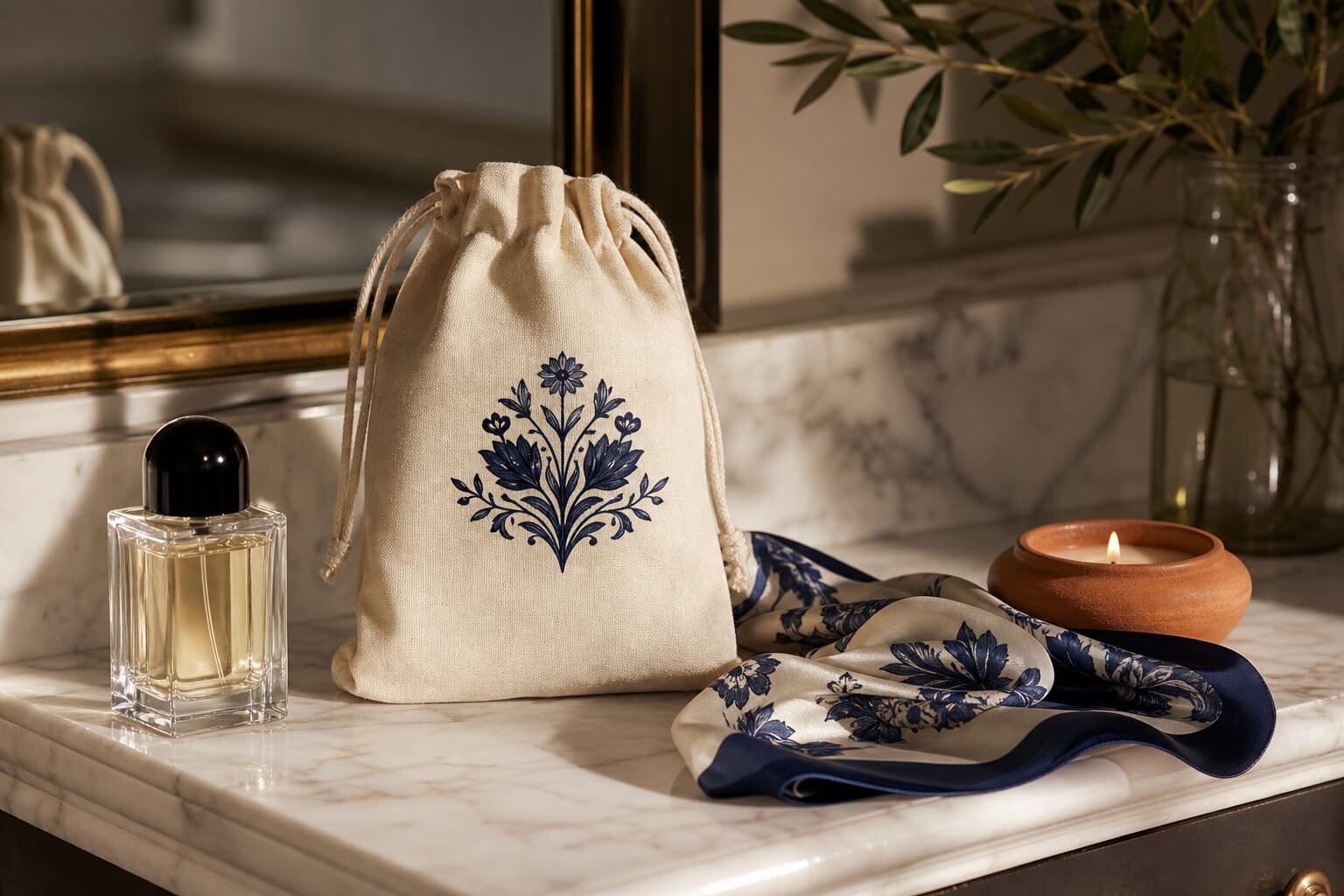
Why Logo Placement Fails on Drawstring Pouches
Logo placement on a drawstring pouch looks simple until the pouch is sewn, filled, and pulled closed. A flat digital mockup does not show how the top channel gathers, how side seams reduce the usable print area, or how a small size change can make the same logo feel too large. For buyers, the most common failure is not a bad logo. It is an RFQ that says only "front center print" without defining where front center starts and what area must remain clear.
A good worksheet turns logo placement into measurable production instructions. It should tell the factory the finished pouch size, the construction reference points, the logo dimensions, the print method, and the allowed variance. This helps the supplier quote correctly and helps your own team compare samples from different factories without arguing over photos.
- Top channel gathering can hide logos placed too high.
- Side seams and gussets reduce the safe flat decoration area.
- Fabric shrinkage after washing or pressing can move the apparent position.
- Different factories may measure from the cut panel, sewn seam, or finished edge unless you specify the reference point.
Start With the Pouch Construction Before the Artwork
The correct logo position depends first on the pouch structure. A simple flat cotton drawstring pouch has a different safe print area from a boxed-bottom pouch, a lined velvet pouch, or a thick canvas pouch with round cotton cord. If the pouch has a double drawcord channel, overlock seams, side gusset, bottom fold, or label in the side seam, these details must be shown on the worksheet before artwork is placed.
For RFQ purposes, buyers should state the finished size in width x height, not just the target product it will hold. Include whether dimensions are measured flat and empty, whether the height includes the top drawcord channel, and what tolerance is acceptable. A common production tolerance for sewn cotton pouches may be a few millimeters, but you should not let each supplier assume its own tolerance if the pouch will fit a rigid item, cosmetic bottle, jewelry box, charger, candle, or wine accessory.
- Record finished flat size, for example 15 x 20 cm, measured after sewing.
- Identify top channel height, such as 20 mm, 25 mm, or 30 mm depending on cord size.
- State seam allowance and whether the bottom is folded, stitched, gusseted, or boxed.
- Mark side label location if a woven CottonToMaker-style label, care label, or barcode label is required.
- Confirm whether the pouch will be used flat, filled, cinched, or displayed hanging.
Define a Real Safe Logo Zone
A practical logo placement worksheet should include a safe logo zone, not only a finished logo position. The safe zone is the area where the print, embroidery, woven patch, or sewn label can sit without interfering with drawcord movement, seam bulk, folding, or packing. This is especially important on small drawstring pouches because a 5 mm shift can make the logo look off-center.
For most cotton or canvas pouches, the top danger area is directly below the drawcord channel. When the buyer wants the logo near the top, the factory should test the pouch after closing. If the fabric gathers over the logo, move the artwork lower or reduce the height. On small pouches, a centered logo may need to sit slightly lower than the visual middle of the flat pouch so it remains visible when tightened.
- Keep at least 20-35 mm below the drawcord channel for many small and medium cotton pouches.
- Keep 10-15 mm away from side seams for screen print and heat transfer on light cotton.
- Keep extra clearance near bulky seams on canvas, jute, velvet, or lined pouches.
- Avoid placing fine logo elements across fold lines, gusset corners, or bottom seam ridges.
- Use the same safe zone drawing for all suppliers so quotes and samples are comparable.
Choose Logo Size by Pouch Size, Not by Brand Preference Alone
Many brand teams send a logo that looks correct on a tote bag and expect the same visual weight on a drawstring pouch. That creates problems. A pouch has less flat surface, more distortion when closed, and more visible seam tolerance. A logo that occupies 70% of the pouch width may look bold on a mockup but crowded on actual fabric.
A useful starting point is to set the logo width as a percentage of the finished flat pouch width. For small jewelry or accessory pouches, 35-50% of pouch width usually gives enough breathing room. For medium cosmetic or gift pouches, 40-60% can work if the artwork is simple. For larger shoe or apparel dust bags, a wider logo can be acceptable, but the buyer should still check whether the pouch will be cinched during display or delivery.
- For 8 x 10 cm pouches, consider a logo width around 30-45 mm depending on artwork detail.
- For 15 x 20 cm pouches, consider a logo width around 60-90 mm for a clean retail look.
- For 30 x 40 cm dust bags, consider logo width around 120-180 mm if the fabric is stable.
- Reduce size when the artwork has small text, thin lines, or multiple registration colors.
- Approve logo size on an actual sample, not only on a PDF layout.
Match Fabric GSM With the Decoration Method
Fabric weight affects both the feel of the pouch and the quality of the logo. Lightweight cotton around 4 oz or roughly 120-140 GSM is common for promotional drawstring pouches and simple packaging. It is economical and folds easily, but heavy ink coverage may show through or feel stiff. Mid-weight cotton around 6 oz or roughly 170-200 GSM gives better body for retail packaging and handles screen print more predictably.
Heavier canvas around 8-10 oz or roughly 250-340 GSM is suitable for premium gift pouches, tool kits, footwear dust bags, or reusable product packaging. The surface may be more textured, so very fine print details need testing. Jute and coarse cotton need extra caution because uneven yarns can break thin lines. Velvet, satin, and microfiber may need heat transfer, embroidery, or woven labels rather than standard screen print.
- Screen print fits solid logos on cotton, canvas, jute, and many repeat orders.
- Heat transfer fits gradients, small color details, and artwork where screen setup is not economical.
- Embroidery fits premium canvas or velvet but needs backing, stitch density control, and more clearance.
- Woven labels fit small, repeated branding when the main pouch surface should remain plain.
- Embossing is more relevant to faux leather, PU patches, or special trims than plain cotton fabric.
Use Placement Tolerances That Inspectors Can Enforce
A worksheet without tolerances is difficult to enforce. The factory may print within its normal production standard, while your inspection team expects near-perfect alignment. For drawstring pouches, placement tolerance should be realistic because fabric cutting, sewing, pressing, and manual loading onto a print table all create small variation.
Define tolerance by measurement method. For example, logo center must be within plus or minus 3 mm from the pouch centerline, and the top of the logo must be within plus or minus 3 mm from the approved distance below the drawcord stitch line. For low-cost promotional orders, a wider tolerance may be commercially acceptable. For retail premium packaging, tighter control may be needed, but the factory must quote based on the added handling and inspection time.
- State whether measurement starts from the top finished edge or the drawcord channel stitch line.
- Measure left and right distances from the logo edge to side seams to confirm centering.
- Set separate tolerances for logo position, logo size, print color, and print registration.
- Keep one approved physical sample as the visual master for production and inspection.
- Require first-piece approval before full print run if placement is critical.
MOQ and Cost Logic Buyers Should Understand
Logo placement affects cost when it changes setup, handling, or decoration process. A centered one-color screen print on one pouch size is usually straightforward. Costs rise when you add multiple pouch sizes, multiple fabric colors, multiple logo positions, two-sided printing, individual retail packing, hangtags, or sewn labels. The MOQ may apply to the fabric dye lot, the pouch sewing run, the print screen, the label production, or the packing version.
When comparing quotes, ask suppliers to break out the cost drivers instead of giving only one unit price. If one factory includes screen setup, sample remake, export carton, and individual polybag while another excludes them, the cheaper unit price may not be cheaper landed cost. Your worksheet should help the factory quote the real production route, not a simplified version that later becomes an extra charge.
- Separate pouch base cost from printing, label, packing, and tooling charges.
- Ask if the same print screen can be used across multiple pouch sizes or if each size needs new setup.
- Confirm whether MOQ changes when the logo is printed on both sides.
- Check if custom dyed fabric has a higher MOQ than natural, black, or stock cotton.
- Ask whether pre-production sample cost is refundable or included after order placement, if relevant.
Sample Approval Workflow That Prevents Bulk Mistakes
The safest workflow is artwork file, placement drawing, strike-off if needed, sewn sample, pre-production sample approval, then bulk. A strike-off can confirm print color and line clarity on actual fabric, but it does not prove final logo position unless it is made on a sewn pouch. For orders where placement is the main risk, the buyer should insist on a real pouch sample with the actual top channel, cord, seam construction, and fabric weight.
When reviewing the sample, do not look only at the front photo. Lay it flat, measure it, pull the cord closed, fill it with the intended product or a similar block, and photograph all conditions. If the logo becomes too high, too low, or distorted after filling, change the placement before bulk production. Once hundreds or thousands of pouches are printed, correcting placement usually means remaking goods, accepting discount claims, or using them for a different project.
- Request sample photos with ruler showing top distance, side distance, and finished pouch size.
- Check logo under natural light and indoor light if color matching matters.
- Confirm drawcord movement does not rub wet, raised, or transfer-printed artwork.
- Keep the signed sample sealed or clearly labeled as the production reference.
- Do not approve bulk based only on a factory photo if the placement risk is high.
Packing and Receiving Details Linked to Logo Placement
Packing is often treated as a separate issue, but it can affect logo appearance and warehouse inspection. If pouches are folded across the printed area immediately after curing, some ink systems may mark, crack, or create pressure lines. If pouches are packed randomly, your receiving team needs more time to confirm logo direction, size mix, and quantity. For retail buyers, a folded pouch with the logo hidden may also fail shelf presentation requirements.
State the required packing method in the RFQ. Flat packing costs more space but protects decoration and makes inspection easier. Folding may be acceptable for low-cost promotional pouches if the fold line avoids the logo. Individual polybag, paper band, belly band, hangtag, barcode sticker, or master polybag should be quoted clearly because each method changes labor time and packing materials.
- Specify whether pouches are packed flat, half-folded, rolled, or bundled.
- Keep fold lines away from printed logos unless tested and approved.
- Ask for logo-facing orientation inside each inner pack for easier receiving inspection.
- Confirm quantity per inner bag, quantity per carton, carton size, and gross weight.
- State carton marks, SKU labels, and mixed-color packing rules before quote confirmation.
Worksheet Fields to Put Into Your RFQ
The buyer worksheet should be short enough for a merchandiser to use but complete enough for production. Put the key fields in a table or one-page attachment. The goal is not to overload the supplier; the goal is to remove assumptions. If the supplier cannot answer the worksheet fields, it is a warning that the quote may be based on generic pouch production rather than your actual requirement.
A strong RFQ includes pouch specification, logo specification, measurement reference, acceptance tolerance, sample requirement, packing method, and quote breakdown. This makes it easier to compare CottonToMaker or any other factory quote against another supplier on equal terms. It also gives your inspection company a practical checklist instead of forcing them to interpret brand intent at the shipment stage.
- Pouch size: finished width x height, tolerance, channel height, gusset or no gusset.
- Material: cotton, canvas, jute, velvet, satin, polyester, blend, GSM or ounce weight.
- Logo: file type, final width and height, placement reference, color standard, print method.
- Clearance: distance from drawcord channel, side seams, bottom seam, gusset, and labels.
- Sampling: strike-off, prototype, pre-production sample, approval method, and sample lead time.
- Quote: MOQ, unit cost, setup cost, sample cost, packing cost, lead time, and excluded items.
Specification comparison for buyers
| Spec decision | Recommended option | When it fits | Buyer risk to check |
|---|---|---|---|
| Logo location on front panel | Centered 25-35 mm below drawcord channel, with clear top margin | Most retail gift, cosmetic, jewelry, and promotional pouch orders | Logo may be partly hidden when the pouch is tightened if placed too close to the cord channel |
| Small pouch logo size | Logo width 35-55% of flat pouch width | Pouches under 12 x 16 cm or small jewelry packaging | Oversized art can wrinkle over side seams or look distorted after cinching |
| Fabric weight | 4-6 oz cotton for soft promotional pouches; 8-10 oz canvas for premium pouches | Choose lighter GSM for giveaways and heavier GSM for retail packaging | Thin fabric can show ink bleed; heavy canvas may need adjusted print pressure |
| Print method | Screen print for solid one to three color logos; heat transfer for gradients or fine detail | Screen print fits MOQ and repeat orders; transfer fits detailed artwork | Fine lines under 0.3 mm may fill in on coarse cotton or jute |
| Side label branding | Woven or printed label inserted into side seam before closing | Minimal branding, resale packaging, or when front panel must stay clean | Label position must be confirmed before mass sewing or it cannot be corrected cheaply |
| Two-sided branding | Front logo plus small back care mark or SKU print | Retail sets, promotional kits, or compliance labeling | Back print can be reversed or shifted if artwork orientation is not marked clearly |
| Packing method | Flat packed by size, logo facing same direction, polybag or paper band by buyer requirement | Importer warehouse receiving, kit assembly, or retail fulfillment | Random orientation slows inbound checking and increases perceived defect claims |
Buyer checklist before sampling
- Confirm pouch finished size, allowed tolerance, fabric material, fabric weight, color, drawcord type, and closure style before logo placement is approved.
- Mark logo centerline from the flat pouch width, not from visual seam-to-seam guesses on a photo.
- Set minimum clearance from drawcord channel, side seam, bottom seam, gusset fold, label insertion point, and top hem stitch line.
- State whether the pouch will be photographed flat, filled, or cinched, because the visible logo area changes after use.
- Provide vector artwork, Pantone or lab dip color reference, final logo dimensions, print method preference, and acceptable print tolerance.
- Require a pre-production sample showing actual fabric, actual logo size, actual print color, actual drawcord, and final logo position.
- Ask the factory to measure placement from fixed construction points and record it on a sample approval photo with ruler visible.
- Check whether side labels, hangtags, barcode stickers, or retail inserts will conflict with the printed logo area.
- Define packing orientation and quantity per inner bag or carton so receiving teams can inspect logo direction quickly.
- Do not approve bulk production from a cropped digital mockup only; approve a real sewn pouch with the selected decoration method.
Factory quote questions to send
- What is the finished pouch size tolerance after sewing and pressing, and how will logo placement be measured during production?
- What fabric GSM or ounce weight are you quoting, and is it greige, bleached, dyed, or washed after sewing?
- What is the minimum safe clearance you require from the drawcord channel, side seams, bottom seam, gusset, and top hem stitch line?
- Which print method do you recommend for our artwork and fabric, and what is the minimum line thickness you can hold consistently?
- Does the quoted MOQ apply to pouch quantity, fabric color, logo design, print color, or packing version?
- Can you provide a strike-off or pre-production sample using actual fabric and drawcord before bulk production starts?
- What setup charges, screen charges, label charges, sample charges, packing charges, and carton mark charges are included or excluded?
- What is the estimated sample lead time and bulk lead time after artwork, fabric color, and pre-production sample approval?
- How will you control logo position during sewing and printing: template, jig, center mark, print table guide, or inline measurement?
- What packing method is included in the quote, and can all logos face the same direction inside each inner pack?
Quality-control points to confirm
- Measure logo placement from the top finished edge or drawcord channel stitch line and from both side seams on flat samples.
- Check logo levelness against the pouch top edge, not against an uneven fabric wrinkle or cord line.
- Confirm print color after curing and cooling; wet ink and fresh heat transfers can appear darker than finished goods.
- Pull the drawcord fully closed and confirm the logo is still visible and not folded into the gathered area.
- Inspect side seam and bottom seam clearance so the print does not crack, lift, or disappear into stitching.
- Rub test printed areas lightly according to the agreed inspection method, especially on washed cotton, canvas, and jute.
- Compare first bulk pieces to the approved sample before the factory prints the full order.
- Open cartons from different production times to check logo drift caused by table setup changes or operator shift changes.
- Check packing orientation, mixed sizes, mixed colors, barcode labels, and carton marks against the purchase order.
- Record approved tolerance for logo position, size, color, and print defects in the inspection report before shipment.