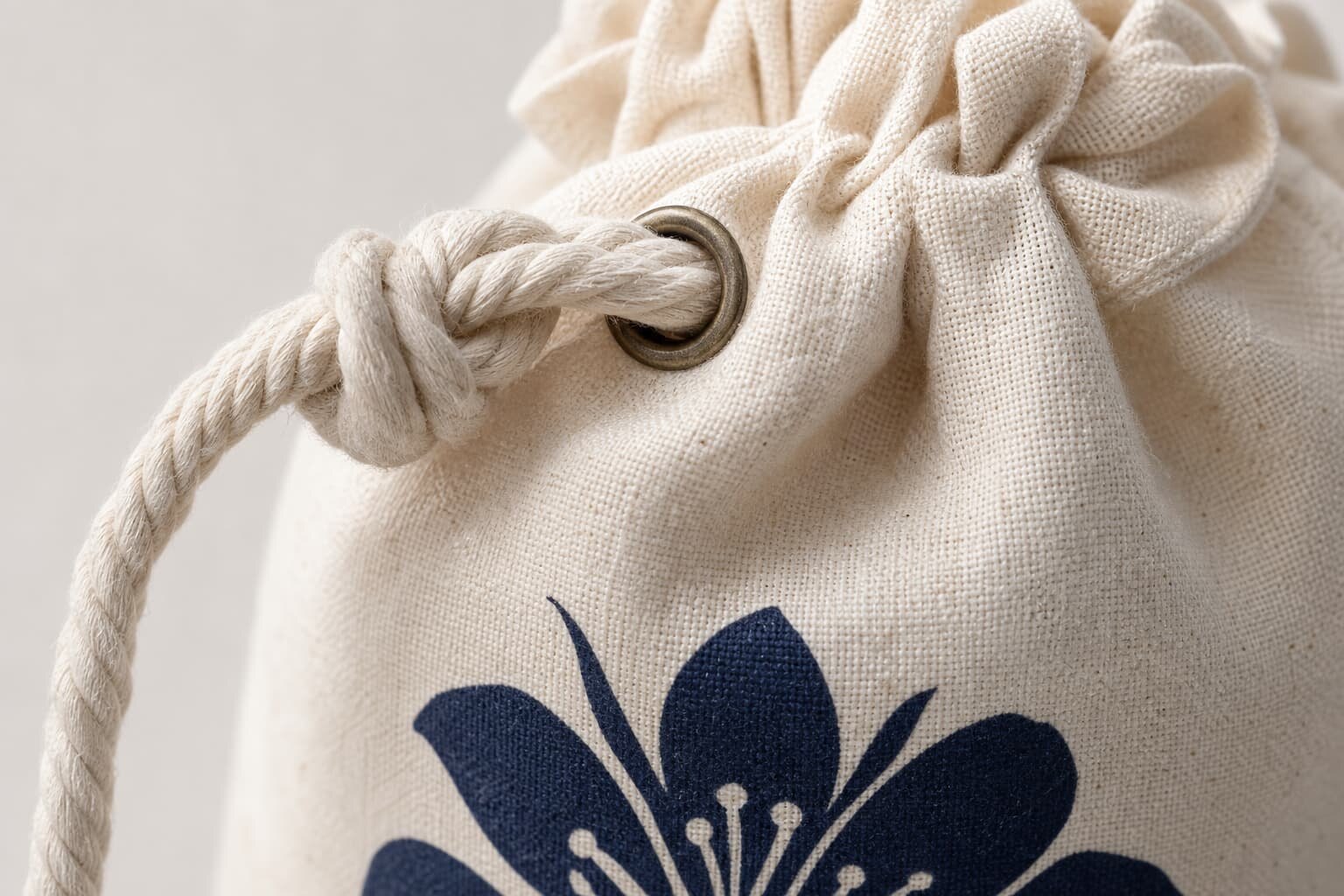
Why logo placement changes the quote
On a drawstring pouch, logo placement is not a cosmetic choice. It changes the usable print area, the decoration method, the sewing sequence, and the amount of scrap risk the factory must carry. A logo near the top hem can force the printer to work around the cord tunnel, while a centered logo on the front panel may require a bigger screen, a more careful jig, or a separate sewing step if you are using a patch or woven badge. If the buyer only sends the artwork and size without the placement dimensions, suppliers will quote different assumptions and the comparison becomes meaningless.
This is why buyers should treat placement as a production parameter, not a marketing preference. A clean quote needs the pouch size, fabric GSM, finish, logo size, exact location, and decoration method to be locked together. If you change any one of those items later, the factory may need a new screen, a new embroidery file, a larger label, or a revised seam allowance. That is where most cost surprises come from, especially on small and mid-size orders where setup costs are spread over fewer units.
- Top-hem and cord-channel zones reduce safe print space.
- Thicker fabrics tolerate embroidery and sewn labels better than light cotton.
- Small position changes can force a new screen or embroidery file.
- The cheapest quote is often based on a larger safe area assumption than your actual pouch allows.
Define the printable zone before you ask for pricing
For a buyer RFQ, do not describe the logo only as "front center" or "bottom right." Add numbers. State the pouch's finished size, then mark the printable rectangle after seam allowances and hems are removed. A common mistake is to measure the flat cut panel and forget that the top fold, side seams, and cord channel can consume 15-30 mm per edge depending on construction. If the logo is too close to the top hem, the factory may have to shrink it, move it lower, or reject the layout entirely.
The best practice is to attach one technical sketch with three things: the finished pouch size, the logo center point, and the maximum width and height allowed for decoration. Buyers should also tell the factory whether the logo must appear on one face only, both faces, or on a side label. That avoids back-and-forth after sample making, when the supplier realizes the artwork would collide with the seam or the drawstring path.
- Measure from the finished edge, not the raw fabric edge.
- Specify whether placement is centered on the pouch or centered inside the printable area.
- State if the reverse side must stay blank for retail or compliance reasons.
- Mark any no-print zones around seams, labels, or drawcord channels.
Match the decoration method to the fabric and GSM
The right logo method depends on fabric weight, weave, and the visual finish you want. On 120-160 GSM cotton, a simple one-color screen print usually gives the best balance of cost and clarity, but it needs a flat surface and enough room for the squeegee to work. On 180-220 GSM cotton canvas, screen print still works well, and embroidery becomes realistic if the logo is simple and you want a premium hand feel. On lighter fabrics, embroidery can pucker the panel and distort the pouch body; on rough jute or very open weaves, fine print detail can break up fast.
Do not choose the method only by appearance. A woven label, patch, or heat transfer may look cleaner in a sales sample, but it must survive the end use. If the pouch will be tossed into a retail kit, handled by consumers, or packed tightly in cartons, the decoration has to survive rubbing, folding, and compression. For that reason, the buyer should ask the factory what method they recommend for the specific GSM and finish, then compare that recommendation with the brand standard rather than assuming all methods are interchangeable.
- Screen print: best for bold logos, low color count, and smoother cotton surfaces.
- Embroidery: better on heavier canvas or premium pouches with simple artwork.
- Woven patch or label: useful when the logo must stay crisp on dark or textured fabric.
- Heat transfer: useful for short runs, but inspect adhesion on fold lines and rough handling.
Use a quote format that forces apples-to-apples pricing
Most quote problems happen because suppliers are pricing different versions of the same pouch. One factory may assume a 140 GSM cotton body, a one-color screen print, and flat-packed bulk cartons. Another may assume 180 GSM fabric, a sewn woven label, and individual polybags. Those are not comparable quotes even if the unit price looks close. A buyer should therefore request a quote table that separates fabric, decoration, packaging, and setup charges. That makes it easier to see where the money goes and which item is driving the difference.
Ask each factory to quote the same quantity tiers and the same logo placement. For example, ask for pricing at 3,000, 5,000, and 10,000 pieces with the same pouch size, the same fabric GSM, and the same print location. Then request a line for setup cost, sample cost, overage tolerance, packing change cost, and any label or barcode fee. If a supplier refuses to break out those items, the low quote may hide a later charge for screens, plates, or logo repositioning.
- Compare only the same size, same fabric, same print method, and same packing.
- Separate unit price from one-time setup charges.
- Ask for quantity-based pricing, not a single blended rate.
- Request confirmation of scrap allowance and reprint policy for logo defects.
How to read sample output before you approve production
A sample should tell you whether the logo can be made cleanly at volume. Do not just check whether the artwork looks nice. Check the placement against your spec sheet, measure the logo area, and confirm the supplier used the same pouch body, GSM, and decoration method that will be used in bulk. If the sample is on a different fabric or a larger test piece, the result is not production proof. This is especially important for small logos near the seam, where a few millimeters of drift can change the whole look.
Request both a physical sample and clear photos of the front, back, interior, and top hem. If the print is screen printed, inspect for ink edge sharpness, coverage, and hand feel after curing. If the logo is embroidered or applied as a patch, check backing, stitch tension, thread trims, and whether the pouch still closes smoothly. A sample that looks acceptable at arm's length but fails a rub test or looks crooked under a flat lay is not ready for production approval.
- Measure the logo position from the finished edges, not from the center of the photo.
- Confirm the sample uses the same fabric color and GSM planned for the order.
- Check the closure function after decoration, not before it.
- Keep one signed sample as the bulk reference and one as the supplier reference.
MOQs and lead time are tied to decoration setup
Buyers often ask for the lowest MOQ possible without realizing that logo method changes the MOQ logic. Screen print orders are usually driven by screen setup, ink change, and the amount of handling per color. Embroidery is driven by digitizing, stitch count, and hooping time. Woven labels and sewn patches often have their own minimums because the supplier needs to run a separate label order first. If you ask for a tiny run with a complex logo, the unit price rises quickly because setup cost is spread over fewer pieces.
Lead time follows the same pattern. A simple one-color screen print on standard cotton can move faster than a multi-step pouch with a woven badge, embroidery, and special packing. In buyer terms, sample lead time and bulk lead time are not the same thing. A realistic RFQ should ask for both, plus a note on what triggers delay: artwork changes, color approvals, fabric sourcing, or waiting for label materials. That way, procurement can build a launch calendar that reflects production reality instead of a hopeful promise.
- MOQ is often lower for plain screen print than for woven labels or embroidery.
- More logo colors usually mean more setup and a higher minimum.
- Sample lead time should be quoted separately from bulk production time.
- Ask what part of the order is the bottleneck: fabric, decoration, or packing materials.
Compare decoration options by risk, not just appearance
When the pouch is for retail, promo, or brand packaging, the logo needs to hold up after handling, shipping, and shelf display. A direct screen print is usually the simplest method to scale, but it can be limited by fabric texture and the number of colors. Embroidery gives a premium feel, yet it adds thickness and can distort a light pouch. Heat transfer can reproduce more detail, but it needs the right fabric surface and curing discipline. A woven or sewn patch gives strong brand presence, but it changes the construction sequence and may reduce the available print area.
The practical buyer question is not "Which method looks best?" It is "Which method gives the lowest total risk at my quantity and target price?" If the pouch is a low-cost insert item, a one-color screen print may be the best commercial answer. If it is a gift-with-purchase or a premium bundle component, a patch or embroidery may justify the added setup cost. The right decision comes from balancing unit cost, setup cost, durability, and the tolerance your brand has for visual variation.
- Choose screen print when speed, cost, and repeatability matter most.
- Choose embroidery when the pouch fabric is heavy enough to support stitch density.
- Choose a woven patch when you need a premium, durable badge on dark or textured fabric.
- Choose heat transfer only when the artwork detail or short-run demand justifies the risk.
Packing details can damage a perfect logo if you ignore them
The pouch may leave the print line in perfect condition and still arrive damaged if the packing spec is weak. If the printed side rubs against a rough carton wall or against a plastic bag seam, the logo can scuff before it reaches your warehouse. If the pouch is folded across the logo area, a fresh print or transfer may crack, crease, or pick up a witness mark. For that reason, buyers should define the packed orientation and ask whether the factory can insert tissue, face the logo upward, or use a protective polybag when needed.
Packing is also part of the quote comparison. A supplier quoting bulk loose packing is not comparable with one quoting individual polybags, barcode stickers, or insert cards. If your retail or distributor channel needs a clean presentation, state the pack format up front and ask the factory to quote it separately. You will get a more honest lead time and avoid a late-stage debate about whether the logo was approved for a packing method it cannot survive.
- Tell the supplier whether the logo side must face up, outward, or be protected.
- Ask if fold marks can hit the printed area during carton compression.
- Separate retail packing from master carton packing in the RFQ.
- Confirm barcode, SKU, and carton mark placement before mass packing starts.
Set acceptance criteria before the bulk run starts
A good pouch order fails when acceptance rules are vague. Write down the placement tolerance, acceptable color variance, decoration edge quality, and packaging standard before production begins. For example, if the logo can move only within a few millimeters of the approved sample, say so. If you can accept slight hand variation on a sewn label but not on the front print, document that difference. Buyers who define these boundaries early reduce disputes because the factory knows what will be measured at inspection.
The other point to lock is the defect decision tree. Ask the factory how they will handle a misprint, a crooked patch, or an embroidery shift discovered during inline inspection. If the answer is unclear, the risk will usually move to the buyer during shipment or claim review. A clean buyer checklist should include approval sample retention, inspection frequency, rework rules, and the packed carton count logic so that there is no gap between the first good sample and the bulk shipment.
- Define placement tolerance in mm for each pouch size.
- State whether slight color variation is acceptable across different dye lots.
- Agree on the rework threshold for misaligned or damaged logos.
- Keep signed sample cards and inspection photos with the PO file.
Specification comparison for buyers
| Spec decision | Recommended option | When it fits | Buyer risk to check |
|---|---|---|---|
| Front-center screen print | 1-2 spot colors on 140-220 GSM cotton or canvas | Standard brand pouch, promo pack, or retail accessory with a clear logo block | Confirm print clearance from the hem and cord tunnel after cutting and sewing |
| Lower-corner woven patch | Small woven label sewn on after bag construction | Premium look, subtle branding, or when the pouch fabric is too dark for direct print | Patch thickness can distort the panel or interfere with the side seam if placement is too close |
| Upper-front embroidery | Simple logo with limited detail on 220 GSM+ canvas | Heavier fabric and a more tactile premium finish | Check puckering, backing material, and stitch density on lighter fabrics |
| Side-panel heat transfer | Short-run artwork or multicolor logos on smooth fabric | Seasonal programs, launch packs, and lower MOQ orders | Adhesion can fail on textured weave, fold lines, or rough handling if the film is wrong |
| Side seam label | Woven or printed brand label sewn into the seam | When the pouch needs discreet branding or the front must stay clean | Label height and seam allowance must not block the drawcord channel or create a twist |
Buyer checklist before sampling
- Confirm the exact logo position in millimeters from the top edge, side edge, and center line.
- State the pouch fabric, GSM, weave, and finish so the factory can judge print hold and needle damage risk.
- Specify decoration method preference and an acceptable fallback method if the first choice is not suitable.
- Ask for a marked artwork proof showing the final placement on the actual pouch size, not only on a flat template.
- Approve the printable area after seam allowance, hem fold, and drawcord channel are removed from the usable front panel.
- Request sample photos under the same lighting used for approval, including close-ups of edges, stitching, and color fill.
- Check whether the quote includes setup, screens, plates, embroidery digitizing, labels, packing, and overage allowances.
- Confirm quantity breaks, MOQ by color, and whether mixed sizes or mixed logo colors change the unit price.
- Define packing format, polybag requirement, carton count, and whether the print side must face up or be protected.
- Set a production acceptance standard for placement tolerance, color match, and defect rate before PO release.
Factory quote questions to send
- What is the usable print area after seam allowance and drawcord channel are removed for each pouch size?
- Which decoration method do you recommend for this fabric and GSM, and why?
- What are the MOQ, setup charge, and unit price breakpoints for each logo color or decoration method?
- Please provide a marked-up artwork proof showing the final logo position on the actual pouch dimensions.
- What is the expected lead time for samples, pre-production approval, and bulk production at the quoted quantity?
- Are screens, plates, digitizing, or woven label tooling included in the quote, or billed separately?
- How do you handle placement tolerance and reprint or repair decisions if the logo shifts during production?
- What packing method is included, and will the printed surface be protected from scuffing in transit?
- Can you confirm the approved fabric GSM, shrinkage assumption, and any pre-wash or colorfastness treatment used?
- Which artwork file format do you need, and do you require vector outlines, Pantone references, or stitch counts?
Quality-control points to confirm
- Logo position matches the approved artwork proof within the agreed millimeter tolerance.
- Print edges are clean with no bleeding into the weave, seam, or cord tunnel.
- Color matches the approved sample under daylight or D65-style inspection lighting.
- The pouch opens and closes smoothly after decoration, with no blocked drawcord movement.
- No puckering, skipped stitches, needle holes, or fabric distortion appear around the logo area.
- Woven labels or patches sit flat and do not twist the pouch panel or cause seam stress.
- Ink, embroidery, or transfer survives a simple rub test without obvious transfer or peeling.
- Sample and bulk packing match the agreed facing direction, quantity, and carton count.
- Carton labels, inner packs, and barcodes match the PO and SKU structure.
- The bulk shipment includes an approved production sample or reference card for final comparison.